Sunny Kumara,
Md Rashid Ali Faridia,
Ashok Kumar Dasmahapatra*ab and
Dipankar Bandyopadhyay*ab
aDepartment of Chemical Engineering, Indian Institute of Technology Guwahati, Assam 781039, India. E-mail: akdm@iitg.ernet.in; dipban@iitg.ernet.in
bCentre for Nanotechnology, Indian Institute of Technology Guwahati, Assam 781039, India
First published on 3rd November 2016
Liquid droplets loaded with paramagnetic or diamagnetic salts, namely liquibots, showed controlled migration inside a fluid medium and on slippery solid surfaces under remote magnetic guidance. The water or oilbots of size ranging from a millimetre to a few microns showed facile attraction, repulsion, division, and coalescence when guided by a magnetic field. The speed of the liquibots could be tuned by varying the size, salt-loading, and magnetic field strength. While the paramagnetic liquibot migrated towards a magnet with a velocity as high as ∼8 body length per s, the diamagnetic one migrated away from the field with a maximum velocity of ∼1 body length per s. The liquibots transported and delivered commercially available drugs to targeted locations showing their potential as drug-delivery vehicles. Remarkably, the experiments showed the utility of the liquibots in digital microfluidics because they moved easily on slippery solid surfaces. For example, a waterbot was split into many droplets on an oil coated solid surface before forming the patterns resembling polygons under magnetic guidance. Further, the liquibot based Packman™ game could also be played with the help of magnetic guidance. The extent of control demonstrated on the motions of the remotely guided liquibots could be useful in diverse futuristic applications including drug-transport, digital-microfluidics, and droplet-electronics.
In this direction, one of the major challenges has been to infuse magnetic properties to the micro or nanoscopic liquid droplets.23 A droplet suspended with the magnetic micro or nanoscale particles or fibres often encounter the problem of phase-separation of the nanoparticles or nanofibres due to rapid nucleation followed by settling.24 The problem becomes more severe in presence of an external magnetic field where the nanoscopic objects are preferentially attracted towards the magnet causing a faster solid–liquid separation from a suspension.25 Previous studies suggest that the use of surfactant coated nanoparticles can be one of the temporary solutions to stabilize solid–liquid suspensions at the microscale26 and delay the phase separation.27 Alternatively, use of paramagnetic ionic liquids and ferrofluids has also been suggested to resolve this problem.28–31 However, most of these solutions are either temporary or costly or toxic. Further, infusing different types of magnetic properties to the microdroplets composed of commonly available materials such as water or oil has been an open challenge so far.
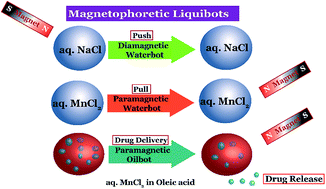
Fig. 1 schematically shows that liquid droplets composed of aqueous solutions of the paramagnetic or diamagnetic salts could engender interesting magnetic field induced motions. The transparent to translucent to opaque salt-laden droplets, namely, the ‘liquibots’ could show facile pull, push, veer, halt, or reverse motions under the remote guidance of an external magnet. For example, a ‘waterbot’ loaded with paramagnetic salt could be pulled while the same loaded with diamagnetic salt could be pushed with the help of a magnetic guidance.
The speed of the liquibots could be modulated by altering the size, magnetic field strength, and salt-loading. In addition, the proposed liquibots could be split into parts or joined or arranged in an ordered manner on a slippery solid surface, which was previously possible only through ferrofluids.31 The magnetic field guided actuation and migration shown by the liquibots indicated that they might be suitable for a number of recently proposed droplet microfluidic applications based on electric field.32,33 Importantly, we have also shown a recipe to synthesize water-in-oil liquibots, which could fluoresce, transport as well as release drugs to the targeted locations through remote magnetic guidance. The reported prototype is expected to improve the efficiency of many recently reported droplets based sensors,34,35 drug transporters,36–38 environmental remediates,39 and microreactors.40–43
Fig. 2(a–d) and ESI video S1† show that a transparent paramagnetic waterbot composed of 0.5 M aqueous MnCl2 was ‘pulled’ by an electromagnet having field strength of 148 mT on a chloroform bath at a maximum speed of 3.44 mm s−1. In comparison, Fig. 2(e–h) and ESI video S1† show that a transparent diamagnetic waterbot composed of aqueous solution of 1 M NaCl could be ‘pushed’ by a permanent magnet of strength 120 mT at a maximum speed of ∼1.4 mm s−1 on the same bath. Control experiments suggested that a de-ionized (DI) waterbot was unable to show such motions on the same chloroform bath. Both the diamagnetic and paramagnetic waterbots moved at the air–chloroform interface because of the higher density of chloroform bath than the waterbots. ESI video S2† show a contrasting pull and push (attractive and repulsive) reciprocating motion of the 10 μL transparent paramagnetic (right side) and diamagnetic (left side) waterbots when placed near a permanent magnet of strength 240 mT. In the ESI video S3,† we have shown the motion of a miniaturized version of the paramagnetic waterbot of diameter of 40 μm moving at a speed of ∼2 body lengths per second when placed near a permanent magnet of strength 80 mT.
Fig. 3(a–d) and ESI video S4† show that an opaque paramagnetic waterbot loaded with paracetamol drug (0.5 M) was pulled by a magnet on a chloroform bath at a maximum speed of 2 mm s−1. In such a situation, the fluorescent tracer provided an optical indication of the local position of the motile droplet, as shown in the Fig. 3(e–h) and the ESI video S5.† Fig. 1–3 and the ESI videos 1–5† together showed diverse pull–push migrations of the waterbots, which can be of importance for in vivo applications of the proposed liquibots.
The magnetic force exerted on the waterbot could be evaluated from the expression, Fm = V(Δχ/μ)B·∇B,44,45 in which ∇ was the gradient operator, B was the magnetic field vector, V was the volume of the droplet, Δχ = χpMC + χwV was the difference in the magnetic susceptibility where χpM and χwV are the molar and volume susceptibilities of salt and water, C was the concentration of the salt, and μ was the magnetic susceptibility of vacuum (4π × 10−7 N A−2). The theoretical average velocity of the droplet could be obtained by applying the Newton's second law of motion (Fm + Fd = ma) in which the drag force on the droplet was evaluated by the Stokes formula, Fd = 6πηrv.46 Where m and a were the mass and acceleration of the droplet, η was the viscosity of the bounding medium, r was the radius of the droplet, and v was the average velocity of the droplet.
We measured the time to traverse 1 cm distance to obtain the experimental average velocity of the liquibots. Further, to evaluate the theoretical average velocity we enforced Newton's 2nd law of motion in the Stokes flow limit, Fm + Fd = 0, which provided the expression for theoretical velocity of the droplet as, v = [(2r2Δχ)/(9η)μ]B·∇B. The expression could further simplify to, v = [(2r2Δχ)/(9ημ)]Bx(∂Bx/∂x), for unidirectional magnetic field where x is the direction of the movement. Plots (a)–(d) in the Fig. 4 show a comparison between the average velocities (Vm) obtained from the theoretical calculations (solid line) and experiments (symbols) with the variations in volume of the paramagnetic waterbot (ϕ), salt concentration (CMn), magnetic field strength (B), and volume of the diamagnetic droplet (ϕ). Table 1 shows the typical properties employed for the calculations in the present manuscript.
| η (Pa s) | ρ (kg m−3) | Mw (MnCl2·4H2O) | χMnM (m3 mol−1) | χNaM (m3 mol−1) | χwV |
|---|---|---|---|---|---|
| 0.001 | 1000 | 198 | 1.8 × 10⁻⁴ | 30 × 10−6 | 9 × 10⁻⁶ |
The plots (a)–(c) suggest that Vm monotonically increased with the increase in ϕ, CMn, and B. Interestingly, the proposed theoretical model could not only predict the trend of the variations in Vm with ϕ, CMn, and B but also quantitatively corroborated the experimentally measured values. The Vm attained by a 2 μL paramagnetic waterbot was ∼2.19 × 10⁻³ ms−1, which increased to ∼6.34 × 10⁻³ ms−1 for a ∼9 μL waterbot. Further, a waterbot containing 2 M MnCl2 showed a speed as high as 11.9 × 10⁻³ ms−1 when the applied field strength was 148 mT. Increase in volume, salt loading, and magnetic field strength led to the manifestation of larger amount of magnetic body force on the waterbot. Plot (d) shows that even for a diamagnetic waterbot Vm monotonically increased with ϕ. We also observed (not reported here) that Vm increased with the NaCl loading (CNa) inside the droplet. The Vm attained by the liquid motor was ∼1.36 × 10⁻³ ms−1 when CNa ∼1 M and B was 240 mT. However, with the increase in CNa to ∼5 M, Vm increased ∼1.95 × 10⁻³ ms−1. Further, with increase in ϕ, Vm increased to ∼2.66 × 10⁻³ ms−1 for a ∼10 μL waterbot. The plot (d) showed that diamagnetic waterbots could also be pushed strongly with the help of remote magnetic guidance inside a fluidic environment, which was also in well accordance with the theoretically predicted average velocity.
Plot (e) show the variation in Vm with the change in the viscosity of the bounding medium (η). The theoretical formula indicated the Vm versus η plots to be a rectangular hyperbola, as depicted in the figure by the broken (η = √ηwηm) and the solid lines (η = ηm). Here the subscripts ‘m’ and ‘w’ indicate water and bounding medium, respectively. The symbols in the plot show the experimentally obtained values. The plots suggest that the theoretical and experimental values matched reasonably well in the limits when the medium viscosity was either high or low. At the intermediate values they deviated significantly. We observed that when the exact experimental values were used for the theoretical calculations (solid line) the deviation was significant in the intermediate domain. Instead, when the geometric mean of the viscosity of the waterbot and the medium (broken line) was employed for the calculations of the Vm, the deviation was significantly less. Further, with a little change in the radius of the waterbots, v ∞ (1/r2), the differences could also be bridged or widened significantly. Thus, it was apparent that the use of Stokes law for a flow past circular solid object was not very appropriate to predict exactly the velocities of the proposed waterbots. The theoretical model employed was able to predict the velocities rather qualitatively and needed additional considerations such as, (i) the liquibot was floating on the chloroform bath having a deformable water–air interface at the top and another deformable water–chloroform interface at the bottom; (ii) liquidbot was strongly slipping on the water–chloroform interface; and (iii) the exact shape of the liquibot was not exactly a sphere, among others. The difference in the magnitude of the values in the experiments and the theoretical predictions could be bridged through a more rigorous analysis of the force balance equations, which was kept as a future scope of research work.
Apart from the waterbots, we also prepared emulsion based oilbots where a 1 M aqueous MnCl2 solution was mixed with commercially available paracetamol before shaken vigorously with oleic acid at different volumetric proportions. The drug and the paramagnetic salt were initially loaded in the water phase and then the drug loaded waterbots were dispersed through shaking inside oleic acid to prepare the oilbots. Fig. 5(a) schematically shows the transport and release of the drug loaded waterbots from the oilbots under magnetic guidance. The optical image shows the dispersion of waterbots in the oil matrix. Images 5 (b–e) and ESI video 6† show motion of the drug-loaded oilbot with the help of permanent magnet (80 mT) in a water bath. The images and video show the transport of the oilbot loaded with the drug embedded waterbots under the remote magnetic guidance before the release of the drug ∼16.9 s in the bath. The plot (f) shows that the average velocity (Vm) of these oilbots could be modulated by tuning the salt loading in the waterbots. The plot (g) suggests that the time for drug release (tr) could also be controlled by tuning the water to oil loading in the oilbot. In particular, dispersing lower amount of water into the oil-phase showed a larger time of release under these conditions. Concisely, Fig. 5 and ESI video 6† suggest that an emulsion of paramagnetic waterbots in oil can be employed for drug transport and delivery under magnetic guidance. The drug loaded paramagnetic waterbots having dimensions of few microns to few hundred microns dispersed inside the oilbots could act as in vivo transporters of drugs in diverse body fluids51,52 such as blood stream, cerebrospinal fluid, mucus, lymph, bile, saliva, tear, or extracellular fluids.
A typical phase separation experiment of oleic acid and water shown in the Fig. 6 supported the observations of the release in the Fig. 5. In the beginning of this experiment, different water-in-oil emulsions were prepared by mixing 1 M aqueous MnCl2 with oleic acid through adequate shaking at proportions (v/v), 1
:
1, 1
:
2, 1
:
3 and 1
:
5, as shown in the rows (a) and (b). The images (c) show that the 1
:
1, 1
:
2, 1
:
3 and 1
:
5 emulsions phase separated at different time intervals 0.67, 3.12, 4.37, and 9.12 min, respectively. It may be noted here that the use of surfactants or surface active agents in these experiments could further help in modulating the time for mixing and phase separation. The experiment indicated that the release mechanisms of the oilbots could efficiently be designed by tuning the tr of these emulsions to ensure targeted release at stipulated time.
Remarkably, apart from the facile movement inside the liquid mediums, the waterbots could also show controlled migration on the solid surfaces coated with thin oil layer, as shown in the Fig. 7a and ESI video 7.† In this case, initially dialling patterns were drawn on a white paper with the help of a pen and then covered by a transparent plastic sheet. Following this, the transparent sheet was coated with a thin layer of oleic acid to reduce the surface friction before dispensing FeCl3 loaded paramagnetic waterbots. The camera recorded the motion from the top while the magnetic control was offered from the bottom of the paper surface. The magnet was not visible in the figures or video because it was masked by the opaque paper surface. The broken line on the image shows the migration path of the waterbot with the remote magnetic guidance on the solid surface. Using a similar setup, we performed the experiments shown in the Fig. 7(b and c) and ESI video 8,† which show that the smaller waterbots from different corners could be merged and coalesced into a bigger one emulating the popular ‘Packman’™ game on a solid surface.
Fig. 8 and ESI video 9† together show that a paramagnetic waterbot (CFe, 2 M aqueous FeCl3) could be split into multiple droplets with the remote guidance of the magnet. Again, in this experiment, a paper was initially coated with a transparent sheet before a thin layer of oleic acid was coated on it to reduce the friction of the waterbot dispensed on it. The magnet was placed underneath the surface while the camera recorded the motion from the top. The movement of the magnet pulled the paramagnetic waterbot towards it against the surface friction on the slippery surface, which caused the splitting of the waterbot into parts.
Image (b–g) show the splitting of a parent waterbot into 2–7 daughters and then ordering them in the shape of a line, triangle, pentagon, hexagon, and heptagon, respectively. A very recent work had shown similar happenings with a droplet composed of ferrofluid.31 Here we could achieve analogous findings employing a much simpler, non-toxic, and transparent system in place. In the present case, the paramagnetic waterbots behaved like a magnet under the influence of magnetic field, which underwent cohesive failure due to viscous stress at the droplet-oil interface53 to cause splitting while moving under the magnetic guidance on a slippery solid surface coated with a thin oil layer.
The magnetically guided droplet actuation shown in the Fig. 7 and 8 had various advantages in the domain of droplet microfluidics over the previously reported methodologies, which employ the electric field as the driving force.32,33 For example, (a) the electrically modulated migrations required high intensity AC or DC fields while the proposed methodology suggested the use of magnets for similar operations; (b) the embedded electrical circuits for electrically actuated drop migration were prone to intense heat generation, which could be avoided employing the proposed methodology; (c) the embedded electrical circuit for the electric field induced motions required complex surface patterning of electrodes employing costly fabrications methodologies. In comparison, the proposed methodology was simple to operate, devoid of the problems associated with heat generation, independent of any circuitry, and did not demand any costly fabrication technique for preparation.
(1) The non-toxic oilbots or waterbots were prepared employing simple methodologies in which either the salt was dissolved in water or the salt laden water medium was emulsified in oil. This is in stark contrast to the preparation of the previously reported nano-enabled solid or soft-solid self-propellers, which required the involvement of costly and complex fabrication mythologies.54
(2) The proposed waterbot was devoid of any phase-separation during its migration whereas the oilbots showed a tuneable phase-separation suitable for in vitro delivery of commercial drugs such as paracetamol, doxorubicin, lopressor, or efavirenz for cancer treatment, heart problem, or HIV antiviral, respectively.55–57
(3) The paramagnetic (diamagnetic) waterbot could migrate, ∼8 body length per s (∼1 body length per s) under remote magnetic guidance, which could further be increased by enhancing the strength of the external magnetic field. Facile controls on the direction and speed of the motions were shown by varying the size and salt loading. The drug loaded water or oilbots could be envisioned as future in vivo transporters of drugs inside diverse body fluids such as blood stream, cerebrospinal fluid, mucus, lymph, bile, tear, mucus, or extracellular fluids.51,52
(4) The motion of the waterbots could be qualitatively explained by balancing the magnetic and viscous forces acting on the waterbots.
(5) The waterbot was split into many smaller parts on an oil coated solid surface and then arranged in the shapes of polygons. A liquibot based ‘Packman’™ game was also demonstrated where the bots moved on the slippery solid surfaces under the magnetic guidance. These experiments suggested the extent of remote control that can be achieved on the liquibots using the present methodology.
The experiments pointed the suitability of the proposed liquibots in diverse droplet microfluidic applications.
:
1 W/O ratio of aqueous MnCl2 solution and oleic acid with 5 mg paracetamol drug. The emulsion was found to be stable after 5 min vigorous shaking. The oilbot could also be made paramagnetic based on the choice of the salt for emulsification and was moved on a water surface with the help the permanent magnet. Paracetamol and fluorescent particles could be mixed with all types of reported liquibots and was transported and delivered to the targeted locations. The motions were recorded with a camcorder for further analysis.The magnetization curve for the paramagnetic and diamagnetic liquibots were obtained from the VSM data at 25 °C by varying the magnetic field from −15 to 15 kG. The magnetization curves in ESI Fig. S1a† show that the liquibot loaded with manganese(II) chloride was highly paramagnetic. The magnetization curves in ESI Fig. S1b† show that liquibot loaded with sodium chloride was diamagnetic in nature. The other paramagnetic salt FeCl3 also showed paramagnetic behaviour when loaded inside the liquibot as shown by Fig. S1c.†
Footnote |
| † Electronic supplementary information (ESI) available. See DOI: 10.1039/c6ra20948c |
| This journal is © The Royal Society of Chemistry 2016 |