
Ping Lianga,
Chi Zhanga,
Hongqi Sun
*b,
Shaomin Liua,
Moses Tadéa and
Shaobin Wang*a
aDepartment of Chemical Engineering, Curtin University, GPO Box U1987, WA 6845, Australia. E-mail: Shaobin.wang@curtin.edu.au
bSchool of Engineering, Edith Cowan University, 270 Joondalup Drive, Joondalup, WA 6027, Australia. E-mail: h.sun@ecu.edu.au
First published on 3rd October 2016
Carbon and nitrogen co-doped ZnO was synthesized by simple, two-step pyrolysis of a zinc-based metal organic framework (Zeolitic Imidazolate Framework-8, ZIF-8). ZIF-8 was firstly carbonized in a nitrogen atmosphere, followed by pyrolysis in air forming carbon and zinc oxide hybrids. The hybrids were evaluated by photocatalytic dye degradation and oxygen evolution reaction (OER). The contents of the dopants influenced the photocatalytic performances of the hybrids. The mechanism was illustrated and showed that hydroxyl radicals and photo-excited electrons contributed to the dye degradation. The carbon–zinc oxide hybrid also demonstrated a great potential for water oxidation because of the more active sites induced by dopants.
Metal–organic frameworks (MOFs), as porous crystalline materials, have been utilized as templates for synthesis of carbon, metal oxides and hybrid materials.17–19 Using MOFs as precursors owns advantages over conventional routes, for example, the MOFs sacrifice themselves to the formation of materials to generate the uniform distributions of elements. Zeolitic Imidazolate Framework (ZIF)-8 is a N-rich Zn-containing MOF which could be synthesized through a facile way at room temperature.20 It can be employed as carbon, nitrogen and zinc sources simultaneously, without extra functional precursors or post-synthesis treatment. Bai et al.21 synthesized N-dope carbon derived from ZIF-8, showing excellent carbon dioxide uptake capacity. However, direct synthesis of carbon–ZnO hybrid materials from a MOF as the sole precursor still needs further investigation.
Herein, we reported our study on a two-step synthesis route towards carbon and nitrogen modified ZnO. The resulting materials were evaluated by the photocatalytic oxygen evolution reaction and dye degradation under solar-simulated light. The mechanism of dye photodegradation was validated by quenching tests.
Photodegradation of MB was performed under the simulated sunlight at 25 °C. Typically, 0.25 g L−1 catalyst was dispersed into 10 ppm MB solution. Prior to the degradation, the solution was continuously stirred in dark for 30 min to achieve adsorption/desorption equilibrium, followed by switching on the lamp. The concentration of MB was determined by a UV-vis spectrometer at λ = 664 nm. Radical trapping experiments were carried out under the same conditions with the addition of radical scavengers of TBA, KI and BQ.
The TGA results (Fig. S1a†) showed that the residual weights were about 98.2 wt%, 92.9 wt% and 84.5 wt% on 6C25, 7C25 and 8C25, respectively. It can be seen that the content of carbonaceous materials in 7C25 and 8C25 (7.1 wt% and 15.5 wt%, respectively) was much higher than 6C25 (1.8 wt%), which was reconfirmed by the EDX results in Table S1.† However, more carbonaceous materials were generally considered to be lost with the increase of carbonization temperature during the first step. The mass ratios of carbon in C600, C700 and C800 were 66.5 wt%, 67.1 wt% and 73.5 wt%. In addition, the carbon combustion started at 401, 420 and 441 °C for C600, C700 and C800, respectively, indicating that the carbonaceous materials were more stable with the increase of carbonization temperature in N2. At a low temperature, the functional groups in MOF might mainly undergo desorption and decomposition, thus successful carbonization cannot be obtained. On the contrary, a higher calcination temperature in N2 might be beneficial to the formation of carbon hybrids while a lower carbonization temperature would induce incomplete conversion of ZIF-8.21 Consequently, more carbon was retained in 7C25 and 8C25 compared with 6C25. Similar result was reported elsewhere by Yamauchi et al.19
Fig. 1 shows XRD patterns of 6C25, 7C25 and 8C25. The similar peaks of the three samples can be ascribed to crystalline ZnO with a wurtzite structure (JCPDS 36-1451). It is noted that the XRD patterns of 6C25 were strong and sharp, while those of 7C25 and 8C25 appeared to be weak, suggesting that ZnO in 6C25 has a high crystalline degree. The carbonaceous materials in 7C25 and 8C25 restrained the crystallinity of ZnO during the pyrolysis in air, because Zn species were covered by the matrix which would hinder the interaction between Zn species and oxygen.21 As a result, the amount and crystallinity of ZnO on 7C25 and 8C25 were inferior to 6C25. The particle sizes of ZnO in 6C25, 7C25 and 8C25 were calculated to be 16.1, 17.3 and 18.8 nm, according to the Scherrer equations. The lattice constants of 6C25 (a = 3.2505, c = 5.2111) were larger than those of pure ZnO (a = 3.2495, c = 5.2069), indicating that carbon/nitrogen substituted oxygen in the ZnO lattice inducing the change of the lattice constants.22
The morphologies of samples were shown in Fig. 2. The carbon network decomposed and collapsed, inducing that ZnO particles agglomerated together densely for 6C25 (Fig. 2a). The TEM image of 6C25 (Fig. 2b) showed that the hexagonal ZnO particles were about 16 nm, conforming to the XRD result above. Much less nanoparticles scattered in the matrix for 7C25 (Fig. 2c) and 8C25 (Fig. 2d), which were proved to be poorly crystalline ZnO by XRD.
The compositions and chemical status of 6C25 were investigated by XPS, as shown in Fig. 3. The strong and sharp peaks of Zn 2p and O 1s could be found with weak peaks assigned to C 1s and N 1s (Fig. 3a). The contents of C, N, O and Zn were 8.74 at%, 1.80 at%, 47.74 at% and 41.72 at%, respectively. Fig. 3b shows the high-resolution C 1s spectra of 6C25. Four peaks centered at 283.6, 284.5, 286.2 and 288.5 eV were observed, which are corresponding to Zn–C, C–C, C–O and O
C–O, respectively.23–25 The presence of Zn–C indicated that carbon was incorporated into the ZnO lattice by substituting for oxygen.14,26
![]() | ||
| Fig. 3 Wide-scan XPS spectrum (a), the high-resolution spectra of C 1s (b), N 1s (c) and O 1s (d) of 6C25. | ||
The Zn–C bond would improve the lattice parameters of carbon-doped ZnO due to the larger size of C4− (0.26 nm) compared with that of O2− (0.14 nm), which was consistent with the XRD result above. In the N 1s spectrum (Fig. 3c), only one peak at 398.3 eV was observed, which is located between the binding energy for metal nitride (396–397 eV)27 and NO species (above 400 eV).28 Thereby, the peak of N 1s was attributed to O–Zn–N, indicating that N dopant was incorporated at O sites in the synthesized structures.29,30 The XPS spectrum of oxygen was wide and asymmetrical, indicating that it can be de-convoluted into more than one peaks, as shown in Fig. 3d. The peaks were centered at 529.5 and 531.0 eV, assigned to O2− in the ZnO lattice and oxygen vacancies on the surface of 6C25 which resulted from pyrolysis in oxygen-poor condition (the first step in this study), respectively.22,31–33 The high-resolution spectra of Zn 2p (Fig. S2†) showed two peaks at 1020.73 and 1043.81 eV, which are attributed to Zn2+ ions.21
Fig. 4 reveals UV-vis diffuse reflectance spectra of 6C25, 7C25 and 8C25. 7C25 and 8C25 demonstrated strong absorption from 200 to 1500 nm, due to much carbon covering the ZnO, as confirmed in Fig. S1.† The absorption of 6C25 was strong below 400 nm and gradually decreased in the visible-light range. The Tauc plot (inset) showed that the band-gap energy of 6C25 was 2.98 eV which was less than that of pure ZnO (3.20 eV).34 The narrowed bandgap was induced by oxygen vacancies confirmed by XPS above, which would generate new energy state under the conduction band.35–37
The N2 sorption isotherm curves of 6C25, 7C25 and 8C25 in Fig. 5a were classified to be type IV isotherm and H2 hysteresis loop, suggesting the existence of mesopores. The specific surface areas of 6C25, 7C25 and 8C25 were 40.9, 47.5 and 41.73 m2 g−1, respectively. The pore size of 7C25 (Fig. 5) was about 2.2 and 3.4 nm while that of 8C25 was mainly 2.2 nm. The pore size of 6C25 was about 10.9 nm, much larger than that of 7C25 and 8C25.
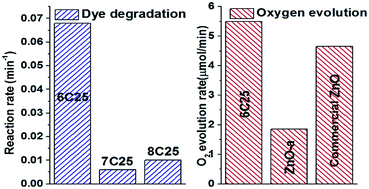
Fig. 6 presents the photocatalytic activity of synthesized samples on degradation of MB under the solar-simulated light. As shown in Fig. 6a, the light could solely degrade about 53% of MB in 150 min. About 68% of MB was removed in 150 min on 7C25 and 92.5% of MB on 8C25, which was mainly attributed to the dark adsorption in the first 30 min and photolysis by solar-simulated light. The first-order kinetic reaction rate constants of 7C25 and 8C25 were calculated to be 0.006 and 0.01 min−1, respectively. The poor photocatalytic activities of 7C25 and 8C25 were attributed to the poor crystalline and minor amount of ZnO covered by carbon, although the samples showed strong light absorption which could not be employed effectively. ZnO-R exhibited better photocatalytic performance, 100% of MB degradation in 150 min and the first-order kinetic rate was 0.049 min−1. 6C25 showed the best photocatalytic effect, 100% of MB degradation in 90 min, and the first-order kinetic rate was 0.068 min−1. Less than 10% of MB was adsorbed in the dark for 6C25, indicating that the decolorization of MB was mainly ascribed to photooxidation.
The influence of carbon and nitrogen fractions on photocatalytic performance was investigated in Fig. 6b. It took 90 min to completely degrade MB on 6C25, while 120 min on 6C20, 6C30 and 6C40. The first-order kinetic rates of 6C20, 6C25, 6C30 and 6C40 were 0.039, 0.068, 0.050 and 0.028 min−1, respectively (Fig. S3†). It seems that calcination time in air exerted a great influence on the photocatalytic efficiency and had an optimum value towards the best effect. The carbon and nitrogen contents decreased with the extension of pyrolysis time in air as shown in Table S1.† 6C20 showed an inferior photocatalytic activity due to too much carbonaceous materials hindering the light absorption. The carbon and nitrogen were burned out in the form of COx and NOx with the calcination time in air, which resulted in the decreased amount of carbon and nitrogen in 6C30 and 6C40 compared with 6C25. Consequently, the positive performances of carbon and nitrogen species (improving the adsorption of MB and hindering the recombination of holes and electrons) on photocatalysis were weakened, leading to the poorer efficiencies. Conclusively, the carbon and nitrogen fractions were important in determining photocatalytic performance, as reported similarly elsewhere.13,38
The stability of the photocatalyst was investigated under solar-simulated light, as shown in Fig. S4.† It can be seen that the photocatalytic activity decreased slightly after three runs, partially due to the coverage of intermediates on the catalyst, which would weaken the light absorption and electron transfer.39 The concentrations of dissolved zinc ions in the reaction solutions after the 2nd and 3rd runs were 4 and 8.5 ppm, respectively, and thereby, the reduction of photocatalytic activity was also induced by the loss of zinc oxide via photo-corrosion.
The best photocatalytic activity of 6C25 could be attributed to the following reasons: (i) ZnO in 6C25 was well-crystalline and the dopants fraction was proper; (ii) the carbon can enhance the MB adsorption ability and improve the interaction between MB and the catalyst; (iii) 6C25 showed high UV absorption ability and narrowed bandgap, compared with ZnO; (iv) the synergetic effect between carbon/nitrogen and ZnO retarded the recombination of electrons and holes, as reported elsewhere;40 (v) as mentioned previously,35 the oxygen vacancy facilitated the photocatalytic activity, due to the new-generated energy level below the conduction band which would inhibit the recombination of photo-excited electrons and holes.
To investigate the mechanism of dye degradation, quenching tests were conducted as shown in Fig. 7. TBA as a typical hydroxyl (˙OH) radicals scavenger was added into the reaction solution to verify the effect of ˙OH radicals. The photocatalytic effect decreased with the addition of 0.01 M TBA. Assuming that ˙OH radicals dominated the degradation, the degradation rate should drop greatly. The decrease indicated that dye degradation was attributed partially to ˙OH radicals.
Iodide ion (I−) was reported to be a scavenger of both ˙OH radicals and positive holes (h+) as reactions below: 41,42
| 2I− + ˙OH → I2 + OH− + e− | (1) |
| 2I− + 2h+ → I2 | (2) |
Fig. 7 showed that the photocatalytic effect increased nearly six times with the addition of KI as I−. As discussed above, ˙OH radicals acted slightly on dye degradation. Thereby, photo-excited holes would attributed to the photocatalytic reaction. However, the reaction rate would decrease if the dye degradation realized via holes. The discrepancy revealed that the photodegradation was not facilitated by holes. The consumption of holes caused by I− inhibited the recombination of electrons and holes, inducing the increase of electrons amount. Therefore, the dye degradation could be ascribed to electrons. Similar conclusions were also reported by other groups.22,43
As reported by other researchers, the carbon state lies deeply in the bandgap of ZnO while the reduction potential of superoxide radicals (−0.28 V vs. NHE) is just below the conductive band of ZnO.44 Thereby, the electrons transferred to carbon could not be trapped by O2 to produce superoxide radicals.22 The addition of BQ in Fig. 7 did not change the reaction rate compared with the absence of BQ excluding dark adsorption in the first 30 min. Li et al. reported that the reaction rate decreased dramatically after adding BQ in the system, confirming the effect of superoxide radicals.41 The contrary results indicated that superoxide ions were not produced in this study. Conclusively, the dye degradation on 6C25 was attributed to hydroxyl radicals and photo-excited electrons.
The mechanism of 6C25 on photocatalytic degradation of the dye was proposed as shown in Fig. 8. The electrons in the valence band (VB) were exited to the conduction band (CB) with the generation of holes in the VB. The holes would oxide the water into ˙OH radicals which would contribute partially to the dye degradation as discussed above. Meanwhile, the electrons in the CB would transfer to the new electron donor state caused by oxygen vacancies which was below the conduction band. The carbon would accept the electrons and then finish the degradation of dye adsorbed on it. It could be seen that the existence of oxygen vacancies and carbon retarded the recombination of holes and electrons. MB was decomposed into CO2 and H2O eventually by ˙OH radicals and photo-excited electrons.
The photocatalytic water oxidation performances of samples were shown in Fig. 9. It could be seen that the oxygen evolution rate was the largest in the first 10 min and then decreased due to the consumption of electron acceptor Ag+ and the block of light induced by the generation of Ag. The amount of O2 evolved on ZnO-R, commercial ZnO and 6C25 were 1.85, 4.65 and 5.50 μmol min−1, respectively, indicating that carbon and nitrogen dopants facilitated oxygen evolution reaction by lowering the bandgap energy and hindering the recombination of photo-excited electrons and holes.
Footnote |
| † Electronic supplementary information (ESI) available: Scheme of synthesis, TGA profiles, XPS studies, reaction kinetics and stability tests. See DOI: 10.1039/c6ra20667k |
| This journal is © The Royal Society of Chemistry 2016 |