
Mengfan Wanga,
Khasanaha,
Harumi Satob,
Isao Takahashic,
Jianming Zhangd and
Yukihiro Ozaki*a
aDepartment of Chemistry, School of Science and Technology, Kwansei Gakuin University, 2-1, Gakuen, Sanda, Hyogo 669-1337, Japan. E-mail: ozaki@kwansei.ac.jp
bGraduate School of Human Development and Environment, Kobe University, 3-11 Tsurukabuto, Nada-ku, Kobe, Hyogo 657-8501, Japan
cDepartment of Physics, School of Science and Technology, Kwansei Gakuin University, Gakuen 2-1, Sanda, Hyogo 669-1337, Japan
dKey Laboratory of Rubber-Plastics, Ministry of Education, Qingdao University of Science and Technology, Qingdao City 266042, People's Republic of China
First published on 30th September 2016
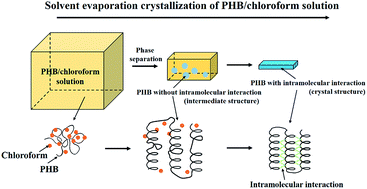
Solvent evaporation crystallization (SEC) of poly(3-hydroxybutyrate) (PHB) in a PHB/chloroform solution was investigated by time-resolved attenuated total reflection Fourier-transform infrared (ATR-FTIR) spectroscopy and grazing incidence wide angle X-ray diffraction (GI-WAXD). The ATR-FTIR investigation reveals that the PHB/chloroform solution was in a homogeneous state at first, and with the evaporation of chloroform, the separated PHB from the chloroform solvent was in the mixture of intermediate and amorphous states, but no crystal structure formed due to the presence of chloroform. Subsequently, further evaporation induced a transition from intermediate to crystal structure and the formation of C
O⋯H–C intramolecular interactions within the latter. As the crystal structure developed, the intra-molecular interaction changed from weak to strong due to the reduced intra-molecular distance within the lamella structure. The results of the GI-WAXD investigation suggest the presence of two kinds of intermediate structures with different order (less ordered and highly ordered). During SEC, the intermediate structures formed first, subsequently transforming into a crystal structure.
Being different from crystallization from pure polymers system, such as cold and melt crystallization, solvent evaporation crystallization (SEC) is in general more complex.15–21 For a polymer solution, the solvent molecules usually exhibit some interactions with polymer chains,22 and phase separation occurs during solvent evaporation when the concentration reaches a saturation point. A SEC polymer film is usually formed in a very short time, so that in situ synchrotron radiation X-ray has usually been used to investigate this process.16,19,20,23–25
Heinzer et al.23 studied the spacing change of hexagonally packed cylinders in a poly(styrene-b-butadiene) copolymer film during solvent drying by in situ grazing incidence small-angle X-ray scattering (GI-SAXS) measurements. The authors found that the above spacing increases on solvent evaporation, with the segregation of blocks increasing first. When the solution concentration reaches a critical point, the spacing decreases due to the loss of solvent. Using same method, Ogawa et al.24 studied the structural development of symmetric poly(styrene-b-2-vinylpyridine) block copolymers thin films during spin-coating. The authors suggested that the microstructure of poly(styrene-b-2-vinylpyridine) is first created from randomly distributed spherical micelles forming a body-centered cubic (BCC) lattice, with further evaporation inducing a transition from spheres in the BCC lattice to cylindrical structures.
Compared to X-ray analysis, it is well known that Fourier-transform infrared (FTIR) spectroscopy is more suitable for investigating the conformational and local molecular environments changes of polymers.26–28 Therefore, time-resolved FTIR spectroscopy has been extensively used to investigate the crystallization of semicrystalline polymers.7,29–31 However, to ensure better signal-to-noise ratio (SNR), IR spectra are usually obtained using 64 or 128 scans at 2–4 cm−1 resolution. Thus, it takes about 1–2 min to obtain one spectrum. Therefore, FTIR investigations of solvent evaporation crystallization are difficult. Due to this limitation, to the best of our knowledge, no reports on FTIR characterization of SEC exist.
During the last two decades, biodegradable polymers have attracted considerable interest. Among them, poly(3-hydroxybutyrate) (PHB) has been extensively studied,32–37 since it has mechanical properties similar to those of conventional synthetic polymers.38–41 The α crystal modification of PHB is the most common form, and its helical chain is packed as an orthorhombic unit cell, P212121-D42, with dimensions of a = 5.76 Å, b = 13.20 Å, and c = 5.96 Å.42–44 Based on IR and X-ray crystallographic studies, Sato et al. suggested the existence of weak hydrogen bonding between the carbonyl and methyl groups (C
O⋯H–C) in the unit cell. The distance between them is 2.62 Å,44 which is shorter than the sum of van der Waals radii of O and H atoms, 2.72 Å. The FTIR investigation of Sato et al.45 showed that the asymmetric CH3 stretching band appears at an abnormally high frequency (3009 cm−1), providing more evidence for the C
O⋯H–C hydrogen bonding. Very recently, Wang and Tashiro44 studied the crystal structure and intermolecular interactions of the α-form of PHB in detail, confirming the existence of C
O⋯H–C hydrogen bonding.
PHB is also a good model for investigating polymer crystallization behavior due to its exceptional purity and low nucleation density.46,47 Therefore, it was chosen as a candidate to investigate SEC in this work. Until now, studies on the crystallization of PHB have been mainly concerned with melt crystallization (around 110 °C).34,37,48 However, no related studies on the cold crystallization of PHB at lower temperature (e.g., room temperature) exist, probably the Tg (glass transition temperature) of PHB is relatively low (around 5 °C). Moreover, the cold crystallization of PHB at room temperature is very fast, and thus, it is rather difficult to carry out the cold crystallization of PHB. Therefore, investigating the SEC of PHB is very meaningful. In this research, SEC studies were carried out at room temperature (25 °C), even though this temperature is higher than the Tg of PHB. The crystallization from an amorphous state can still be traced very clearly due to the presence of solvent. It should be noticed that by SEC, PHB can form only one kind of crystal structure (α-form) from amorphous state, changing SEC condition will not change the crystallization process and the final crystal structure.
In the present study, we focus on such two points: (1) the structure change of PHB from molecular level during SEC; (2) the multi molecular interaction change between PHB and chloroform and within PHB crystal structure during SEC. Attenuated total reflection Fourier-transform infrared (ATR-FTIR) spectroscopy was used to investigate the SEC of a PHB/chloroform solution. To overcome the conflict between high IR signal-to-noise ratio and high evaporation rate of chloroform, a glass tube was used to hold the PHB/chloroform solution (Fig. 1). This can slow down the evaporation rate due to the reduction of exposed area and increase the chloroform concentration in vapor on the solution surface. Therefore, the PHB/chloroform solution in the glass tube provided enough time for FTIR measurements during SEC. ATR-FTIR spectroscopy can be used to investigate the SEC of the PHB/chloroform solution in detail, especially in terms of the formation of intermediate structures and hydrogen bonding. Moreover, time-resolved in situ grazing incidence wide angle X-ray diffraction (GI-WAXD) was also used to support the results of ATR-FTIR.
000 g mol−1 was purchased from Sigma-Aldrich Chemical Co., Ltd., and was used without further purification. A PHB/chloroform solution was prepared by dissolving PHB powder in hot chloroform at 80 °C to produce a homogeneous solution with a concentration of 5 wt%.
O stretching region (b), and C–Cl stretching region (c) of pure PHB and chloroform. The corresponding assignments are summarized in Table 1. Chloroform shows only two bands, at 3020 and 742 cm−1 (Fig. 2(a) and (c)). Attention should be paid to the PHB bands at 1722 and 3009 cm−1, which are characteristic of the crystalline state (Fig. 2(a) and (b)). The frequency of these bands indicates the existence of C
O⋯H–C hydrogen bonding in crystalline PHB.34,44,45 Bands at 1738 and 1748 cm−1 are due to the C
O stretching modes of different PHB conformations in the main chain34,45 or to differently ordered49 amorphous parts of PHB. The bands at 2974, 2934, and 2874 cm−1 are assigned to CH3, CH2 asymmetric, and CH symmetric stretching modes in the crystalline region, respectively,36 while the band at 2998 cm−1 exists both in the crystalline and amorphous regions (Fig. 2(a)).34 During the crystallization of PHB, these IR bands show sequential changes, which can be used to track the molecular structure change of PHB during SEC.
| IR frequencies (cm−1) | Assignments |
|---|---|
| 3020 | CH3 asymmetric stretching mode in chloroform |
| 3009 | CH3 asymmetric stretching mode in PHB (C) |
| 2998 | CH3 asymmetric stretching mode in PHB |
| 2974 | CH3 asymmetric stretching mode in PHB (C) |
| 2934 | CH2 antisymmetric stretching mode in PHB (C) |
| 2874 | CH symmetric stretching mode in PHB (C) |
| 1748 | C O stretching mode in PHB (A) |
| 1738 | C O stretching mode in PHB (A) |
| 1731 | C O stretching mode in PHB (I) |
| 1722 | C O stretching mode in PHB (C) |
| 1686 | C O stretching mode in PHB (C) |
| 742 | C–Cl stretching mode in chloroform |
Fig. 3(a) and (b) show time-dependent variations of IR spectra in the 3050–2800 and 1770–1680 cm−1 regions during the SEC of PHB, respectively. The yellow and blue regions in Fig. 3(a) stand for the C
O stretching bands of PHB in the amorphous and crystalline regions, respectively. Fig. 4 shows changes in the amorphous (a) and crystalline (b) C
O stretching bands of the PHB/chloroform solution during SEC. SEC prior to the appearance of the crystal C
O band (1722 cm−1) is discussed first. Based on Fig. 4(a), the changes in the amorphous PHB C
O stretching band (denoted C
O (amorphous)) can be divided into two regions, depending on the absorbance and wavenumber changes: time range Δt1, from 0 to 117 min, and time range Δt2, from 117 to 146 min. In the first time range, the wavenumber and absorbance of C
O (amorphous) do not change much. Chloroform is good solvent for PHB, and it is reasonable to consider that intermolecular interactions exists between PHB molecular chains and chloroform molecules (denoted as inter).50 Jacquel et al.49 studied the solubility of polyhydroxyalkanoates (PHAs) in different solvents. They found that among tetrachloromethane, chloroform, dichloromethane, and 1,2-dichloroethane, chloroform and dichloromethane exhibited high solubilizing properties for PHAs, while tetrachloromethane and 1,2-dichloroethane exhibited lower solubilizing properties. The carbon atom in solvent molecules with high PHA solubilizing properties should carry at least one chlorine atom and one hydrogen atom. These high solubilizing properties can be explained by a polar interaction between the chloride atom and the carbonyl group carbon, together with the fact that the electron-deficient hydrogen atom of the halogenated compound is linked to the carbonyl group of the polymer [see Fig. 4 in ref. 50].
![]() | ||
Fig. 3 ATR-FTIR spectra in the C O stretching region (a) and C–H stretching region (b) from 0 to 160 min during SECB. | ||
![]() | ||
Fig. 4 ATR-FTIR absorbance and wavenumber change of amorphous (a) and crystal (b) C O stretching bands of PHB/chloroform solution with time during SECB. | ||
Fig. 5(a) and (b) shows IR spectra of the PHB/chloroform solution in the C
O (amorphous) stretching region and the chloroform CH3 asymmetric stretching band region during Δt1, respectively. The absorbance of C
O (amorphous) increases with time due to chloroform evaporation, but the wavenumber remains constant at around 1739 cm−1 (Fig. 4(a) and 5(a)). Similar behavior is also observed for the CH3 asymmetric stretching band region of chloroform. These results imply that even though the PHB concentration increases due to solvent evaporation, the inter changes little. In the other words, the PHB/chloroform solution is still homogenous, and no phase separation takes place.
![]() | ||
Fig. 5 ATR-FTIR spectra of the C O (amorphous) (a) and C–H stretching band in chloroform (b) during Δt1. | ||
![]() | ||
Fig. 6 ATR-FTIR spectra (top panels) and their second derivatives spectra (bottom panels) in the C O stretching band region of PHB during 117–146 min (a) and 146–148 min (b). | ||
O (amorphous) of PHB, while the new band at 1727 cm−1 is present in neither pure PHB nor pure chloroform spectrum. As discussed above for Δt1, the solution is still homogeneous, with no phase separation and nucleation taking place. Thus, no crystal structure is formed. Therefore, this new peak of the PHB/chloroform system may reflect inter C
O. In the 117–127 min interval, the 1741 cm−1 band becomes stronger and is shifted to lower frequency, while the intensity of the 1727 cm−1 band slightly increases. The absorbance increase in this range is due to the increase of PHB concentration (Fig. 5(a)). However, the reason behind the hardly detectable concentration change in the Δt1 range may be due to the sensitivity of the FTIR instrument, since even though chloroform undergoes extensive evaporation, the solution is still dilute, and the amount of PHB on the surface of the ATR crystal does not change much. Thus, the absorbance of PHB changes little.
O decreases. In other words, the interaction between chloroform and PHB starts to gradually disappear. This means that the amount of chloroform is not sufficient to completely dissolve PHB. Therefore, PHB starts to separate out from chloroform (phase separation). It is reasonable to speculate that the IR absorbance of PHB separated out from chloroform is stronger than that of PHB in solution. Therefore, the absorbance in Fig. 4(a) shows a sudden increase from 127 min onwards.The most interesting finding in this time domain is that a new band appears at 1731 cm−1. Since this band shows up after phase separation occurs, it is not due to the interaction between PHB and chloroform. In our previous research, we also observed the 1731 cm−1 band during the isothermal crystallization of PHB from melt.34,48 This band was assigned to an intermediate structure between the amorphous and crystalline states of PHB following the concept proposed by Strobl,51 since the intensity of the 1731 cm−1 band tends to decrease as the intensity of the crystalline band around 1722 cm−1 increases. The results in Fig. 6(b) show that the intensity of the 1731 cm−1 band decreases, while that of the crystalline band at 1722 cm−1 increases, which is similar to the results of previous studies.34,48 Therefore, we assign the 1731 cm−1 band to the intermediate structure. However, contrary to the previous results, the 1731 cm−1 band (e.g., in the spectrum at 132 min) does not appear simultaneously with the 1722 cm−1 band.
It should be noted that the so-called crystalline band of PHB at 1722 cm−1 is the crystalline C
O stretching band featuring intramolecular interactions (denoted intra) within PHB, and this band starts to appear just after secondary crystallization. During the introduction period, only the 1732 cm−1 band (due to the C
O stretching mode without intra) shows complex change.48 Therefore, studying the intermediate structure of PHB is very important for understanding the crystallization process. However, the isolated intermediate structure is difficult to form during melt crystallization of bulk PHB, since the crystal with intra has a lower energy than the intermediate state, and the transformation of the latter into the former is very fast and spontaneous. However, in the present study, the intermediate state is relativity stable during SEC. This may be due to the presence of chloroform solvent, which weakly interacts with PHB to loosen the crystal structure of the latter. In other words, the distance between CH3 and C
O groups in the molecular chain of PHB may become longer than the van der Waals separation between the O and H atoms (2.72 Å), thus excluding the formation of intra. Therefore, only the amorphous and intermediate structures appear before intra.
The 1722 cm−1 band starts to appear from 146.5 min, as shown in Fig. 6(b). The absorbance and wavenumber changes between 147.5–160 min are shown in Fig. 4(b) (since the absorbances at 146.5 and 147 min are difficult to read from the raw IR spectra, the absorbance in Fig. 4(b) is plotted starting from 147.5 min). The crystallization process is almost complete after 153 min, as shown by the black broken dotted line in Fig. 4(b). Fig. 4(b) shows that the wavenumber is shifted to lower frequency (from 1722 to 1720 cm−1), accompanied by an increase of absorbance intensity between 146.5–153 min. This change can also be seen from the second derivative spectra in this time domain, as shown in Fig. 7. The low frequency shift of the 1722 cm−1 band is due to the intra becoming stronger during crystallization. This behavior is easy to understand, since the formation of intra involves the creation of C
O⋯H–C hydrogen bonds in PHB, where the distance between the crystal lattice planes is becoming shorter. With closer packing of the crystal lattice planes, the distance between the C
O and CH3 groups becomes shorter, so that intra becomes stronger during 146.5–153 min.
The IR and corresponding second-derivative spectra of the 3040–2950 cm−1 CH stretching region during SEC in the 146.5–153 min interval are shown in Fig. 8. The three bands at 3008, 2997, and 2976 cm−1 are assigned to the CH3 asymmetric stretching modes of PHB,34 with their intensities increasing concomitantly with that of the 1722 cm−1 band (Fig. 7). The 3008 cm−1 band is due to the weak C
O⋯H–C hydrogen bonds44 and shows a shift to higher frequency from 3008 to 3010 cm−1, presenting additional evidence of the intra becoming stronger during SEC.
Time-resolved evolution of two-dimensional GI-WAXD patterns during SEC of the PHB/chloroform solution is shown in Fig. 9. No diffraction pattern of PHB is observed before 50 s, and the diffraction profile of crystalline PHB appears after 55 s (not always clear in the 2D pattern in Fig. 9, see Fig. 10(a)). The diffraction arcs of the (020) and (110) lattice planes of PHB44 become more distinct with the evaporation of chloroform starting from 75 s (as shown by the white arrows in Fig. 9(c)). Since each diffraction arc is continuous, there is no preferred orientation within the film. Time-resolved GI-WAXD profiles of the (020) reflection during SEC between 0–300 s integrated from 2D diffraction patterns are shown in Fig. 10(a). It can be seen from the latter figure that the diffraction profiles are very broad and unsymmetrical, implying the presence of more than one diffraction peak.
![]() | ||
| Fig. 9 Time-resolved two-dimensional GI-WAXD patterns of PHB/chloroform solution during SECB at 0 s (a), 50 s (b), 75 s (c), 150 s (d), 200 s (e) and 300 s (f). | ||
To quantitatively investigate the SEC of PHB, diffraction profiles of the (020) reflection were deconvoluted assuming a Gaussian shape of the underlying peaks. Fig. 10(b) and (c) depict two typical curve fitting results of the diffraction profiles at 75 and 100 s, respectively. Four peaks are present at 2θ ≈ 12.96°, 13.21°, 13.68° and 14.21°. The diffraction arc at 2θ ≈ 14.21°, indicated by the black arrow in Fig. 10(a), is clearly separated from the (020) diffraction arc, as can be seen in Fig. 10(d). Therefore the above ghost peak does not arise from the (020) lattice plane and necessitates future research. It is very interesting that three peaks overlap in the (020) diffraction region, with their relative intensity also changing during SEC. From the relative intensity change and diffraction angle, it is reasonable to assign the peak at 2θ ≈ 13.68° to the crystalline PHB. Meanwhile, the intensities of the other two diffraction peaks at 2θ ≈ 12.96° and 13.21° decrease with time. Their lattice plane distance is slightly larger than the one of the crystal structure, so it is reasonable to assign them to intermediate structures. Very recently, Khasanah et al.50 found that ultra-thin PHB films contain stable intermediate structures, and the GI-WAXD diffraction profile of the (020) lattice plane is overlapped by two peaks, assigned to the intermediate and highly-ordered structures.
The two kinds of intermediate structure observed in this study may also be due to their different order (the reason why only one intermediate structure was reported by Khasanah et al., but two are reported in this study may be due to the different confinement in ultrathin and thin films); the lower angle one arises from the less ordered intermediate structure (inter, L), whereas the higher angle one is due to the highly-ordered intermediate structure (inter, H). One may wonder about the controversy between the GI-WAXD and ATR-FTIR observations in this study: the IR spectra indicate the presence of only one intermediate state (1731 cm−1 band), whereas the GI-WAXD results show two kinds of intermediate states. The reason for this controversy may be ascribed to the different principles of IR and WAXD, which are sensitive to changes of the dipole moment and the crystal lattice, respectively. Therefore, IR spectra usually reflect different conformations of polymers, whereas WAXD is usually used to investigate ordered structures having three-dimensional periodicity, such as crystals. Therefore, one possibility is that the two intermediate structures possess similar conformations. To find the true reason, it is crucial to conduct simultaneous GI-WAXD and ATR-FTIR measurements.
Time-resolved fractions of less ordered intermediate structure (Xinter,L(t)), highly-ordered intermediate structure (Xinter,H(t)), and crystalline structure (XCrys(t)) during SEC between 75–100 s are shown in Fig. 11. Even though the diffraction peaks of crystalline PHB appeared after 55 s, their intensity was very low, and the noise level was high. Therefore, it was impossible to successfully carry out curve-fitting of the profiles in the 55–70 s domain. Thus, the plot starts at 75 s in Fig. 11. The fraction of each part was calculated based on the curve-fitting result using the following equation (using Xinter,L(t) as an example):
![]() | (1) |
O stretching band show almost no change, indicating that the SEC is complete.
Time-resolved GI-WAXD measurements were performed by casting the PHB/chloroform solution on a Si substrate. The diffraction arcs of PHB during SEC were very broad. The curve fitting procedure revealed that the diffraction peak of the (020) lattice plane contained three overlapping peaks, attributable to the less ordered intermediate, highly-ordered intermediate, and crystalline structures. During SEC, the intermediate structure was formed first, subsequently transforming into the crystalline structure.
C
Hydrogen Bondings of Poly(3-hydroxyvalerate) and Poly(3-hydroxybutyrate) Studied by Infrared Spectroscopy and X-ray Diffraction, Macromolecules, 2008, 41, 4305–4312 CrossRef CAS.| This journal is © The Royal Society of Chemistry 2016 |