Madhvi Bhardwaj,
Manmeet Kour and
Satya Paul*
Department of Chemistry, University of Jammu, Jammu-180 006, India. E-mail: paul7@rediffmail.com; Fax: +91-191-2431365; Tel: +91-191-2453969
First published on 13th October 2016
A series of novel and highly efficient bifunctional heterogeneous catalysts based on Cu(0) onto sulfonic acid functionalized silica/carbon composites derived from silica and inexpensive natural organic materials (starch, glucose, maltose, cellulose and chitosan) were successfully synthesized. The utility of the developed catalysts was explored for the one-pot synthesis of polysubstituted pyridines under solvent-free conditions and for the oxidative transformation of aldehydes to nitriles using aqueous ammonia and H2O2. Among the different catalysts screened, Cu(0)–SilCcell–SO3H was found to be the most active and selective. The prepared bifunctional composites were characterized by FTIR, TGA and CHNS, while the most active catalyst, Cu(0)–SilCcell–SO3H was further characterized by SEM, TEM, XRD, EDX, ICP-AES and XPS analysis. Further, the catalyst can be recovered and reused for atleast six runs without any significant impact on catalytic activity and selectivity. The high catalytic activity, thermal stability, simple recovery, reusability and eco-friendly nature of the catalyst makes the present protocol particularly attractive from the view point of green chemistry.
Composites containing metal NPs have attracted a great deal of attention, due to their unique optical, electrical, and catalytic properties.6,11,12 Recently, Cu(0) nanoparticles have drawn attention of chemists owing to their inexpensive nature, easy preparation and the ability to replace other noble metals, such as Ag, Au and Pt.13 Conversely, the use of Cu(0) nanoparticles is often complicated by the issues related with their oxidation and agglomeration in the absence of stabilizers, thereby diminishing their activity.14 Recent advances in the design and preparation of Cu(0) nanoparticles confirmed that they can be synthesized through different preparation routes and using acid functionalized supports to give tailored sizes, shapes and distributions, overcoming the main drawbacks of traditional synthetic methodologies.15 Furthermore, acid functionalized organic/inorganic composites generally exhibit important advantages over traditional catalysts such as: (i) the control of the particle shape by the acidic functional groups located in the polymer chain; (ii) the improvement of catalytic selectivity; (iii) the stabilization of nanoparticles by suppression of their aggregation16,17 and thus can act as efficient supports for the immobilization of metal nanoparticles. Hence, with the growing interest in the heterogeneous catalysis, it is certain that metal nanoparticles based acid functionalized organic/inorganic composites will continue to be a fast moving topic for next several years.
Pyridine and its derivatives are an important class of N-heterocyclic compounds which have been found to be an integral part of many natural products18–20 and have shown potent pharmacological properties.21 Recently, multicomponent reactions (MCRs) have gained tremendous attention from medicinal and organic chemists. These methods offer rapid and convergent construction of complex molecules without isolation and purification of intermediates, minimizing waste, effort, time, and cost. Thus, several elegant and effective methods based on MCRs have been reported for the synthesis of pyridine derivatives.22
Further, nitriles are an important class of compounds in organic synthesis, because of their versatility and potential for further transformation into other functional compounds.23 Representative strategies for the synthesis of nitriles generally involve the use of toxic reagents, high temperature, pressure, and generate large amount of wastes.24–26 Hence, there is a growing demand for a highly practical nitrile synthesis by employing heterogeneous metal catalysts and using cheap and commercially available starting materials.
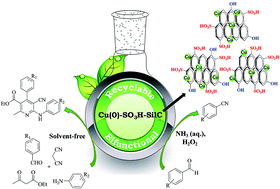
Herein, we have synthesized novel and sustainable bifunctional heterogeneous catalysts based on Cu(0) NPs onto sulfonic acid functionalized silica/carbon composites [Cu(0)–SilC–SO3H]. The developed catalyst has been efficiently utilized for the one-pot synthesis of polysubstituted pyridines via nucleophilic addition/intermolecular cyclization under solvent-free conditions. Further, to explore the wider applicability of the developed catalyst, we have used Cu(0)–SilC–SO3H for the oxidative transformation of aldehydes to nitriles using aqueous ammonia and H2O2 at 100 °C. In both these reactions, excellent results were obtained. To the best of our knowledge, the use of copper nanoparticles onto sulfonic acid functionalized silica/carbon composites as catalysts for the one-pot synthesis of polysubstituted pyridines and for the oxidative synthesis of nitriles from aldehydes has not been previously reported in the literature.
The surface chemical structure of Cu(0)–SilC–SO3H was characterized by FTIR spectroscopy. The FTIR spectrum showed bands in the region of 1639–1648 cm−1 which were assigned to aromatic C
C stretching modes in polycyclic aromatic rings. The absorption bands in the range of 1402–1406 cm−1 and 1100–1106 cm−1 were observed due to the asymmetric and symmetric stretching modes of SO2 group, indicating the successful incorporation of SO3H groups into the carbon framework. Further, the broad bands ranging from 3401–3412 cm−1 were due to the phenolic –OH groups present in the aromatic rings. The Cu(0) based sulfonated silica/carbon composites prepared from different natural organic compounds (Cu(0)–SilCstar–SO3H from starch, Cu(0)–SilCglu–SO3H from glucose; Cu(0)–SilCmal–SO3H from maltose, Cu(0)–SilCcell–SO3H from cellulose and Cu(0)–SilCchit–SO3H from chitosan) showed almost similar FTIR spectra. The major absorption frequencies are shown in Table 1 and the FTIR spectra of Cu(0)–SilCcell–SO3H is shown in Fig. 1.
| Entry | Catalyst | C C |
SO2 asym. | Str. sym. | –OH |
|---|---|---|---|---|---|
| a FTIR was recorded on Perkin-Elmer FTIR spectrophotometer using KBr discs. | |||||
| 1 | Cu(0)–SilCstar–SO3H | 1646 | 1404 | 1104 | 3410 |
| 2 | Cu(0)–SilCglu–SO3H | 1639 | 1402 | 1100 | 3401 |
| 3 | Cu(0)–SilCmal–SO3H | 1643 | 1406 | 1105 | 3405 |
| 4 | Cu(0)–SilCcell–SO3H | 1645 | 1403 | 1102 | 3406 |
| 5 | Cu(0)–SilCchit–SO3H | 1648 | 1406 | 1106 | 3412 |
The thermal stability of Cu(0)–SilC–SO3H was examined by TGA in the temperature range of 30 to 800 °C under a static atmosphere of nitrogen. The major weight losses of different Cu(0)–SilC–SO3H catalysts are represented in Table 2. The TGA curve of Cu(0)–SilCcell–SO3H (Fig. 2) showed an initial weight loss below 110 °C which can be ascribed to the evaporation of water and solvent molecules present in the composite. The second weight loss appeared between 310–350 °C, which may be attributed to the decomposition of sulfonic acid moieties present in Cu(0)–SilCcell–SO3H. Further weight loss from 350 to 800 °C was attributed to the bulk pyrolysis of silica/cellulose skeleton.
| Entry | Catalyst | Loss of residual solvent (°C) | Loss of organic functionality (°C) |
|---|---|---|---|
| a Thermal analysis was carried out at a heating rate of 10 °C min−1. | |||
| 1 | Cu(0)–SilCstar–SO3H | 100 | 325–800 |
| 2 | Cu(0)–SilCglu–SO3H | 100 | 318–670 |
| 3 | Cu(0)–SilCmal–SO3H | 110 | 315–670 |
| 4 | Cu(0)–SilCcell–SO3H | 108 | 320–800 |
| 5 | Cu(0)–SilCchit–SO3H | 105 | 322–800 |
The amount of sulfonic acid groups grafted onto the surface of Cu(0) based sulfonated silica/carbon composites was determined by CHNS analysis (Table 3). The results indicated that Cu(0)–SilCstar–SO3H contained 0.89 wt%, Cu(0)–SilCglu–SO3H contained 0.81 wt%, Cu(0)–SilCmal–SO3H contained 0.58 wt%, Cu(0)–SilCcell–SO3H contained 1.2 wt% and Cu(0)–SilCcell–SO3H contained 0.98 wt% of sulfur, equivalent to SO3H loading of 0.28, 0.25, 0.18, 0.32 and 0.30 mmole per gram of the catalyst. Further, the acid densities and the amount of C, H and S present in Cu(0)–SilC–SO3H as determined by elemental analysis is also presented in Table 3. Among the different Cu(0)–SilC–SO3H catalysts, Cu(0)–SilCcell–SO3H exhibited the highest SO3H density. The most active Cu(0)–SilCcell–SO3H was further characterized by SEM, TEM, XRD, EDX and XPS analysis.
| Entry | Catalyst | –SO3H (mmol g−1) | S (wt%) | C (wt%) | H (wt%) |
|---|---|---|---|---|---|
| a Determined by elemental analysis. | |||||
| 1 | Cu(0)–SilCstar–SO3H | 0.28 | 0.89 | 18.2 | 1.2 |
| 2 | Cu(0)–SilCglu–SO3H | 0.25 | 0.81 | 19.1 | 1.3 |
| 3 | Cu(0)–SilCmal–SO3H | 0.18 | 0.58 | 20.4 | 1.7 |
| 4 | Cu(0)–SilCcell–SO3H | 0.32 | 1.2 | 19.6 | 1.5 |
| 5 | Cu(0)–SilCchit–SO3H | 0.30 | 0.98 | 21.5 | 1.6 |
The shape and surface morphology of the catalyst was investigated by scanning electron microscopy (Fig. 3). The SEM micrographs of Cu(0)–SilCcell–SO3H showed floccules like structure with quasi spherical morphology. On the other hand, the surface of the composite was non-smooth depicting its amorphous nature and thus resulted in an increase in its surface area.
To provide more accurate information on the particle size and fine structure of Cu(0)–SilCcell–SO3H, transmission electron microscopy (TEM) was carried out. TEM micrographs revealed the uniform formation of Cu(0) nanoflowers onto the surface of sulfonated SilCcell material (Fig. 4a). The sulfonated carbon material appears as light grey particles over which black coloured Cu(0) nanorods combined to form nanoflowers, which can be easily visualised (Fig. 4b). The average diameter of the Cu(0) nanorods as determined from TEM analysis was found to be 28 nm (Fig. 4c).
The XRD pattern of Cu(0)–SilCCell–SO3H exhibited diffraction peaks corresponding to face-centered cubic (fcc) Cu.28 Fig. 5 showed three reflection patterns at 2θ = 43.4, 50.5, and 74.2° which can be indexed as [111], [200] and [220] planes of copper. All the diffraction peak values along with the d-spacings match those in standard XRD data for copper (JCPDS 04-0836).28 These results indicated that copper metal in Cu(0)–SilCcell–SO3H was present in Cu(0) state and no peaks of impurity were detected. In addition, a broad diffraction peak at 2θ = 15–29° was attributed to the reflection patterns of amorphous carbon composed of polycyclic aromatic carbon sheets oriented in a random manner.29
The elemental composition of Cu(0)–SilCcell–SO3H was determined by energy dispersive X-ray (EDX) analysis. The EDX spectrum, displayed in Fig. 6, clearly reveals the presence of C, Si, O, S and Cu present in Cu(0)–SilCcell–SO3H. Further, the weight percentage of Cu in Cu(0)–SilCcell–SO3H was determined by inductively coupled plasma atomic emission spectroscopy (ICP-AES). The results indicated that Cu content loaded onto Cu(0)–SilCcell–SO3H was 3.2 wt%.
The electron properties of the species formed on the surface of Cu(0)–SilCcell–SO3H, such as the oxidation state, and the binding energy of the core electron of the copper metal were analyzed using XPS. Fig. 7a showed the overall survey spectrum of Cu(0)–SilCcell–SO3H in which peaks corresponding to carbon 1s (284.9 eV), oxygen 1s (532.2 eV), silica 2p (105.3 eV) and copper 2p (932.7 eV) are clearly observed. In addition, the survey spectrum of the catalyst showed a singlet at around 168 eV for sulphur 2p, which is associated with SO3H groups.30 Fig. 7b showed the typical Cu(0) absorptions at 932.7 and 952.1 eV for 2p3/2 and 2p5/2 respectively, which are consistent with the literature values for Cu(0).31
| Entry | Catalyst | Pyridinesa | Nitrilesb | ||
|---|---|---|---|---|---|
| Time (h) | Yieldc (%) | Time (h) | Yieldd (%) | ||
| a Reaction conditions: benzaldehyde (1 mmol), malononitrile (1 mmol), ethyl acetoacetate (1 mmol), aniline (1 mmol) and catalyst (0.13 mol% Cu) at 100 °C under solvent-free conditions.b Reaction conditions: benzaldehyde (1 mmol), 25% NH3(aq.) (5 mL), 30% H2O2 (0.1 mL, 2 mmol) and catalyst (0.19 mol% Cu) at 100 °C.c Isolated yields.d Column chromatography yields. | |||||
| 1 | Cu(0)–SilCstar–SO3H | 3.5 | 90 | 4.5 | 91 |
| 2 | Cu(0)–SilCglu–SO3H | 4 | 82 | 5 | 86 |
| 3 | Cu(0)–SilCmal–SO3H | 5 | 80 | 5 | 85 |
| 4 | Cu(0)–SilCcell–SO3H | 2.5 | 92 | 3.5 | 93 |
| 5 | Cu(0)–SilCchit–SO3H | 3 | 90 | 4 | 92 |
Further, to select the appropriate catalyst amount, the model reaction was also examined by varying the catalyst amounts such as 0.05 g (0.06 mol% Cu), 0.1 g (0.13 mol% Cu), 0.15 g (0.19 mol% Cu) and 0.2 g (0.26 mol% Cu). It was found that 0.1 g (0.13 mol% Cu) of Cu(0)–SilCcell–SO3H was sufficient to get the optimum product yield, while further increase in the catalyst amount did not increase the yield significantly (entries 8, 10, 11, 12, Table 5). Furthermore, to optimize the reaction conditions with respect to different solvents and reaction temperature, the model reaction was examined in different solvents such as ethanol, methanol, acetonitrile, water, toluene as well as under solvent-free conditions. It was found that higher product yield was obtained when the reaction was carried out under solvent-free conditions in comparison to liquid phase conditions (Table 5). The maximum catalytic activity under solvent-free conditions may be attributed to the good dispersion of active reagent sites which facilitates better contact between reactants and the catalyst.33 However, due to the absence of any solvent (as medium), there is no dilution effect and the heat needed for energy of activation is directly available to the reactant molecules. Further, to select the optimum reaction temperature, the model reaction was carried out under solvent-free conditions at 80, 90, 100 and 120 °C, and 100 °C was choosen as the optimum reaction temperature in view of the product yield and reaction time (entry 8, Table 5).
| Entry | Solvent | Temp. (°C) | Catalyst (g) | Time (h) | Yieldb (%) |
|---|---|---|---|---|---|
| a Reaction conditions: benzaldehyde (1 mmol), malononitrile (1 mmol), ethyl acetoacetate (1 mmol) and aniline (1 mmol) at 100 °C under solvent-free conditions.b Isolated yield.c Column chromatography yields. | |||||
| 1 | Ethanol | Reflux | 0.1 | 4 | 86 |
| 2 | Methanol | Reflux | 0.1 | 5 | 80 |
| 3 | Acetonitrile | Reflux | 0.1 | 7.5 | 45c |
| 4 | Water | Reflux | 0.1 | 7.5 | 55c |
| 5 | Toluene | Reflux | 0.1 | 10 | 35c |
| 6 | Solvent-free | 80 | 0.1 | 3.5 | 85 |
| 7 | Solvent-free | 90 | 0.1 | 3.25 | 88 |
| 8 | Solvent-free | 100 | 0.1 | 2.5 | 92 |
| 9 | Solvent-free | 120 | 0.1 | 2.5 | 92 |
| 10 | Solvent-free | 100 | 0.05 | 4 | 70 |
| 11 | Solvent-free | 100 | 0.15 | 2.5 | 92 |
| 12 | Solvent-free | 100 | 0.2 | 2.5 | 92 |
After optimizing the reaction conditions, the substrate scope with respect to various aldehydes and aromatic amines was examined and a wide range of pyridine derivatives were prepared. The results are summarized in Table 6. Among various aromatic aldehydes studied, aldehyde possessing electron-withdrawing group such as –NO2 gave higher yields (product 5g, Table 6) compared to those possessing electron-donating groups (–OCH3, –CH3) (products 5b, 5c, Table 6). It is pertinent to mention that the positions of these substituents had an apparent effect on the reaction. When aromatic aldehyde bearing ortho substituted electron withdrawing group (–NO2) was used, a comparatively lower yield was obtained (product 5f, Table 6). Moreover, the reaction with heteroaromatic aldehyde also proceeded well and gave the corresponding product in good yield (product 5i, Table 6). Among various substituted aromatic amines, the anilines with electron-withdrawing as well as electron donating groups also worked well and gave good yields (product 5j–5o, Table 6). Therefore, the present methodology offers wider substrate scope for the synthesis of polysubstituted pyridines under the optimized reaction conditions.
The mechanisms of Bronsted acid catalysis as well as the synergism between metal and Bronsted acid in the field of organic synthesis have been discussed in detail in the comprehensive review by Rueping et al.24,34 Accordingly, a probable mechanism has been proposed (Scheme 2) for the synthesis of polysubstituted pyridines catalyzed by the bifunctional Cu(0)–SilCcell–SO3H. Initially, aromatic aldehyde and malononitrile undergo Knoevenagel condensation to give I. Then, the Michael addition of ethyl acetoacetate to intermediate I gave intermediate II. Subsequently, aromatic amine reacts with II to form intermediate III. An intramolecular cyclization of III (via loss of H2O molecule) followed by isomerization to give intermediate IV. Finally oxidative aromatization of IV in the presence of catalyst gave the final product V. Overall, four new bonds were formed in a one-pot process to give the polysubstituted pyridines.
![]() | ||
| Scheme 2 Plausible mechanism for the Cu(0)–SilCcell–SO3H catalyzed one-pot synthesis of polysubstituted pyridines. | ||
Furthermore, to optimize the reaction conditions with respect to different oxidants and reaction temperature, the reaction with test substrate was carried out under different set of conditions to obtain the best possible combination. The effect of various oxidants such as molecular oxygen (O2), hydrogen peroxide (H2O2) and TBHP in aqueous ammonia at temperatures ranging from R.T. to 120 °C was explored with test substrate (Table 7). Initially, when the reaction was carried out in the absence of any oxidant at 100 °C, no product formation took place (entry 1, Table 7). Further, when the reaction was carried out in the presence of different oxidants, it was observed that molecular oxygen (O2) gave the poorest yield (entry 2, Table 7) and the best results were obtained with H2O2 in terms of time and yield (entry 3, Table 7). Although, good results were obtained with TBHP as well, however, it has led to decrease in selectivity of the product formation (entry 4, Table 7). The decrease in yield in case of TBHP as oxidant may be due to the interaction of the developed catalyst with tert-butyl alcohol, a by-product formed from the decomposition of TBHP which leads to decrease in activity of the catalyst. However, such kind of catalyst deactivation or catalyst poisoning is limited using H2O2 as oxidant and hence results in better conversion than TBHP.35
| Entry | Oxidant | Temperature (°C) | Time (h) | Yieldb (%) |
|---|---|---|---|---|
| a Reaction conditions: benzaldehyde (1 mmol), 25% NH3(aq.) (5 mL), 30% H2O2 (0.1 mL, 2 mmol) and Cu(0)–SilCcell–SO3H (0.15 g, 0.19 mol% Cu) at 100 °C.b Column chromatography yields.c No reaction. | ||||
| 1 | — | 100 | 5 | NRc |
| 2 | O2 | 100 | 5 | 30 |
| 3 | H2O2 | 100 | 3.5 | 93 |
| 4 | TBHP | 100 | 3.5 | 80 |
| 5 | H2O2 | R.T. | 5 | 45 |
| 6 | H2O2 | 60 | 4.5 | 85 |
| 7 | H2O2 | 80 | 4.0 | 90 |
| 8 | H2O2 | 120 | 3.5 | 93 |
Further, to select the optimum reaction temperature, the reaction with test substrate was carried out in aqueous ammonia at R.T., 60, 80, 100 and 120 °C, and 100 °C was choosen to be the optimum reaction temperature in view of the product yield and reaction time (entry 3, Table 7). At room temperature, the yield of the product obtained was very poor, while the reaction at 60 and 80 °C was little slow, and at 120 °C, no significant improvement in yield was observed (entries 5–8, Table 7). With an optimized reaction conditions, we then prepared various substituted aryl nitriles to explore the substrate scope. As shown in Table 8, a variety of substituted aldehydes bearing either electron-withdrawing or electron-donating groups were oxidatively transformed into corresponding nitriles using H2O2 in aqueous ammonia at 100 °C. Various functional groups such as methoxy, methyl, bromo, chloro and nitro at ortho, meta or para position in arylaldehyde were tolerated fairly well and afforded the desired products in moderate to high yields (products 2b–2h, Table 8). Further, thiophene-2-aldehyde and naphthyl-1-aldehyde were also successfully employed and corresponding nitriles were obtained in good yields (products 2i–2j).
A cyclic mechanism has been proposed (Scheme 3), which involves the electrophilic activation of aldehyde by Cu(0)–SilCcell–SO3H followed by the nucleophilic attack of aqueous ammonia to form an aldimine (I). This step is followed by the activation of H2O2 by co-ordinating with Cu(0) to form Cu(I) imine complex (II). Then, the activated oxygen of the co-ordinated H2O2 abstracts hydrogen from the imine to give the final product ‘III’ and an intermediate ‘IV’. Intermediate ‘IV’ then loses molecule of water and Cu(0) is regenerated.
| Entry | Catalyst | Pyridinesa | Nitrilesb | ||
|---|---|---|---|---|---|
| Time (h) | Yieldc (%) | Time (h) | Yieldd (%) | ||
| a Reaction conditions: benzaldehyde (1 mmol), malononitrile (1 mmol), ethyl acetoacetate (1 mmol) and aniline (1 mmol) and catalyst (0.1 g for entries 2 and 3; 0.13 mol% Cu for entries 4 and 5) at 100 °C under solvent-free conditions.b Reaction conditions: benzaldehyde (1 mmol), 25% NH3(aq.) (5 mL), 30% H2O2 (0.1 mL, 2 mmol) and catalyst (0.15 g for entries 2 and 3; 0.19 mol% Cu for entries 4 and 5).c Isolated Yield.d Column chromatography yields.e No reaction. | |||||
| 1 | No catalyst | 2.5 | NRe | 3.5 | NRe |
| 2 | SilCcell | 2.5 | Traces | 3.5 | Traces |
| 3 | SilCcell–SO3H | 2.5 | 65 | 3.5 | 60 |
| 4 | Cu(0)–SilCcell | 2.5 | 70 | 3.5 | 75 |
| 5 | Cu(0)–SilCcell–SO3H | 2.5 | 92 | 3.5 | 93 |
Further, in order to study the merits of the current protocol for the synthesis of polysubstituted pyridines and nitriles, a comparison of the efficacy of Cu(0)–SilCcell–SO3H with some of the reported catalytic systems in the literature was done. The results presented in Table 10 clearly depicts that the present method comparatively affords a truly green process using benign reaction media along with higher product yields in shorter reaction time. Further, it is noteworthy to mention here that Cu(0)–SilCcell–SO3H with lower catalyst loading exhibits high activity in the synthesis of polysubstituted pyridines and nitriles under the same reaction conditions along with the added advantages of catalyst recovery and reusability. In addition, the greenness of our protocol is also evaluated by employing the applications of green chemistry metrics (E-factor). The comparison of E-factor with several other catalyst systems explained the improved greenness of the present protocol (Table S1, see ESI†).
| Reaction | Catalyst | Reaction Conditions | Time (h) | Yield (%) | Reference |
|---|---|---|---|---|---|
| a Reaction conditions: benzaldehyde (1 mmol), malononitrile (1 mmol), ethyl acetoacetate (1 mmol) and aniline (1 mmol).b Reaction conditions: benzaldehyde (1 mmol).c Isolated yield.d Column chromatography yield. | |||||
| Pyridinesa | FeCl3 (Homogeneous) | EtOH, 70 °C, Catalyst (5 mol%) | 6 | 75 | 36 |
| SnCl2·2H2O (homogeneous) | H2O, 60 °C, Catalyst (10 mol%) | 8 | 82 | 37 | |
| Cu(0)–SilCcell–SO3H (heterogeneous) | Solvent-free, 100 °C, catalyst (0.1 g, 0.13 mol% Cu) | 2.5 | 92c | Present work | |
| Nitrilesb | Cu(OTf)2/Bipy (homogeneous) | OH-TEMPO, NH3 (aq), NaOH, MeCN, 25 °C, Catalyst (10 mol%) | 16 | 95 | 38 |
| Polymer-PhI(OAc)2 (heterogeneous) | Sodium dodecylsulfate (SDS), aq NH4OAc, 70 °C, catalyst (1.0 g, 2 mmol) | 4 | 90 | 39 | |
| Cu(0)–SilCcell–SO3H (heterogeneous) | NH3 (aq), H2O2, 100 °C, Catalyst (0.15 g, 0.19 mol% Cu) | 3.5 | 93d | Present work | |
:
1.2 in a round-bottom flask (100 mL) were dried at 80 °C for 6 h, followed by incomplete carbonization at 250 °C under nitrogen atmosphere for 10 h. These were then sulfonated using concentrated sulfuric acid (15 mL, >96 wt%) on heating at 150 °C for 6 h under N2 atmosphere. The composite material obtained was then washed repeatedly with hot distilled water (>80 °C) until sulfate anions were no longer detected in the filtered water. Sulfonated carbon/silica composites were finally dried in an oven at 100 °C for 2 h. For the preparation of Cu(0)–SilC–SO3H, a mixture of aqueous CuCl2 solution (0.134 g, 1.0 mmol, 3 mL) was added to sulfonated silica/carbon composite (1 g) in ethanol (10 mL) and the reaction mixture was stirred at room temperature for 6 h. After that, aqueous solution of NaBH4 (1.2 mmol, 5 mL) was added slowly to the above reaction mixture during 8 h. Finally, the mixture was filtered, and the residue was successively washed with H2O (3 × 5 mL) and ethanol (3 × 5 mL), and dried under vacuum at room temperature.
Footnote |
| † Electronic supplementary information (ESI) available: Spectral details of all the products listed in Tables 6 and 8 and copies of spectras of 1H, D2O and 13C of selected products. See DOI: 10.1039/c6ra19840f |
| This journal is © The Royal Society of Chemistry 2016 |