Metal-free regioselective construction of indolin-3-ones via hypervalent iodine oxidation of N-substituted indoles

Chao Yanga, Guanyun Chenga, Baofu Huangc, Fengtian Xue*b and Chao Jiang*a
aDepartment of Pharmaceutical Engineering, School of Chemical Engineering, Nanjing University of Science and Technology, Nanjing, Jiangsu 210094, China. E-mail: chaojiang@njust.edu.cn
bDepartment of Pharmaceutical Sciences, University of Maryland School of Pharmacy, 20 Penn Street, Baltimore, Maryland 21201, United States. E-mail: fxue@rx.umaryland.edu
cNanjing Perlong Medical Equipment Co., Ltd., 989 East Qingshuiting Road, Jiangning Development Zone, Nanjing, Jiangsu 211102, China

Received 4th August 2016 , Accepted 6th September 2016

First published on 7th September 2016


Abstract

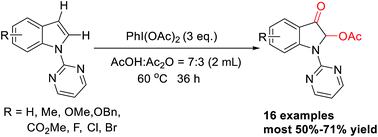
A metal-free method for the regioselective construction of 2-acetoxy indolin-3-ones from N-substituted indoles with PhI(OAc)2 as the oxidant was developed under mild reaction conditions. A range of functionalized 2-acetoxy indolin-3-ones were readily accessed by this strategy with moderate to good yields.

Introduction

Indolin-3-ones (3-oxyindoles) are unique structural motifs with frequent occurrence in the structures of a large variety of natural alkaloids and biologically active molecules.1 Over the past few decades, research showed that indolin-3-ones have great promise in medicine2 and polymers.3 Although some C-2 substituted indolin-3-one derivatives have been used in the total synthesis of molecules, such as iboluteine,4 (+)-isatisine A,5 fistulosin,6 brevianamide B,7 (+)-austamide8 and so on9 (Fig. 1), comparing with the construction of indolin-2-one derivatives,10 reports about syntheses of intricate indolin-3-one derivatives are still limited. Most of the methods rely on either transformations of pre-existing indolin-3-ones11 or tandem cyclization with complicated substrates,12 moreover, the use of precious or toxic metal catalysts, such as Au,12a,12f Ag,12c Al,12d Pd,13 Ru14 has accounted for a great proportion. In 2014, Ye and co-workers reported a new way towards the flexible and practical synthesis of indolin-3-ones catalysed by Au (Scheme 1a).12b These insufficiences have hindered further application in pharmaceutical synthesis of existing methods. As a result, it is very urgent to develop straightforward and efficient methods with simple substrates and transition-metal-free procedure.
image file: c6ra19741h-f1.tif
Fig. 1 Selected natural products with indolin-3-one motifs.

image file: c6ra19741h-s1.tif
Scheme 1 The synthesis of indolin-3-ones.

In recent years, transition-metal-free C–H bond functionalization has attracted a great deal of attention.15 In this research direction, hypervalent iodine system occupied a very important role for their benign environmental character and ready availability.16 Some properties, similar to transition metals, which are easy to undergo ligand exchange and reductive elimination, make hypervalent iodine a good choice for carbon–carbon, carbon–heteroatom, or hetero–heteroatom bond formations to construct various carbon- and heterocycles.17 In 2010, Fan's group reported a new way to the construction of indolin-3-ones via tandem oxidative cyclization–acetoxylation of o-acyl anilines (Scheme 1b),12h and 2-acetoxy indolin-3-ones could be synthesized, which is the fundamental structure of fistulosin. This result inspired us to think the feasibility of constructing indolin-3-ones directly from the indole motif using hypervalent iodine as oxidant, and fortunately, we found PhI(OAc)2 could achieve the goal after a careful study of reaction conditions (Scheme 1c).

Results and discussion

We chose N-(2-pyrimidyl)indole (1a) as the model substrate in the initial study and the results were summarized in Table 1. Using 3 equivalents of PhI(OAc)2 in AcOH/Ac2O for the reaction, 2a was observed in 62% yield along with 13% yield of 4a in 12 hours (entry 1). Comparing this interesting result with Lei's18 and Punji's19 work (Scheme 2), increasing the amount of hypervalent iodine oxidant and reaction time shifted the product formation towards the desired 2a, which was not mentioned under their reaction conditions. Further increase of reaction time led to 2a in 65% yield without the formation of 3a and 4a. This observation indicated 2a is the thermodynamically stable product under the reaction conditions compared with 3a and 4a observed under Lei's and Punji's conditions. Further optimization including different hypervalent iodine oxidants (PhI(TFA)2, PhI(OTs)OH, PhIO, and NaIO3) and other oxidant (m-CPBA, K2S2O8) proved to be less efficient (entries 3–8). The equivalence of oxidants also affected the product distribution. When 2 equivalents of PhI(OAc)2 was used, 2a was isolated in a slightly higher yield, but a significant amount of 4a was also observed (entry 9). Increasing the amount of PhI(OAc)2 dropped down the yield (entry 10). Lowering the reaction temperature promoted the formation of 3a (entry 11), and higher temperature decreased the yield (entry 12).
Table 1 Optimization studies for 2-acetoxy indolin-3-onesa

image file: c6ra19741h-u1.tif

Entry Oxidant T (°C) 2a (%) 3a (%) 4a (%)
a Unless otherwise noted, the reactions were carried out with compound 1a (0.30 mmol), oxidant (3 eq.), AcOH/Ac2O = 7[thin space (1/6-em)]:[thin space (1/6-em)]3 (2.0 mL), 24 h. Yields of isolated compounds.b Reaction for 12 h.c PhI(OAc)2 = 2 eq.d PhI(OAc)2 = 4 eq.
1b PhI(OAc)2 60 62 Trace 13
2 PhI(OAc)2 60 65 Trace 0
3 PhI(TFA)2 60 9 0 0
4 PhI(OTs)OH 60 11 0 0
5 PhIO 60 58 Trace 7
6 NalO3 60 35 0 7
7 m-CPBA 60 15 Trace Trace
8 K2S2O8 60 5 5
9c PhI(OAc)2 60 71 Trace 17
10d PhI(OAc)2 60 60 Trace 0
11 PhI(OAc)2 20 53 25 Trace
12 PhI(OAc)2 80 42 0 0


image file: c6ra19741h-s2.tif
Scheme 2 (a) Lei's and (b) Punji's work of indole oxidation with PhI(OAc)2.

Further optimization of the N-substituted groups suggested pyrimidyl group on indole nitrogen was essential to afford the desired product (Table 2). In the reaction of N-substituted indoles containing N-phenyl,20 N-methyl and N-(2-pyridyl), neither 2 or 3 were not detected in the reaction (entries 1–3). At the same time, the indole substrates substituted by acetyl and tosyl on nitrogen gave 3 in 76% and 74% yields, respectively (entry 4 and 5).18 When there is no substituent group on the nitrogen atom of indole, the reaction also failed (entry 6).

Table 2 Effect of N-substituents on the formation of 2-acetoxy indolin-3-onesa,b

image file: c6ra19741h-u2.tif

Entry R SM 2 (%) 3 (%)
a Isolated yield based on 1.b Detected based on TLC and 1H NMR analysis.c No protect group.d Decomposed into intractable products.
1 Ph 1q 0 0
2 CH3 1r 0 0
3 2-Py 1s 0 0
4 Ac 1t 0 76 (3t)
5 Tosyl 1u 0 74 (3u)
6c d


With the optimized reaction conditions in hand, we then extended the reaction with a range of substrates (Table 3). The reaction was compatible with different substituents at C4-, C5-, C6- or C7-positions, and afforded 2-acetoxy indolin-3-ones with high regioselectivity. Substrates containing electron-donating groups (EDG) or electron-withdrawing groups (EWG) all afforded 2-acetoxy indolin-3-one products predominately. Indoles with electron-donating methyl (2b, 2f and 2p), benzyloxy groups (2c) usually gave better yields than those with electron-withdrawing ester (2l), halogen groups (2d, 2e, 2h–2k and 2m–2o). This might be due to the increased electron-density and reactivity of indoles with EDG towards PhI(OAc)2 oxidation. For indole substrates containing EWG, they tended to generate 3-acetoxy by-products (4d, 4h and 4j). Perplexing, although methoxy is a strong electron-donating group, substrate 1g only gave a low yield of 2g.

Table 3 The scope of 2-acetoxy indolin-3-onesa,b
a Reaction conditions: substrate (0.3 mmol), PhI(OAc)2 (0.9 mmol), AcOH[thin space (1/6-em)]:[thin space (1/6-em)]Ac2O = 7[thin space (1/6-em)]:[thin space (1/6-em)]3 (2.0 mL), 60 °C, 24–36 h (to ensure the completion).b Isolated yield.c Isolated yield of the 3-OAc product.
image file: c6ra19741h-u3.tif


Other acids and their anhydrides were tested as the mixed solvents for the reaction (Scheme 3). Employing n-propionic acid and propionic anhydride gave the corresponding 2-propionyloxy indolin-3-one (2aa) in 40% yield, along with the 3-propionyloxy indole product in 40% yield (4aa) (eqn (1)). However, when n-butyric acid and butyric anhydride were used as the solvents, 2-butyroyloxy indolin-3-one product (2ab) were observed in a low yield together with some intractable by-products (eqn (2)). For both reactions, trace amount of 2-acetoxy indolin-3-one (2a) could be observed in the end of the reaction. The formation of 2aa and 2ab might result from the exchange of alkyl acids with acetoxy group either in PhI(OAc)2 or in the 2a.


image file: c6ra19741h-s3.tif
Scheme 3 Diversified acyloxylated indolin-3-ones.

To explore the reaction path, a few control experiments were conducted to monitor the probable intermediates in the reaction (Scheme 4). When 1a reacted with 1.1 equivalents of PhI(OAc)2 at room temperature for 1 hour, diacetoxylated indoline 3a was isolated in 50% yield (Scheme 4a). Then simply heating compound 3a in AcOH/Ac2O for 3 hours led to the 3-acetoxylated indole 4a in 95% yield (Scheme 4b). Both products 3a and 4a have been observed as the major products under Lei's and Punji's conditions respectively.18,19 When 4a was heated with more PhI(OAc)2 for prolonged time, 2a was formed in 52% yield (Scheme 4c). These experiments indicated the reaction from 1a to 2a might go through intermediates 3a and 4a gradually.


image file: c6ra19741h-s4.tif
Scheme 4 Control experiments addressing intermediate species.

On the basis of the above observation and literature evidence,18,19 we propose the reaction pathways as shown in Scheme 5. The C-3 acetoxylated product 4a reacts further with PhI(OAc)2 to form the hyperiodination intermediate A, which readily undergoes an intramolecular attack by the acetate to give unstable intermediate B accompanied by the reductive elimination of PhI. B undergoes intramolecular nucleophilic attack to generate cis oxygen cation intermediate C. Then C is attacked by acetate to afford the final product 2a. The structure of the products were confirmed by the single-crystal diffraction analysis of 2j as shown in Fig. 2.21


image file: c6ra19741h-s5.tif
Scheme 5 Proposed mechanism for the construct of 2-acetoxy indolin-3-ones.

image file: c6ra19741h-f2.tif
Fig. 2 X-ray diffraction structure of 2j.

Inspired by Fan's work,12h the 2-acetoxy indolin-3-ones structure might be reactive to undergo the Friedel–Crafts reaction with p-xylene to afford 3-indolone derivatives (Scheme 6). In the presence of 2 equivalents of trifluoromethane sulfonic acid, reaction of 2a with p-xylene gave 2-(2,5-dimethylphenyl)-1-(pyrimidin-2-yl)indolin-3-ones (5a) in 50% yield.


image file: c6ra19741h-s6.tif
Scheme 6 Friedel–Crafts reaction of 2-acetoxy indolin-3-ones.

Conclusions

In conclusion, we have discovered a reaction for the selective construction of 2-acetoxy indolin-3-ones through control of the amount of PhI(OAc)2 oxidants and the reaction time. Comparing with the previous work related to indole oxidation, 2-acetoxy indolin-3-ones are believed to be the thermodynamic product under the reaction conditions. The method features the selective formation of 2-acetoxy indolin-3-ones instead of its isomeric 3-acetoxy indolin-2-one.

Experimental section

General information

All reagents and metal catalysts were obtained from commercial sources without further purification. Representative starting compounds 1, PhI(OAc)2 and AcOH/Ac2O were analysed by ICP-AES, which showed only trace amount of transition metals (<0.1 ppm Fe, Co, Ni, Cu, Pd). Analytical thin layer chromatography (TLC) was performed on precoated silica plates. Yields of the products refer to purification by silica-gel column chromatography. Silica gel 60H (200–300 mesh) manufactured by Qingdao Haiyang Chemical Group Co. (China) was used for general chromatography. Mass spectra were recorded with a TSQ Quantum-LC/MS/MS of Finnigan using Electron spray ionization (ESI) techniques. 1H and 13C NMR spectra were recorded with a Bruker AV-300 and AV-500 spectrometer operating at 300 MHz/500 MHz and 75 MHz/125 MHz, respectively, with chemical shift values being reported in ppm relative to chloroform (δ = 7.26 ppm) for 1H NMR, and chloroform (δ = 77.16 ppm) for 13C NMR.

The N-substituted indoles 1a–1p were prepared according to reported literature procedures.22 Phenyl-1H-indole, methyl-1H-indole, 1-(pyridin-2-yl)-1H-indole, 1-(1H-indol-1-yl) ethan-1-one, 1-tosyl-1H-indole (1q–1u) were prepared according to other known literature procedures.18,23

Representative procedure for 2-acetoxy indolin-3-ones of N-substituted indole. The mixture of PhI(OAc)2 (289.8 mg, 0.9 mmol), substrate (0.3 mmol) and AcOH[thin space (1/6-em)]:[thin space (1/6-em)]Ac2O = 7[thin space (1/6-em)]:[thin space (1/6-em)]3 (2 mL) were added under air to a high pressure tube (35 mL). After sealing the tube, the mixture was stirred at 60 °C for 24–36 h. Then the reaction mixture was cooled to ambient temperature, poured into H2O (20 mL) and extracted with EtOAc (3 × 20 mL). The combined organic phase was washed with H2O (3 × 20 mL) and saturated NaHCO3 solution (15 × 2 mL), then dried over Na2SO4. After filtration and evaporation of the solvents in vacuo, then purified directly via chromatography on silica gel with (EA[thin space (1/6-em)]:[thin space (1/6-em)]petroleum ether = 2[thin space (1/6-em)]:[thin space (1/6-em)]8) to provide the corresponding product.
3-Oxo-1-(pyrimidin-2-yl)indolin-2-yl acetate (2a). Yield: 65%, yellow solid. 1H NMR (300 MHz, CDCl3) δ 8.74 (d, J = 8.4 Hz, 1H), 8.59 (d, J = 4.8 Hz, 2H), 7.76 (d, J = 7.6 Hz, 1H), 7.68 (s, 1H), 7.16 (d, J = 7.4 Hz, 1H), 6.94 (t, J = 4.8 Hz, 1H), 6.90 (s, 1H), 2.13 (s, 3H). 13C NMR (75 MHz, CDCl3) δ 193.17, 169.18, 157.86, 157.63, 153.73, 137.61, 124.36, 122.76, 121.98, 117.24 (s), 114.56 (s), 79.54 (s), 20.65 (s). IR (neat): 2979, 2848, 1754, 1723, 1559, 1461, 1461, 1428, 1012, 745. HRMS (ESI) calcd for C14H12N3O3 [M + H]+: 270.0879, found 270.0879.
1-(Pyrimidin-2-yl)indoline-2,3-diyl diacetate (3a). White solid. 1H NMR (500 MHz, CDCl3) δ 8.55 (d, J = 4.7 Hz, 2H), 8.44 (d, J = 8.4 Hz, 1H), 7.53 (d, J = 7.4 Hz, 1H), 7.43 (t, J = 7.8 Hz, 1H), 7.22 (s, 1H), 7.07 (t, J = 7.5 Hz, 1H), 6.86 (t, J = 4.7 Hz, 1H), 6.01 (s, 1H), 2.07 (s, 3H), 2.05 (s, 3H). The spectral data of the product were in accordance with those reported in the literature.19
1-(Pyrimidin-2-yl)-1H-indol-3-yl acetate (4a). White solid. 1H NMR (300 MHz, CDCl3) δ 8.82 (d, J = 8.4 Hz, 1H), 8.66 (d, J = 4.8 Hz, 2H), 8.44 (s, 1H), 7.57 (d, J = 7.9 Hz, 1H), 7.43–7.33 (m, 1H), 7.31–7.21 (m, 1H), 7.00 (t, J = 4.8 Hz, 1H), 2.40 (s, 3H). The spectral data of the product were in accordance with those reported in the literature.19
4-Methyl-3-oxo-1-(pyrimidin-2-yl)indolin-2-yl acetate (2b). Yield: 65%, yellow solid. 1H NMR (300 MHz, CDCl3) δ 8.65–8.46 (m, 3H), 7.63–7.35 (m, 1H), 6.92 (dd, J = 6.2, 3.4 Hz, 1H), 6.89 (d, J = 6.6 Hz, 2H), 2.62 (d, J = 8.5 Hz, 3H), 2.11 (d, J = 9.9 Hz, 3H). 13C NMR (75 MHz, CDCl3) δ 193.76, 169.22, 157.73 (3C, for three carbons on pyrimidine), 154.17, 139.95, 136.84, 124.63, 119.78, 114.42 (2C), 79.39, 20.68, 18.29. IR (neat): 2931, 2849, 1745, 1718, 1597, 1574, 1558, 1410, 1207, 779. HRMS (ESI) calcd for C15H14N3O3 [M + H]+: 284.1035, found 284.1029.
4-(Benzyloxy)-3-oxo-1-(pyrimidin-2-yl)indolin-2-yl acetate (2c). Yield: 71%, yellow solid. 1H NMR (300 MHz, CDCl3) δ 8.57 (d, J = 4.7 Hz, 2H), 8.31 (d, J = 8.3 Hz, 1H), 7.54 (dd, J = 11.4, 7.9 Hz, 3H), 7.38 (t, J = 7.4 Hz, 2H), 7.31 (d, J = 7.2 Hz, 1H), 6.95–6.89 (m, 2H), 6.60 (d, J = 8.3 Hz, 1H), 5.28 (s, 2H), 2.12 (s, 3H). 13C NMR (75 MHz, CDCl3) δ 190.05, 169.15, 157.74, 154.50, 139.19, 136.06, 128.52, 127.76, 126.49, 114.60, 110.99, 109.39, 106.35, 79.59, 70.06, 20.71, 0.95. IR (neat): 2923, 2851, 1752, 1715, 1619, 1584, 1560, 1450, 1416, 1146, 191. HRMS (ESI) calcd for C21H18N3O4 [M + H]+: 376.1297, found 376.1290.
4-Chloro-3-oxo-1-(pyrimidin-2-yl)indolin-2-yl acetate (2d). Yield: 51%, yellow solid. 1H NMR (300 MHz, CDCl3) δ 8.70 (d, J = 8.5 Hz, 1H), 8.59 (d, J = 4.8 Hz, 2H), 7.55 (t, J = 8.2 Hz, 1H), 7.07 (d, J = 7.9 Hz, 1H), 6.97 (t, J = 4.8 Hz, 1H), 6.87 (s, 1H), 2.12 (s, 3H). 13C NMR (75 MHz, CDCl3) δ 190.25, 168.97, 157.83, 157.47, 154.91, 137.55, 132.31, 123.99, 118.57, 115.40, 115.00, 79.48, 20.57. IR (neat): 2924, 2852, 1744, 1728, 1599, 1575, 1559, 1448, 1206, 963, 781. HRMS (ESI) calcd for C14H11ClN3O3 [M + H]+: 304.0489, found 304.0483.
4-Chloro-1-(pyrimidin-2-yl)-1H-indol-3-yl acetate (4d). Yield: 20%, white solid. 1H NMR (300 MHz, CDCl3) δ 8.78 (d, J = 8.1 Hz, 1H), 8.69 (d, J = 4.8 Hz, 2H), 8.30 (s, 1H), 7.26 (s, 1H), 7.22 (d, J = 5.9 Hz, 1H), 7.07 (s, 1H), 2.40 (s, 3H). 13C NMR (75 MHz, CDCl3) δ 169.29, 157.96, 157.14, 134.48, 132.13, 124.87, 124.14, 123.20, 121.30, 116.77, 116.45, 115.17, 20.90. IR (neat): 2922, 2846, 1738, 1669, 1771, 1561, 1456, 830. HRMS (ESI) calcd for C14H11ClN3O2 [M + H]+: 288.0540, found 288.0534.
4-Bromo-3-oxo-1-(pyrimidin-2-yl)indolin-2-yl acetate (2e). Yield: 48%, yellow solid. 1H NMR (300 MHz, CDCl3) δ 8.81–8.68 (m, 1H), 8.58 (d, J = 4.8 Hz, 2H), 7.45 (t, J = 8.1 Hz, 1H), 7.30–7.16 (m, 1H), 6.96 (t, J = 4.8 Hz, 1H), 6.86 (s, 1H), 2.10 (s, 3H). 13C NMR (75 MHz, CDCl3) δ 190.70, 169.01, 157.86, 157.43, 155.33, 137.58, 131.88, 130.32, 127.39, 115.96, 115.01, 79.53, 20.59. IR (neat): 2982, 2929, 1741, 1728, 1572, 1447, 1408, 1206, 958, 777. HRMS (ESI) calcd for C14H11BrN3O3 [M + H]+: 347.9984, found 347.9979.
5-Methyl-3-oxo-1-(pyrimidin-2-yl)indolin-2-yl acetate (2f). Yield: 70%, yellow solid. 1H NMR (300 MHz, CDCl3) δ 8.61 (s, 1H), 8.57 (d, J = 4.8 Hz, 2H), 7.56 (s, 1H), 7.49 (d, J = 8.1 Hz, 1H), 6.91 (t, J = 4.8 Hz, 1H), 6.87 (s, 1H), 2.38 (s, 3H), 2.12 (s, 3H). 13C NMR (75 MHz, CDCl3) δ 193.19, 169.21, 157.76 (3C, for three carbons on pyrimidine), 151.88, 138.62, 132.58, 124.10, 117.05, 114.27, 79.83, 20.64, 20.50. IR (neat): 2924, 2850, 1756, 1715, 1621, 1581, 1560, 1417, 1191, 1146, 788. HRMS (ESI) calcd for C15H14N3O3 [M + H]+: 284.1035, found 284.1033.
5-Methoxy-3-oxo-1-(pyrimidin-2-yl)indolin-2-yl acetate (2g). Yield: 25%, green yellow solid. 1H NMR (300 MHz, CDCl3) δ 8.66 (d, J = 9.1 Hz, 1H), 8.55 (d, J = 4.8 Hz, 2H), 7.32–7.27 (m, 1H), 7.20 (d, J = 2.7 Hz, 1H), 6.90 (t, J = 4.7 Hz, 1H), 6.86 (s, 1H), 3.84 (s, 3H), 2.13 (s, 3H). 13C NMR (75 MHz, CDCl3) δ 193.13, 169.21, 157.77, 155.59, 148.53, 126.32, 122.61, 118.62, 114.12, 105.40, 80.09, 55.72, 20.65. IR (neat): 2922, 2853, 1761, 1730, 1578, 1556, 1468, 1426, 1246. HRMS (ESI) calcd for C15H14N3O4 [M + H]+: 300.0984, found 300.0980.
5-Fluoro-3-oxo-1-(pyrimidin-2-yl)indolin-2-yl acetate (2h). Yield: 56%, yellow solid. 1H NMR (300 MHz, CDCl3) δ 8.80–8.70 (m, 1H), 8.58 (d, J = 4.8 Hz, 2H), 7.41 (d, J = 7.7 Hz, 2H), 6.95 (s, 1H), 6.85 (s, 1H), 2.13 (s, 3H). 13C NMR (75 MHz, CDCl3) δ 192.47, 169.09, 157.84, 157.64, 157.19 (d, J = 245.7 Hz), 150.06 (s), 124.56 (d, J = 23.6 Hz), 123.06 (d, J = 7.5 Hz), 118.81 (d, J = 6.5 Hz), 114.62, 109.86 (d, J = 23.3 Hz), 80.06, 20.56. IR (neat): 2979, 1754, 1727, 1621, 1579, 1556, 1418, 1210, 1133, 882. HRMS (ESI) calcd for C14H11FN3O3 [M + H]+: 288.0784, found 288.0780.
5-Fluoro-1-(pyrimidin-2-yl)-1H-indol-3-yl acetate (4h). Yield: 11%, white solid. 1H NMR (300 MHz, CDCl3) δ 8.77 (dd, J = 9.1, 4.6 Hz, 1H), 8.67 (d, J = 4.8 Hz, 2H), 8.47 (s, 1H), 7.20 (dd, J = 8.6, 2.4 Hz, 1H), 7.10 (dd, J = 9.2, 2.4 Hz, 1H), 7.04 (t, J = 4.8 Hz, 1H), 2.39 (s, 3H). The spectral data of the product were in accordance with those reported in the literature.19
5-Chloro-3-oxo-1-(pyrimidin-2-yl)indolin-2-yl acetate (2i). Yield: 55%, yellow solid. 1H NMR (300 MHz, CDCl3) δ 8.69 (d, J = 8.9 Hz, 1H), 8.58 (d, J = 4.8 Hz, 2H), 7.68 (s, 1H), 7.58 (d, J = 8.9 Hz, 1H), 6.96 (t, J = 4.8 Hz, 1H), 6.83 (s, 1H), 2.11 (s, 3H). 13C NMR (75 MHz, CDCl3) δ 192.0, 169.05, 157.87, 157.4, 152.01, 137.09, 128.35, 123.71, 123.23, 118.59, 114.82, 79.81, 20.55. IR (neat): 2922, 2846, 1752, 1733, 1669, 1771, 1561, 1456, 834, 700. HRMS (ESI) calcd for C14H11ClN3O3 [M + H]+: 304.0489, found 304.0485.
5-Bromo-3-oxo-1-(pyrimidin-2-yl)indolin-2-yl acetate (2j). Yield: 57%, yellow solid. 1H NMR (300 MHz, CDCl3) δ 8.63 (d, J = 8.9 Hz, 1H), 8.58 (d, J = 4.8 Hz, 2H), 7.82 (d, J = 1.9 Hz, 1H), 7.71 (dd, J = 8.9, 2.1 Hz, 1H), 6.96 (t, J = 4.8 Hz, 1H), 6.81 (s, 1H), 2.11 (s, 3H). 13C NMR (75 MHz, CDCl3) δ 191.85, 169.02, 157.87, 157.54, 152.40, 139.85, 126.79, 123.65, 118.95, 115.55, 114.84, 79.66, 20.55. IR (neat): 2921, 2852, 1734, 1574, 1463, 1232, 1044, 733. HRMS (ESI) calcd for C14H11BrN3O3 [M + H]+: 347.9984, found 347.9980. The structure of 2j was confirmed by the single-crystal diffraction analysis (CCDC deposition number: 1495548).
5-Bromo-1-(pyrimidin-2-yl)-1H-indol-3-yl acetate (4j). Yield: 6%, white solid. 1H NMR (300 MHz, CDCl3) δ 8.71–8.59 (m, 3H), 8.43 (s, 1H), 7.68 (d, J = 1.7 Hz, 1H), 7.43 (dd, J = 8.9, 1.8 Hz, 1H), 7.05 (t, J = 4.8 Hz, 1H), 2.39 (s, 3H). The spectral data of the product were in accordance with those reported in the literature.19
5-Iodo-3-oxo-1-(pyrimidin-2-yl)indolin-2-yl acetate (2k). Yield: 45%, yellow solid. 1H NMR (300 MHz, CDCl3) δ 8.59 (d, J = 4.8 Hz, 2H), 8.54 (d, J = 8.8 Hz, 1H), 8.05 (d, J = 1.8 Hz, 1H), 7.92 (dd, J = 8.8, 1.9 Hz, 1H), 6.96 (d, J = 4.8 Hz, 1H), 6.83 (s, 1H), 2.12 (s, 3H). 13C NMR (75 MHz, CDCl3) δ 191.64, 169.02, 157.81, 157.54, 152.97, 145.56, 132.86, 124.08, 119.35, 114.86, 85.31, 79.39, 20.57. IR (neat): 2981, 2919, 2849, 1750, 1734, 1568, 1461, 1192, 809. HRMS (ESI) calcd for C14H11BrN3O3 [M + H]+: 395.9845, found 395.9840.
Methyl 2-acetoxy-3-oxo-1-(pyrimidin-2-yl)indoline-5-carboxylate (2l). Yield: 40%, yellow solid. 1H NMR (300 MHz, CDCl3) δ 8.78 (d, J = 8.8 Hz, 1H), 8.62 (d, J = 4.8 Hz, 2H), 8.41 (d, J = 1.1 Hz, 1H), 8.34 (dd, J = 8.8, 1.8 Hz, 1H), 7.02 (d, J = 4.8 Hz, 1H), 6.91 (s, 1H), 3.93 (s, 3H), 2.12 (s, 3H). 13C NMR (75 MHz, CDCl3) δ 192.33, 168.98, 165.72, 157.93, 157.48, 156.29, 138.69, 126.20, 124.60, 121.97, 116.82, 115.30, 79.90, 52.20, 20.54. IR (neat): 2916, 2848, 1735, 1703, 1622, 1579, 1558, 1418, 1211, 1012, 763. HRMS (ESI) calcd for C16H14N3O5 [M + H]+: 328.0933, found 328.0930.
6-Fluoro-3-oxo-1-(pyrimidin-2-yl)indolin-2-yl acetate (2m). Yield: 60%, yellow solid. 1H NMR (300 MHz, CDCl3) δ 8.60 (d, J = 4.8 Hz, 2H), 8.49 (dd, J = 11.0, 2.2 Hz, 1H), 7.76 (dd, J = 8.4, 5.9 Hz, 1H), 6.98 (t, J = 4.8 Hz, 1H), 6.89 (s, 1H), 6.88–6.79 (m, 1H), 2.12 (s, 3H). 13C NMR (75 MHz, CDCl3) δ 191.25, 169.03, 168.81 (d, J = 255.7 Hz), 157.87, 157.46, 155.41 (d, J = 14.9 Hz), 126.49 (d, J = 11.8 Hz), 118.43, 114.99, 110.72 (d, J = 24.5 Hz), 105.04 (d, J = 29.7 Hz), 79.86, 20.58. IR (neat): 2919, 2850, 1748, 1717, 1618, 1576, 1555, 1456, 1435, 793. HRMS (ESI) calcd for C14H11FN3O3 [M + H]+: 288.0784, found 288.0780.
6-Chloro-3-oxo-1-(pyrimidin-2-yl)indolin-2-yl acetate (2n). Yield: 59%, yellow solid. 1H NMR (300 MHz, CDCl3) δ 8.80 (d, J = 1.4 Hz, 1H), 8.61 (d, J = 4.8 Hz, 2H), 7.67 (d, J = 8.2 Hz, 1H), 7.12 (dd, J = 8.2, 1.4 Hz, 1H), 6.97 (d, J = 4.8 Hz, 1H), 6.87 (s, 1H), 2.12 (s, 3H). 13C NMR (75 MHz, CDCl3) δ 191.76, 169.02, 157.88, 157.46, 154.05, 144.00, 125.14, 123.31, 120.46, 117.51, 114.99, 79.75, 20.57. IR (neat): 2997, 2840, 1750, 1732, 1603, 1574, 1554, 1417, 1065, 786. HRMS (ESI) calcd for C14H11ClN3O3 [M + H]+: 304.0489, found 304.0484.
6-Bromo-3-oxo-1-(pyrimidin-2-yl)indolin-2-yl acetate (2o). Yield: 55%, yellow solid. 1H NMR (300 MHz, CDCl3) δ 8.99 (t, J = 7.5 Hz, 1H), 8.62 (dd, J = 12.4, 4.8 Hz, 2H), 7.59 (d, J = 8.1 Hz, 1H), 7.28 (dd, J = 8.2, 1.6 Hz, 1H), 6.97 (t, J = 4.8 Hz, 1H), 6.84 (s, 1H), 2.11 (s, 3H). 13C NMR (75 MHz, CDCl3) δ 192.00, 169.02, 157.89, 157.45, 153.95, 132.97, 126.19, 125.15, 120.84, 120.42, 115.00, 79.64, 20.55. IR (neat): 2921, 2852, 1730, 1574, 1463, 1232, 1044, 733, 650. HRMS (ESI) calcd for C14H11BrN3O3 [M + H]+: 347.9984, found 347.9980.
7-Methyl-3-oxo-1-(pyrimidin-2-yl)indolin-2-yl acetate (2p). Yield: 59%, yellow solid. 1H NMR (300 MHz, CDCl3) δ 8.56 (d, J = 4.8 Hz, 2H), 7.60 (d, J = 7.4 Hz, 1H), 7.51 (d, J = 7.3 Hz, 1H), 7.18 (d, J = 7.5 Hz, 1H), 6.98 (t, J = 4.8 Hz, 1H), 6.64 (s, 1H), 2.24 (s, 3H), 2.19 (d, J = 3.7 Hz, 3H). 13C NMR (75 MHz, CDCl3) δ 194.46, 169.12, 159.95, 157.98 (for three carbons on pyrimidine), 154.08, 139.77, 129.34, 124.66, 122.00, 115.77, 84.52, 20.90, 20.79. IR (neat): 2927, 1744, 1723, 1591, 1575, 1562, 1409, 1277, 1018, 759. HRMS (ESI) calcd for C15H14N3O3 [M + H]+: 284.1035, found 284.1031.
Acetylindoline-2,3-diyl diacetate (3t). Yield: 76%, yellow solid. 1H NMR (300 MHz, CDCl3) δ 8.18 (s, 1H), 7.49 (d, J = 7.5 Hz, 1H), 7.40 (t, J = 7.9 Hz, 1H), 7.13 (t, J = 7.5 Hz, 1H), 6.66 (s, 1H), 5.91 (s, 1H), 2.29 (s, 3H), 2.12 (s, 3H), 2.09 (s, 3H). The spectral data of the product were in accordance with those reported in the literature.18
1-Tosylindoline-2,3-diyl diacetate (3u). Yield: 74%, white solid, 1H NMR (300 MHz, CDCl3) δ 7.66 (d, J = 8.3 Hz, 2H), 7.56 (d, J = 8.6 Hz, 1H), 7.38–7.24 (m, 2H), 7.18 (d, J = 7.9 Hz, 2H), 7.02 (d, J = 0.7 Hz, 1H), 6.58 (s, 1H), 5.69 (s, 1H), 2.30 (s, 3H), 2.03–1.97 (m, 3H), 1.78 (s, 3H). The spectral data of the product was in accordance with that reported in the literature.18
3-Oxo-1-(pyrimidin-2-yl)indolin-2-yl propionate (2aa). Yield: 40%, yellow solid. 1H NMR (300 MHz, CDCl3) δ 8.72 (d, J = 8.5 Hz, 1H), 8.57 (d, J = 4.8 Hz, 2H), 7.75 (d, J = 7.6 Hz, 1H), 7.71–7.62 (m, 1H), 7.13 (dd, J = 11.1, 3.8 Hz, 1H), 6.93 (t, J = 4.8 Hz, 1H), 6.86 (s, 1H), 2.39 (q, J = 7.5 Hz, 2H), 1.14 (t, J = 7.5 Hz, 3H). 13C NMR (75 MHz, CDCl3) δ 193.27, 172.68, 157.77, 153.68, 137.56, 124.33, 122.74, 122.04, 117.23, 114.54, 79.58, 27.26, 8.86. IR (neat): 2988, 1762, 1732, 1467, 1422, 1077, 753, 634. HRMS (ESI) calcd for C15H14N3O3 [M + H]+: 284.1035, found 284.1030.
1-(Pyrimidin-2-yl)-1H-indol-3-yl propionate (4aa). Yield: 40%, white solid. 1H NMR (300 MHz, CDCl3) δ 8.81 (d, J = 8.4 Hz, 1H), 8.68 (d, J = 4.8 Hz, 2H), 8.45 (s, 1H), 7.55 (d, J = 7.7 Hz, 1H), 7.36 (d, J = 7.3 Hz, 1H), 7.29–7.23 (m, 2H), 7.03 (t, J = 4.8 Hz, 1H), 2.70 (q, J = 7.5 Hz, 2H), 1.34 (t, J = 7.5 Hz, 3H). 13C NMR (75 MHz, CDCl3) δ 171.60, 157.94, 157.61, 133.42, 132.73, 124.50, 122.05, 117.36, 116.39, 115.92, 114.45, 27.61, 9.18. IR (neat): 2982, 1749, 1564, 1433, 1147, 732, 640, 591. HRMS (ESI) calcd for C15H14N3O2 [M + H]+: 268.1086, found 268.1081.
3-Oxo-1-(pyrimidin-2-yl)indolin-2-yl butyrate (2ab). Yield: 29%, yellow oil. 1H NMR (300 MHz, CDCl3) δ 8.73 (d, J = 8.4 Hz, 1H), 8.57 (d, J = 4.8 Hz, 2H), 7.75 (d, J = 7.6 Hz, 1H), 7.67 (s, 1H), 7.14 (s, 1H), 6.93 (s, 1H), 6.89 (s, 1H), 2.35 (t, J = 7.3 Hz, 2H), 1.72–1.58 (m, 2H), 0.93 (t, J = 7.4 Hz, 3H). 13C NMR (75 MHz, CDCl3) δ 193.27, 171.80, 157.76, 153.70, 137.55, 124.34, 122.72, 122.02, 117.22, 114.53, 79.47, 35.79, 18.23, 13.42. IR (neat): 2959, 2921, 1739, 1437, 1425, 1237, 1043, 736, 650. HRMS (ESI) calcd for C16H16N3O3 [M + H]+: 298.1192, found 298.1190.
2-(2,5-Dimethylphenyl)-1-(pyrimidin-2-yl)indolin-3-one (5a). Yield: 50%, white solid. 1H NMR (300 MHz, CDCl3) δ 8.89 (d, J = 8.5 Hz, 1H), 8.46 (d, J = 4.7 Hz, 2H), 7.84–7.67 (m, 2H), 7.15 (dd, J = 15.0, 7.5 Hz, 2H), 6.93 (d, J = 7.7 Hz, 1H), 6.77 (t, J = 4.8 Hz, 1H), 6.69 (s, 1H), 5.94 (s, 1H), 2.66 (s, 3H), 2.10 (s, 3H). 13C NMR (75 MHz, CDCl3) δ 197.77, 157.76, 157.61, 154.85, 136.95, 135.31, 134.45, 133.94, 130.85, 128.40, 124.56, 123.43, 122.29, 117.15, 113.61, 66.39, 20.91, 19.47. IR (neat): 2918, 2855, 1716, 1586, 1466, 1429, 1310, 752, 598. HRMS (ESI) calcd for C20H18N3O [M + H]+: 316.1450, found 316.1443.

Acknowledgements

This work was supported by the National Natural Science Foundation of China (NSFC) (Grant No. 21402092), Natural Science Foundation of Jiangsu Province – China (Grant No. BK20140775), Nanjing University of Science and Technology – China (“Zijin Star Program”), the Priority Academic Program development of Jiangsu Higher Education Institutions – China (PAPD).

Notes and references

  1. (a) W. Gu, Y. Zhang, X. J. Hao, F. M. Yang, Q. Y. Sun, S. L. Morris-Natschke, K. H. Lee, Y. H. Wang and C. L. Long, J. Nat. Prod., 2014, 77, 2590 CrossRef CAS PubMed; (b) T. Mohn, I. Plitzko and M. Hamburger, Phytochemistry, 2009, 70, 924 CrossRef CAS PubMed; (c) H. Fujii, R. Ogawaa, K. Ohata, T. Nemoto, M. Nakajima, K. Hasebe, H. Mochizuki and H. Nagase, Bioorg. Med. Chem., 2009, 17, 5983 CrossRef CAS PubMed; (d) R. Abonia, P. Cuervo, J. Castillo, B. Insuasty, J. Quiroga, M. Nogueras and J. Cobo, Tetrahedron Lett., 2008, 49, 5028 CrossRef CAS; (e) I. Nakamura and Y. Yamamoto, Chem. Rev., 2004, 104, 2127 CrossRef CAS PubMed; (f) H. Takayama, H. Ishikawa, M. Kurihara, M. Kitajima, N. Aimi, D. Ponglux, F. Koyama, K. Matsumoto, T. Moriyama, L. T. Yamamoto, K. Watanabe, T. Murayama and S. Horie, J. Med. Chem., 2002, 45, 1949 CrossRef CAS PubMed.
  2. (a) J. A. Campbell, V. Bordunov, C. A. Broka, M. F. Browner, J. M. Kress, T. Mirzadegan, C. Ramesha, B. F. Sanpablo, R. Stabler, P. Takahara, A. Villasenor, K. A. Walker, J. H. Wang, M. Welch and P. Weller, Bioorg. Med. Chem., 2004, 14, 4741 CrossRef CAS PubMed; (b) J. F. Dropinski, T. Akiyama, M. Einstein, B. Habulihaz, T. Doebber, J. P. Berger, P. T. Meinke and G. Q. Shi, Bioorg. Med. Chem., 2005, 15, 5035 CrossRef CAS PubMed.
  3. P. N. Wyrembak and A. D. Hamilton, J. Am. Chem. Soc., 2009, 131, 4566 CrossRef CAS PubMed.
  4. G.-Y. Zhao, X.-G. Xie, H.-Y. Sun, Z.-Y. Yuan, Z.-L. Zhong, S.-C. Tang and X.-G. She, Org. Lett., 2016, 18, 2447 CrossRef CAS PubMed.
  5. A. Karadeolian and M. A. Kerr, J. Org. Chem., 2010, 75, 6830 CrossRef CAS PubMed.
  6. Y. Terada, M. Arisawa and A. Nishida, J. Org. Chem., 2006, 71, 1269 CrossRef CAS PubMed.
  7. L. A. Adams, M. W. N. Valente and R. M. Williams, Tetrahedron, 2006, 62, 5195 CrossRef CAS.
  8. P. S. Baran and E. J. Corey, J. Am. Chem. Soc., 2002, 124, 7904 CrossRef CAS PubMed.
  9. (a) K. Higuchi, Y. Sato, M. Tsuchimochi, K. Sugiura, M. Hatori and T. Kawasaki, Org. Lett., 2009, 11, 197 CrossRef CAS PubMed; (b) Y.-H. Liu and W. W. McWhorter Jr, J. Am. Chem. Soc., 2003, 125, 4240 CrossRef CAS PubMed; (c) D. Stoermer and C. H. Heathcock, J. Org. Chem., 1993, 58, 564 CrossRef CAS; (d) K. Yamada, T. Kurokawa, H. Tokuyama and T. Fukuyama, J. Am. Chem. Soc., 2003, 125, 6630 CrossRef CAS PubMed.
  10. (a) F. Zhou, Y. L. Liu and J. Zhou, Adv. Synth. Catal., 2010, 352, 1381 CrossRef CAS; (b) C. V. Galliford and K. A. Scheidt, Angew. Chem., Int. Ed., 2007, 46, 8748 CrossRef CAS PubMed; (c) H. Lin and S. J. Danishefsky, Angew. Chem., Int. Ed., 2003, 42, 36 CrossRef CAS.
  11. (a) J.-Y. Xu, S.-H. Hu, Y.-Y. Lu, Y. Dong, W.-F. Tang, T. Lu and D. Du, Adv. Synth. Catal., 2015, 357, 923 CrossRef CAS; (b) Y.-Y. Lu, W.-F. Tang, Y. Zhang, D. Du and T. Lu, Adv. Synth. Catal., 2013, 355, 321 CrossRef CAS; (c) J. X. Liu, Q. Q. Zhou, J. G. Deng and Y. C. Chen, Org. Biomol. Chem., 2013, 11, 8175 RSC; (d) A. Parra, R. Alfaro, L. Marzo, A. Moreno-Carrasco, J. L. Garcia Ruano and J. Aleman, Chem. Commun., 2012, 48, 9759 RSC; (e) M. Rueping, R. Rasappan and S. Raja, Helv. Chim. Acta, 2012, 95, 2296 CrossRef CAS; (f) C. Y. Jin, Y. Wang, Y. Z. Liu, C. Shen and P. F. Xu, J. Org. Chem., 2012, 77, 11307 CrossRef CAS PubMed; (g) Q. Yin and S. L. You, Chem. Sci., 2011, 2, 1344 RSC; (h) W.-S. Sun, L. Hong and R. Wang, Chem.–Eur. J., 2011, 17, 6030 CrossRef CAS PubMed; (i) M. Rueping, S. Raja and A. Núñez, Adv. Synth. Catal., 2011, 353, 563 CrossRef CAS; (j) Y. Z. Liu, J. Zhang, P. F. Xu and Y. C. Luo, J. Org. Chem., 2011, 76, 7551 CrossRef CAS PubMed; (k) K. Higuchi, K. Masuda, T. Koseki, M. Hatori, M. Sakamoto and T. Kawasaki, Heterocycles, 2007, 73, 641 CrossRef CAS; (l) Y.-Y. Liu and W. W. McWhorter Jr, J. Org. Chem., 2003, 68, 2618 CrossRef CAS PubMed.
  12. (a) R. R. Liu, S. C. Ye, C. J. Lu, G. L. Zhuang, J. R. Gao and Y. X. Jia, Angew. Chem., Int. Ed., 2015, 54, 11205 CrossRef CAS PubMed; (b) C. Shu, L. Li, X. Y. Xiao, Y. F. Yu, Y. F. Ping, J. M. Zhou and L. W. Ye, Chem. Commun., 2014, 50, 8689 RSC; (c) S. R. Mothe, M. L. Novianti, B. J. Ayers and P. W. H. Chan, Org. Lett., 2014, 16, 4110 CrossRef CAS PubMed; (d) M. Shimizu, Y. Takao, H. Katsurayama and I. Mizota, Asian J. Org. Chem., 2013, 2, 130 CrossRef CAS; (e) P. Kothandaraman, B. Q. Koh, T. Limpanuparb, H. Hirao and P. W. H. Chan, Chem.–Eur. J., 2013, 19, 1978 CrossRef CAS PubMed; (f) A. Wetzel and F. Gagosz, Angew. Chem., Int. Ed., 2011, 50, 7354 CrossRef CAS PubMed; (g) K. Okuma, N. Matsunaga, N. Nagahora, K. Shioji and Y. Yokomori, Chem. Commun., 2011, 47, 5822 RSC; (h) Y. Sun and R.-H. Fan, Chem. Commun., 2010, 46, 6834 RSC.
  13. (a) S. K. Guchhait, V. Chaudhary, V. A. Rana, G. Priyadarshani, S. Kandekar and M. Kashyap, Org. Lett., 2016, 18, 1534 CrossRef CAS PubMed; (b) T. G. Chen, P. Fang, X. L. Hou and L. X. Dai, Synthesis, 2015, 47, 134 CrossRef CAS.
  14. W. Ding, Q. Q. Zhou, J. Xuan, T. R. Li, L. Q. Lu and W. J. Xiao, Tetrahedron Lett., 2014, 55, 4648 CrossRef CAS.
  15. (a) C. L. Sun and Z. J. Shi, Chem. Rev., 2014, 114, 9219 CrossRef CAS PubMed; (b) V. P. Mehta and B. Punji, RSC Adv., 2013, 3, 11957 RSC.
  16. (a) V. V. Zhdankin, Chem. Rev., 2008, 108, 5299 CrossRef CAS PubMed; (b) V. V. Zhdankin, Chem. Rev., 2002, 102, 2523 CrossRef CAS PubMed; (c) R. M. Moriarty, J. Org. Chem., 2005, 70, 2893 CrossRef CAS PubMed; (d) P. J. Stang, J. Org. Chem., 2003, 68, 2997 CrossRef CAS PubMed; (e) V. V. Grushin, Chem. Soc. Rev., 2000, 29, 315 RSC; (f) P. J. Stang, Chem. Rev., 1996, 96, 1123 CrossRef CAS PubMed.
  17. L. F. Silva Jr, Molecules, 2006, 11, 421 CrossRef.
  18. Q. Liu, Q. Y. Zhao, J. Liu, P. Wu, H. Yi and A.-W. Lei, Chem. Commun., 2012, 48, 3239 RSC.
  19. V. Soni, U. N. Patel and B. Punji, RSC Adv., 2015, 5, 57472 RSC.
  20. The 1-(pyridin-2-yl)indoline-2,3-dione was isolated. The spectral data of the product was in accordance with those reported in the literature. ( J. Sun, Q.-T. Tan, W.-S. Yang, B.-X. Liu and B. Xu, Adv. Synth. Catal., 2014, 356, 388 CrossRef CAS .)
    image file: c6ra19741h-u4.tif
    .
  21. I. Mutule, E. Suna, K. Olofsson and B. Pelcman, J. Org. Chem., 2009, 74, 7195 CrossRef CAS PubMed.
  22. (a) L. Ackermann and A. V. Lygin, Org. Lett., 2011, 13, 3332–3335 CrossRef CAS PubMed; (b) Z. Ding and N. Yoshikai, Angew. Chem., Int. Ed., 2012, 51, 4698 CrossRef CAS PubMed; (c) J. Shi, B. Zhou, Y. Yang and Y. Li, Org. Biomol. Chem., 2012, 10, 8953 RSC; (d) S. Xu, X. Huang, X. Hong and B. Xu, Org. Lett., 2012, 14, 4614 CrossRef CAS PubMed; (e) P.-J. Feng, Y.-K. Fan, F.-Z. Xue, W.-G. Liu, S. L. Li and Y. Shi, Org. Lett., 2011, 13, 21 Search PubMed; (f) K. S. Feldman and P. Ngernmeesri, Org. Lett., 2010, 12, 20 CrossRef PubMed; (g) J. Zhao, X. Cheng, J. Le, W. Yang, F. Xue, X. Zhang and C. Jiang, Org. Biomol. Chem., 2015, 13, 9000 RSC.
  23. (a) Q.-C. Yang, Y.-F. Wang, B.-J. Zhang and M.-J. Zhang, Chin. J. Chem., 2012, 30, 2389 CrossRef CAS; (b) V. K. Tiwari, N. Kamal and M. Kapur, Org. Lett., 2015, 17, 1766 CrossRef CAS PubMed; (c) J. M. Fraile, K. L. Jeune, J. A. Mayoral, N. Ravasio and F. Zaccheria, Org. Biomol. Chem., 2013, 11, 4327 RSC.

Footnote

Electronic supplementary information (ESI) available. CCDC 1495548. For ESI and crystallographic data in CIF or other electronic format see DOI: 10.1039/c6ra19741h

This journal is © The Royal Society of Chemistry 2016
Click here to see how this site uses Cookies. View our privacy policy here.