Yangyang Du,
Hongkun Cai*,
Hongbin Wen,
Yuxiang Wu
,
Zhenglong Li,
Jian Xu,
Like Huang,
Jian Ni,
Juan Li and
Jianjun Zhang
College of Electronic Information and Optical Engineering, Nankai University, Key Laboratory of Opto-electronic Information Science and Technology for Ministry of Education, Tianjin, 300071, China. E-mail: caihongkun@nankai.edu.cn
First published on 14th October 2016
Two-step deposition methods for preparing CH3NH3PbI3 films are becoming increasingly competitive when considering fabricating perovskite solar cells (PSCs) under ambient conditions, along with possessing the ability to better control their morphology. The surplus PbI2 phase can be detected within the formed CH3NH3PbI3 films due to partial conversion of PbI2 to CH3NH3PbI3, which causes variation in the PbI2 stoichiometry of the resultant films. In this work, we carefully study the influence of the remnant PbI2 on the performance of planar PSCs including efficiency and thermal stability by varying the PbI2 stoichiometry of the resultant CH3NH3PbI3. Through a further comparative study, the undesirable role of the remnant PbI2 layer on planar PSC performance is exposed, indicating that the remnant PbI2 layer not only greatly impedes carrier extraction and transport, but also accelerates the degradation of the CH3NH3PbI3 film. To further eliminate the interference of this phenomenon, low temperature processed planar PSCs approaching 13% efficiency are attained in ambient atmosphere by the modified two-step method with enhanced thermal stability, which has significant potential for future mass production of PSCs and provides insight into the correlation between device performance and the PbI2 stoichiometry of CH3NH3PbI3 films.
Fortunately, a two-step deposition method has been developed to offer high quality perovskite films in ambient air with excellent morphology characteristics. And it is therefore justified that a high PCE of 15% has been obtained via a conventional two-step sequential deposition method (CSD) under relatively relaxed conditions, in which PbI2 is first deposited on a mesoporous TiO2 substrate by spin-coating a dimethylformamide (DMF) solution of PbI2, followed by exposing it to an anhydrous isopropanol (IPA) solution of CH3NH3I.1,15 However, in spite of the advantages, another problem concerning remnant PbI2 has also caused notable attention in turn which can result in an uncertain control of the amount and exact location of remnant PbI2.16–22 And the resultant PbI2 stoichiometry usually depends on the length of the dipping time. At the same time, surplus PbI2 precursor solution can be cast away producing a potential crisis of environmental pollution.
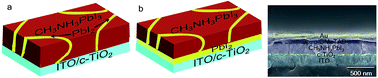
Currently, although many researchers have pointed out that a slight excess of PbI2 in the perovskite film is beneficial and the best performing devices have a few percent excess PbI2 in them, not everyone finds the excess PbI2 to be beneficial.17–19,23,24 That makes it an open question. For those who hold the positive view, excess PbI2 can passivate the TiO2/CH3NH3PbI3 interface to decrease carrier recombination,18–20 and passivate the grain boundary of the perovskite resulting in good termination with fewer intra-band gap states as possible recombination centers.21 Besides, they also propose that PbI2 may be not beneficial in itself, but rather be correlated with other secondary advantageous effects, such as increasing perovskite grains or improving crystallization.18,22 Oppositely, those who hold the negative view argue that if the remnant PbI2 layer is too thick, it can result in electronic insulation and blocking of the carrier extraction due to the unfavourable energy level alignment.23–25 Moreover, some reports state that it is relatively difficult to realize highly efficient planar PSCs via CSD compared to the same situation with mesoporous PSCs.23,24 This may be due to the fact that PbI2 layers from PbI2 DMF solution are often prone to form dense and highly crystalline films impeding the short diffusion of CH3NH3I into them and affecting the complete conversion of PbI2 to perovskite. Also the correlation between remnant PbI2 and device stability is uncertain. Motivated by the previous results, we here denote the situation of remnant PbI2 classified into two categories. The remnant PbI2, formed as a consequence of perovskite degradation or the incomplete conversion of the precursors where there is a slight excess of PbI2, is beneficial by playing a role in passivation (Fig. 1a).20,22 And the remnant PbI2 layer, formed as a unreacted precursor composition via CSD, will to a greater extent be found close to the back contact (Fig. 1b).17,25 Remarkably, when we here say the remnant PbI2 layer, we technically mean the situation illustrated in Fig. 1b, where the influence on the planar PSC performance is distinct from that in Fig. 1a.
In this article, all low temperature processed planar PSCs are fabricated containing ITO/compact TiO2 (c-TiO2)/CH3NH3PbI3/spiro-OMeTAD/Au (Fig. 1c). By controlling the length of the dipping time in the CSD method, the CH3NH3PbI3 films with various PbI2 stoichiometry are prepared. And it is further observed that the device performance based on those films originally increases and then decreases with prolonging the dipping time, which are in good consistency with the result reported in ref. 19. Meanwhile, the fact that the remnant PbI2 layer should be mainly responsible for the inferior CH3NH3PbI3 thermal stability is experimentally demonstrated. Hence, the confluence of those two findings unveils the undesirable role of the remnant PbI2 layer on planar PSCs. Furthermore, it is also indicated that CSD is not an effective method for the fabrication of planar PSCs. And a modified two-step deposition method in ambient atmosphere is proposed to fabricate PbI2-free planar PSCs possessing superior device performance.
:
1 volume ratio) via sonication for 15 min, and then sequentially rinsed with IPA solution for 15 min. Next, ITO glass substrates were treated in a UV-ozone clearer for 12 min to further remove attached residual organics on the surface. After that, a low temperature processed c-TiO2 electron transport layer was deposited on the ITO substrate by a previously reported anodic oxidation method.26 And the scanning electron microscopy (SEM) images of the formed dense c-TiO2 are shown in Fig. S1† showing good uniformity and crystallization, apart from full coverage. For comparison, the substrates based on mesoporous TiO2 (m-TiO2) were also prepared according to ref. 27. With regard to the fabrication of CH3NH3PbI3 films, we adopted CSD as a starting point, where the PbI2 DMF solution (40 wt%) was primarily spun on c-TiO2 and m-TiO2 substrates at 5000 rpm for 40 s in ambient air (about 20% humidity) respectively, followed by exposing the formed PbI2 film to an IPA solution of CH3NH3I (10 mg mL−1). To observe the effect of the remnant PbI2 layer on PSC performance, the length of the dipping time was controlled to vary the stoichiometry of the resultant films. In contrast, the modified two-step method was also proposed, in which PbI2 powder (around 50 mg) was deposited on a c-TiO2 substrate via thermal evaporation in a low vacuum (∼1 Pa) with 60 A evaporation current, and subsequently surplus CH3NH3I powder was evaporated on the formed PbI2 film as well to ensure full conversion from PbI2 to CH3NH3PbI3. The distance between the c-TiO2 substrate and evaporation source was kept at 15 cm. Then, the resultant CH3NH3PbI3 film was further assembled by the interaction and inter-diffusion between the solid-state PbI2 and CH3NH3I during the process of annealing at 100 °C. Finally, surplus CH3NH3I was removed by rinsing CH3NH3PbI3 with IPA solution. A spiro-OMeTAD solution was prepared by dissolving 80 mg spiro-OMeTAD in 1 mL chlorobenzene, to which 18 μL of lithium bis(trifluoromethanesulfonyl)imide (LiTFSI) solution (280 mg mL−1 acetonitrile) and 10 μL of 4-tert-butylpyridine (tBP) were added. The hole transport layer (HTL) was prepared by spin-coating spiro-OMeTAD solution at 3500 rpm for 40 s. Finally, a 150 nm thick gold counter electrode was deposited by thermal evaporation in a high vacuum (under 10−4 Pa) atmosphere and the dot area of the planar PSCs was 0.06 cm2. The whole fabrication temperature could be confined to 120 °C.
As further information to substantiate our hypothesis, X-ray diffraction (XRD) and UV-vis absorption spectra of CH3NH3PbI3 were also recorded. As shown in Fig. 3a, the spun PbI2 film on a planar substrate obviously presented intensity diffraction peaks near 12.6° indicating excellent crystallization. With delaying the length of the dipping time, the CH3NH3PbI3 (near 14°) diffraction peaks started to compete with those of PbI2. Notably, by comparing the XRD results, no systematic peak shifts were observed, which showed that the composition of the crystalline CH3NH3PbI3 is unaffected by the overall stoichiometry and perovskite phase, which was essentially the same in the different samples. On the other hand, UV-vis absorption was measured on the same subset of samples (Fig. 3b). Also the samples with 30 s and 15 min dipping time were incorporated into them as extreme situations. As shown in Fig. 3b, the absorption of the CH3NH3PbI3 films presented a large difference as a consequence of the variation of the PbI2 stoichiometry. This may be because the reduced remnant PbI2 firstly strengthened the ability of absorption but then vast pinholes in turn weakened it. Moreover, although all those samples showed typical CH3NH3PbI3 absorption characteristics, there existed sharp absorption losses at a wavelength around 500 nm. It is known that the band gap of PbI2 is around 2.3–2.5 eV, which corresponds to a threshold absorption wavelength around 496–539 nm.20,28 Therefore, major sunlight absorption is lost due to the influence of the remnant PbI2 layer. Furthermore, the pictures of the corresponding CH3NH3PbI3 films are also shown in Fig. 3c and are in good consistency with the findings concluded from Fig. 3a and b.
![]() | ||
| Fig. 3 (a) XRD pattern of CH3NH3PbI3 films by CSD with various dipping times; (b) the corresponding absorption spectrum; (c) the corresponding authentic CH3NH3PbI3 pictures. | ||
Furthermore, the planar PSCs were fabricated according to the structure provided in Fig. 1c via CSD. Fig. 4a showed the whole planar device performance and the corresponding parameters are summarized in Table 1. Also mesoporous PSCs were fabricated by CSD with a 5 min dipping time and the device performance was presented in Fig. S4† for comparison. It was observed that the planar devices exhibited an improved short circuit density (Jsc) with prolonging the length of the dipping time. However, when the dipping time reached as long as 15 min, the Jsc value reduced 16.20 mA cm−2. As an extreme situation, the device with a full PbI2 film replacing CH3NH3PbI3 was also probed (Fig. S5†). It exhibited obvious ohmic contact characteristics and possessed an enormous resistance, indicating that pure PbI2 has the potential to impede carrier extraction and transport. Correspondingly, the EQE response (Fig. 4b) presented nearly the same trend as that of the Jsc variation observed in Table 1. For the situation of mesoporous construction, it could exhibit a decent performance via CSD with just 5 min dipping time because of the prosperous conversion of PbI2 to CH3NH3PbI3 as well as a favourable morphology (Fig. S3 and S4†). In general, the dependence of Voc is closely connected with the rising concentration of the photo-generated carriers and the associated separation of the electron and hole quasi-Fermi levels. It is therefore justified that the favourable carrier collection should facilitate the achievement of a high Voc value. Surprisingly, although the planar device with a dipping time of 5 min had an inferior Jsc and Voc, it possessed a distinctly superior fill factor (FF).
![]() | (1) |
| Sample | Jsc (mA cm−2) | Voc (V) | FF (%) | PCE (%) |
|---|---|---|---|---|
| 30 s | 0.32 | 0.52 | 54.08 | 0.09 |
| 1 min | 9.06 | 0.61 | 32.38 | 1.79 |
| 3 min | 15.49 | 0.69 | 38.64 | 4.13 |
| 5 min | 16.76 | 0.80 | 60.71 | 8.14 |
| 7 min | 17.24 | 0.82 | 53.34 | 7.54 |
| 9 min | 17.91 | 0.84 | 47.39 | 7.13 |
| 15 min | 16.20 | 0.66 | 50.70 | 5.42 |
To better illustrate our conclusion, the energy band alignment was further shown in Fig. 5. Theoretically, the PSC energy band alignment should be considered as Fig. 5a,27 in which the photo-generated carriers could successfully be conveyed to the relevant electrode with a low potential barrier resistance facilitating the carrier collection. However, due to the presence of the remnant PbI2 layer, the energy band alignment became the situation shown in Fig. 5b. The remnant PbI2 layer would be considered as a tunnelling layer for its undesirable energy alignment, implying that the carriers were collected unless they went through the PbI2 layer by the tunnelling effect with a high potential barrier. And the tunnelling current could be ascribed as eqn (1), where Vb represents the tunnelling voltage, ϕ represents the average work function, A represents the constant usually set as 1, and d represents the tunnelling layer thickness. Therefore, when the remnant PbI2 layer was too thick, few carriers could be injected and collected. Meanwhile, steady-state photoluminescence (PL) and electrochemical impedance spectroscopy (EIS) were together displayed in Fig. S6 and S7† to confirm this description. In our case, the difference between all samples was only the variation of the dipping time resulting in different PbI2 stoichiometry of the resultant CH3NH3PbI3. With an approximately identical CH3NH3PbI3 thickness (determined by cross-section SEM shown in Fig. S8†), all the CH3NH3PbI3 films exhibited a significant PL peak around 780 nm, but the intensity was entirely different. The large difference in PL intensity should be mainly attributed to the number of photo-generated carriers resulting from the sunlight absorption difference. Additionally, owing to the influence of the remnant PbI2, it was observed that when contacted with c-TiO2, the PL quenching was also not as apparent as that we previously reported,26 which implied an inferior carrier collection efficiency. Furthermore, the EIS results also demonstrated that the remnant PbI2 layer seriously enhanced the carrier transport resistance by blocking carrier transport according to the feature at a low frequency response shown in the Nyquist plot.29,30
With respect to the difference between the planar and mesoporous PSCs fabricated by the CSD method, several reports have shown positive effects of remnant PbI2 in mesoporous PSCs.20,21 Having studied and compared our results to the related studies reported in the literature we discuss here the comprehensive roles of remnant PbI2 in PSCs to clarify this observation. Firstly, remnant PbI2 indeed can reduce carrier recombination in the perovskite layer as well as at the interface of TiO2/CH3NH3PbI3 to some extent due to its increased barrier, preventing electrons from combining with grain boundary defects and oxygen vacancy defects.17,20,21 Secondly, the remnant PbI2 also can block the electron extraction and transport from the perovskite into TiO2, especially when a thick and dense PbI2 layer at TiO2/CH3NH3PbI3 is not thin enough to allow quantum tunnelling. Thirdly, remnant PbI2 located in the perovskite grain boundary region alleviates the barrier of electron extraction from CH3NH3PbI3 to the HTL by upward energy band bending, where electrons can be repelled thereby facilitating the improvement of hole extraction.20 Moreover, PbI2 has the ability to increase the crystallization growth of the CH3NH3PbI3 film.22 Since it is a difficulty to control the amount and exact location of the remnant PbI2 by the CSD method, competition concerning the above-mentioned effects together exists in typical PSCs.
A superior device performance is strongly dependent on photo-generated carrier extraction and transport, which avoid accumulation and decrease the corresponding recombination rate. According to a previous report, it is found that carrier extraction mainly arises from the interface of TiO2/perovskite.31 For the case of mesoporous PSCs, it is better for carrier extraction owing to the increased TiO2/perovskite interface area. However, abundant defects are located in the perovskite grain boundary and more oxygen vacancy defects are exposed to the interface of TiO2/CH3NH3PbI3, greatly weakening the carrier extraction efficiency in turn by capturing electrons into defects.20,32 Therefore, a PbI2 passivation of these defects, which reduces the density of defects as much as possible, can be a very important key technique. Also because there is a high chance that remnant PbI2 does not make a continuous layer on the mesoporous TiO2 scaffold, a sufficient TiO2/CH3NH3PbI3 interface area for carrier extraction and transport still exists despite slight excess remnant PbI2 decreasing the interface area. Moreover, remnant PbI2 passivation of defects may make up those losses. On the other hand, for planar PSCs, since the interface area is too little in comparison to the mesoporous structure, it is reasonable that there is not enough area for carrier extraction and transport if PbI2 is there. As our results shows, the remnant PbI2 is likely to be present at the interface of TiO2/CH3NH3PbI3 by means of a thick and dense layer structure in planar PSCs fabricated by CSD. In this case, it may completely prevent carrier extraction from perovskite to TiO2 surpassing its other positive effects.
Besides, a high efficiency has been obtained in PSCs with a slight excess of PbI2, formed as the incomplete conversion of the precursors where a slight excess of PbI2 is intentionally used.22 This is because the remnant PbI2 used in the precursor solution itself usually results in a uniform distribution in the bulk of CH3NH3PbI3 grain boundaries, preferably not at the TiO2/CH3NH3PbI3 interface. Consequently, it can not only passivate defects, but possesses enough TiO2/CH3NH3PbI3 interface area to ensure carrier extraction and transport in this situation.
Moreover, the influence of the remnant PbI2 layer on the thermal stability of the perovskite films was also observed. And thermogravimetric analysis (TGA) was conducted to characterize the thermal property of the CH3NH3PbI3 film on a silicon substrate. Fig. 6a demonstrated that the weight loss was mainly concentrated at 200–300 °C and 400–500 °C. According to the previously reported results, the weight loss for the absorption peak (AP) at 200–300 °C was the result of CH3NH3I loss decomposed from CH3NH3PbI3.33 With regard to the weight loss at 400–500 °C, it should be as a consequence of the PbI2 melting which was beyond the scope of our discussion. As shown in Fig. 6b, the CH3NH3PbI3 film possessing various stoichiometries via CSD had a detectable difference in the derivative weight value. And the greater the PbI2 stoichiometry in the perovskite is, the higher the derivative weight value is, suggesting that the remnant PbI2 layer indeed should be responsible for accelerating the degradation rate of the CH3NH3PbI3 film. Besides, the colour of the formed CH3NH3PbI3 film changed from dark black to dark yellow at 100 °C annealing in just 120 min (Fig. 6c), consistent with the observed results.
According to some reported works, a porous PbI2 film can more effectively promote the conversion of PbI2 to CH3NH3PbI3, consequently facilitating the formation of PbI2-free perovskite films.34,35 Thus, a modified two-step method was proposed to fabricate planar PSCs, in which PbI2 and CH3NH3I were successively deposited by thermal evaporation in an approaching ambient atmosphere. Different from the situation of the PbI2 film by spinning PbI2 DMF solution, a porous snowflake shape PbI2 film was obtained (Fig. 7a and b), which increased the contact area between PbI2 and CH3NH3I thereby reducing their diffusion length to form CH3NH3PbI3. Moreover, the resultant CH3NH3PbI3 film not only exhibited full coverage, but the grain size was also improved to about 1 μm (Fig. 7c and d). It was therefore justified that the modified two-step method was more suitable for the fabrication of planar PSCs to address the dilemma situation faced by CSD.
Therefore, the planar devices were prepared with an identical structure except for the fabrication method of CH3NH3PbI3 and the corresponding results are shown in Fig. 8a. Obviously, with the backward and forward direction scanning, the J–V curves are closely coincident, indicating a relatively credible efficiency and little hysteresis. Meanwhile, compared to the samples made via CSD, all the device parameters were enhanced and the whole EQE response was superior in the whole wavelength range, agreeing with the improvement of EIS measurement (Fig. S9†). As a result, the planar PSCs exhibited a Voc value of 1.01 V, Jsc of 19.19 mA cm−2, FF of 65.7%, and PCE value of 12.74%. On the other hand, as shown in Fig. 8b, two preferential and high-purity XRD diffraction peaks near 14.17° and 28.51° were detected, as evidence of the CH3NH3PbI3 phases of (110) and (220), indicating an enhanced crystallization structure facilitating carrier transport without the remnant PbI2 layer. Moreover, compared to CH3NH3PbI3 via CSD, the CH3NH3PbI3 films via the modified two-step method could suffer from long-term thermal annealing even for as long as 2 days at 100 °C in air atmosphere. And the device performance corresponding to thermal annealing reaching 2 days is also shown in Fig. S10,† implying that the efficiency value could still reach 34% of its initial PCE value. The degraded efficiency might arise from the influence of LiTFSI and tBP on the CH3NH3PbI3 film. Anyway, the enhanced thermal stability due to complete conversion of PbI2 to CH3NH3PbI3 was observed.
Footnote |
| † Electronic supplementary information (ESI) available: The SEM images of low temperature processed compact TiO2 film. The cross-section SEM images of CH3NH3PbI3 films on c-TiO2 via CSD with various dipping times. The cross-section SEM image of CH3NH3PbI3 film on m-TiO2 via CSD. The J–V and EIS performance of mesoporous PSCs via CSD. The steady-state photoluminescence (PL) measurement. The electrochemical impedance spectroscopy (EIS) measurement. The diagram of planar PSCs replacing CH3NH3PbI3 with PbI2 and corresponding J–V curve. See DOI: 10.1039/c6ra19265c |
| This journal is © The Royal Society of Chemistry 2016 |