Evolution in surface coverage of CH3NH3PbI3−XClX via heat assisted solvent vapour treatment and their effects on photovoltaic performance of devices

Dhirendra K. Chaudharya, Pramendra Kumarb and Lokendra Kumar*a
aDepartment of Physics, University of Allahabad, Allahabad-211 002, U. P., India. E-mail: lokendrakr@allduniv.ac.in; lkumarau@gmail.com
bDepartment of Applied Chemistry, IET, M. J. P. Rohilkhand University, Bareilly-243 006, U. P., India

Received 23rd July 2016 , Accepted 26th September 2016

First published on 29th September 2016


Abstract

We demonstrate a facile and well controlled heat assisted solvent vapour treatment (HASVT) method for the growth of compact perovskite layers with good surface coverage areas in ambient atmosphere. The structural and optical properties of the as deposited and solvent vapour treated films have been investigated using SEM, XRD, UV-Vis and PL spectroscopy. Furthermore, photovoltaic devices in layered configuration (FTO/TiO2/CH3NH3PbI3−XClX/P3HT/Ag) are fabricated using as deposited and solvent vapour treated CH3NH3PbI3−XClX films. The photoactive perovskite films were treated with chlorobenzene solvent vapour using the HASVT method. The comparative photovoltaic performance of devices fabricated using as deposited and solvent vapour treated CH3NH3PbI3−XClX films was assessed. The maximum power conversion efficiency in the case of vapour treatment was estimated to be ∼8.05% as compared to the devices fabricated using as deposited films (∼5.51%). Our systematic investigations reveal that the enhancement in power conversion efficiency is due to modification in the structural and surface morphology of CH3NH3PbI3−XClX films.

Introduction

Methyl ammonium lead halide perovskite materials have stimulated a resurgence of interest in excellent light to power conversion efficiency and cost effective photovoltaic (PV) devices.1,2 These perovskite photoactive materials exhibit many interesting optoelectronic properties like ambipolar charge transport, long electron–hole diffusion length and high absorption coefficients with tunable optical band gap.3–6 These interesting properties may lead to a potential high efficiency solar cell device. In the past five years organometal halide perovskite based photovoltaic technology has grown very fast and formamidinium lead iodide (FAPbI3) based solar cells demonstrate 20% efficiency which is comparable to the commercially available silicon based solar cells.7

The power conversion efficiency of the perovskite solar cells is highly dependent on quality of films such as, surface coverage, grain size distribution, nature of crystallinity and surface morphology.8–10 The control over the surface morphology is one of the major challenges in order to realize solution processed efficient perovskite solar cells.11 A large volume of research has been carried out for achieving high quality perovskite films using different methods, for example– mixed solvent for preparation of perovskite precursor,12–14 solute composition,15 using different humidity for processing,16 thermal deposition of perovskite layers,1 optimization of annealing temperature and time,17,18 method of annealing,19 perovskite film processing steps,20 solvent treatment of perovskite layer21 etc. Among them the modification in perovskite film via solvent treatment is a convenient, facile and practicable route to get control over solution processed perovskite layer. Recently, in case of DMSO solvent treatment of perovskite films, Jiang Liu et al. demonstrated high efficiency solar cells via engineering the crystallite size using solvent annealing method and achieved ∼13% power conversion efficiency.22 Xingtian Yin et al. demonstrated the solution induced morphology changes in perovskite films and recorded ∼13.1% efficiency in devices with inverted architectures.23 Qi Chen et al. developed Vapor-Assisted Solution Process (VASP) method for the growth of compact perovskite layer. This process lead modification in surface morphology as well as the device performances.24 In same order Jiarong Lian et al. also observed the improvement in the surface morphology via organic solvent vapor treatment using DMSO and DCB as treating solvent.8 Although, these treatment methods provides better film quality of photoactive layer but shown a lack of control over solvent treatment.

Recently, we have developed an indigenous setup of heat assisted solvent vapour treatment (HASVT) for controlled solvent treatment of small molecule organic semiconducting material.25 It is important to note that the adopted technique was successful in achieving controlled solvent vapour treatment that modify the ZnPc film surface roughness at nanoscale also.

Here, we demonstrate a new technique of heat assisted solvent vapour treatment (HASVT) for the manipulation of surface coverage and morphology of CH3NH3PbI3−XClX layer and get improvement in photovoltaic performance. Using this technique the improvement in the surface coverage (84.30 from 98.96%) in relative humid environment with humidity 45 (±2)% was observed. Not only the surface modification, the larger grain boundaries (2–3 μm) and large crystallite size with preferential c-axis growth in perovskite films has been achieved after solvent vapour treatment.

Furthermore, perovskite solar cells was fabricated in conventional device architecture (FTO/TiO2/CH3NH3PbI3−XClX/P3HT/Ag) using P3HT as hole transport layer. A significant improvement (31.51%) in the power conversion efficiency (η%) was achieved in the devices after solvent vapour treatment of CH3NH3PbI3−XClX layer as compared to as grown films. After solvent vapour treatment of CH3NH3PbI3−XClX films the η ∼ 8.05% with short circuit current density (JSC) 21.37 mA cm−2, open circuit voltage (VOC) 0.8 V and fill factor 0.47 was obtained. This enhancement in device performance can be attributed to the improvement in the surface coverage, and crystalline nature of the perovskite layer after solvent vapour treatment.

Experimental details

Synthesis of CH3NH3I

Methyl ammonium iodide was synthesised by reacting 24 ml of methylamine (33 wt% in absolute ethanol) with 10 ml of hydroiodic acid (57 wt% in water) in 250 ml round bottom flask at 0 °C for 2 h under continuous stirring. The achieved solution was put in a rotary evaporator where the solvent was evaporated at 50 °C and yellowish white powder of MAI (CH3NH3I) was obtained which was re-dissolved in 80 ml of absolute ethanol and re-precipitated by addition into 300 ml of diethyl ether. The precipitate was filtered out and the above step was repeated again for further purification. Finally a white powder of MAI was achieved which was dried in vacuum oven overnight at 70 °C.

TiO2 precursor solution preparation

TiO2 precursor solution was prepared by following steps: firstly 370 μL titanium isopropoxide was drop wise added into 2.53 ml ethanol under constant stirring, keeping this solution on stirring, an another solution containing 350 μL diluted HCl (3[thin space (1/6-em)]:[thin space (1/6-em)]1) in 2.53 ml ethanol was prepared separately. This acidic solution of ethanol was mixed drop wise under constant stirring in ethanol containing titanium isopropoxide. The resulting solution was stirred for 30 min to yield a homogenous, clear and transparent precursor solution.

Perovskite precursor preparation

Non-stoichiometric precursor solution of CH3NH3PbI3−XClX was obtained by dissolving 3[thin space (1/6-em)]:[thin space (1/6-em)]1 molar ratio of methyl ammonium iodide (MAI) to lead chloride (PbCl2) in anhydrous N,N-dimethylformamide (DMF). The concentration of PbCl2 and MAI was kept constant at 0.8 M and 2.4 M, respectively. The homogeneous precursor solution was obtained by steering precursor solution overnight at 60 °C in relative humidity 45 (±2)%.

Preparation of solar cells

FTO coated glass substrates of sheet resistivity 7–10 Ω sq−1 (Sigma Aldrich) were patterned by wet etching method using HCl and Zn metal powder. Then substrates were cleaned subsequently with deionized water, acetone and isopropanol for 10 min using ultrasonic cleaner and dried in vacuum oven at 100 °C for 15 min. Thereafter TiO2 precursor solution was spin-coated onto pre-cleaned FTO coated glass substrates at 2000 rpm for 30 s, the coated substrates were first dried at 100 °C and then sintered at 450 °C for 40 min to get TiO2 compact layer.

Perovskite precursor solution was spin coated onto compact TiO2 films at 5000 rpm for 20 s. After spin coating of the perovskite layer the films were subjected to heat assisted solvent vapour treatment (HASVT). Here, the chlorobenzene organic solvent was used for the treatment of perovskite films. For solvent vapour treatment the perovskite precursor coated film was exposed to the chlorobenzene solvent vapour for 60 s (optimized time) by keeping the distance constant between substrate and vapour shower 10 cm and simultaneously heating the block at 80 °C. After solvent vapour treatment the perovskite film annealed for 50 min at 80 °C using hot plate in relative humidity 45 (±2)% to get CH3NH3PbI3−XClX film. Then poly(3-hexylthiophene-2,5-diyl) P3HT hole transport layer was deposited onto CH3NH3PbI3−XClX layer by spin coating of solution containing 16 mg ml−1 P3HT in chlorobenzene at 2000 rpm for 60 s. Then the substrates were annealed at 100 °C for 5 min in vacuum oven for removal of residual solvents. Finally, 100 nm silver top electrodes was thermally deposited using cross mask at deposition rate of 0.3–0.5 Å s−1 and base pressure 1 × 10⁻⁶ torr. The thickness of the deposited silver films was measured in situ using quartz crystal thickness monitor. The active area of device prepared under cross masks was estimated to be 0.04 cm2.

Material characterization

Surface morphology of the perovskite films were investigated using Zeiss field emission scanning electron microscope (FE-SEM). Crystalline property of the perovskite films were recorded at room temperature using Proto A-XRD diffractometer using CuKα (λ = 1.54 Å) radiation. Electronic absorption (EA) spectra of the films were obtained using Unicam 5625 UV-Vis spectrometer. Photoluminescence (PL) spectra were recorded for various samples in steady-state using Horiba Fluorolog with a 450 W xenon lamp excitation source. All spectra were corrected for instrumental response using a calibration lamp of known emissivity.

Photovoltaic characterization

Current density–voltage (JV) measurements were performed under simulated AM 1.5 sunlight, using photo emission technology, USA (PET-SS50AAA-EM), a class AAA solar simulator calibrated for 100 mW cm−2 light intensity (in constant intensity mode) using National Renewable Energy Laboratory (NREL) calibrated silicon reference cell. The external quantum efficiency (EQE) of the solar cells were recorded using calibrated AM 1.5G solar photon flux in the spectral range of 300 nm to 800 nm and JV characteristics were recorded with a Keithley 2400 sourcemeter with the scanning rate of 0.285 V s−1. We observed an anomalous hysteresis effect in the devices by changing the sweep direction from −1 to +1.

Results and discussion

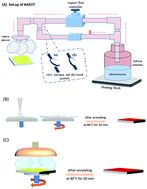
Fig. 1(A) shows the schematic diagram of heat assisted solvent vapour treatment (HASVT) setup. The setup consist of heating block, solvent container, vapour flow controller and vapour shower (porosity 0.5 mm) with pipe line of 2.4 cm inner diameter.
image file: c6ra18729c-f1.tif
Fig. 1 Schematic diagram of (A) heat assisted solvent vapour treatment (HASVT) set up (B) as deposited perovskite (C) solvent vapour treatment.

The chemical processing of as deposited and solvent vapour treated perovskite films are shown schematically in Fig. 1(B) and (C), respectively.

Fig. 2(A) shows the SEM micrograph of as deposited perovskite films, which shows the random distribution of perovskite grains size with some ribbon/rod like structures with large voids. The surface morphology of the as deposited perovskite films are in good agreement with report of Qing Zhou et al.17 It clears from the SEM micrograph that the surface coverage of perovskite layer consists of large number of voids with different shape and size over the entire surface. The broad distribution of the perovskite grains can be clearly seen [see inset Fig. 2(A)] in the as deposited films. Fig. 2(B) shows the surface morphology of perovskite films grown using chlorobenzene solvent vapour using HASVT method. Clearly, the vapour treatment affects the surface morphology of the film. A drastic change in the surface morphology is observed and a very dense perovskite layer with grain size of 2–3 micrometres can be seen in the samples with vapour treatment [see inset Fig. 2(B)]. Bairu Li et al. suggests that the CB vapour help DMF evaporation and accelerate the crystallization26 and also the process of acceleration via spin coating of anti-solvent is proved for one step processing of perovskite films.27,28 So, in case of samples with vapour treatment, the observed modification in morphology could be due to acceleration in recrystallization process of perovskite films.


image file: c6ra18729c-f2.tif
Fig. 2 SEM micrograph of the perovskite layers (A) as deposited (B) solvent vapour treated.

The surface coverage of perovskite layer has been estimated via ImageJ program using threshold function29 at different location and magnification of the SEM images. The estimated value of surface coverage for as deposited and solvent vapour treated CH3NH3PbI3−XClX films are 84.30% and 98.98%, respectively. These results provide strong evidence that the good quality of CH3NH3PbI3−XClX films could be achieved through chlorobenzene solvent vapour treatment using HASVT method.

Fig. 3(A) shows the XRD pattern of as deposited and solvent vapour treated CH3NH3PbI3−XClX films. The diffractions peaks at position 14.1, 28.4, 31.83, 43.2 and 58.9 2θ degree positions are assigned to the planes of (110), (220), (310), (330) and (440) tetragonal crystal structure of CH3NH3PbI3. It is interesting to note that no additional peak of PbI2 or CH3NH3I has been observed which suggests that the entire surface covered with crystalline CH3NH3PbI3−XClX only. The intensity of the characteristic peak for solvent treated CH3NH3PbI3−XClX film are found to be significantly enhanced in comparison to the as grown samples. A small variation in the FWHM of the prominent peaks corresponding to plane (110) and (220) is observed, which varied from 0.062 to 0.053 and 0.0680 to 0.0602, respectively. The mean coherent scattering domain size of crystallites were calculated using Debye–Scherrer formula and found to be 130 nm and 150 nm for as deposited and solvent vapour treated CH3NH3PbI3−XClX films respectively. The change in FWHM and enhancement in the intensity of the peak profile may be due to larger crystallite size and dense perovskite layer after solvent treatment [see Fig. 2(B)]. To take insight look of XRD data, the normalized XRD data plots corresponding to peak at position 14.2° 2θ value has been shown in Fig. 2(B). The enlarge plot shows some other peaks of very small intensity in as deposited films and chlorobenzene solution treated films. Interestingly, the relative intensity of peak at position 20.04, 24.64, 31.95, 35.09, 40.69 and 60.84 have diminished in solvent vapour treated CH3NH3PbI3−XClX films which suggest that highly oriented crystal domains formation of CH3NH3PbI3−XClX form solvent vapour treatment.


image file: c6ra18729c-f3.tif
Fig. 3 (A) The absolute and (B) normalized XRD pattern of as deposited, solvent treated and solvent vapour treated CH3NH3PbI3−XClX films.

Note that the surface modification using other techniques like thermal solvent annealing, and solvent treatment method changes the surface morphology of the films but these techniques are not able to change the crystallite size. The modification in crystallite size after chlorobenzene treatment has been discussed by Jiarong Lian et al.8

Fig. 4 shows the UV-Vis absorption spectra of the CH3NH3PbI3−XClX films under different processing conditions. The absorption spectra of CH3NH3PbI3−XClX films show the good coverage of solar spectrum from band gap ∼1.57 eV [calculated from Tauc plot] with considerably sharp absorption edge. Also, the absorption profile that the solvent vapour treated CH3NH3PbI3−XClX samples shows more absorbance in comparison to as grown samples. The sharper absorption edge and enhanced absorbance could be the due to combined effect of well-defined crystal morphology, high degree of crystallinity and good surface coverage of the CH3NH3PbI3−XClX films.


image file: c6ra18729c-f4.tif
Fig. 4 UV-Vis absorption spectra of as deposited and solvent vapour treated CH3NH3PbI3−XClX films.

It is possible that the larger grain size may leads enhancement in the absorbance of vapour treated films. The large grain size increases the distance of light propagation due to back scattering of incident light from the comparatively rough surface.30–32

Fig. 5 shows the normalized steady state photoluminescence (PL) emission spectra of CH3NH3PbI3−XClX films on glass substrate under different processing conditions. PL of the films was recorded by using the excitation wavelength near the absorption band edge. The CH3NH3PbI3−XClX sample without any treatment shows the PL emission peak at 787 nm, which shows good agreement with previous reported data.33 After HASVT treatment of the film the PL peak blue shifted as compared to the as deposited film and appeared at 783 nm. A negligibly small change in the FWHM of the PL peak has been observed before and after the treatment. In general the PL emission is related to the recombination channels concerning the band gap and trap state.22 The observed blue shift with reduced FWHM of PL emission of perovskite films could be due to reduction of trap density near the band edge. The reduction in trap density could be due to larger grain size.


image file: c6ra18729c-f5.tif
Fig. 5 Photoluminescence spectra of perovskite films processed under different conditions.

Fig. 6(A) and (B) shows the JV characteristics in forward and backward scan direction of our best performing devices, fabricated using as deposited and HASVT films, respectively. The photovoltaic performances of the devices are shown in Table 1. The devices fabricated using CH3NH3PbI3−XClX film without any treatment shows η ∼ 3.26% and ∼5.51% in forward and backward scan respectively, which is in good agreement with others reports of devices fabricated in ambient atmosphere. Interestingly, the enhancement in the power conversion efficiency up to η ∼ 7.38% (in forward scan) and ∼8.1% (in backward scan) is reached in the devices when we use vapour treatment to the perovskite films. The scan direction dependent behaviour in the device is due to existence of anomalous hysteresis.34,35 Sufficiently high hysteresis has been observed in JV curve of devices fabricated with as deposited perovskite layer. Whereas, significant passivation in anomalous hysteresis of JV characteristics is observe in solvent vapour treated devices.


image file: c6ra18729c-f6.tif
Fig. 6 JV characteristics of device fabricated with (A) as deposited (B) solvent vapour treated CH3NH3PbI3−XClX films and (C) external quantum efficiency spectra (D) JSC and η with different scan delay.
Table 1 Photovoltaic performance of the devices fabricated with as deposited and solvent vapour treated CH3NH3PbI3−XClX films
Device JSC (mA cm−2) VOC (V) FF η%
As deposited Forward scan 14.63 0.62 0.36 3.26
Backward scan 16.70 0.74 0.44 5.51
Solvent vapour treated Forward scan 20.03 0.79 0.46 7.38
Backward scan 21.37 0.80 0.47 8.05


To compare the hysteresis in both devices the hysteresis index (HI) has been estimated using hysteresis index formula reported by R. S. Sanchez et al.36 and shown in eqn (1).

 
image file: c6ra18729c-t1.tif(1)
where JFS(0.5VOC) and JBS(0.5VOC) stands for value of photocurrent density at 50% of VOC for forward and backward scan respectively. The value of HI = 0 corresponds to a device without observable hysteresis, while HI = 1 corresponds to such type of devices which possess hysteresis as high as the photocurrent.36 Using eqn (1) we estimated the value of HI in both devices and found to be ∼0.440 and ∼0.036 for devices fabricated with as deposited and solvent vapour treated perovskite films respectively. Here, we observed a twelve fold reduce in HI[thin space (1/6-em)] after solvent vapour treatment. This reduced anomalous hysteresis attributes could be due to the reduction in trap states which causes due to formation of compact perovskite films with larger grain size. Whereas the residual hysteresis in JV characteristics of solvent treated devices may be due to ferroelectric properties,35 electro migration of ions or some other factors. Fig. 6(C) shows the external quantum efficiency (EQE) spectrum of the both devices. The EQE curve starts increasing near 800 nm in both spectra which is in good agreement with electronic absorption of CH3NH3PbI3−XClX. A broad plateau of ∼78% (±2%) in entire visible region is observed in the EQE curve of device fabricated with solvent vapour treated perovskite films. To check the reproducibility of the data, we recorded EQE of the four devices and observed almost same profile of EQE spectrum with small variation. The integrated JSC value was estimated theoretically and found to be ∼19.21 mA cm−2. Estimated value of JSC is very close to experimentally observed value of JSC. The observed slightly lower value of current density from EQE may be due the surface trap of the TiO2 electron transporting layer.24 Whereas the estimated value of current density is found to be ∼12.59 mA cm−2 of device fabricated using perovskite films without treatment. A large difference in calculated and experimentally observed value of EQE is observed in the devices fabricated without treatment. This difference may be due to the capacitance of the devices.37,38 The plot of power conversion efficiency and JSC of the devices fabricated with solvent vapour treated perovskite films with different delay time are shown in Fig. 6(D). Almost delay independent behaviour in device performance is observed. Whereas JV characteristics of the devices fabricated using without treated perovskite films are highly dependent on scan delay time (data not shown).

Fig. 7 shows the efficiency histogram plot of 20 devices fabricated using as deposited and solvent vapour treated perovskite films respectively, keeping same processing parameters conditions at same lab conditions. A wide range distribution in efficiency of the devices fabricated using as deposited perovskite films is observed. This wide range distribution in efficiency could be due to unequal distribution of perovskite layer. Whereas 95% of devices shows efficiency very close to best performing device after HASVT of perovskite films. These results show that the device performance quit consistent and reproducible after solvent vapour treatment. This consistency and reproducibility in devices are result of compact perovskite films.


image file: c6ra18729c-f7.tif
Fig. 7 Histogram of power conversion efficiency of devices fabricated as deposited and solvent vapour treated CH3NH3PbI3−XClX films.

The devices fabricated using HASVT treated CH3NH3PbI3−XClX films shows power conversion efficiency up to η ∼ 8.05% with reduced anomalous hysteresis. The performances of devices are reproducible and consistent. Note that, these films are fabricated in the ambient atmosphere without any lithographic and glove box fabrication processes. The better photovoltaic performance in vapour treatment of the CH3NH3PbI3−XClX layer is attributed to the larger grain size and surface coverage. It could be possible that the larger grain sizes reduce the recombination centres (trap level) and grain boundaries which reduce possibility of electron and hole recombination processes as a result of photon excitation. So the larger grain size, compact perovskite layer and enhanced absorbance of the CH3NH3PbI3−XClX all these collectively contributed to enhance power conversion efficiency by the devices fabricated with solvent vapour treated CH3NH3PbI3−XClX films.

Conclusions

The heat assisted solvent vapour treatment (HASVT) method has been demonstrated for uniform growth of perovskite layers. A systematic investigation on the structural and optical properties of perovskite layers has been carried out. Our results suggest that the larger surface coverage and grain size can be obtained in CH3NH3PbI3−XClX layer by the HASVT method. These parameters result in the blue shift in the PL spectra of the solvent vapour treated CH3NH3PbI3−XClX films. Photovoltaic performances of devices fabricated with as deposited and films grown with HASVT methods were compared. An enhancement of 33.51% has been achieved in the devices fabricated using films grown with the HASVT method. Our results provide strong evidence that the HASVT method could be a potential technique for the growth of high quality active layers for PV devices.

Acknowledgements

The financial support to this work was provided by the Department of Science & Technology under FTP grant number SERB/F/5521 and DST-FIST grants. We thank P. Kumar, CSIR-NPL, New Delhi for perovskite materials and other supports during this work. Author(s) acknowledge Rahul and R. K. Gupta, Chemical Engineering Department, IIT, Kanpur, India, for their kind help in EQE measurements.

References

  1. M. Liu, M. B. Johnston and H. J. Snaith, Nature, 2013, 501, 395–398 CrossRef CAS PubMed.
  2. M. M. Lee, J. Teuscher, T. Miyasaka, T. N. Murakami and H. J. Snaith, Science, 2012, 338, 643–647 CrossRef CAS PubMed.
  3. M. A. Green, A. Ho-Baillie and H. J. Snaith, Nat. Photonics, 2014, 8, 506–514 CrossRef CAS.
  4. G. E. Eperon, S. D. Stranks, C. Menelaou, M. B. Johnston, L. M. Herz and H. J. Snaith, Energy Environ. Sci., 2014, 7, 982–988 CAS.
  5. N. J. Jeon, J. H. Noh, Y. C. Kim, W. S. Yang, S. Ryu and S. I. Seok, Nat. Mater., 2014, 13, 897–903 CrossRef CAS PubMed.
  6. H. J. Snaith, J. Phys. Chem. Lett., 2013, 4, 3623–3630 CrossRef CAS.
  7. W. S. Yang, J. H. Noh, N. J. Jeon, Y. C. Kim, S. Ryu, J. Seo and S. I. Seok, Science, 2015, 348, 1234–1237 CrossRef CAS PubMed.
  8. J. Lian, Q. Wang, Y. Yuan, Y. Shao and J. Huang, J. Mater. Chem. A, 2015, 3, 9146–9151 CAS.
  9. J. Xing, X. F. Liu, Q. Zhang, S. T. Ha, Y. W. Yuan, C. Shen, T. C. Sum and Q. Xiong, Nano Lett., 2015, 15, 4571–4577 CrossRef CAS PubMed.
  10. J. Chen, T. Shi, X. Li, B. Zhou, H. Cao and Y. Wang, Appl. Phys. Lett., 2016, 108, 053302 CrossRef.
  11. Q. Chen, H. Zhou, Z. Hong, S. Luo, H.-S. Duan, H.-H. Wang, Y. Liu, G. Li and Y. Yang, J. Am. Chem. Soc., 2014, 136, 622–625 CrossRef CAS PubMed.
  12. H.-B. Kim, H. Choi, J. Jeong, S. Kim, B. Walker, S. Song and J. Y. Kim, Nanoscale, 2014, 6, 6679–6683 RSC.
  13. C. D. Chandler, C. Roger and M. J. Hampden-Smith, Chem. Rev., 1993, 93, 1205–1241 CrossRef CAS.
  14. P. W. Liang, C. Y. Liao, C. C. Chueh, F. Zuo, S. T. Williams, X. K. Xin, J. Lin and A. K. Y. Jen, Adv. Mater., 2014, 26, 3748–3754 CrossRef CAS PubMed.
  15. J. Qing, H.-T. Chandran, Y.-H. Cheng, X.-K. Liu, H.-W. Li, S.-W. Tsang, M.-F. Lo and C.-S. Lee, ACS Appl. Mater. Interfaces, 2015, 7, 23110–23116 CAS.
  16. J. Yang, B. D. Siempelkamp, D. Liu and T. L. Kelly, ACS Nano, 2015, 9, 1955–1963 CrossRef CAS PubMed.
  17. Q. Zhou, Z. Jin, H. Li and J. Wang, Sci. Rep., 2016, 6, 21257 CrossRef CAS PubMed.
  18. A. Dualeh, N. Tétreault, T. Moehl, P. Gao, M. K. Nazeeruddin and M. Grätzel, Adv. Funct. Mater., 2014, 24, 3250–3258 CrossRef CAS.
  19. F. X. Xie, D. Zhang, H. Su, X. Ren, K. S. Wong, M. Grätzel and W. C. Choy, ACS Nano, 2015, 9, 639–646 CrossRef CAS PubMed.
  20. H.-L. Hsu, C.-P. Chen, J.-Y. Chang, Y.-Y. Yu and Y.-K. Shen, Nanoscale, 2014, 6, 10281–10288 RSC.
  21. N. J. Jeon, J. H. Noh, Y. C. Kim, W. S. Yang, S. Ryu and S. I. Seok, Nat. Mater., 2014, 13, 897–903 CrossRef CAS PubMed.
  22. J. Liu, C. Gao, X. He, Q. Ye, L. Ouyang, D. Zhuang, C. Liao, J. Mei and W. Lau, ACS Appl. Mater. Interfaces, 2015, 7, 24008–24015 CAS.
  23. X. Yin, M. Que, Y. Xing, X. Liu, W. Que and C. Niu, Electrochim. Acta, 2016, 191, 750–757 CrossRef CAS.
  24. Q. Chen, H. Zhou, Z. Hong, S. Luo, H.-S. Duan, H.-H. Wang, Y. Liu, G. Li and Y. Yang, J. Am. Chem. Soc., 2013, 136, 622–625 CrossRef PubMed.
  25. D. K. Chaudhary and L. Kumar, J. Mater. Sci.: Mater. Electron., 2016, 1–6,  DOI:10.1007/s10854-016-5170-5.
  26. B. Li, T. Jiu, C. Kuang, S. Ma, Q. Chen, X. Li and J. Fang, Org. Electron., 2016, 34, 97–103 CrossRef CAS.
  27. M. Xiao, F. Huang, W. Huang, Y. Dkhissi, Y. Zhu, J. Etheridge, A. Gray-Weale, U. Bach, Y.-B. Cheng and L. Spiccia, Angew. Chem., 2014, 126, 10056–10061 CrossRef.
  28. N. Ahn, D.-Y. Son, I.-H. Jang, S. M. Kang, M. Choi and N.-G. Park, J. Am. Chem. Soc., 2015, 137, 8696–8699 CrossRef CAS PubMed.
  29. W. Rasband, Image J, US National Institutes of Health, 2005 Search PubMed.
  30. N. Cheng, P. Liu, S. Bai, Z. Yu, W. Liu, S.-S. Guo and X.-Z. Zhao, J. Power Sources, 2016, 319, 111–115 CrossRef CAS.
  31. Y. Xie, F. Shao, Y. Wang, T. Xu, D. Wang and F. Huang, ACS Appl. Mater. Interfaces, 2015, 7, 12937–12942 CAS.
  32. T. Zhang, M. Yang, Y. Zhao and K. Zhu, Nano Lett., 2015, 15, 3959–3963 CrossRef CAS PubMed.
  33. C. Wehrenfennig, M. Liu, H. J. Snaith, M. B. Johnston and L. M. Herz, J. Phys. Chem. Lett., 2014, 5, 1300–1306 CrossRef CAS PubMed.
  34. E. L. Unger, E. T. Hoke, C. D. Bailie, W. H. Nguyen, A. R. Bowring, T. Heumuller, M. G. Christoforo and M. D. McGehee, Energy Environ. Sci., 2014, 7, 3690–3698 CAS.
  35. H. J. Snaith, A. Abate, J. M. Ball, G. E. Eperon, T. Leijtens, N. K. Noel, S. D. Stranks, J. T.-W. Wang, K. Wojciechowski and W. Zhang, J. Phys. Chem. Lett., 2014, 5, 1511–1515 CrossRef CAS PubMed.
  36. R. S. Sanchez, V. Gonzalez-Pedro, J.-W. Lee, N.-G. Park, Y. S. Kang, I. Mora-Sero and J. Bisquert, J. Phys. Chem. Lett., 2014, 5, 2357–2363 CrossRef CAS PubMed.
  37. Y. Shao, Z. Xiao, C. Bi, Y. Yuan and J. Huang, Nat. Commun., 2014, 5, 5784 CrossRef CAS PubMed.
  38. B. Chen, M. Yang, X. Zheng, C. Wu, W. Li, Y. Yan, J. Bisquert, G. Garcia-Belmonte, K. Zhu and S. Priya, J. Phys. Chem. Lett., 2015, 6, 4693–4700 CrossRef CAS PubMed.

This journal is © The Royal Society of Chemistry 2016
Click here to see how this site uses Cookies. View our privacy policy here.