
Green, simple and large scale synthesis of N-doped graphene quantum dots with uniform edge groups by electrochemical bottom-up synthesis

Linfan Tian abd, Siwei Yangcde, Yucheng Yangb, Jipeng Lif, Yuan Dengf, Suyun Tianbc, Peng Hece, Guqiao Ding*ce, Xiaoming Xiebc and Zhongyang Wang*ab
aShanghai Advanced Research Institute, Chinese Academy of Science, Shanghai, 20050, China. E-mail: wangzy@sari.ac.cn
bSchool of Physical Science and Technology, ShanghaiTech University, Shanghai, 200031, China
cState Key Laboratory of Functional Materials for Informatics, Shanghai Institute of Microsystem and Information Technology, Chinese Academy of Science, Shanghai, 200500, China. E-mail: gqding@mail.sim.ac.cn
dUniversity of Chinese Academy of Sciences, Beijing 100049, China
eCAS Center for Excellence in Superconducting Electronics (CENSE), Shanghai 200050, China
fDepartment of Ophthalmology, Shanghai Ninth People's Hospital, Shanghai Jiaotong University School of Medicine, Shanghai, 20011, China

Received 23rd July 2016 , Accepted 21st August 2016

First published on 22nd August 2016


Abstract

We developed an electrochemical bottom-up synthesis of N-doped GQDs (N-GQDs) with a large number of well-defined edge groups for the first time. This progress is green (both atom utilization and yield are higher than 95%, without by-products), simple and suitable for large scale synthesis (10 g per batch). The exclusive edge group of the obtained N-GQDs is –NH2 because of the amino oxidative coupling of o-phenylenediamine, which results in unique excitation wavelength independence behavior. The high quantum yield (ϕ = 0.71) of yellow green PL is believed to originate from the localized π state due to the graphitic doping of nitrogen. The edge groups have little influence on the spectral resolved PL lifetime as well as the size distribution. The low biotoxicity of N-GQDs is also proved by live cell fluorescent imaging.

Introduction

As a new kind of photoluminescence (PL) material, graphene quantum dots (GQDs) have drawn the extensive attention of researchers because of their remarkable properties, such as biocompatibility,1–3 high stability,3–6 low cytotoxicity7–9 and excellent solubility3,10,11 etc. These unique natures make the GQDs have potential applications in bioimaging,3 photovoltaics,8 and fluorogenic quantitative detecting.11,12 It is of note that the specific PL mechanism of GQDs is the fundamental issue for their development.3 It has been demonstrated that the size, heteroatoms, edge carbon atoms, defects and edge groups all obviously affect the PL progress of GQDs.13–16 As the inevitable constituent part of GQDs, edge groups have a significant influence on the PL spectra.14 However, the real role of edge groups in the PL process is unclear. This can be due to the unavoidable different edge groups in most reported GQDs.6 Thus, it is very necessary to develop a new preparation approach for GQDs with uniform edge groups.

The synthetic approaches towards GQDs fall into two broad categories: top-down and bottom-up.6 The top-down approach faces the dilemma of unavoidable diverse edge groups.17,18 It is well known that top-down approaches involved the decomposition and exfoliation of readily available bulk sp2 carbon materials (including graphite, graphene and carbon nanotubes) in harsh conditions.19 However, due to the usage of powerful oxidants and concentrated acids (such as KClO3, KMnO4, HNO3 and H2SO4), the top-down approach still inevitably leads to the introducing of diverse edge groups.6 On the other hand, the bottom-up approach involves the synthesis of GQDs from polycyclic aromatic compounds or other molecules with aromatic structures. Traditional approaches aimed at the exact organic synthesis, which is the only way to obtain GQDs with uniform edge groups at present.20,21 Li et al. developed a series of organic synthesis strategy for the preparation of GQDs.19 However, the tedious approach makes it hard for large scale preparation. Meanwhile, other bottom-up approaches aimed at the thermal polymerization process of micro-molecules (such as citric acid).22–24 However, due to the complex reaction process, it inevitably leads to the introducing of diverse edge groups.

Here, for the first time, we develop the electrochemical bottom-up synthesis of N-doped GQDs (N-GQDs) with large amount of well-defined edge groups (–NH2). With this facile synthesis process, the output of N-GQDs is 10 g per batch without by-products. The exclusive edge group of N-GQDs is –NH2 because of the amino oxidative coupling of o-phenylenediamine, which results in the excitation wavelength independence behaviour. Moreover, we also proved the low biotoxicity of the obtained products and demonstrated their potential application in live cell fluorescent imaging.

Experimental part

Materials

O-Phenylenediamine (98%) was purchased from Aladdin (Shanghai, China) and used as received without further purification. Platinum electrodes were purchased from Aida (Tianjin, China) and used as received without further purification. The water used throughout all experiments was purified through a Millipore system.

Synthesis of GQDs

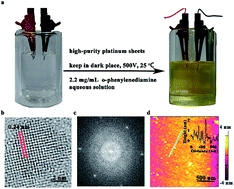
The N-GQDs were prepared through the bottom-up electrochemical synthesis. We used o-phenylenediamine as the reactant in pure water as electrolyte without any other chemical reagents, as shown in Fig. 1a. Unlike the traditional top-down electrochemical method using graphite-based materials as the electrodes, herein two high-purity platinum sheets were used as the anode and cathode for the bottom-up synthesis. In the process of reaction, constant voltage mode of 500 V was applied between the electrodes for more than 1 hour at 25 °C and 1000 rpm stirring. The colourless solution gradually turned into yellow. To avoid the spontaneous oxidation of o-phenylenediamine, the whole experiment was operated in dark condition.
image file: c6ra18695e-f1.tif
Fig. 1 (a) Digital photograph of the electrochemical bottom-up synthesis setup. Left: the o-phenylendiamine aqueous solution, right: the product after 1 h reaction. (b) HR-TEM image of a typical N-GQD particle obtained under 500 V. (c) FFT image of N-GQD particle. (d) AFM topography image of N-GQDs on a mica substrate, inset: height profile analysis along the line in the image.

Characterization

X-ray photoelectron spectroscopy (XPS) was performed on a spectrometer from PHI 5000C ESCA System, using Mono Al Mg radiation at a power of 250 W (14 kV). Transmission electron microscopy (TEM) images were collected on a Tecnai G2 transmission electronic microscope (FEI). The ultraviolet-visible (UV-vis) spectra were obtained by a Cary 4000 UV-vis spectrophotometer (Agilent technologies) in the region of 200–800 nm. PL and PLE spectra were collected on a PerkinElmer LS55 luminescence spectrometer (PerkinElmer Instruments, U.K.) at room temperature in aqueous solution. Via the time-correlated single-photon counting (TCSPC, Hydra Harp 400, Pico Quant) technique, we conducted the measurements of the fluorescence lifetime on N-GQDs with a single photon detector (PMA185, Pico-Quant). The samples were excited by a Ti:sapphire system (Chameleon Vision, Coherent) with a repetition rate of 80 MHz, whose fluorescence was collected by spectrometer (iHR550, Horiba Jobin Yvon) and detected by a photomultiplier tube. As the most direct and important index, the quantum yield (ϕ) of GQDs was calculated according to equation
ϕ = ϕR × (I/IR) × (AR/A) × (η/ηR)
where I is the measured integrated emission intensity, η is the refractive index of the solvent, A is the optical density, and the subscript R refers to the reference standard with a known ϕ (RhB in ethanol solution).

Results and discussion

The main paragraph text follows directly on here. Transmission electron microscopy (TEM) images of the resulting product obtained under different voltage show that the lateral size of N-GQDs are largely in the range of 2 to 6 nm (Fig. S1e). High resolution TEM image (Fig. 1b) indicates the honeycomb molecular structure which illustrates the excellent crystalline of the typical N-GQDs fabricated under 500 V. The 0.24 nm lattice is corresponding to that of graphite (002).25 It is noteworthy that the fast Fourier transform (FFT) (Fig. 1c) shows a high crystalline structure and significant nonstandard six-fold symmetry. The XRD pattern of the N-GQDs (Fig. S2) shows a wide (002) peak centered at 27° which consistent with the lattice spacing of graphite. It is suggested that the GQDs was carbonized to produce graphite structures, which is consistent with the TEM results. Atomic force microscopy (AFM) observations (Fig. 1d) reveal dispersed N-GQDs on the mica substrate with a typical topographic height of 1.0–2.5 nm, which indicates the 3–6 atomic layers in thickness.

Fig. 2a presents the Raman spectrum of N-GQDs. The spectrum has peaks of D band 1368 cm−1, G band 1595 cm−1, and 2D band 2736 cm−1. The ID/IG ratio is ca. 0.23, which is much lower than that of most reported GQDs.26 This low ID/IG ratio indicates that the doping of N does not destroy the conjugated structure of N-GQDs, and that there are limited defects on the GQDs. The above Raman data agrees with the TEM result. For further analysis, the elemental composition in the N-GQDs was measured by X-ray photoelectron spectroscopy (XPS) measurement. The XPS survey spectrum of the N-GQDs clearly shows the presence of C 1s and N 1s (Fig. S3). The C 1s and N 1s peaks are located at 284.69 and 399.01 eV, respectively. The N/C atomic ratio was 11.97%, which was very similar to other heavily doped N-GQDs reported previously. High-resolution C 1s spectrum of N-GQDs (Fig. 2b) indicates the signals of C–C (284.69 eV), C–N (285.84 eV), and C[double bond, length as m-dash]N (288.35 eV). In addition, the high-resolution N 1s spectrum of N-GQDs (Fig. 2c) reveals the presence of both amidogen N (399.21 eV) and graphitic N (400.88 eV) atoms, with the atom percentages of 8.75% and 1.91%, respectively. The C atoms bonding with edge groups (–NH2) account for 92% of the total edge C atoms by calculation. FTIR was used to characterize the functional groups in the prepared N-GQDs, as shown in Fig. S4. It's clear that, the peak at 762 cm−1, characteristic of C–H out of plane bending vibrations of benzene nuclei in the phenazine skeleton. The peaks at 1240 and 1366 cm−1 are associated with the C–N stretching in the benzenoid and imine units. The absorption bands at 3245 and 1076 cm−1 are assigned to N–H stretching-vibration peaks, respectively. In addition, new doublet peaks at 1622 cm−1 and 1450 cm−1, corresponding to N–H bending and C–N stretching, can be observed in the spectrum of N-GQDs, which is caused by the successful incorporation of nitrogen atoms into the N-GQDs layer through the present synthesis process.


image file: c6ra18695e-f2.tif
Fig. 2 (a) Raman spectra. (b) High-resolution C 1s. (c) High-resolution N 1s of N-GQDs thus formed under 500 V.

Optical properties of N-GQDs were investigated and presented in Fig. 3. Direct absorption peaks located at about 258 and 425 nm are observed in UV-vis absorption spectra of N-GQDs (Fig. 3a), with an optical absorption edge at about 535 nm. The absorption peak at 258 nm is assigned to the π–π* transition of C[double bond, length as m-dash]C, and is blue-shifted comparing to the normal observed value along 270 nm,27 which is believed to originate from the strong electronic affinity of –NH2 dopants. However, the absorption peak at 425 nm is attribute to the localized π state owe to the doping of the graphitic N. When the graphitic N is doped into the sp2 network of carbon, the n electron of nitrogen is transferred to the π conjugated state of carbon, and it leaves behind a positive charge of the graphitic N, which attracts the surrounded π electrons to form the localized π state.28,29 PL and PL excitation (PLE) spectra of N-GQDs are also shown in Fig. 3a. The PL spectrum shows the maximum emission wavelength located at 569 nm with a full width at half maximum 105 nm. The PLE spectrum shows two peaks at 380 and 450 nm. In addition, the Commission International d'Eclairage (Fig. S5) chromaticity coordinates for N-GQD is (0.46, 0.52), which agrees with the digital photograph in Fig. 3a, which shows the digital photograph of N-GQDs solution under UV lamp. The quantum yield (ϕ) 0.71 of yellow green PL can be measured and calculated,3 which is much higher than most reported values. The high ϕ of our N-GQDs is believed to originate from the localized π state due to the graphitic doping of nitrogen.


image file: c6ra18695e-f3.tif
Fig. 3 (a) UV-vis absorption, PL (λex = 420 nm) and PLE (λem = 569 nm) spectra of N-GQDs aqueous solution, inset: the photograph of N-GQDs aqueous solution under 365 nm UV light. (b) PL spectra of N-GQDs aqueous solution at different excitation wavelengths (370–500 nm). (c) The lifetime of N-GQDs measured at 25 °C (λex = 420 nm and λem = 570 nm). (d) PL decay curves of N-GQDs tested at 25 °C with 10 nm increments of progressive emission wavelength (λex = 420 nm).

It is well known that the edge group results in the excitation wavelength dependent behaviour of general reported GQDs. However, our fabricated N-GQDs exhibit a maximal wavelength shift of 5 nm when the excitation wavelength increases from 370 to 500 nm (Fig. 3b). The N-GQDs also show excitation wavelength independence behaviour in principle. This contradicts with most previous reports of GQDs.1–8 Our results confirm that the excitation wavelength dependence PL of GQDs is not caused by the amount of edge group, but the diversification of edge groups.

Deep investigation of the relationship between the PL decay and the emission wavelengths was made by measuring the PL decay of N-GQDs using the time-correlated single photon counting technique. A monoexponential function is good enough to fit the PL decay curves (Fig. 3c), and the lifetime is dominant with a decay component 1.7 ns. In order to better understand the effects of size distribution and the edge functional groups, we measured the PL decay of N-GQDs by the spectral resolution measurement.30 Fig. 3d shows the PL lifetime of different emission wavelengths when excited at 420 nm. It is found that with the emission wavelength changing from 520 nm to 660 nm, the lifetime varies little, which is very different with the wavelength dependent lifetime we observed in hydrothermal cutting N-GQDs.3,28 Thus we can conclude that the size distribution and the functional groups had little influence on the PL Lifetime. The localized π electronic states are reported to form at the neighboring C atoms and graphitic N anisotropically and extend to a few nanometers, therefore it is insensitive with the GQD size (the average size 3.9 nm of our GQDs). Furthermore, the functional groups provide the different nonradiative decay channels and also influence the lifetime.28 However, the formed N-GQDs have the same nonradiative decay channels, whose edge C atoms bonding with edge groups (–NH2) account for 92% of the total edge C atoms by calculation. In other words, the same nonradiative decay channels originating from the same edge groups make the contribution of the nonradiative rate changeless, and as a result the lifetime varies little.

Next, we discuss the fabrication mechanism in detail. N-GQDs were synthesized under different voltages (100–500 V). The voltage–current curve is shown in Fig. 4a. The experimental results show that a linear relationship between current and voltage. This indicates the same electrochemical process under 100–500 V. However, under higher voltage, the electrochemical polymerization progress is much efficient than that under low voltage. As shown in Fig. 4b, with the increase of the voltage, the absorbance of the product also increases after the same reaction time, indicating that the higher concentration of N-GQDs under high voltage, just as shown in Fig. 4c. The concentration of N-GQDs is 0.56, 0.87, 1.64, 2.04 and 2.08 mg mL−1 when the electrode voltage is 100, 200, 300, 400 and 500 V, respectively. Due to the same reaction process, the products obtained under different voltages show the same morphology and PL behaviour. As shown in Fig. S1, TEM images indicate the same morphology of N-GQDs obtained under different voltages. The lateral sizes of these N-GQDs are largely in the range of 2 to 6 nm. Fig. 4d shows the average diameter of these N-GQDs. The average diameter increased by 18.5% (from 3.29 to 3.90 nm) when the voltage increased from 100 to 500 V. However, there is almost no change on the emission wavelength of the different voltages (Fig. S6). Generally speaking, all these N-GQDs show excitation wavelength independence PL behaviour. Indeed, the oxidative polymerization process is same while the electrode voltage is higher than 4.0 V (oxidation potential of o-phenylenediamine). The polymerization process mainly attribute to the information of phenazine structure. As proposed in Fig. 4e, o-phenylenediamine coupled together by forming mine bonds. Subsequently, the mine bonds and partial amino groups further oxidative coupled, and the phenazine structure was formed. At last, the two dimensional nitrogen-doped graphene-like structure comes into being with very small lateral size and well-defined edge groups.


image file: c6ra18695e-f4.tif
Fig. 4 (a) The changes of currents (b) the changes of absorption of the N-GQDs (c) the concentrations of the N-GQDs (d) the average sizes of the N-GQDs obtained under the different voltages (e) the possible reaction mechanism of the electropolymerization progress.

Finally, to assess the prospects of the N-GQDs as a practical bioimaging material, HeLa cells were used to evaluate the property of the N-GQDs. We tested the in vitro cytotoxicity of N-GQDs using the HeLa cell line. The metabolic activity of HeLa cells was treated with different concentrations of N-GQDs (Fig. S7). Varied concentrations of N-GQDs were added to the cells cultured in 96 well-plates and incubated for 24 h. Subsequently, a standard assay was performed to assess the cell viabilities after the N-GQDs treatments. No significant reduction in cell viability was observed for cells treated with N-GQDs even at high concentrations (up to 500 μg mL−1). For cell imaging applications, HeLa cells were incubated with the N-GQDs at a concentration of 100 μg mL−1 for 2 h at 37 °C, followed by image acquisition via confocal microscopy under 400 nm light excitation. As observed in Fig. 5a and b, bright green PL is observed inside the cells, which means that the N-GQDs have been internalized by the HeLa cells. These results demonstrate the excellent cyto-compatibility of the as-prepared N-GQDs which is favourable for their easy cellular uptake by the cells for efficient bio-imaging. And the as-prepared N-GQDs could be used as a kind of efficient bio-imaging materials.


image file: c6ra18695e-f5.tif
Fig. 5 (a) Bright-field microphotographs of HeLa cells. (b) Confocal fluorescence microphotograph of HeLa cells incubated with 100 μg mL−1 N-GQDs (λex = 400 nm).

Conclusions

In summary, we developed an electrochemical bottom-up synthesis of N-GQDs with large amount of well-defined edge groups for the first time. This progress is green (both atom utilization and yield are higher than 95%, without by-products), simple and suitable for large scale synthesis (10 g per batch). The exclusive edge group of the obtained N-GQDs is –NH2 results in the excitation wavelength independence behavior. The spectral resolved PL lifetime measurement shows that the size distribution and the edge functional groups of GQDs both have little influence. The low biotoxicity and high PL efficiency of N-GQDs ensured the possibility of practical application in bioimaging. This work is helpful to develop new preparation approaches and PL mechanism research of GQDs.

Acknowledgements

This work was supported by Strategic Leading Science and Technology Programme (Class B) of the Chinese Academy of Sciences (Grant No. XDB01010200) and the Science and Technology Commission of Shanghai Municipality (Grant No. 14DZ1203700 and 14ZR1444700).

Notes and references

  1. M. Bacon, S. J. Bradley and T. Nann, Part. Part. Syst. Charact., 2014, 31, 415 CrossRef CAS.
  2. S. W. Yang, J. Sun, X. B. Li, W. Zhou, Z. Y. Wang, P. He, G. Q. Ding, X. M. Xie, Z. H. Kang and M. H. Jiang, J. Mater. Chem. A, 2014, 2, 8660 CAS.
  3. J. Sun, S. W. Yang, Z. Y. Wang, H. Shen, T. Xu, L. T. Sun, H. Li, W. W. Chen, X. Y. Jiang, G. Q. Ding, Z. H. Kang, X. M. Xie and M. H. Jiang, Part. Part. Syst. Charact., 2014, 32, 434 CrossRef.
  4. G. Rohan and S. Pooja, Part. Part. Syst. Charact., 2014, 31, 433 CrossRef.
  5. S. W. Yang, J. Sun, P. He, X. X. Deng, Z. Y. Wang, C. Y. Hu, G. Q. Ding and X. M. Xie, Chem. Mater., 2015, 27, 2004 CrossRef CAS.
  6. C. Zhu, S. W. Yang, G. Wang, R. W. Mo, P. He, J. Sun, Z. F. Di, Z. H. Kang, N. Y. Yuan, J. N. Ding, G. Q. Ding and X. M. Xie, J. Mater. Chem. B, 2015, 3, 6871 RSC.
  7. X. H. Zhu, X. Xiao, X. X. Zuo, Y. Liang and J. M. Nan, Part. Part. Syst. Charact., 2014, 31, 801–809 CrossRef CAS.
  8. G. H. Zhou, C. H. Chen, L. Y. Zhang, X. F. Guo, H. Wang, X. H. Ji and Z. K. He, Part. Part. Syst. Charact., 2014, 31, 382–389 CrossRef CAS.
  9. D. Y. Pan, J. C. Zhang, Z. Li and M. H. Wu, Adv. Mater., 2010, 22, 734 CrossRef CAS PubMed.
  10. Y. Li, Y. Hu, Y. Zhao, G. Q. Shi, L. E. Deng, Y. B. Hou and L. T. Qu, Adv. Mater., 2011, 23, 776 CrossRef CAS PubMed.
  11. S. H. Li, Y. C. Li, J. Cao, J. Zhu, L. Z. Fan and X. H. Li, Anal. Chem., 2014, 86, 10201 CrossRef CAS PubMed.
  12. Z. F. Wang, H. D. Zeng and L. Y. Sun, J. Mater. Chem. C, 2015, 3, 1157 RSC.
  13. M. L. Mueller, X. Yan, A. J. McGuire and L. S. Li, Nano Lett., 2010, 10, 2679 CrossRef CAS PubMed.
  14. Y. P. Sun, B. Zhou, Y. Lin, W. Wang, K. A. Shiral Fernando, P. Pathak, J. M. Meziani, A. B. Harruff, X. Wang, H. F. Wang, P. G. Luo, H. Yang, M. E. Kose, B. L. Chen, M. L. Veca and S. Y. Xie, J. Am. Chem. Soc., 2006, 128, 7756 CrossRef CAS PubMed.
  15. D. Y. Pan, J. C. Zhang, Z. Li, C. Wu, X. M. Yan and M. H. Wu, Chem. Commun., 2010, 46, 3681 RSC.
  16. C. M. Luk, B. L. Chen, K. S. Teng, L. B. Tang and S. P. Lau, J. Mater. Chem. C, 2014, 2, 4526 RSC.
  17. R. Q. Ye, C. S. Xiang, J. Lin, Z. W. Peng, K. W. Huang, Z. Yan, N. P. Cook, E. L. G. Samuel, C. C. Hwang, G. D. Ruan, G. Ceriotti, A. R. O. Raji, A. A. Marti and J. M. Tour, Nat. Commun., 2013, 6, 7063 CrossRef PubMed.
  18. Y. Li, Y. Hu, Y. Zhao, G. Shi, L. Deng, Y. Hou and L. Qu, Adv. Mater., 2011, 23, 776 CrossRef CAS PubMed.
  19. X. Wu, F. Tian, W. X. Wang, J. Chen, M. Wu and X. J. Zhao, J. Mater. Chem. C, 2013, 1, 4676 RSC.
  20. X. Yan, X. Cui and L. Li, J. Am. Chem. Soc., 2010, 132, 5944 CrossRef CAS PubMed.
  21. K. J. Williams, C. A. Nelson, X. Yan, L. S. Li and X. Y. Zhu, ACS Nano, 2013, 7, 1388 CrossRef CAS PubMed.
  22. D. Qu, M. Zheng, L. Zhang, H. Zhao, Z. Xie, X. Jing, R. E. Haddad, H. Fan and Z. Sun, Sci. Rep., 2014, 4, 5294 CAS.
  23. Z. L. Wu, M. X. Gao, T. T. Wang, X. Y. Wan, L. L. Zheng and C. Z. Huang, Nanoscale, 2014, 6, 3868 RSC.
  24. J. Zong, Y. Zhu, X. Yang, J. Shen and C. Li, Chem. Commun., 2011, 47, 764 RSC.
  25. Y. S. Liu, B. Gao, Z. Q. Qiao, Y. J. Hu, W. F. Zheng, L. Zhang, Y. Zhou, G. B. Ji and G. C. Yang, Chem. Mater., 2015, 27, 4319 CrossRef CAS.
  26. F. Liu, M. H. Jang, H. D. Ha, J. H. Kim, Y. H. Cho and T. S. Seo, Adv. Mater., 2011, 23, 776 CrossRef PubMed.
  27. S. Kim, S. W. Hwang, M. K. Kim, D. Y. Shin, D. H. Shin, D. H. Shin, C. O. Kim, S. B. Yang, J. H. Park, E. Hwang, S. H. Choi, G. Ko, S. Sim, C. Sone, H. J. Choi, S. Bae and B. H. Hong, ACS Nano, 2012, 6, 8203 CrossRef CAS PubMed.
  28. T. Kondo, S. Casolo, T. Suzuki, T. Shikano, M. Sakurai, Y. Harada, M. Saito, M. Oshima, M. I. Trioni, G. F. Tantardini and J. N. Nakamura, Phys. Rev. B: Condens. Matter Mater. Phys., 2012, 86, 035436 CrossRef.
  29. L. Y. Zhao, R. He, K. T. Rim, T. Schiros, K. S. Kim, H. Zhou, C. Gutiérrez, S. P. Chockalingam, C. J. Arguello, L. Pálová, D. Nordlund, M. S. Hybertsen, D. R. Reichman, T. F. Heinz, P. Kim, A. Pinczuk, G. W. Flynn and A. N. Pasupathy, Science, 2011, 333, 999 CrossRef CAS PubMed.
  30. X. X. Deng, J. Sun, S. W. Yang, H. Shen, W. Zhou, J. Lu, G. Q. Ding and Z. Y. Wang, Appl. Phys. Lett., 2015, 107, 241905 CrossRef.

Footnotes

Electronic supplementary information (ESI) available: Experimental section; size distribution and PL behaviour of N-GQDs. See DOI: 10.1039/c6ra18695e
These authors (Linfan Tian and Siwei Yang) contributed equally.

This journal is © The Royal Society of Chemistry 2016
Click here to see how this site uses Cookies. View our privacy policy here.