Jusung
Han‡
a,
Yo-Han
Kim‡
a,
Hyung-Seok
Jang
a,
Sung-Yeon
Hwang
b,
Jonggeon
Jegal
b,
Jung Won
Kim
*c and
Yoon-Sik
Lee
*a
aSchool of Chemical and Biological Engineering, Seoul National University, Gwanak-Ro, Gwanak-Gu, Seoul 151-742, Republic of Korea. E-mail: yslee@snu.ac.kr
bKorea Research Institute of Chemical Technology, Ulsan 681-802, Republic of Korea
cDepartment of Chemical Engineering, Kangwon National University at Samcheok, Joonang-Ro, Samcheok, Kangwon 245-711, Republic of Korea. E-mail: jwemye@kangwon.ac.kr
First published on 21st September 2016
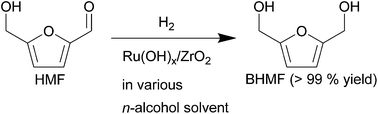
5-Hydroxymethyl-2-furaldehyde (HMF) was hydrogenated to 2,5-bis(hydroxymethyl)furan (BHMF) (>99% yield) in various n-alcohol solvents using a Ru(OH)x/ZrO2 catalyst. The TON and TOF for the hydrogenation were calculated to be 912 and 304 h−1, respectively.
Despite of its usefulness, efficient production of BHMF from HMF is challenging because HMF was over-hydrogenated to 2,5-dimethyl furan (DMF) and 2,5-bis(hydroxymethyl)-tetrahydrofuran (BHMTHF).8,10–12 To overcome these problems, heterogeneous catalytic hydrogenations using molecular hydrogen have been designed.13,14 Ohyama et al. reported that HMF was transformed into BHMF in 96% yield in water over Au/Al2O3 catalyst.7 Tamura et al. obtained BHMF in 99% yield using Ir–ReOx catalyst in water.15 Recently, Chatterjee et al. gained 98.9% selectivity of BHMF with complete conversion in an aqueous medium using Pt/MCM-41 catalyst.16 In parallel, Alamillo et al. reported that HMF was converted to BHMF with 94% yield in 2
:
1 bi-phasic 1-butanol
:
water over supported Ru catalysts.17 In spite of above improvements, these reactions are achieved using large amounts of noble metals with relatively low turnover number (TON) or turnover frequency (TOF). And also, all these reactions are only applicable to specific solvents which restrict broad application of BHMF. If hydrogenation of HMF to BHMF occurred in various alcohol solvents, BHMF can be easily etherified to 2,5-bis(alkoxymethyl)furans (BAMFs) through simple addition of proton donor.9,18,19
Herein, we report a highly active and selective HMF hydrogenation to BHMF with heterogeneous zirconia-supported ruthenium (Ru(OH)x/ZrO2) catalyst.20 The reactions proceed completely in various n-alcohol solvents with more than 99% yield (Scheme 1). The catalyst could be reused at least 5 times without significant loss of activity. Moreover, the TON and TOF with large amounts of the substrate (HMF, 4.85 mmol) and minimum amount of catalyst (Ru(OH)x/ZrO2, 0.1 mol% based on ruthenium) reached up to 912 and 304 h−1, respectively. To the best of our current knowledge, it is the best result that shows the highest catalytic activity in hydrogenation of HMF to BHMF in various n-alcohol solvents.
The Ru(OH)x/ZrO2 catalyst was prepared by the previously reported method,20 and applied in the hydrogenation of HMF to BHMF. Reaction temperature and H2 pressure were optimized for the hydrogenation of HMF with Ru(OH)x/ZrO2 (0.3 mol%) (Table S1 and S2†). Fig. 1 shows the effect of time on the conversion of HMF to BHMF. The hydrogenation of HMF to BHMF proceeded rapidly and very selectively within 2 h (87% conversion). After 2 h, the yield of BHMF increased slowly up to 99% and no further reaction occurred from 6 h to 12 h. This might be attributed to an inhibition of hydrogenation by BHMF, which contains two –CH2OH groups, and other combination of inhibiting effect.21 This result implies that the Ru(OH)x/ZrO2 catalyst has a higher activity toward the C
O bond of HMF than other reactive sites.
Table 1 presents the solvent effect of the hydrogenation reaction. The selectivity toward BHMF was very high in various solvents. Especially, HMF was hydrogenated exclusively to BHMF without any side reactions in more than 99% yield in n-alcohols (entries 1–3 & 5). The corresponding BHMF was clearly identified by 1H NMR without purification (Fig. S1–S4†). In case of 2-propanol and t-butanol (entries 4 & 6), complete conversion of HMF was not achieved and some byproducts such as 5-(alkoxymethyl) furfuryl alcohol (AMFA) and 5-methylfurfuryl alcohol (MFA) were produced (Scheme 2 and Fig. S6–S8 and S11–S13†). On the other hand, HMF was converted to BHMF in moderate yield in the presence of nonpolar solvent such as toluene (entry 7). These findings suggest that the catalytic activity for the hydrogenation of HMF to BHMF is related to the polarity of the solvents. In polar solvents, the C
O bond is more polarized, and H2 absorbed on the Ru active site can easily attack the C
O bond of HMF due to the strong interaction between C
O bond and the solvents.22 Owing to these phenomena, n-alcohols which have relatively higher polarity gave superior catalytic performance compared to branched alcohols. Among the solvents, toluene showed the least conversion yield. It might be related to low solubility of HMF and low polarity of toluene. Actually, the polarity of solvents is one of the controlling factors for the hydrogenation of HMF.23
| Entry | Solvent (3 mL) | Conversion (%) | TON | Selectivity (%) | ||
|---|---|---|---|---|---|---|
| BHMF | AMFA | MFA | ||||
| a Reaction condition: HMF (100 µL, 0.97 mmol), Ru(OH)x/ZrO2 (15 mg, 0.3 mol%), temperature 120 °C, H2 15 bar, solvent (3 mL), 6 h. Results were analyzed by 1H NMR spectrum. b H2 30 bar. | ||||||
| 1 | Methanolb | >99 | 323 | >99 | n.d. | Trace |
| 2 | Ethanolb | >99 | 323 | >99 | n.d. | n.d. |
| 3 | 1-Propanol | >99 | 323 | >99 | n.d. | n.d. |
| 4 | 2-Propanol | 82 | 244 | 92 | 4 | 4 |
| 5 | 1-Butanol | >99 | 323 | >99 | n.d. | n.d. |
| 6 | t-Butanol | 70 | 215 | 95 | 1 | 4 |
| 7 | Toluene | 55 | 171 | 96 | n.d. | 4 |
The catalytic activity and selectivity for the hydrogenation of HMF to BHMF was compared for various Ru catalysts (Table 2). Among them, Ru(OH)x/ZrO2 showed the most excellent catalytic activity than the conventional Ru catalysts under the same reaction conditions (entries 2–7). When the results of HMF hydrogenation with Ru(OH)x·nH2O and RuCl3·xH2O were compared, Ru–OH active site seems to be more favourable than Ru–Cl because Ru(OH)x·nH2O gave higher yield and better selectivity for BHMF (entries 3 & 4). The results of entry 5 and 6 support this hypothesis because RuO2 hydrate has a crystal water structure, and it can hold more Ru–OH active sites than RuO2 anhydrous.24 Commercially available heterogeneous Ru/C catalyst gave lower yield and selectivity for BHMF (entry 7), while no yield was obtained in the absence of the catalyst as well as with pristine ZrO2 and base treated ZrO2 under the same reaction conditions (entries 1, 9 & 10). From these results with Ru(OH)x/ZrO2 and Ru(OH)x·nH2O, it can be concluded that the ZrO2 solid support enhanced the catalytic activity of Ru–OH in HMF hydrogenation and the selectivity toward BHMF (entries 2 & 3). Based on the electronic metal-support interactions theory, catalytic performance of metal active site can be enhanced by the metal oxide support.25 In this regard, owing to the unique surface characteristics of ZrO2 such as –OH groups and coordinative unsaturated acidic–basic Zr4+–O2− pairs, ZrO2 supported Ru possesses higher catalytic activity than the other Ru catalysts.26–28 Therefore, the H2 molecules can be easily absorbed on the active site of Ru and then transferred to C
O bond for the hydrogenation of HMF to BHMF. The catalytic activity of calcined Ru(OH)x/ZrO2 for the hydrogenation reaction of HMF decreased significantly (entry 8), probably because the interface characteristics between ZrO2 and the Ru active site (Ru–OH) could be altered by the calcination process (Fig. S14†). This can also support the aforementioned electronic effect on the activity of the Ru(OH)x/ZrO2 catalyst. Very recently, zirconia hydroxide (ZrO(OH)2) has been reported to have an excellent catalytic activity for the hydrogenation of HMF to BHMF.29 However, this activity only observed in ethanol solvent and ZrO(OH)2 catalyst has a problem in reusability test due to carbon deposits during the reaction.
| Entry | Catalyst | Conversion (%) | BHMF selectivity (%) | BHMF yield (%) |
|---|---|---|---|---|
| a Reaction condition: HMF (100 µL, 0.97 mmol), catalysts (0.3 mol%), temperature 120 °C, H2 15 bar, 1-butanol (3 mL), 6 h. Results were analyzed by GC/MS. b Calcination at 700 °C. n.d.: no dectection. | ||||
| 1 | None | n.d. | n.d. | n.d. |
| 2 | Ru(OH)x/ZrO2 | >99 | >99 | >99 |
| 3 | Ru(OH)x·nH2O | 72 | 80 | 58 |
| 4 | RuCl3·xH2O | 92 | 17 | 16 |
| 5 | RuO2 anhydrous | 15 | 91 | 13 |
| 6 | RuO2 hydrate | 57 | 81 | 46 |
| 7 | Ru/C | 79 | 53 | 42 |
| 8 | Ru(OH)x/ZrO2b | 43 | >99 | 43 |
| 9 | ZrO2 | 6 | n.d. | n.d. |
| 10 | NaOH treated ZrO2 | 8 | n.d. | n.d. |
The stability of heterogeneous catalyst is of great concern in a continuous catalytic process. Therefore, reusability of the catalyst was investigated. Fig. 2 shows the result of recycling Ru(OH)x/ZrO2 catalyst for the HMF hydrogenation to BHMF. The catalyst was recovered, washed with acetone and 0.1 N aqueous NaOH solution, and reused after drying in an oven for 15 minutes and in air overnight. During five times of recycling, no significant loss of catalytic activity was observed and Ru(OH)x/ZrO2 catalyst gave almost the same conversion and selectivity toward BHMF (Fig. S5†).
Footnotes |
| † Electronic supplementary information (ESI) available. See DOI: 10.1039/c6ra18016g |
| ‡ These authors contributed equally to this work. |
| This journal is © The Royal Society of Chemistry 2016 |