In situ synchrotron small- and wide-angle X-ray study on the structural evolution of Kevlar fiber under uniaxial stretching

Xiaoyun Li, Feng Tian, Ping Zhou, Chunming Yang*, Xiuhong Li*, Fenggang Bian and Jie Wang
Shanghai Synchrotron Radiation Facility, Shanghai Institute of Applied Physics, Chinese Academy of Sciences, Shanghai, China. E-mail: lixiuhong@sinap.ac.cn; yangchunming@sinap.ac.cn

Received 11th July 2016 , Accepted 12th August 2016

First published on 12th August 2016


Abstract

The structural evolution and mechanism of Kevlar 29 and Kevlar 129 (poly(p-phenylene terephthalamide)) fibers during stretching were studied by in situ synchrotron small-angle X-ray scattering (SAXS) and wide-angle X-ray scattering (WAXS). Compared with Kevlar 29, the tensile strength of Kevlar 129 increased, while the elongation-to-break ratio decreased. SAXS results showed that ordered lamellae were observed only in Kevlar 29. The fibril length of Kevlar 129 was larger than that of Kevlar 29; however, the fibril misorientation width of Kevlar 129 was smaller. During stretching, both the fibril length and fibril misorientation width decreased at low strains, and then increased until the fibrils broke both in Kevlar 29 and Kevlar 129 fibers. From WAXS results, the crystal orientation angle decreased in Kevlar 29 during stretching, while that in Kevlar 129 increased at low strains and then decreased until the fibers broke. The change of crystallinity indicated that the amorphous phase can convert to the crystal phase at high strains, although the conversion ratio was not large. By combining the SAXS and WAXS results, a potential mechanism for Kevlar fibers during stretching was proposed.

1. Introduction

Kevlar fiber with high tensile modulus, strength and thermal stability is a commercial poly(p-phenyleneterephthalamide) (PPTA) fiber.1 PPTA fiber is a type of material that is related to the national economy and national security, and is widely used in the energy industry, civil construction, transportation and numerous other fields. Its morphology, structure, property and the relationship between microstructure and properties have gained extensive investigation for its commercial value and scientific interests. A monoclinic crystal structure with a unit cell of a = 7.87, b = 5.18, c (fiber axis) = 12.9 Å, γ = α = β = 90°, which was proposed by Northod on the basis of X-ray diffraction,1 was observed by Haraguchi2 and Li3 from different Kevlar fibers. Panar et al.4 proposed that PPTA fibers consisted of fibrils, and the fibrils were composed by the stacks of the crystalline layers that were perpendicular to the fiber axis. A streak in the equatorial direction was obtained from SAXS measurements, which was considered as evidence that fibrils exist in PPTA.5 The fibrils were 600 nm wide and several centimeters in length, which were observed by transmission electron microscopy (TEM) of the PPTA fibers.6,7

The mechanical property of a PPTA fiber is strongly affected by its internal structure. Rao8,9 studied the relationship of apparent crystal size, crystal orientation, degree of crystallinity and mechanical properties, in which the results showed that crystallite orientation and apparent crystal size were closely related to the fiber modulus and strength. The strength decreased with the increase of crystal size. Young et al.10 investigated the structure and mechanical properties of various PPTA fibers using TEM and Raman microscopy. It indicated that the fiber tensile strength was determined by the overall molecular orientation, while the increasing skin region would reduce the strength. A series of PPTA fibers with different strengths were studied using the new two-dimensional full pattern fitting method for 2D SAXS patterns by Zhu et al.,11 and the results showed that the greater the number of spherical microvoids and the larger the ellipsoidal microvoids, the weaker is the strength in the aramid fiber.

It is well known fact that the manufacturing process condition affects the internal structure, thus affecting its mechanical properties. The heat temperature and applied tension in manufacturing processes play important roles in fiber mechanical properties.10–14 Kevlar 29 fibers belong to a common PPTA fiber. Moreover, the strength of Kevlar 129 fibers is higher than that of Kevlar 29. The mechanical properties of Kevlar 129 were improved by the selection of the processing parameters and the molecular weight of spinning resin or injection of a third monomer. In the manufacturing process, with increasing temperature and applied tension, the modulus and tensile strength improved owing to the crystallites improved alignment. Some works11,13 showed that the molecular orientation, crystal perfection and crystallinity can be improved by heat treatment processes; therefore, the modulus and strength of the fiber increased. Due to the different process technologies having been using for Kevlar 29 and Kevlar 129, the crystalline perfections, molecular orientation, modulus and the strength were observed to be different.8

Although a lot of work has been performed to investigate the structure and properties,8–11 there are few studies on structural and morphological evolution of various Kevlar fibers during stretching. In the present study, our goal is to obtain an in-depth understanding of the internal structure evolution, including the fibrils and crystal structure of different Kevlar fibers under the external stresses. Kevlar 29 and Kevlar 129 were investigated by SAXS/WAXS technique combined with an in situ uniaxial stretching apparatus. The relationship of the structural evolution and mechanical properties in various Kevlar fibers was studied.

2. Experimental

Two types of fibers, Kevlar 29 and Kevlar 129, were investigated in this study, which were provided by Hebei Silicon Valley Chemical Co. Ltd. China. Kevlar 29 belongs to a common PPTA fiber. In our sample, compared with Kevlar 29, the higher molecular weight of resin and different processing parameters were used for spinning Kevlar 129. A home-made uniaxial tensile apparatus was used for deformation. The uniaxial stretching guarantees that the focused X-ray beam illuminates the same sample position during stretching. The chosen stretching speed was 10 μm s−1 in this experiment.

The in situ small- and wide-angle X-ray scattering measurements were performed on the beamline BL16B1 at the Shanghai Synchrotron Radiation Facility (SSRF). The X-ray wavelength was 0.124 nm. The 2D SAXS and WAXS patterns were recorded by Mar165 CCD with pixel size of 79 μm × 79 μm. The sample-to-detector distance was 1820 mm for SAXS, which was calibrated using a silver behenate standard, and 154 mm (calibrated by CeO2) for WAXS. The collection time was 5 s and 10 s for SAXS and WAXS measurements, respectively. All X-ray scattering data were corrected for background scattering and X-ray absorption. X-polar software (Precision Works Inc., NY, USA) was used to analyze SAXS and WAXS patterns and thus obtained the one-dimensional integrated intensity profiles.

3. Results and discussion

3.1 Stress–strain curves of various Kevlar fibers

The engineering stress–strain curves of Kevlar 29 and Kevlar 129 were obtained from the tensile tests, as plotted in Fig. 1. The tensile strength of Kevlar 129 was obviously higher than Kevlar 29. Compared with Kevlar 29, the tensile strength of Kevlar 129 was increased by about 150%. It can be observed that the elongation at break of Kevlar 129 showed an obvious decrease compared with Kevlar 29. Such a marked change in strength and elongation at the break point would be attributed to the characterized microstructures and morphologies of the fiber.
image file: c6ra17671b-f1.tif
Fig. 1 Engineering stress–strain curves of various Kevlar fibers.

3.2 Morphological changes for various Kevlar fibers during stretching

A detailed structure evolution during stretching of different Kevlar fibers was analyzed by in situ SAXS. Fig. 2 shows the selected SAXS patterns of Kevlar 29 and Kevlar 129 during tensile deformation. A streak along the equator can be clearly seen, and there is no detectable scattering along the meridional direction. Compared with Kevlar 29, it can be clearly seen that the streak of Kevlar 129 was shorter and sharper. During stretching, the streak became sharper for both of Kevlar 29 and Kevlar 129. The equator streak indicated that voids or fibrillary structure exist in Kevlar 29 and Kevlar 129 (ref. 13 and 15) and the details are discussed in the following section.
image file: c6ra17671b-f2.tif
Fig. 2 Selected SAXS patterns of various Kevlar fibers at different strains during the deformation.

Fig. 3 shows the one-dimensional SAXS profiles of Kevlar fibers obtained using projection integration from Fig. 2. It can be clearly seen that a sharp peak appeared in Kevlar 29, which suggested that the Kevlar 29 fiber exhibited a lamellar morphology with a long-period order character (Fig. 3(a)). This result is consistent with the work reported by Panar et al.6 observed that some fractionally ordered lamellae appeared in the superstructure of the Kevlar fibers. Compared with the Kevlar 29 fiber, a less obvious peak in Kevlar 129 was found in Fig. 3(b). From Fig. 3(a), it can be clearly seen that a sharp peak appeared at q = 0.71 nm−1 (q = 4π[thin space (1/6-em)]sin[thin space (1/6-em)]θ/λ with λ being the wavelength and 2θ being the scattering angle) in the equatorial direction with different strain for Kevlar 29. It indicated that some structures stack periodically perpendicular to the fiber axis. The long period (L) can be calculated according to Bragg's law. For Kevlar 29, the long period is estimated to be 8.8 nm. During stretching, the scattering intensity of the peak in Fig. 3(a) became gradually weaker. It indicated that some lamellar structures in Kevlar 29 may break during stretching because they most likely carry a small part of the loading. However, during stretching, there is no trace of lamellar morphology in Kevlar 129.


image file: c6ra17671b-f3.tif
Fig. 3 Selected integrated SAXS profiles of different Kevlar fibers during stretching. (a) Kevlar 29 (b) Kevlar 129.

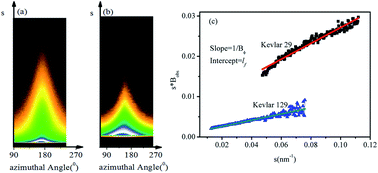
Grubb et al.16 and Dobb17 et al. pointed out that the streak on the equator of the Kevlar fiber was due to its microfibrillar structure and not attributed to the microvoids morphology. We are in complete agreement with their opinions. If the microvoids were the main contribution for the equatorial streak, the microvoids would be formed and become larger, and the difference of electron density between the microvoids and matrix would increase during the stretching of the fibers, and the scattering intensity of the equatorial streak would be visibly changed. From Fig. 3, there was no obvious change at the low q. Ran et al.18 also proposed that the Kevlar fiber had a fibril structure and caused an equatorial streak in SAXS. From 2D SAXS patterns, it was found that the intensity of the streak was changed with the scattering angle, implying that the fibrils have a size distribution and orientation distribution along the fiber axis. In order to obtain the information for the fibrils structure, the Ruland's streak method19 was used to analyze the intensity distribution to ascertain the average length and misorientation width. In this study, it is found that the azimuthal scans of the equatorial streak of Kevlar fibers with different scattering vectors s (s = q/2π) can be described by Cauchy–Cauchy-type functions. The average fibrils length lf and the misorientation width Bϕ can be calculated from the following equation:

 
image file: c6ra17671b-t1.tif(1)
where Bobs is actually the full width at the half maximum of the azimuthal profile from the equatorial streak fitted with a Lorentzian function. The fibril length (lf) and misorientation width (Bϕ) thus could be obtained from the intercept and slope of the sBobs vs. s plot (Fig. 4(c)).


image file: c6ra17671b-f4.tif
Fig. 4 Azimuthal scans of the equatorial streak (a) Kevlar 29, (b) Kevlar 129 and (c) the corresponding Ruland plot (at 1.75% strain).

From Fig. 4(a) and (b), it was clearly seen that the equatorial streak of Kevlar 29 was much stronger than Kevlar 129 at larger q, so for Kevlar 29, we took the slope of the intermediate values of s (0.047 < s < 0.11) for analysis, and at this range, the sBobs vs. s plot can used for linear fitting. However, for Kevlar 129, the intermediate values of s (0.012 < s < 0.78) was taken for analysis, because in a large q range, the intensity became weak, resulting in large errors. All the obtained values, including fibrils length lf, misorientation Bϕ and long-period L, are summarized in Table 1. It indicated a clear trend that the magnitude of lf of Kevlar 129 was notably larger as compared with the Kevlar 29, whereas the fibrils misorientation width Bϕ of Kevlar 129 was less than that of Kevlar 29 at different strains. The tensile strength of Kevlar 129 was increased by 150% compared to Kevlar 29. Jaffe et al.20 and Schaefgen et al.21 also found that the improvement of orientation of fibrils induced the increase in the modulus and strength. The results indicated that fibrils orientation was the most important factor relating to fiber strength. It was observed that the length fibrils lf had a minimum value at 1.75% strain for both of the types of fibers, which may be due to some fibrils breaking during the stretching. The fibrils misorientation width Bϕ has showed a similar behavior, i.e., decrease with increasing stretch ratio with a limiting value at 1.75% of the strain, which indicated a good change in the orientation of the fibrils during the first stage of the stretching. However, both the value of lf and Bϕ increased as the fibers was continually stretched. It is probable that at high strains, some amorphous phase coverts to the crystal phase and causes the increase of average length fibrils; however, at the same time the fibrils may break, resulting in an increased width of the misorientation.

Table 1 Results from SAXS analyses
Parameter Kevlar 29 Kevlar 129
Strain Strain
0% 0.5% 1.75% 3% 5% 9% 0% 0.5% 1.75% 3% 5%
Fibril length lf (nm) 213 199 145 157 167 205 1076 1013 943 1025 1038
Misorientation Bϕ (deg) 13.6 13.5 10.5 10.8 11.8 14.4 5.18 4.98 4.26 4.61 6.18
Long period L (nm) 8.8


3.3 Crystal structure and molecular orientation

Fig. 5 shows the selected two dimensional WAXS patterns for two types of Kevlar fibers during the stretching. Two strong reflections were located in the equatorial direction, indexed as (110) and (200).18 The small spread along the azimuthal direction of the reflections, indicated that the Kevlar fibers have a high degree of crystal orientation. During stretching, the spread became narrower, for both Kevlar 29 and Kevlar 129, indicating that the crystal had a perfected orientation during the stretching processes.
image file: c6ra17671b-f5.tif
Fig. 5 Selected WAXS patterns of Kevlar 29 and Kevlar 129 during stretching.

For Kevlar fibers, the (200) plane is often used for evaluating crystal orientation,22 and the full width at the half maximum (FWHM) of the azimuthal scan was adopted to simplify the calculation of the (200) orientation angle.8 Fig. 6(a) shows the azimuthal intensity profiles of reflection (200) obtained from the stretched fiber of Kevlar 129 at various strains. A Lorentzian function was used to fit the intensity profiles I(φ) of the main (200) peak:

image file: c6ra17671b-t2.tif
where b is the FWHM and y0, φ0, a are other fitting parameters. A selected azimuthal intensity I(φ) profile of the (200) reflection and its Lorentzian fit obtained from stretch fiber at 0.5% strain are shown in Fig. 6(b). The values of the FWHM can be calculated from the fitted profiles, which characterized the crystal orientation.9 Fig. 6(c) shows the misorientation angle of Kevlar 29 and Kevlar 129 with various strains. The misorientation angle of Kevlar 29 decreased gradually during stretching, while the misorientation angle of Kevlar 129 was first increased at a low strain (<1% strain) and then decreased before fiber breaking. It indicated that the crystals of Kevlar 29 under applied tension tend to reorient and the crystal becomes more perfect. The crystals of Kevlar 129 had been first tilted along the fiber axis at the lower strain rate, and then the crystal aligned along the fiber axis with increasing strain. As the stretch ratio reached 5% for Kevlar 129 and 9% for Kevlar 29, the orientation angle increased dramatically. It is well known that the stretch ratio of 5% and 9% is close to the breaking points for Kevlar 129 and Kevlar 29, respectively. Therefore, it was conceivable that some of the chains were broken at the elongation-to-break ratio,17 which led to a decrease in the crystal orientation (Fig. 6(c)) and fibrils orientation (Table 1).


image file: c6ra17671b-f6.tif
Fig. 6 (a) Azimuthal intensity profiles of reflection (200) of Kevlar 129 at various strains; (b) A azimuthal intensity I(φ) profile of the (200) reflection and its Lorentzian fit at 3% strain, the r2 (coefficient of determination) is 0.998, where r2 = 1 is a perfect fit; (c) orientation angle of crystal plane (200) at various strains.

In this study, the integrated intensity profiles of every crystal reflection were fitted using the PeakFit software. Fig. 7(a) shows a representative WAXD profiles with the fitting result. Fig. 7(b) and (c) show the crystallinities and crystallite size of Kevlar 29 and Kevlar 129 obtained at various strains. It was clearly seen that the crystallinity and crystallite size first decreased at low strains (<1.3% for Kevlar 29 and <1% for Kevlar 129), which agreed with the decreasing fibrils length of SAXS analysis. As the stretch ratio increased continually, the crystallinity was observed to be increased, which is attributed to some chains from the amorphous phase being converted to the crystal phase at high strains (>1.5% strain).18 Above 3% strain, the crystallinity of both two fibers decreased with increasing strain rate due to some broken crystals.


image file: c6ra17671b-f7.tif
Fig. 7 (a) A representative WAXS peak fitting result for Kevlar 29 at 0.5% strain. (b) The crystallinity of Kevlar 29 and Kevlar 129 (c) crystallite size of Kevlar 29 and Kevlar 129 at various strains.

3.4 Potential mechanisms of Kevlar fiber during stretching

According to the results of SAXS and WAXS of the two Kevlar fibers, a model illustrated based on fibrils and crystal structure in Fig. 8 was used for the structural evolution and fracture mechanism. At the initial stage of stretching (0–1.75% strain), the average of fibril length decreased due to some fibril breakages (Table 1), resulting in the slightly decreased crystallinity before 1% stretch ratio (Fig. 7(b)), which increased due to the conversion of the amorphous phase to crystals above 1% strain. At the middle stage of stretching (during 1.75–3% strain), the average fibril length increased gradually above 1.75% strain, and the crystallinity increased, indicating that the fraction of conversion of the amorphous phase to crystals was more than that of the fraction of fibril breakage (Fig. 6(c) and 7(b)). At the late stage of stretching (above 3% strain), on the small scale, there is a decrease in the misorientation angle of the crystal plane (002), which indicates that the crystals were aligned along the fiber axis and perfectly gradually during stretching (Fig. 6(c)). At the large scale, the width of orientation for the fibrils increased above 3% strain, which could be attributed to the breakage of some fibrils.
image file: c6ra17671b-f8.tif
Fig. 8 Illustrations of structural behavior for Kevlar fiber during stretching.

4. Conclusions

In situ SAXS and WAXS experiments coupled with uniaxial stretching were performed to investigate the structural evolution and stretching mechanisms of Kevlar 29 and Kevlar 129. The results are summarized as follows:

The tensile strength of Kevlar 129 is stronger than that of Kevlar 29, while the elongation-to-break ratio decreased. Some fraction ordered lamellae appeared in the superstructure of the Kevlar 29 fibers, while that was not observed in Kevlar 129 fibers. The fibril length and misorientation of the fibrils were calculated by the Ruland streak method from 2D SAXS patterns. The fibril length of Kevlar 129 was larger than Kevlar 29, while the misorientation of fibrils for Kevlar 129 was smaller than Kevlar 29. It was indicated that the total orientation of Kevlar 129 was better than Kevlar 29 and verified that the total orientation was an important factor for the tensile strength and modulus.

During stretching, the average fibril length and the misorientation of fibrils were found to be decreased firstly at low strains and then increased at high strains (above 1.75% strain) for both Kevlar 129 and Kevlar 29. Below 1% strain, the misorientation angle of Kevlar 29 decreased, while that of Kevlar 129 increased under stretching. It was indicated that the molecular chains tend to reorient with increasing strain and the crystal of Kevlar 29 becomes more ordered but for Kevlar 129, it was the opposite. However, at high strains, the crystal orientation increased upon stretching until at the fiber breaking point, which was agreement with the SAXS data. From the crystallinity and the average length of the fibrils, it was found that the amorphous phase can be converted to the crystal phase during stretching, but the conversion ratio was not much larger.

Acknowledgements

The study was funded by the National Natural Science Foundation of China (Grant Nos. 11405259 and U1532108) and the State Key Laboratory for Modification of Chemical Fibers and Polymer Materials, Donghua University.

References

  1. M. G. Northolt and J. J. V. Aartson, J. Polym. Sci., Polym. Lett. Ed., 1973, 29, 333–335 CrossRef.
  2. K. Haraguchi, T. Kajiyama and M. Takayanagi, J. Appl. Polym. Sci., 1979, 23, 915–926 CrossRef CAS.
  3. C. Li, M. Zhan, X. Huang and H. Zhou, J. Appl. Polym. Sci., 2012, 126, 552–558 CrossRef CAS.
  4. M. Panar, P. Avakian, R. C. Blume, K. H. Gardner, T. D. Gierke and H. H. Yang, J. Polym. Sci., Part B: Polym. Phys., 1983, 21, 1955–1969 CrossRef CAS.
  5. D. T. Grubb, K. Prasad and W. Adams, Polymer, 1991, 32, 1167–1172 CrossRef CAS.
  6. M. Panar, P. Avakian, R. C. Blume, K. H. Gardner, T. D. Gierke and H. H. Yang, J. Polym. Sci., Polym. Phys. Ed., 1983, 21, 1955 CrossRef CAS.
  7. L. Li, L. F. Allard and W. C. Bigelow, J. Macromol. Sci., Part B: Phys., 1983, 22(2), 269 CrossRef.
  8. Y. Rao, A. J. Waddon and R. J. Farris, Polymer, 2001, 42, 5937–5946 CrossRef CAS.
  9. Y. Rao, A. J. Waddon and R. J. Farris, Polymer, 2001, 42, 5925–5935 CrossRef CAS.
  10. R. J. Young, D. Lu, R. J. Day, W. F. Knoff and H. A. Davis, J. Mater. Sci., 1992, 27, 5431–5440 CrossRef CAS.
  11. C. Zhu, X. Liu, J. Guo, N. Zhao, C. Li, J. Wang, J. Liu and J. Xu, J. Appl. Crystallogr., 2013, 46, 1178–1186 CAS.
  12. K. G. Lee, R. Barton and J. M. Schultz, J. Polym. Sci., Part B: Polym. Phys., 1995, 33, 1–14 CrossRef CAS.
  13. M. G. Dobb and R. M. Robson, J. Mater. Sci., 1990, 25, 459–464 CrossRef CAS.
  14. W. F. Knoff, J. Textil. Inst., 1993, 84, 130–137 CrossRef CAS.
  15. B. R. Pauw, M. E. Vigild, K. Mortensen, J. W. Andreasen and E. A. Klop, J. Appl. Crystallogr., 2010, 43, 837–849 CrossRef CAS.
  16. D. T. Grubb, K. Prasad and W. Adams, Polymer, 1991, 32, 1167–1172 CrossRef CAS.
  17. M. G. Dobb, D. J. Johnson and B. P. Saville, J. Polym. Sci., Polym. Symp., 1977, 58, 237–251 CrossRef CAS.
  18. S. Ran, D. Fang, X. Zong, B. S. Hsiao, B. Chu and P. M. Gunniff, Polymer, 2001, 42, 1601–1612 CrossRef CAS.
  19. A. F. Thunemann and W. Ruland, Macromolecules, 2000, 33, 1848–1852 CrossRef.
  20. M. Jaffe and R. S. Jones, High-performance aramid fibers, in High Technology fibers, ed. M. Jaffe and R. S. Jones, Marcel Dekker, New York, 1983, pp. 349–392 Search PubMed.
  21. J. R. Schaefgen, Aramid fibers: structure, properties, and applications, in The strength and stiffness of polymers, ed. J. R. Schaefgen, Marcel Dekker, New York, 1983, pp. 327–355 Search PubMed.
  22. H. H. Yang, Kevlar aramid fiber, Wiley, Chichester, UK, 1993, p. 200 Search PubMed.

This journal is © The Royal Society of Chemistry 2016
Click here to see how this site uses Cookies. View our privacy policy here.