Zhiping Lin,
Shijie Shen,
Kunkun Li,
Han Zhang,
Duanduan Yuan,
Shifeng Jin* and
Liwei Guo*
Research and Development Center for Functional Crystals, Beijing National Laboratory for Condensed Matter Physics, Institute, of Physics, Chinese Academy of Sciences, Beijing 100190, China
First published on 5th September 2016
It is well known that the superconducting transition temperature (Tc) is very sensitive to the electronic density of states at the Fermi energy (N(EF)) and the Debye frequency (ΘD) for a BCS superconductor. However, which one plays a leading role in the ternary silicides AeMSi (Ae = Ca/Sr/Ba and M = Al/Ga) system is still unclear. Here, we report a comparative study of doping effects by V and Cr at Al sites in SrAlSi, which has a relatively high Tc among AeMSi systems. It is found that V and Cr atoms can be successfully introduced into SrAlSi with the actual solid solution limit up to 16 at% and 13 at%, respectively. In this case, the incorporation of V and Cr will have nearly identical effects in decreasing ΘD. Hall effect measurements demonstrate that V and Cr have dramatically different effects on the carrier concentration upon doping. In SrAl1−xVxSi, the carrier concentration is decreased by about three orders of magnitude and V dopants lead to the quenching of superconductivity at the highest doping level. In contrast, Cr almost does not change the carrier concentration, leading to a minor change in Tonsetc of 0.6 K. Our results provide solid evidence that the N(EF) should be responsible for the Tc in the transition metal doped AeMSi system.
For a BCS superconductor, chemical doping is an effective way to tune its superconducting properties. While the intrinsic characters of AeMSi materials are intensively investigated, the effects of transition metal dopants on their superconducting properties are far less understood. Lorenz et al. found the Tc reaches the maximum in CaAl2−xSix (0.6 < x < 1.2) compounds when x = 1, and a possible doping-induced electronic transition at x = 0.75.10 Recently, Li et al. studied the doping effect by Cu at the Al sites in CaAlSi12 with the maximum doping concentration of Cu reaching 6 at%. It was found that Cu doping slightly decreases Tc. However, it is unclear whether the N(EF) or the ΘD should play a decisive role without further quantitative results. To further explore the doping effects of the transition metal elements, we choose V and Cr to partially substitute Al in SrAlSi. The evolution of crystal structures, magnetic and transport properties of V-substituted and Cr-substituted SrAlSi compounds were carefully studied. We found that the actual solid solution limits of V and Cr in SrAlSi are 16 at% and 13 at%, respectively. V dopants ranging from 0 to 16 at% reduce the carrier concentration from 2.7 × 10²¹ electrons per cm3 to 5.5 × 10¹⁸ electrons per cm3. Correspondingly, Tonsetc decreases rapidly and superconductivity is quenched at the highest doping level. In comparison, Cr dopants ranging from 0 to 13 at% show almost no change in the carrier concentration and the maximum decrease in Tonsetc, 0.6 K, is attained at a Cr nominal dopant amount of ∼13 at%.
Fig. 2(a) shows PXRD patterns for a series of nominal SrAl1−xCrxSi (x = 0, 0.1, 0.2, 0.3 and 0.4) samples collected at room temperature. All strong peaks can be indexed with the same hexagonal AlB2 structure. The remaining weak peaks are attributed to side phases SrAl2O4 (marked by (*)) and SrCrO3 (marked by (o)). It is also noticed that a mass of impurity phases CrAl0.42Si1.58 and Cr5Si3 arise with x = 0.4. To reveal the evolution of the crystal structure with the increasing content of Cr, we selected the (100) diffraction peak from SrAl1−xCrxSi crystals to analyze the peak shift, as shown in the inset of Fig. 2(a). Similar to the case of V-doped samples, the (100) peak shifts to higher diffraction angle with increasing x. Fig. S2† shows the Rietveld refinements for PXRD data of nominal SrAl1−xCrxSi (x = 0, 0.1, 0.2, 0.3 and 0.4). All the crystallographic data are summarized in Table S3.† The refined lattice parameters a and c of SrAl1−xCrxSi samples are shown in Fig. 2(b). The results showed that the lattice parameter a decreases from 4.2415(4) Å to 4.223(1) Å with increasing x till x = 0.3 and c keeps nearly a constant of 4.750 Å. We attributed the change in lattice parameters to the smaller radius of V and Cr atoms than Al atoms upon doping. The more Al atoms are replaced, the smaller the lattice constant a is. The interlayer spacing of SrAlSi is larger than the distance of intra layer atoms, indicating weaker interactions between interlayers. Accordingly the substitution for Al atoms by V/Cr atoms will bring negligible influence on the interlayer spacing. So the lattice constant c does not show prominent change. The SEM images of the SrAl1−xVxSi samples (Fig. S1†) and the SrAl1−xCrxSi samples (Fig. S2†) show that the morphology of the particles is the average size of the particles is around 3 μm. To further examine the exact contents of V and Cr in the samples, EDX (Table S1†) and Rietveld refinements (Tables S2 and S3†) were performed to evaluate the values of x in prepared SrAl1−xVxSi and SrAl1−xCrxSi compounds. As shown in Table S1,† the actual solid solution limits of V and Cr in SrAlSi reach 16 at% and 13 at%, respectively. In SrAl1−xVxSi, the results of EDX analysis agree with the nominal contents within the experimental error. The refinement results are also in good accordance with the EDX results (Tables 1 and 2). Meanwhile, larger discrepancy appeared between the measured compositions and the nominal compositions of SrAl1−xCrxSi, which could be raised from the appearance of extra impurity SrCrO3 in the Cr doped system. The trend in variation of Cr measured contents is consistent with that in nominal contents.
| V content (x) | ||
|---|---|---|
| Nominal | EDX results | Refined results |
| 0 | 0 | 0 |
| 0.05 | 0.05 | 0.05(2) |
| 0.10 | 0.11 | 0.11(2) |
| 0.15 | 0.14 | 0.14(1) |
| 0.20 | 0.16 | 0.16(1) |
| V content (x) | ||
|---|---|---|
| Nominal | EDX results | Refined results |
| 0 | 0 | 0 |
| 0.10 | 0.09 | 0.09(2) |
| 0.20 | 0.11 | 0.11(1) |
| 0.30 | 0.13 | 0.13(1) |
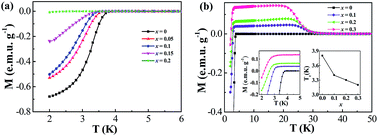
Fig. 3(a) shows the temperature dependence of susceptibility for zero-field-cooled (ZFC) V-doped samples at 40 Oe. In the high temperature range, the magnetic susceptibility is essentially flat and temperature independent, which is a Pauli paramagnet.5 Large diamagnetism due to superconductivity was observed and the temperature where the susceptibility starts to drop and deviate the temperature independent behaviour is defined as the Tonsetc. When x = 0, as is the case for SrAlSi, its Tonsetc is 3.8 K, which is close to the previously reported results.5 Furthermore, Tonsetc decreases monotonically as x increases. And when x reaches 0.2, the superconductivity almost disappears. In SrAl1−xVxSi, there only exists minor impurity SrAl2O4, which is a paramagnet15 and less than 3%. So we think that impurity SrAl2O4 will not affect the superconductivity. In addition, the measurements of magnetic susceptibility in SrAl1−xVxSi indicate a superconducting dome which is commonly observed in many superconductors. For example, BaAgxSi2−x2e which is a derivant of the AeMSi (Ae = Ca/Sr/Ba and M = Al/Ga) superconductors manifests a superconducting dome. When x changes from 0.2 to 0.4, the onset of superconducting transition varys from 3.19 K to 2.78 K, variation is about 0.4 K. When x increases to 0.5, the onset of superconducting transition drops to 1.22 K. The temperature dependence of ZFC magnetization for samples of SrAl1−xCrxSi, measured under the identical conditions as for V-doped samples, as shown in Fig. 3(b), where a magnetic transition signal at about 25 K is attributed to impurity SrCrO3.16 To see the variation of Tonsetc with Cr doping, a magnified magnetization curve around the Tonsetc is given in the inset of Fig. 3(b). It is noted that the Tonsetc just slightly decreases as x increases. When x increases to 0.3, Tonsetc reduces from 3.8 K to 3.2 K.
Fig. 4(a) displays the temperature dependence of electrical resistivity (ρ) for SrAl1−xVxSi compounds. At the same temperature, the electrical resistivity of SrAl1−xVxSi compounds with bigger x is larger than that with lower x. The increasing electrical resistivity might be attributed to the decreased carrier concentration which will be mentioned in the latter and the incensement of crystal defects induced by the more substitutions of V for Al sites. In the high temperature range, the resistivity of SrAl1−xVxSi varies smoothly. Sharp drops of resistivity due to superconductivity were observed with lowered temperature and the temperature where the resistivity start to drop and deviate the normal state behaviours is defined as the Tonsetc. Tonsetc decreases rapidly with the increasing content of V, which is consistent with the results in Fig. 3(a). When x = 0.2, superconductivity almost disappears although a weak superconducting phase remains which probably results from the inhomogeneous compositions in the sample. Fig. 4(b) displays the temperature dependence of electrical resistivity for SrAl1−xCrxSi samples with various Cr concentrations. The increasing electrical resistivity with higher Cr content might be attributed to the impurities and the incensement of crystal defects. It was observed that the transition temperature shifts to lower temperature with the increasing content of Cr. When x = 0.3, the transition temperature reaches 3.4 K, which is in good agreement with the results of the magnetism measurements.
In order to get insight into the doping effects, we investigate the carrier concentration of V-doped and Cr-doped samples by Hall effect measurements at room temperature, as shown in Table 3. For SrAl1−xVxSi, the carrier concentration is 2.7 × 10²¹ electrons per cm3 when x = 0, which is close to the concentration of CaAlSi.17 It decreases to 3.1 × 10²⁰ electrons per cm3 when x = 0.1 and continuously drops to 5.5 × 10¹⁸ electrons per cm3 when x = 0.2. In contrast, Cr dopant almost maintains the carrier concentration at the order of 1021 electrons per cm3 when x changes from 0 to 0.3 (shown in Table 4). These results are well explained by that the V atom has one less valence electron than the Cr atom.
| SrAl1−xVxSi | ||
|---|---|---|
| Nominal V content (x) | Measured V content (x) | Carrier concentration (electrons per cm3) |
| 0 | 0 | 2.7 × 10²¹ |
| 0.05 | 0.05 | 5.6 × 10²⁰ |
| 0.10 | 0.11 | 3.1 × 10²⁰ |
| 0.15 | 0.14 | 8.8 × 10¹⁸ |
| 0.20 | 0.16 | 5.5 × 10¹⁸ |
| SrAl1−xCrxSi | ||
|---|---|---|
| Nominal Cr content (x) | Measured Cr content (x) | Carrier concentration (electrons per cm3) |
| 0 | 0 | 2.7 × 10²¹ |
| 0.1 | 0.09 | 5.5 × 10²⁰ |
| 0.2 | 0.11 | 6.1 × 10²⁰ |
| 0.3 | 0.13 | 3.7 × 10²¹ |
In order to further explore the doping effects, the total and partial density of states of SrAlSi are calculated and plotted in Fig. 5. Prior to DOS calculation, we first made geometric relaxation by calculation based on density function theory. The lattice constants of SrAlSi are extracted to be a = b = 4.250 Å, c = 4.778 Å, which are slightly larger than the experimental data (aexp = bexp = 4.2415(4) Å, cexp = 4.750 Å). The errors are less than 1%, confirming the validity of our calculation. Partial density of states of SrAlSi indicates that all states included are strongly hybridized. Our calculated results for SrAlSi agree well with the previous ones.8a N(EF) would be affected by the doping of V/Cr inducing the shift of the Fermi energy of SrAlSi. We found a small peak in DOS above the Fermi level in SrAlSi, and the DOS at the Fermi level, N(EF), is 3.66 st. per eV per cell in SrAlSi. The decreasing carrier concentration through doping with V means that the Fermi surface is pushed to lower energy and results in the lower N(EF). Meanwhile, the N(EF) of SrAl1−xCrxSi is approximately the same to SrAlSi since the carrier concentration is almost unchanged through doping with Cr.
SrAlSi, which has a relatively high Tc among AeMSi (Ae = Ca/Sr/Ba and M = Al/Ga) system, is a typical BCS superconductor. To explain the effects of V and Cr doping on SrAlSi, the BCS theory is applied to show the variation trend of Tc. According to the BCS theory, Tc = 1.13 ΘD
exp (−1/N(EF)V), where ΘD is the Debye frequency, N(EF) is the electronic density of states at the Fermi level and V is the electron–phonon coupling potential. For SrAl1−xTmxSi (Tm = V/Cr), V are assumed to be constant since the actual doping content of Tm is less than 16%. In the case of SrAl1−xTmxSi (Tm = V/Cr), the incorporation of V and Cr will have nearly identical effect in decreasing ΘD, because the ΘD is proportional to M−1/2 (M is the atomic mass) and the atomic mass of V and Cr are nearly equal. In SrAl1−xCrxSi system, both the N(EF) and the Tonsetc are almost unchanged along with increased Cr dopants, indicating the ΘD has little influence on Tonsetc. Meanwhile, the carrier concentration in SrAl1−xVxSi is decreased about three orders of magnitude with doping and V dopants lead to the quenching of superconductivity. In contrast, Cr almost does not change the carrier concentration, leading to a minor change in Tonsetc of 0.6 K. With the comparison of SrAl1−xVxSi and SrAl1−xCrxSi, we can conclude that the N(EF) is the leading role of changing Tc in the AeMSi (Ae = Ca/Sr/Ba and M = Al/Ga) system. This result is consistent with the case of MgB2 superconductor. Slusky et al.18 found that introducing electrons into MgB2 through partial substitution of Al for Mg can rapidly destroyed superconductivity in MgB2. Our results provide solid evidences that the N(EF) should be responsible for the Tc in the transition metal doped AeMSi system.
Footnote |
| † Electronic supplementary information (ESI) available. See DOI: 10.1039/c6ra17081a |
| This journal is © The Royal Society of Chemistry 2016 |