
Zhifang Huang,
Yan Zhao*,
Yuehong Song,
Yawen Li,
Gongjuan Wu,
Hongjiao Tang and
Jingzhe Zhao*
College of Chemistry and Chemical Engineering, Hunan University, Changsha 410082, P. R. China. E-mail: zhaojz@hnu.edu.cn; Tel: +86-731-82548686
First published on 18th August 2016
The transformation process of cobalt hydroxide (Co(OH)2) to cobalt oxides (Co3O4/CoOOH) in aqueous solution was studied in the temperature range of 50–90 °C. The crystalline structures and morphologies of the samples were characterized by X-ray diffraction (XRD), Fourier transform infrared spectroscopy (FT-IR) and scanning electron microscopy (SEM) analysis. The OH−
:
Co2+ ratio and aging time influenced the transformation process from Co(OH)2 to final products. And the formation of hydrotalcite-like phase intermediate ([CoII1−xCoIIIx(OH)2](NO3)x·nH2O) is a crucial factor for synthesizing Co3O4. When the OH−
:
Co2+ ratio was in the range of 1.0
:
1–1.8
:
1, α-Co(OH)2 was oxidized to [CoII1−xCoIIIx(OH)2](NO3)x·nH2O at first, and then transformed to Co3O4 crystals. When the OH−
:
Co2+ ratio was in the range of 2.0
:
1–50.0
:
1, without the appearance of soluble Co(OH)42− ions in the reaction system before oxidation, fast conversion from α-Co(OH)2 to β-Co(OH)2 resulted in the formation of only CoOOH crystals, without the appearance of [CoII1−xCoIIIx(OH)2](NO3)x·nH2O or Co3O4 crystals.
Cobalt hydroxide Co(OH)2 has two polymorphs: α and β. α-Co(OH)2 crystals preserve a lamellar structure constructed by positively charged Co(OH)2−x layers and charge balancing anions (NO3−, CO32−, Cl−, etc.) between the layers.17,18 For β-Co(OH)2 crystals, Co–OH octahedral units (divalent cobalt cation six-fold coordinated by hydroxyl ions) share edges to produce 2D charge-neutral layers, and the layers stack one over the other without any anion.19 In principle, α-Co(OH)2 has more interesting interlayer character, however its metastable phase always performs rapid transformation to stable β phase in strong alkaline circumstances. With the presence of oxidants, Co(OH)2 (α or β phase) has opportunities to be oxidized to hydrotalcite-like phase [CoII1−xCoIIIx(OH)2](A)x·nH2O (A = NO3−, CO32−, Cl−), Co3O4 or CoOOH.20–24 Although great emphasis was made on material synthesis and characterization of cobalt oxides, researches on understanding phase transformation are relatively lacking.
In the present work, we performed a systematic investigation on the transformation of α-Co(OH)2 to β-Co(OH)2, and their oxidation to Co3O4 and CoOOH at low temperature of 50 °C. OH−
:
Co2+ ratio played a key role in the reaction processes. When OH−
:
Co2+ ratio was in the range of 1.0
:
1–1.8
:
1, α-Co(OH)2 transformed to Co3O4 with [CoII1−xCoIIIx(OH)2](NO3)x·nH2O as intermediate. When OH−
:
Co2+ ratio was larger than 2.0
:
1 and without the appearance of Co(OH)42− ions before oxidation, α-Co(OH)2 fast transformed to β-Co(OH)2 at the initial stage of the reaction, and CoOOH was the oxidation product.
:
Co2+ ratios of 1.0
:
1–50.0
:
1. Blue or pink precipitates formed after adding. When 0.5 mL of 30% H2O2 solution was subsequently added into the above suspensions, the blue or pink precipitates gradually turned to brown ones. The color change indicated the oxidation of CoII to CoIII by the uptake of H2O2. The reaction suspension was kept in a water bath of 50 °C for 5 h, black or dark brown precipitates formed at the end of the reaction. The precipitates were collected by vacuum suction filtration, washed three times with deionized water and finally dried in an air oven of 60 °C for 3 h.
:
Co2+ ratios of 2.0
:
1–50.0
:
1) resulted in rapid transformation from α-Co(OH)2 to β-Co(OH)2 within 2 min with blue precipitates (α-Co(OH)2) changing to pink ones (β-Co(OH)2), while low OH− introduction (OH−
:
Co2+ ratios of 1.0
:
1–1.8
:
1) only led to the appearance of blue α-Co(OH)2 before the oxidation process. Seven oxidized samples were obtained with OH−
:
Co2+ ratios of 1.0
:
1, 1.5
:
1, 1.7
:
1, 1.8
:
1, 2.0
:
1, 2.2
:
1 and 50.0
:
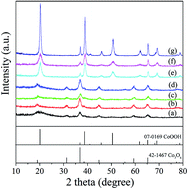
1. XRD patterns of the samples are given in Fig. 1, accompanied by standard data of Co3O4 (ICDD 42-1467) and CoOOH (ICDD 07-0169). The results reveal that samples with OH−
:
Co2+ ratios of 1.0
:
1–1.8
:
1 are Co3O4 crystals (Fig. 1a–d), and samples with OH−
:
Co2+ ratios of 2.0
:
1–50.0
:
1 are CoOOH crystals (Fig. 1e–g). Experiments with further increased OH−
:
Co2+ ratios (100
:
1 and 200
:
1) were also performed by our strategy, part of CoII existed as soluble Co(OH)42− ions besides Co(OH)2 precipitates in the reaction system before oxidation. Even though Co3O4 composition was not found in the final oxidation samples with OH−
:
Co2+ ratios of larger than 50.0
:
1, it would be possible to produce Co3O4 crystals if the reactions between Co(OH)42− and CoOOH could be accelerated by changing the reaction parameters, as reported in the literature.25 This part of work is still undergoing, and will be reported elsewhere.
![]() | ||
Fig. 1 XRD patterns of cobalt based samples with different OH− : Co2+ ratios. (a) 1.0 : 1; (b) 1.5 : 1; (c) 1.7 : 1; (d) 1.8 : 1; (e) 2.0 : 1; (f) 2.2 : 1; (g) 50.0 : 1. | ||
The morphologies of two typical samples (OH−
:
Co2+ ratios of 1.5
:
1 and 2.2
:
1) were characterized by SEM examination, the images in Fig. 2 demonstrate nanoparticles for Co3O4 crystals (OH−
:
Co2+ ratio of 1.5
:
1, sample S1) and nanoplates for CoOOH crystals (OH−
:
Co2+ ratio of 2.2
:
1, sample S2).
In order to examine the formation processes of Co3O4 nanoparticles and CoOOH nanoplates, time-dependent experiments were carried out on the basis of the two typical samples (samples S1 and S2). The existing time of Co(OH)2 precursor before oxidation is controlled to be 2 min for all the samples. One series of samples with OH−
:
Co2+ ratio of 1.5
:
1 were obtained at different oxidation time (0, 10, 30, 60, 90 and 180 min), which are assigned as samples S3, S4, S5, S6, S7 and S8 for clear explanation. Sample S3 with oxidation time of 0 min was caught when the blue precipitates first appeared in solution without H2O2 addition, XRD pattern in Fig. 3a shows that it is α-Co(OH)2 crystals before oxidation. Because α-Co(OH)2 crystals are not stable enough and convert easily into stable β-Co(OH)2 upon heating or exposing in air for long time, XRD detection for the sample were made on the wet precipitates without drying process. The four characteristic peaks at 11.3°, 22.7°, 33.9° and 60.1° correspond to (003), (006), (012) and (018) planes of α-Co(OH)2, which are similar to the results reported in literature.17,26
When the oxidation time is 180 min, the obtained sample S8 (Fig. 3f) exhibits a crystalline structure of Co3O4. All the XRD diffraction peaks are related to cubic phase Co3O4. When the oxidation time is in the range of 10–90 min, XRD patterns of samples S4–S7 (Fig. 3b–e) reveal mixed phases of Co3O4 and [CoII1−xCoIIIx(OH)2](NO3)x·nH2O. Diffraction peaks at 10.8°, 22.3°, 33.8° and 60.8° associate with [CoII1−xCoIIIx(OH)2](NO3)x·nH2O crystals, these peak locations are quite similar to those of α-Co(OH)2 crystals (Fig. 3a). The difference is that the peak around 11° for [CoII1−xCoIIIx(OH)2](NO3)x·nH2O shifts to lower angle compared to that of α-Co(OH)2. As reported in literature, α-Co(OH)2 and [CoII1−xCoIIIx(OH)2](NO3)x·nH2O crystals have similar lamellar structures with different interlayer distances.27,28 The interlayer spacings along [001] direction for α-Co(OH)2 and [CoII1−xCoIIIx(OH)2](NO3)x·nH2O are calculated to be 0.79 and 0.82 nm based on the peaks around 11° in Fig. 3a and b. The larger spacing of [CoII1−xCoIIIx(OH)2](NO3)x·nH2O would be due to more anions entering into the interstices of each two layers for balancing the charge of CoIII. From pattern b to e in Fig. 3, the intensities of [CoII1−xCoIIIx(OH)2](NO3)x·nH2O peaks decrease, while those of Co3O4 peaks increase. It demonstrates that the content of Co3O4 increases with oxidation time on the transformation from [CoII1−xCoIIIx(OH)2](NO3)x·nH2O. From the above results, we know that a phase transformation process α-Co(OH)2 → [CoII1−xCoIIIx(OH)2](NO3)x·nH2O → Co3O4 occurred in the preparation with OH−
:
Co2+ ratio of 1.5
:
1.
The transformation of α-Co(OH)2 → [CoII1−xCoIIIx(OH)2](NO3)x·nH2O → Co3O4 can also be confirmed by FT-IR results. Fig. 4 gives the FT-IR spectra of the six samples S3–S8 in the wavenumber range of 400–4000 cm−1. For all the samples, the wide absorption bands at 3423 and 1620 cm−1 correspond to the O–H vibrations of water molecules.29 The sharp 1384 cm−1 peaks in Fig. 4a–e indicate a certain amount of NO3− anions included in samples S3–S7, which are characteristic vibrations of intercalated NO3− between layers for α-Co(OH)2 and [CoII1−xCoIIIx(OH)2](NO3)x·nH2O crystals.30,31 No peak at this location in sample S8 demonstrates the disappearance of lamellar structure in Co3O4 crystals. On comparison between curves a–f in Fig. 4, we found differences existed in the low wavenumber region. For sample S3 (Fig. 4a), absorption peaks at 620 and 511 cm−1 are assigned to δ (CoII–O–H) and ν (CoII–O) vibrations of Co(OH)2, respectively.18,32 For sample S8 of Co3O4, two intensive absorption peaks locate at 667 and 580 cm−1 in the curve of Fig. 4f. The band at 667 cm−1 concerns CoII–O stretching vibration in tetrahedrally coordinated structures, and the band at 580 cm−1 is associated with CoIII–O stretching vibrations in octahedrally coordinated structures.33 For samples S4–S7, the curves b–e in Fig. 4 present two additional peaks at 562 and 512 cm−1 except the characteristic peaks of Co3O4, the two peaks are related to CoIII–O and CoII–O vibrations in hydrotalcite-like phase [CoII1−xCoIIIx(OH)2](NO3)x·nH2O.22 Thus, FT-IR results of the six samples also demonstrate mixed phases of [CoII1−xCoIIIx(OH)2](NO3)x·nH2O and Co3O4 in samples S4–S7.
SEM images of samples S3–S8 are shown in Fig. 5. For sample S3 of Co(OH)2 crystals, irregular plate-like structures prevail in the sample (Fig. 5a), and sample S8 of Co3O4 has the morphology of nanoparticles with tens of nanometers in size (Fig. 5f). Samples S4–S7 in Fig. 5b–e extends morphologies of nanoparticles distributed plate-like structures. According to the XRD results, the plates are assumed to be [CoII1−xCoIIIx(OH)2](NO3)x·nH2O crystals and nanoparticles are Co3O4. And with the oxidation time increasing from 10 min (sample S4) to 90 min (sample S7), nanoparticles increase in the samples with plate structures decreasing in size and amount. The above observations under OH−
:
Co2+ ratio of 1.5
:
1 at the temperature 50 °C evidence the transformation from α-Co(OH)2 plates to [CoII1−xCoIIIx(OH)2](NO3)x·nH2O plates, and finally to Co3O4 nanoparticles.
Time-dependent experiments were also performed under OH−
:
Co2+ ratio of 2.2
:
1, five samples were obtained at oxidation time of 0, 10, 30, 60 and 120 min under parallel reaction parameters as the typical sample in Fig. 2b (the oxidation time of the sample is 300 min). The samples are labeled as S9–S13 in the following parts. XRD patterns of samples S9–S13 are shown in Fig. 6 to unveil their crystalline structures. The initial Co(OH)2 (sample S9) is in β phase, and final oxidation sample is CoOOH (sample S13), as revealed from Fig. 6a and e. On observing the experimental phenomenon, we can see rapid change of blue precipitates to pink ones in tens of seconds. Samples S10–S12 with the oxidation time of 10–60 min are the mixture of β-Co(OH)2 and CoOOH. The results reveal that CoOOH crystals were transformed from β-Co(OH)2. Similar experiments under OH−
:
Co2+ ratio of 2.0
:
1 give results that the oxidation sample is the mixture of Co3O4 and CoOOH crystals with initial formed Co(OH)2 in mixed α and β phases (Fig. 7).
![]() | ||
Fig. 7 XRD patterns of samples obtained at different oxidation time with OH− : Co2+ ratio of 2.0 : 1 at 50 °C: (a) 0 min, (b) 10 min, (c) 30 min, (d) 60 min and (e) 120 min. | ||
On the basis of the above results, a conclusion can be made that OH−
:
Co2+ ratio (actually OH− amount for fixed Co introduction) influences two transformation processes, one is the transformation from α- to β-Co(OH)2, the other is the oxidation process from Co(OH)2 to oxidation substances (Co3O4 or CoOOH). The transformation mechanism under different OH−
:
Co2+ ratios are illustrated in Fig. 8. When OH−
:
Co2+ ratios are smaller 2.0
:
1, the transformation of α- to β-Co(OH)2 is slow, thus α-Co(OH)2 remains longer time in solution, the succeeding oxidation begins from α-Co(OH)2, leading to the formation of Co3O4 with [CoII1−xCoIIIx(OH)2](NO3)x·nH2O as intermediate in the process. When OH−
:
Co2+ ratios are in the range of 2.0
:
1–50.0
:
1, the transformation to β-Co(OH)2 is fast that the oxidation reaction begins with β-Co(OH)2 as the precursor, and CoOOH is the oxidation product. From the analysis, the composition and crystalline structure of final oxidation samples are determined by the type of initial formed Co(OH)2, α-Co(OH)2 tends to be oxidized to Co3O4, and β-Co(OH)2 has a tendency to CoOOH. The results can be explained on examining the crystal structures of α-/β-Co(OH)2, [CoII1−xCoIIIx(OH)2](NO3)x·nH2O, Co3O4 and CoOOH crystals. The simulated crystalline structures of the cobalt compounds along the same directions are also given in Fig. 8. The intermediate [CoII1−xCoIIIx(OH)2](NO3)x·nH2O has similar crystalline structure as α-Co(OH)2, combined valences of cobalt element in one compound of hydrotalcite-like phase are of beneficial to the formation of Co3O4. Similar interlayer spacing in lamellar structures led to the oxidation of β-Co(OH)2 to CoOOH.
We also did time-dependent experiments at elevated temperature (90 °C) under OH−
:
Co2+ ratio of 1.5
:
1. The existing time for Co(OH)2 precursor was still controlled to be 2 min, we got β-Co(OH)2 crystals (pink precipitates) at this situation of 90 °C before 0.5 mL of oxidation reagent H2O2 was added to the reaction system, XRD pattern of the sample is given in Fig. 9a. The phenomenon is different from the achievement of α-Co(OH)2 crystals (blue precipitates) at 50 °C. It means the transformation from α-Co(OH)2 to β-Co(OH)2 is faster at elevated temperatures. As concluded above, the oxidation product from β-Co(OH)2 should be CoOOH. However, from the XRD results of Fig. 9b–f at different oxidation time (10–120 min), we found sequent appearance of CoOOH and Co3O4 in the samples, and the final oxidation sample for 180 min is pure Co3O4 crystals. The results also obey the rule we expressed above. CoOOH crystallites can be found in the samples of short oxidation time (Fig. 9b and c), which were originated from the oxidation of β-Co(OH)2. The formed CoOOH further reacted with the superfluous Co2+ in solution to form Co3O4. We verified the conclusion by doing experiment on pure CoOOH crystalline precipitates and Co2+ solution, Co3O4 crystals were obtained from the experiment. The results reveal that Co3O4 crystals can be prepared from β-Co(OH)2 precursor only when residual Co2+ ions are present in solution.
![]() | ||
Fig. 9 XRD patterns of samples obtained at different oxidation time with OH− : Co2+ ratio of 1.5 : 1 at 90 °C: (a) 0 min, (b) 10 min, (c) 30 min, (d) 60 min, (e) 120 min and (f) 180 min. | ||
:
Co2+ ratios. When OH−
:
Co2+ ratios are in the range of 1.0
:
1–1.8
:
1, the initial formed α-Co(OH)2 was first oxidized to a hydrotalcite-like phase in which both Co2+ and Co3+ are present, then it transformed to Co3O4 for prolonged reaction time. When OH−
:
Co2+ ratios are in the range of 2.0
:
1–50.0
:
1, no soluble Co(OH)42− ions were present in the reaction system before oxidation, the transformation rate of α-Co(OH)2 to β-Co(OH)2 was fast, thus the oxidation process begun from β-Co(OH)2, and CoOOH was the oxidation product. The oxidation substances of Co2+ are tightly related to the type of the initial formed Co(OH)2, which can be explained on the basis of crystalline structures of Co compounds.
| This journal is © The Royal Society of Chemistry 2016 |