Ziyu Wang,
Hua Zhang,
Linlin Xu,
Ziwei Wang,
Dameng Wang,
Xiangdong Liu and
Ming Chen*
School of Physics, Shandong University, Jinan 250100, China. E-mail: chenming@sdu.edu.cn
First published on 29th August 2016
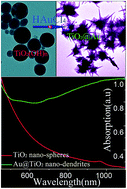
In this report, highly branched Au@TiO2 nano-dendrites with a tailored surface topography have been conveniently fabricated via a novel and effective laser-induced strategy. The TiO2 nanospheres fabricated by laser ablation of the Ti target in H2O2 solution are characterized by abundant oxygen vacancies (OVs) on the (110) surface. Then, the hydroxyl radical (OH−) groups will be easily formed on the OVs in terms of water dissociation by UV laser irradiation of the TiO2 nano-spheres at the liquid interface. With the aid of OH− groups, the formation of Au@TiO2 nano-dendrites is based on the overgrowth of gold on the TiO2 nano-spheres through the reduction of HAuCl4. The absorption spectra of Au@TiO2 nano-dendrites show that localized surface plasmon resonance (LSPR) peaks can be effectively modulated from the visible region (∼545 nm) to the near-infrared region (NIR ∼ 1090 nm). The as-prepared Au@TiO2 nano-dendrites with excellent NIR absorption properties have a promising potential for developing important novel sensors and super photo-catalysts.
Most recently, noble metal bimetallic nano-dendrite/hyper-branch structures with controllable branch lengths, such as Au@Pd,9–11 Au@Au,12 Au@Pt,13 etc., exhibited good plasmonic properties, high-performance H2O2 sensing and excellent catalytic activities, because their LSPR peaks can be modulated from the visible to the NIR region. It is noted that previous reports mainly focused on the synthesis of isolated Au island-like structures on the TiO2 precursors.5–8 If the Au nano-branches can be linked on the TiO2 nano-structures, the novel hybrid nano-composites should possess superior catalytic performances than the Au island-structure, due to the longitudinal plasmonic properties. Up to now, there are very few reports on the controllable synthesis of Au@TiO2 nano-dendrites. The main reason is related to the fact that the inevitable large mismatch of crystal lattices between Au and TiO2 composites, which will limit the overgrowth of Au branch on the TiO2 surface.2–4
It is well known that the oxygen vacancy (OV) will be easily generated on the TiO2(110) surface by UV light irradiation, resulting in abundant hydroxyl radical (OH−) groups formed and embedded on the surface (110).14–20 Taking advantage of the enough OH− groups embedded on the TiO2(110) nano-structures, we deduce that the oriented crystal growth of Au composite on TiO2 surface will occur by the reduction of HAuCl4 with surface OH− groups. Herein, for the first time, we demonstrate an innovative synthetic approach for the formation of novel Au@TiO2 nano-dendrites with controllable surface structures. The adopted strategy is based on laser-induced fabrication of TiO2(110) nano-spheres in H2O2 solution, and then the UV-laser irradiation of TiO2. The H2O2 provides the oxygen sources, which is environmentally friendly and has negligible toxicity. Laser fabrication in liquid is a new green technology for the synthesis of novel metal stable phase of materials, which is characterized by unique high non-equilibrium processing with high temperature and pressure.21–27 This is a breakthrough in the toxicity problems that arise from standard chemical fabrication. In this way, the TiO2(110) nano-spheres are helpful for the generation of abundant OH− groups via UV-laser irradiation in liquid. It is therefore possible to tailor the morphology of the Au@TiO2 branches over a broad range by changing irradiation time. Moreover, the LSPR peaks of the as-prepared Au@TiO2 nano-dendrites can be modulated from the visible (∼545 nm) to the near-infrared region (NIR ∼ 1090 nm). There is no doubt that the present results in this paper will be a breakthrough in the fabrication of noble metal–metal oxide semiconductor with hyper-branched structures.
000 rpm for 10 min in an ultracentrifuge, and the precipitates were carefully washed in distilled water three times. The sediments were dropped on a copper mesh and dried in an oven at 60 °C for observation by transmission electron microscopy (JEOL-JEM-2100F). Morphological investigations and chemical composition measurements were performed by field emission scanning electron microscope (SEM, Hitachi S-4800) equipped with energy-dispersive X-ray spectroscopy (EDS). And the crystallographic investigation of the TiO2 fabricated by laser ablation was analyzed by X-ray diffraction (XRD) patterns (Rigaku, RINT-2500HF) using Cu Kα radiation (λ = 0.15406 nm). The Fourier transforms infrared spectra (FTIR) of the TiO2–OH groups dried in vacuum at 60 °C were measured by a UV-vis-NIR spectrometer (Shimadzu, UV-1700). Finally, the UV-visible-NIR absorption spectra of Au@TiO2 nano-dendrites were measured with UV-vis-IR spectrometer (Shimadzu, UV-1800).
:
1 according to the EDS result, which is obviously different from a common TiO2 material. Because some light elements, such as hydrogen, cannot be detected in EDS pattern, the existence of extra oxygen element originated from OH− groups was evidenced by the FTIR spectra. FTIR spectrum of the same product in Fig. 1(d) shows that this spectrum (1000–4000 cm−1) is dominated by the broad band with peak at 3436 cm−1 of the strongly adsorbing OH stretching vibrations and relatively sharp peaks at 1636 and 1437 cm−1 of OH bending mode. In addition to the TiO2 lattice vibrations at about 670 cm−1, the several improved FTIR spectra from OH− groups combined with the obvious higher O element in the products confirm that abundant OH− groups can be indeed embedded on the TiO2 nano-spheres by UV-light irradiation. Increasing the irradiation time should result in more OH− groups formed on the TiO2 structures, which can be confirmed by measuring the PH value of the TiO2 water solution. It is well known that the hydroxyl radicals can be weakly ionized in the water solution, resulting in some hydrogen ions formed in the liquid. As shown in Fig. S1,† the PH value of the TiO2 solution linearly decreases from about 6.76 to 5.38 with an increase of irradiation time (0–120 min), implying more hydrogen ions formed in the solution. In this way, it is therefore to deduce that a longer irradiation time can lead to more OH− groups formed on the TiO2 structures.
The evolution and modification of the TiO2 nano-structures by using UV-laser irradiation are illustrated by the high-resolution transmission electron microscopy (HRTEM) of the products before and after irradiation for 120 min. The HRTEM images in Fig. 2(a and b) clearly reveal that the well crystalline of the TiO2(110) structure with a periodicity corresponding to a d-spacing of 0.325 nm can be de-crystallized after UV-laser irradiation, resulting in some amorphous or distortion structures. The distortion structures should be attributed to the formation of OH− groups on the TiO2 nano-spheres. The possible TiO2–OH structure growth processes have been proposed in a schematic growth diagram, as shown in Fig. 2(c). At the moment of pulse laser arriving at Ti target, rapid boiling and vaporization of Ti element will occur, resulting in the nucleation of explosive Ti plasma with O element in H2O2 solution. After laser ablation (∼6 ns), the rapid quenching process enables the disorder degrees of Ti and O species to become more and more intensive, which makes O species at a highly excited state. Under the UV-laser irradiation of the as-prepared TiO2(110) nano-spheres, oxygen vacancy (OV) sites can thus be expected to occur on the rutile surface owing to the photo-induced hole–electron pairs, which is a ubiquitous feature in nature.12–17 Compared with commercial TiO2 nano-particles, the degree of OV sites will be significantly enhanced due to the unique active O species generated in TiO2 nano-spheres during laser ablation, leading abundant/enough OV sites formed on the surface. The abundant OVs will then act as adsorption sites for surrounding H2O molecules, and then the hydrophilic nature of the TiO2 surface increases remarkably.12–20 Meanwhile, the photo-induced holes enable the water dissociation to dominate the following process. The longer UV-irradiation time can lead to an increase in the number of surface OH− groups. The inset in Fig. 2(c) shows that the UV-laser irradiation for 120 min leads to an obvious change in the colloidal suspension color from light yellow to dark yellow, which is a reasonable evidence for the formation of abundant OH− groups embedded on the TiO2 nano-spheres. The unique TiO2 nano-sphere with enough OH− groups embedded on the surface is highly dependent on the enhanced active O species and subsequent UV-laser irradiation. Finally, interesting chemistry can thus be expected to occur at the abundant surface OH− groups on the TiO2 nano-spheres.
The abundant/enough OH− groups formed on the surface of TiO2 nano-spheres play a crucial role in the production of Au@TiO2 nano-dendrites. To verify it, the as-prepared TiO2 nano-spheres without any UV-laser irradiation were selected as the precursor for the fabrication of Au@TiO2 nano-composites through the reduction of HAuCl4. As shown in Fig. 3(a and b), isolated island-shaped Au nano-structures were formed on the TiO2 nano-spheres, which is similar to the previous reports.1–7 The typical region in Fig. 3(c) with a d-spacing of 0.235 nm could be indexed as the Au(111) plane structure. The large mismatch of crystal lattices between Au and TiO2 is considered to be the main reason for the formation of island-shaped Au structures. The LSPR spectra of the TiO2, two Au@TiO2 nano-composites by using 20 and 70 μL HAuCl4 are shown in Fig. 3(c). The increasing HAuCl4 concentration improved the peak intensity of Au particle-structure at about 530 nm. There are no red-shifted spectra in the different nano-composites. The Au@TiO2 nano-dendrites with obvious hierarchical branches cannot be generated owing to the inadequate OH− groups in the precursors.
Then, based on UV-laser irradiation for 60 min, the TiO2 nano-spheres with OH− groups embedded on the surfaces were adopted as the precursors for the fabrication of Au@TiO2 hybrid nano-materials. The obtained novel nano-structures by using 20 μL and 100 μL HAuCl4 are shown in Fig. 4(a and b). The low-magnification TEM image in Fig. 4(a) displays that the hybrid nano-materials appeared to be complex nano-structures with dense core and hierarchical branches. The inset shows that the typical small branch with a d-spacing of 0.235 nm can be indexed to be the (111) plane of the Au structure. Moreover, enlarged and high-magnification TEM images in Fig. 4(b and c) illustrate that the higher HAuCl4 concentration (100 μL) enables the Au@TiO2 nano-dendrites to possess more clearly hyper-branched surface structures. Compared with the nano-dendrites in Fig. 4(a), the branch length significantly increases from about 35 nm to approximately 75 nm by measuring the size of more than 200 particles in sight of the TEM images. The Au(111) structure is also illustrated in Fig. 4(d). The unique optical properties of the as-prepared Au@TiO2 nano-dendrites with controllable branch lengths are illustrated by the UV-visible absorption spectra in Fig. 4(e). The direct photographs of the TiO2 nano-spheres and the Au@TiO2 nano-dendrites (inset in Fig. 4(e)) show that Au branch-structures lead to a significant change in the colloidal solution color from dark yellow to grey brown. The absorption spectra of the Au@TiO2 nano-dendrites illustrate that the LSPR peaks distinctly red shifted from the visible ∼545 nm to about 806 nm with an increase of HAuCl4 content during the reduction process.
Finally, we further increase the UV-laser irradiation time to 120 min in order to get the TiO2 nano-spheres with abundant/enough OH− groups. By using 100 μL HAuCl4 in the overgrowth process, the low- and high-magnification TEM images in Fig. 5(a–d) clearly show that highly branched Au@TiO2 nano-dendrites can be obtained by using TiO2 nano-spheres with abundant OH− groups. Compared with the nano-dendrites in Fig. 4, the branch is highly elongated by using the co-reduction of HAuCl4 with enough surface OH− groups in the precursors, as shown in Fig. 5(b and c). Meanwhile, Fig. 5(d) reveals that the Au(111) structures can also be formed on the Au branches. Moreover, the elemental mapping images of the typical Au@TiO2 nano-branched structure in Fig. S2† show that the hybrid nano-dendrite is indeed composed of Au, Ti and O elements, and the corresponding relative ratio is about 75
:
8
:
17, respectively. Then, the Au content in the Au@TiO2 nano-branched structure is about 75%. The elemental mapping images can also provide detailed information of the elements distributions in the branched nano-structures. We found that the Ti and O elements can be detected in core region, and Au element was formed on the outside. The detailed structure-evolutions of Au@TiO2 nano-dendrites obtained from a same amount (100 μL) of HAuCl4 in each experiment but different UV-laser irradiation times (0–120 min) were shown in Fig. S3.† The experimental results are obtained by measuring the Au contents and the Au branch lengths of more than 200 particles in sight on the elemental mapping images and TEM images, respectively. As illustrated in Fig. S3(a and b†), the results clearly reveal that both the average Au content and Au branch length in the hybrid Au@TiO2 nano-structures obtained from a some amount Au source increase linearly with an increase of irradiation time. Increasing irradiation time (0–120 min) result in the more OH− groups formed on the surface of TiO2 structures. Therefore, the results in Fig. S3(a and b†) show that the mean Au content and Au branch length separately increases from about 11% and 24 nm to 75% and 167 nm with an increase of irradiation time (0–120 min), respectively. The above results show that the amount of OH− groups plays an important role in the formation of higher branched Au@TiO2 nano-dendrites. Then, the UV-visible absorption spectra of the hyper-branched Au@TiO2 nano-dendrites are illustrated in Fig. 5(e). It is interesting to note that the LSPR peaks can be modulated from the visible ∼545 nm to the NIR region ∼1090 nm with the increase of the HAuCl4 content (20–100 μL) during the overgrowth process. The enhanced NIR absorption property should be attributed to longitudinal plasmon wavelength of the Au elongated branches on the TiO2 nano-dendrites. It is reasonable to deduce that the highly branched Au@TiO2 nano-dendrites with excellent NIR absorption properties will be very suitable for developing super-active photo-catalysts, novel solar cells, and biomedical sensor, etc.
Footnote |
| † Electronic supplementary information (ESI) available: The pH value of the TiO2 solution versus the UV-laser irradiation time. The typical TEM images and corresponding elemental mapping images of the Au@TiO2 nano-dendrites obtained by UV-laser irradiation for 120 min and using 100 μL HAuCl4. The structure-evolutions of Au@TiO2 nan-dendrites obtained from a same amount (100 μL) of Au sours in each experiment versus UV-laser irradiation time. See DOI: 10.1039/c6ra15398d |
| This journal is © The Royal Society of Chemistry 2016 |