
Il-Han Yooa,
Shankara S. Kalanura,
Sang Yeon Leea,
Kiryung Eoma,
Hyeongtag Jeon*b and
Hyungtak Seo*a
aDepartment of Energy Systems Research and Department of Materials Science & Engineering, Ajou University, Suwon, 16499, Republic of Korea. E-mail: hseo@ajou.ac.kr
bDivision of Materials Science & Engineering, Hanyang University, Seoul, 04763, Republic of Korea. E-mail: hjeon@hanyang.ac.kr
First published on 26th August 2016
Cu2O is a good candidate material for use as a p-type absorber in solar cells. Here, uniform ZnO nanorod (NR)–Cu2O core–shell structures are fabricated and their diode performances are studied. ZnO NRs are grown on fluorine-doped tin oxide (FTO) glass using a hydrothermal method. Cu2O is then deposited on the ZnO NRs using bottom-up RF magnetron sputtering. The crystal structures of the deposited ZnO NRs and Cu2O are characterized using X-ray diffraction. From secondary electron microscopy analysis, the uniform core–shell structure and its size are identified. UV-vis spectroscopy measurements show that the optical bandgap of the Cu2O in this structure is 2.3 eV. The diode characteristics of the fabricated nanostructures depend on the thickness of Cu2O; 2.7 μm-thick Cu2O on ZnO NRs shows diode properties. Lastly, we propose a band alignment model based on X-ray photoelectron spectroscopy analysis and demonstrate a possible approach for fabricating CuxO–ZnO nanohybrids for further improvements to device efficiency, highlighting a need for interfacial band offset medication for oxide heterojunction solar cells.
In this study, uniform ZnO nanorod (NR)–Cu2O core–shell structured solar cells are fabricated and characterized. ZnO NRs are grown on fluorine-doped tin oxide (FTO) using a hydrothermal method, and Cu2O is deposited on the ZnO NRs using RF magnetron sputtering. Atomic layer deposition (ALD) is generally used to make uniform core shell structures,19,20 but it is difficult to deposit thicker Cu2O films (>1 μm) as absorber layers using ALD. Therefore, in this study, bottom-up sputtering is used to obtain thick uniform Cu2O shell structures on ZnO NRs in an effort to create 3D interfacial p/n junctions. The diode characteristics and solar cell properties are evaluated, and the interfacial band alignment is analyzed.
:
O2 (50
:
0–50
:
1.5) reactive mixtures. The applied RF power was 150 W under 10 mTorr working pressure.23
The morphology and core–shell structures of the samples were measured by field emission scanning electron microscopy (SEM) (JEOL JSM-6700F Japan, Hitachi S-4300SE Japan). X-ray diffraction (XRD) measurements were obtained using a Rigaku MiniFlex-II desktop X-ray diffractometer (Japan). Ultraviolet-visible (UV-vis) absorption spectra and optical bandgaps were recorded using an Avantes spectroscopy system with an AvaLight-DH-S-BAL balanced power source and AvaSpec-ULS2048 Starline versatile fiber-optic spectrometer detector (Netherlands). Surface chemical binding states, valence band-edge states, and depth profiles were measured by X-ray photoelectron spectroscopy (XPS) (theta probe base system, Thermo Fisher Scientific Co. USA). Diode properties of the samples were characterized in the probe station by measuring electrical conductivity using a Keithley 4200-SCS apparatus (USA). Diode properties were measured with linear sweep from 0 V to −10 V and from 0 V to 10 V consecutively by the step of 0.1 V. Diode cells were made by depositing Ni in 100 μm dots on the ZnO NR/Cu2O using an e-beam evaporator. IPCE analysis was performed at the probe station using a homemade optical setup using monochromatic light from a 300–1000 nm form xenon lamp. A standard Si solar cell (BS-500, BUNKOUKEIKI Co., Japan) was used to calculate the IPCE. The photocurrent response under 1 sun conditions was measured using an Ivium technologies Ivium-n-Stat (Netherlands) with a constant applied potential of 0 V by blocking and passing the light.
:
O2 ratio (50
:
0–50
:
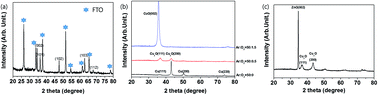
1.5) forms different copper oxides with varying x values. Fig. 1 shows XRD patterns of the synthesized ZnO NRs on FTO and sputtered CuxO samples with varying x ratios. Cu2O was obtained at a 50
:
0.5 sccm Ar
:
O2 ratio (JCPDS-01-071-3645), and this ratio was used to make our nanostructures.
![]() | ||
Fig. 1 XRD results of (a) ZnO NRs and (b) Cu2O film as a function of various Ar : O2 ratios during RF sputtering (c) ZnO NRs/Cu2O structure. | ||
The surface morphology and thickness of the deposited Cu2O film were analyzed using SEM. Fig. 2 shows a cross-sectional SEM image of Cu2O deposited on FTO at different deposition times. Cu2O thickness is dependent on sputtering time based on these data, and the growth rate was estimated to be ∼30 nm min−1. In addition, the deposited films have no pores or voids, and hence are suitable for use as diode junctions. Fig. 3 shows cross sectional SEM images of Cu2O deposited on ZnO nanorods. From these, the amount of Cu2O on ZnO can be easily controlled by the sputtering process. After 30 min of deposition time, a thick layer of Cu2O is already formed. The overall thickness of the nanostructure is 816 nm. At this deposition time, the deposited Cu2O is uniform across the entire ZnO nanorod. When the deposition time is increased to 1.5 h, a much thicker Cu2O layer is formed (approximately 2.7 μm). Under these conditions, Cu2O is deposited more heavily on top of the nanorod compared to the bottom. These deposition conditions preferentially fill the upper side of the nanorod structure, leaving empty regions at the bottom. This demonstrates the advantage of the present method in controlled deposition of Cu2O by RF magnetron sputtering.
![]() | ||
| Fig. 2 Cross-sectional SEM images of Cu2O films as a function of deposition time at (a) 10 min (286 nm), (b) 30 min (816 nm), (c) 1 h (1.8 μm), and (d) 1 h 30 min (2.7 μm). | ||
The optical absorbances of the prepared heterojunctions were measured. UV-vis analysis was conducted to measure the light absorbance of the ZnO NRs and Cu2O-deposited samples (Fig. 4). ZnO NRs on glass show a bright gray color and highly visible light transmittance. The Cu2O deposited sample, however, shows a brown color and has high absorbance in the ultraviolet-visible range, with a wide band from 250 nm to 800 nm. This shows that the present heterojunction can effectively absorb visible light. As shown in the inset image in Fig. 4, Cu2O-deposited ZnO NR samples deposited at 30 min with 286 nm thickness effectively absorb visible light and with relatively low transmission. From the optical absorbance data, the optical bandgap was plotted using Tauc plots (Fig. 5) as expressed by
versus hν curves for the band alignment model. Tauc plots were plotted with n = 1/2 (in the case of direct bandgap) where α is the absorption coefficient calculated from absorption spectra and photon energy.24,25 The optical bandgaps of ZnO and Cu2O were 3.25 eV and 2.25 eV, respectively.
![]() | ||
| Fig. 4 UV-vis spectra of ZnO NRs and Cu2O film (thickness = 286 nm) with digital images of the samples. | ||
The fabricated ZnO NR/Cu2O heterojunction was further analyzed to determine its I–V characteristics. From I–V measurements (Fig. 6(a)), it was confirmed that the device forms p–n junctions, showing diode rectifying ZnO as an n-type semiconductor,26,27 and Cu2O as a p-type semiconductor formed by controlling the oxygen stoichiometry during sputtering deposition. Because the properties of the final NR structure are dependent on the thickness of the deposited Cu2O (for the diode), Cu2O deposited for 10 min to a thickness of 286 nm has a limited local electrical connection in the upper region of the ZnO NR. Here, the current rises at positive potentials to a similar magnitude as the negative potential, suggesting that diode behavior was not achieved with 286 nm-thick Cu2O. However, for the diode with a Cu2O layer 2.7 μm thick, regular diode properties emerged. This diode characteristic of the device was mainly dependent of Cu2O thickness which is investigated in this study and found out that the Cu2O which the less than 1 micrometer did not showed convinced p–n junction characteristic while thickness more than 1 micrometer showed significant p–n junction property. Fig. 6(b) shows a rectification factor that is calculated by the ratio of reverse current (+bias polarity) to forward current (−bias polarity) as a function of applied voltage. Here, the rectification factor has a value between 0.14 and 90.57, and incrementally improved at high voltages. This bias-related change to the rectification factor is possibly due to the different charge emission mechanism as a function of voltage bias under a forward current. In particular, a potential difference predicted by a band-offset of the Cu2O/ZnO conduction band and valence band is approximately −5 V at the interface, which matches with the forward current onset bias at −5 V in Fig. 6(a).28
![]() | ||
| Fig. 6 (a) I–V curves of ZnO/Cu2O core–shell structures with 286 nm and 2.7 μm Cu2O thickness and (b) rectification factor as a function of applied bias. | ||
Solar cell properties of the ZnO/Cu2O nanostructures were evaluated by measuring the transient photocurrent and IPCE (incident photon-to-current efficiency) at 1 sun conditions (Fig. 7). Its properties were measured by on/off switching every 10 s in 1 sun conditions, in order to determine the reversibility of photo-carrier generation and recombination. From Fig. 7(a), no noticeable residual photocurrent lag was present during the on/off transition step, meaning that there is no significant photocurrent trapping in the diode. The approximate efficiency of the solar cells was calculated from IPCE measurements. From the IPCE (Fig. 7(b)) and absorbance (Fig. 4) data, we can define the effective visible light absorbance range (380–510 nm), generating a relatively high photocurrent with a maximum IPCE of approximately 4% at 406 nm. The comparison of IPCE values of the reported methods and our result are tabulated in Table 1.
![]() | ||
| Fig. 7 (a) Dark and photocurrent on/off under 1 sun conditions and (b) IPCE of ZnO/Cu2O core–shell structured solar cell. | ||
| Materials | Method | IPCE (%) | Reference |
|---|---|---|---|
| Patterned ZnO NRAs/Cu2O | Hydrothermal/electrodeposition | 58 | 15 |
| ZnO/Cu2O planar | ALD/thermally oxidize | 78 | 12 |
| AZO/Cu2O planar | DC sputter/electro deposition | 90 | 5 |
| Cu2O/ZnO planar | Electrodeposition/electrodeposition | 58 | 8 |
| ZnO nanotube/Cu2O | Electrodeposition/electrodeposition | 25 | 18 |
| Cu2O/ZnO nanorod | Electrodeposition/hydrothermal | — | 11 |
| ZnO nanorod/Cu2O | Hydrothermal/RF magnetron sputter | 4 | Present work |
The XPS depth profiles of the ZnO NR/Cu2O heterojunctions were measured (Fig. 8). 30 nm Cu2O was deposited on ZnO NRs for XPS measurement. The Ar sputtering conditions were 0.2 nm s−1 deposition rate (referenced to SiO2) and a sputtering area of 1 mm2. As the etch time increased, the Zn 3d5/2 binding energy at 9.23 eV and Zn 3p3/2 binding energy at 88.8 eV increased, suggesting an approach of depth position to ZnO interface. In addition, the Cu 3p binding energy at 74.83 eV decreased as the etch time increased. In this XPS depth profile, a 5 s etch time was considered as bulk Cu2O. Because of the nanostructure's geometric characteristics, the Cu peak is present during the first 120 s of etching, denoting the interface of the ZnO NR/Cu2O heterojunction.29 For the band alignment model, the valence band maximum (VBM) change was analyzed, showing a slight shift to a higher binding energy as etching occurred. No significant change in the VBM was observed, as the ZnO NR/Cu2O interface continues due to longitudinal interface effects along the ZnO nanorods sidewalls.
VBM was obtained separately for the planar Cu2O film and ZnO NR to determine the valence band offset by XPS analysis. Fig. 9(a) shows VBM values of bulk Cu2O and ZnO NRs as 0.5 eV and 1.75 eV, respectively. Using similar experimental extraction and optical bandgap conditions (Fig. 5), a band alignment model with conduction band offset (CBO), valence band offset (VBO) and band bending structure is suggested. VBO (ΔEv) is calculated using Kraout's theory as shown in eqn (1) and (2)
| ΔEv = EBVB − EAVB + [(EACL − EA/BCL) + (EB/ACL − EBCL)] | (1) |
| ΔEC = EBg − EAg + ΔEv | (2) |
![]() | ||
| Fig. 9 (a) Valence band-edge XPS spectra of ZnO NRs and bulk Cu2O and (b) electronic band alignment of ZnO NR/Cu2O heterostructure constructed by XPS data. | ||
From this band alignment model, we determined a high spike barrier height between the ZnO NRs and Cu2O at the conduction band and the valence band. This small spike barrier is more suitable for solar cells than cliff barriers or no offset, but too high of a spike can disrupt the carrier flow and decrease the photocurrent efficiency.32,33 From this, we could assume that this band structure has too high of a spike at the valence band and conduction band, and photogenerated currents become blocked at this spike. Therefore, this result strongly suggests that a significant modification of the interfacial band offset is needed for Cu2O/ZnO heterojunction stacking in solar cell applications. This task may be related to the surface control of ZnO (i.e., O- or H-polar surface termination)34,35 and Cu2O (i.e., CuO subphase formation at the surface).36
| This journal is © The Royal Society of Chemistry 2016 |