
Yuanyuan Cui,
Xi Chen and
Wei-Lin Dai*
Department of Chemistry & Shanghai Key Laboratory of Molecular Catalysis and Innovative Material, Fudan University, Shanghai 200433, P. R. China. E-mail: wldai@fudan.edu.cn; Fax: +86 021 5566 5572; Tel: +86 021 5566 4678
First published on 15th July 2016
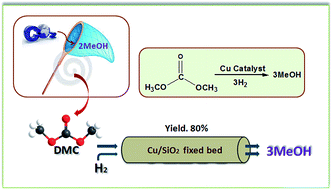
Catalytic mild hydrogenation of carbonates synthesized from the CO2 captured by alcohols is of significant interest both conceptually and practically, which provides alternative approaches to the indirect hydrogenation of CO2 to methanol. However, the catalytic efficiency of the process of dimethyl carbonate (DMC) hydrogenation still remains unsatisfactory. Unprecedented gas–solid phase fix-bed catalyzed hydrogenation of DMC to methanol has been made. Herein, we address this issue with facile Cu/SiO2 catalysts, reaching complete conversion and highly selective formation of methanol (up to 80% yield) under mild conditions (503 K, 2.5 MPa), which is the highest yield that has been reported. Characterization results indicate that the copper dispersion and the synergetic effect between balanced Cu0 and Cu+ sites are considered to play critical role in attaining high yield of methanol. The optimized Cu/SiO2 catalyst displayed excellent catalytic performance in the hydrogenation of diethyl carbonate (DEC) and di-n-propyl carbonate (DPC) as well, presenting a broad substrate scope. Moreover, the comparative catalytic activity (∼76% methanol yield) in the hydrogenation of DMC under solvent-free conditions shows promise for its scalable application in industry.
O bond.3 As we know, traditional industrial Cu/ZnO/Al2O3 exhibits promising performance for MeOH production from CO and H2 (syngas) with a space-time yield up to 0.842 gMeOH gCat−1 h−1 under certain conditions, and this process is the dominant one for MeOH production.4 However, syngas is a synonym of “fossil carbon”, as it is generated from fossil fuels, like coals, crude oils and CH4. Along with the resource exhaustion, the need to reduce the emission of carbon dioxide into the atmosphere is pushing toward the use of “renewable carbon”, so to avoid as much as possible burning “fossil carbon”.5 Thus, it would be more valuable to develop new industrial processes for converting CO2 that can be captured from atmosphere into “working carbon”. The solar-driven reduction of CO2 into chemicals and fuels such as formic acid, methane or methanol has been considered as a promising approach to address the problems of global warming and energy crisis.6 However, most of reported solar-active catalysts for CO2 photo-reduction suffer from low energy conversion efficiency, uncontrollable selectivity, instability and incapability to completely suppress the competing hydrogen evolution reaction in the presence of water. The conversions of CO2 into more valuable products such as CH4, CH3OH or C2H4, which involve multiple proton-coupled electron transfer, have only been demonstrated with low conversion efficiency and selectivity.7 Furthermore, many possible products of CO2 photo-reduction could be presented both in the gaseous and liquid phases, which makes the product separation and detection quite a complex process. Hence, the design and fabrication of highly active photocatalytic systems with high conversion efficiency and selectivity for CO2 reduction remain a grand challenge. Electrolysis of water, driven by electricity that is derived from renewable energy sources, could provide hydrogen as an ideal energy carrier for clean and sustainable energy technologies, which has been industrialized. Besides, the research of photocatalytic decomposition of water to hydrogen energy with solar energy has made some progress, which can also provide an inexpensive approach for the H2 production.
Conventional processes for CO2 hydrogenation involving gas phase catalytic conversion over Cu–Zn based catalysts was proceeded at high pressure and temperatures (503–543 K), where methanol production was unfavourable in consideration of the reaction is exothermic (ΔH298K = −49.5 kJ mol−1).8–11 CuO/ZnO/Al2O3 catalysts present methanol productivity of 0.311 g gCat−1 h−1 at 553 K and 5 MPa.12 Traditional Cu/ZnO/Al2O3 catalysts would lead to huge amount of CO as a by-product of methanol via the reverse water-gas shift (rWGS) reaction. As we know, the production of CO not only reduces the yield of methanol but also has a negative effect when methanol is used in fuel cells because CO poisons the metal-based catalyst used.13 In view of the great challenge exists in highly efficient production of methanol from CO2 by direct hydrogenation under mild conditions,14,15 indirect hydrogenation of CO2 has been successfully achieved resulting in establishing a bridge from CO2 to methanol.
The hydrogenation of a series of CO2 derivatives including carbonates, carbamates, urea derivatives, formates, polycarbonates and so on, were investigated in the laboratory and in industry.16–19 Milstein and coworkers pioneered this reaction process and reported the highly catalytic hydrogenation of dimethyl carbonate to methanol using a homogeneous dearomatized PNN/RuII pincer complex under serious conditions (383 K and 5 MPa H2).20 Ding and coworkers have developed a novel CO2 indirect conversion process by selective hydrogenation of cyclic carbonates from readily available CO2 and epoxides to give methanol and the corresponding ethylene glycol with excellent catalytic efficiency.17 Considering the difficulties in industrial production of homogenous catalysts in terms of stability, separation, handling, and reuse, heterogeneous catalyst system for the hydrogenation of carbonates under mild conditions with ease of catalyst separation and recycling from industrial viewpoint is in urgent demand. Recently, Li and coworkers firstly achieved the heterogeneous hydrogenation of cyclic ethylene carbonate (EC) over a copper–chromite nanocatalyst with moderate selectivity (60%) for the formation of methanol and good selectivity for production of EG (93%) at 453 K and 5 MPa H2,21 however, its practical application might be hindered to some extent due to environmentally unfriendly condition. Liu22 and Chen23 reported the application of copper–silica nanocomposite in the hydrogenation of EC, affording methanol and EG in higher yields in batch and fixed-bed continuous flow reactors under relatively mild conditions respectively. Nevertheless, the solid state of EC at room temperature and the separation of hydrogenation products may limit its industrial production. Notably, the liquid phase product of DMC hydrogenation need no separation owing to the unitary MeOH as product compared with other carbonates, while the hydrogenation of linear dimethyl carbonate is particularly difficult due to the two adjacent active methoxyl groups.24,25 Very recently, M. Tamura reported the Cu/CeO2 as an effective catalyst for methanol synthesis from DMC hydrogenation with 94% yield in a batch reactor under 433 K and 6–8 MPa.26 The hydrogenation of DMC technology can be combined with the synthesis of DMC to accomplish the fixation and indirect transformation of CO or CO2. DMC obtained from the first step can be directly pumped into the hydrogenation device without separation and purification process, which can greatly reduce the production costs. Thus, the methanol from this technology shows advantages in the separation and purification compared with the traditional methanol process. DMC can also be obtained easily by transesterification of ethylene carbonate (EC) with methanol. The transesterification of ethylene carbonate (EC) synthesized from ethylene oxide and carbon dioxide with methanol, ethylene glycol as main product and DMC as co-production of the whole process. This technology can not only solve the problem of excess CO2, but also provide a low cost pathway for the DMC production. Up to now, no gas–solid phase heterogeneous continuous hydrogenation of DMC has been reported until now.
Herein, we report our preliminary results in the vapor phase hydrogenation of DMC with copper–silica catalysts prepared by evaporating ammonia (AE) method which can not only conveniently and effectively disperse copper species on silica but also show high catalytic activity for hydrogenation of DMC to MeOH. Accordingly, a series of silica supported copper catalysts with different copper content were fabricated and the relationship between the catalysts structure and activities were investigated.
:
9 mole ratio of Cu/Zn–Al (the mole ratio of Zn/Al was fixed at 4
:
5) were synthesized by the deposition–precipitation method using Na2CO3 as the precipitant according to previous report,27 which was denoted as CuZnAl (1/4/5).
For the XRD examination of reduced catalysts, to avoid and diminish phase transformation from surface oxidation, a variety of measures were taken to suppress the occurrence of oxidization. Firstly, these catalysts which were reduced one at a time in tube furnace by 5 vol% H2/Ar would not be taken out until the temperature of the tube furnace was below 303 K. What more important is that, to prevent them from being oxidized, the reduced catalysts were loaded immediately into a centrifuge tube full of absolute ethanol which could provide a great effect of isolation from air for these catalysts after reduction. And then the sample was sent to the laboratories for the XRD measurements as soon as possible.
The particle size and distribution were observed by transmission electron microscopy (TEM; JEOL JEM2011) with acceleration voltage of 200 kV. The reduced samples for electron microscopy were prepared by grinding and subsequent dispersing the powder in ethanol and applying a drop of very dilute suspension on carbon-coated grids and then quickly moved into the vacuum chamber. The surface species were detected by X-ray photoelectron spectroscopy (XPS; Perkin Elmer PHI 5000C). The spectra were recorded with Mg Kα line as the excitation source (hν = 1253.6 eV) at 14 kV and 20 mA. The binding energy (BE) values were referenced to the C 1s peak of contaminant carbon at 284.6 eV with an uncertainty of ±0.2 eV. XPSPeak 4.1 was employed to deconvolute the Cu 2p peaks using the Shirley-type baseline and an iterative least-squared optimization algorithm. The FWHMs of peaks divided (for Cu+ and Cu0) are almost consistent. The ratio of Cu+/Cu0 was calculated from the ratio of the peak area. Fourier transform infrared spectroscopy (FT-IR) experiments of the catalysts were performed using a Bruker Vector 22 spectrometer equipped with a DTGS detector and a KBr beam splitter.
The TPR profiles were conducted with a homemade apparatus. During the experiments, each sample (20 mg) was outgassed under flowing Ar at 473 K for 1 h and then cooled to ambient temperature. The TPR profiles were obtained with 5 vol% H2/Ar flow (40 mL min−1). The temperature was increased from 303 to 773 K at a rate of 10 K min−1. The H2 consumption was monitored using a TCD detector. The Cu dispersion was determined by dissociative N2O adsorption-H2-TPR reverse titration. The N2O chemisorption process consists of three sequential steps:
| CuO + H2 → Cu + H2O (hydrogen consumption = A1) | (1) |
| 2Cu + N2O → Cu2O + N2 | (2) |
| Cu2O + H2 → 2Cu + H2O (hydrogen consumption = A2) | (3) |
Step 1 represents the reduction of CuO in the catalysts. In this step, a flow of 5 vol% H2/Ar (40 mL min−1) was used as the reducing agent, and the temperature was risen from 298 to 773 K with a heating rate of 10 K min−1. Step 2 represents the oxidation of surface Cu to Cu2O by N2O, which is a well-known method to evaluate the dispersion of Cu based catalysts.28,29 This step was conducted after the reduced catalyst was cooled to 333 K in Ar (30 mL min−1) and purged with pure Ar flow for 30 min. After then, pure N2O (30 mL min−1) is introduced to the catalyst at 333 K for 0.5 h. Subsequently, the catalyst is purged with Ar (30 mL min−1) for 0.5 h to remove the residual N2O. Step 3 represents the reduction of surface Cu2O species. In this step, a flow of 5 vol% H2/Ar (40 mL min−1) is also used as the reducing agent, and the temperature was risen from room temperature to 773 K with a heating rate of 10 K min−1. The dispersion (D) of Cu was calculated as the following equation, which has extensively been used in literatures elsewhere.
| D = 100% × 2A2/A1 |
The specific area of metallic copper was calculated from the amount of H2 consumption with 1.46 × 10¹⁹ copper atoms per m2.30
![]() | ||
| Fig. 1 XRD patterns of xCu/SiO2 reduced at 573 K: (A) 20Cu/SiO2, (B) 30Cu/SiO2, (C) 40Cu/SiO2, (D) 50Cu/SiO2. | ||
| Catalyst | SBET (m2 g−1) | Vp (cm3 g−1) | dp (nm) | dCua (nm) | DCub (%) | S0Cub (m2 g−1) | Cu+/Cu0c | Cu+/Cu0b | TOFd (h−1) |
|---|---|---|---|---|---|---|---|---|---|
| a Cu average diameter of particle size calculated from the XRD.b Cu dispersion, surface area of Cu0 and Cu+/Cu0 determined by N2O titration.c Calculated from XPS data of reduced samples.d TOF (grams DMC reacted per gram surface Cu per hour) at temperature of 433 K, at conversion below 30%. | |||||||||
| 20Cu/SiO2 | 367.6 | 1.03 | 11.8 | 10.7 | 31.5 | 4.1 | 0.56 | 0.51 | 7.9 |
| 30Cu/SiO2 | 279.8 | 0.81 | 11.1 | 14.6 | 28.7 | 5.6 | 0.69 | 1.01 | 9.1 |
| 40Cu/SiO2 | 257.6 | 0.54 | 8.8 | 15.1 | 22.6 | 5.9 | 1.08 | 1.73 | 13.7 |
| 50Cu/SiO2 | 232.6 | 0.49 | 10.8 | 15.5 | 13.0 | 4.2 | 0.87 | 1.43 | 8.6 |
Table 1 summarizes the chemical compositions and textural properties of xCu/SiO2 catalysts. The increase of copper content resulted in the gradual loss in both surface area and the Cu dispersion, indicating that the excess amount of copper species in the catalyst adversely impact on the structure of the supports. BET surface area and Cu dispersion with varying Cu amount significantly ranged from 367.6 to 232.6 m2 g−1 and 31.5 to 13.0%, respectively. Active metal dispersion was crucial factor determining the catalytic performance of catalysts.33 The highest Cu0 surface area (5.9 m2 g−1) was obtained on 40Cu/SiO2. N2 adsorption–desorption results (Fig. S2 in ESI†) showed that all the catalysts displayed the hysteresis loop with type IV, confirming the presence of the mesoporous structure in the catalysts. The elevated Cu content resulted in a decrease of pore volume, as well as BET surface area. The corresponding pore size distributions are shown in Fig. S2.† The average pore size of 20Cu/SiO2 catalyst derived from the desorption branch was at 11.8 nm. With the increase of copper content, the average pore size decreased to 8.8 nm for the 40Cu/SiO2 catalyst, while it can be seen from the pore size distribution that the presence of more smaller pores in this catalyst was probably due to the porosity provided by the laminar structure of copper phyllosilicate. With the copper loading increased to 50 wt%, agglomeration copper particles filled up some smaller pores and covered the surface of the support, which therefore had relatively larger average pore size.34
H2-Temperature-progammed reduction (H2-TPR) was performed to further investigate the reducibility and structural evolutions of calcined samples (Fig. 2). The calculations of hydrogen consumption added in Table S1.† It can be observed that the uptake of H2 increased along with the increasing in copper content. The reduction peak covered a range from approximately 460 to 560 K, which could be attributed to the reduction of CuO species. Only one single reduction peak at about 530 K could be observed in the 20Cu/SiO2 catalyst, indicating that the copper species are in well-dispersed state. A shoulder peak at higher temperature appeared when the copper content was higher than 30 wt%. The high temperature reduction peak was ascribed to the reduction of the bulk CuO, and the low temperature one could be assigned to the reduction of small isolated highly dispersed CuO species on the surface.35–37 With an increase in copper mass ratio, the amount of highly dispersed CuO species decreased gradually, resulting in the relatively large Cu particle. The results were in good accordance with the observations made by XRD and N2O measurement.
Fourier-transform IR (FTIR) spectroscopy is usually adopted to discriminate the species from copper hydroxide, copper nitrate hydroxide, and copper hydrosilicate according to the structural OH groups.38,39 As shown in Fig. S3,† the band near 1640 cm−1 appeared, corresponding to the bending mode of OH groups of adsorbed water.40 The appearance of the δOH vibration at 668 cm−1 and the νSiO shoulder peak at 1039 cm−1 illustrated that the structure of copper phyllosilicate existed in the samples.
The XPS spectra of the samples as well as the X-ray induced Auger spectra (XAES) of the reduced Cu/SiO2 catalysts were displayed in Fig. 3 and S4.† The intense and broad photoelectron peak at above 933.4 eV (Cu 2p3/2) along with the presence of the characteristic shake-up satellite peaks suggested that the copper oxidation state was +2 in all the calcined samples (Fig. S4†). In the case of the reduced samples (Fig. S4†), the BE values of Cu 2p3/2 core levels were located in the range of 932.4–932.7 eV and the absence of Cu 2p satellite peak strongly demonstrated that all Cu2+ species had been reduced to a low valence state of +1 or 0 after the reduction. The Cu+ species was mainly formed upon the reduction of the copper phyllosilicate under the experimental conditions (reduced at 573 K), since the further reduction of Cu+ to Cu0 required a temperature higher than 873 K.38 The result was consistent with those from FT-IR and XRD. Because the BE values of Cu+ and Cu0 were almost identical, the distinction between these two species present on the catalyst surface was feasible only through the examination of XAES spectra. Two overlapping Cu LMM Auger kinetic energy peaks centered at about 916.5 and 913.6 eV were observed in the reduced catalyst (Fig. 3). Deconvolution of the original Cu LMM peaks was thus carried out and the Cu+/Cu0 ratios extracted from the deconvolution were listed in Table 1. As shown in Table 1, the Cu+/Cu0 ratio derived by fitting the Cu LMM peak first rose and then decreased with the increment of copper loading, and the highest Cu+/Cu0 (1.08) was obtained on 40Cu/SiO2. This finding agreed well with N2O titration.
![]() | ||
| Fig. 3 Cu LMM XAES with different catalysts reduced at 573 K: (A) 20Cu/SiO2, (B) 30Cu/SiO2, (C) 40Cu/SiO2, (D) 50Cu/SiO2. | ||
The TEM images and copper particles sizes distributions of different Cu/SiO2 catalysts were shown in Fig. 4. Light gray spherical silica particles are identified along with dark ones assignable to CuO particles. The increased Cu particle sizes and decreased dispersion of copper species with the increase of the copper content can be directly observed in Fig. 4, well consistent with the XRD and N2O titration results.
O. Therefore, a detailed catalytic performance study of the Cu-based catalysts system was performed by changing the amount of Cu. As shown in Table 2, at liquid hourly space velocity (LHSV) of 0.2 h−1, all catalysts achieved 100% DMC conversion, which manifested the high activity of Cu in the hydrogenation of DMC. Different Cu/SiO2 catalysts showed volcano-type catalytic behavior in terms of MeOH yield. Along with the Cu loading, the yield of MeOH and STYMeOH increased slightly and were maximized on the 40Cu/SiO2 catalyst (80.0%). Further increase in the Cu loading led to a decrease in MeOH yield. For all the Cu/SiO2 catalysts, methanol was the main reaction product with CH4, CO, and CO2 as main by-products produced through methanation, decarbonylation and decomposition side-reactions. The stability of 40Cu/SiO2 catalyst was tested, as shown in Fig. S5,† the Cu species was not sintered in a 100 h test, besides, the yield of methanol could achieve ∼76% when neat DMC as reactant, indicating super stability of catalyst and the potential for further industrial applications. The conversion of DMC and yield of MeOH could maintain at ∼100% and >75% respectively when the LHSV based on DMC is lower than 1.4 h−1 for the 40Cu/SiO2 catalyst. Considering the calculation method on the yield of MeOH is complex if the DMC was not converted totally (<100%), the influence of LHSV was not discussed in detail. The Cu component dispersed on oxide supports, including TiO2, ZrO2, CeO2, shows large amount of gas products, which illustrated that the role of active copper dispersion and the acidic–basic property on the surface.22 Interestingly, when the CuZnAl catalyst was introduced into this reaction, the gas products mainly consist of CO, demonstrating that the conventional CuZnAl catalyst showed higher catalytic activity in the hydrogenation of CO2 derived from DMC hydrolysis, while the CO produced cannot be efficiently converted to methanol, which was in accordance with the report that Cu/ZnO/Al2O3 catalyst did not work well in the hydrogenation of CO.13
| Entry | Catalyst | DMC conv. (%) | MeOH sel. (%) | STYMeOH (×10 h−1) | Gas products COx (%) | Gas products CH4 (%) |
|---|---|---|---|---|---|---|
| a Reaction conditions: liquid hour space velocity (LHSV of DMC) ∼ 0.2 h−1, H2/DMC ∼ 260 (mol mol−1), 503 K, 2.5 MPa. COx means that CO and CO2. STY represents the space time yield of MeOH for the catalysts, grams of product per gram of catalyst per hour (g gCat−1 h−1). | ||||||
| 1 | 20Cu/SiO2 | 100 | 60.4 | 0.43 | 33.0 | 1.4 |
| 2 | 30Cu/SiO2 | 100 | 73.1 | 0.52 | 23.1 | 1.1 |
| 3 | 40Cu/SiO2 | 100 | 80.0 | 0.57 | 16.7 | 0.9 |
| 4 | 50Cu/SiO2 | 100 | 71.5 | 0.54 | 21.8 | 1.7 |
| 5 | 40Cu/ZrO2 | 100 | 13.5 | 0.10 | 73.5 | 1.9 |
| 6 | 40Cu/TiO2 | 100 | 25.8 | 0.18 | 60.3 | 0.1 |
| 7 | 40Cu/CeO2 | 100 | 72.1 | 0.51 | 25.4 | 0.4 |
| 8 | CuZnAl (1/4/5) | 100 | 64.7 | 0.46 | 27.6 | 1.2 |
Fig. 5 demonstrated the dependence of the yield of methanol on reaction temperature from 473 to 553 K. The methanol yield increased with reaction temperature and a maximum was reached at 503 K, when the temperature was lower than 473 K, the conversion could not reach 100%, which lowered the methanol yield. Nevertheless, the side reactions were favourable at high temperature. Hence, we speculate that the hydrogenation of DMC over 40Cu/SiO2 catalyst is reversible and equilibrium conversion is reached at temperature of 503 K.
![]() | ||
| Fig. 5 The yield of methanol as a function of reaction temperature on 40Cu/SiO2 catalyst. Reaction conditions: liquid hour space velocity (LHSV of DMC) ∼ 0.2 h−1, H2/DMC ∼ 260 (mol mol−1), 2.5 MPa. | ||
O bond via the electron lone pair on oxygen, thus improving the reactivity of the ester group. Fridman et al. mentioned that the dissociative adsorption of cyclohexanol on Cu0 sites were accompanied by formation of cyclohexanol alcoholate and phenolate species, leading to the poor chemi-selectivity on this site, which did not occur on the Cu+ species.42 Hence, it can be deduced that the Cu+ species is more suitable for the stabilization of intermediate product. Presumably, excessive Cu0 species might induce the side reactions, such as decomposition of the reaction intermediates, most probably ethyl formate, which likely result in the increasing amount of gas products. Liu and coworkers22 discovered that the synergistic effect between Cu0 and Cu+ plays a critical role for attaining high yields of methanol and diols during the process of EC hydrogenation. The adsorption of ethyl acetate on Cu under reduction conditions has been hypothesized in previous report to proceed via the cleavage of the C–O bond adjacent to the carbonyl group,43 here we tentatively propose that the adsorption of DMC also proceeds in this manner. The yield of methanol rapidly increased with an increase in the Cu+/Cu0 value, which was probably due to that the Cu+ contributed to the adsorption of methoxy and acyl species of DMC during the hydrogenation reactions, while Cu0 facilitated the decomposition of H2. SCu/m2 gCat−1 and the mole ratio of Cu+/Cu0 as a function of Cu loading were shown in Fig. 7. It was notable that the 40Cu/SiO2 catalyst showed the highest Cu+/Cu0 ratio and the largest Cu0 surface area. Correspondingly, the methanol yield increased significantly owing to the dissociation of H2 molecules on highly dispersed catalytically active Cu species and the stronger methoxy and acyl species adsorption on the Cu+ sites. Remarkably, the TOF increased steadily at low Cu+/Cu0, reached a maximum at Cu+/Cu0 of 1.08, and decreased with further increases in the ratio (Table 1). Therefore, the optimal TOF on the 40Cu/SiO2 catalyst lies in the high surface Cu0 site density and the cooperative effect of Cu0 and Cu+.
On the basis of “The omega process”, a possible process for the DMC hydrogenation over Cu/SiO2 catalyst was proposed (Fig. 8). No gas product could be found when the reactant was methanol instead of DMC with 40Cu/SiO2 as catalyst, indicating that the methanol could not decompose to CO2 on the active Cu sites under the H2 atmosphere. No gas product and methanol was observed for the hydrogenation of DMC without any catalysts, showing that the active Cu species are essential in the hydrolysis process of DMC at relatively high temperature. This transformation begins with the initial reduction of DMC to methyl formate (step 1), followed by the further reduction of methyl formate to methanol (step 2). Methanol from the methoxy group was produced in this process. It seems that these competing reaction paths exist in the hydrogenation of DMC. CO2 could be produced in the analogous “Omega process”, in which MeOH is reacted with CO2 to first afford DMC, followed by catalytic hydrolysis of the DMC with H2O in the system which comes from solvent and environment to selectively produce MeOH.17 CO is a problematic by-product in heterogeneously catalyzed hydrogenation of methyl formate.16,44–46 Inevitably, the co-existence of Cu0 and Cu+ can promote the hydrogenation of CO2 to CO, methanol and small amount of CH4. Wang's work47 demonstrated the conversion of CO2 rapidly increased with an increase in the Cu+/(Cu0 + Cu+) value and reached the maximum when Cu+/(Cu0 + Cu+) was 1.00, which showed that the Cu+ species was the active component in the Cu/SiO2-AE nanocatalyst for activation and conversion of CO2. Moderate higher reaction temperature is conducive to the methanol production from direct hydrogenation of DMC and indirect hydrogenation of CO2. The side reactions would be promoted which resulted in more gas products if the reaction temperature was too high. However, methanol produced from CO2 and DMC was inhibited at lower temperature. Both of these factors will result in the decline of methanol yield. Hence, a proper reaction temperature is essential in the gas–solid phase hydrogenation of DMC.
Footnote |
| † Electronic supplementary information (ESI) available. See DOI: 10.1039/c6ra14447k |
| This journal is © The Royal Society of Chemistry 2016 |