C. P. Fenga,
L. Chenb,
F. Weia,
H. Y. Nia,
J. Chen*a and
W. Yang*ac
aCollege of Polymer Science and Engineering, Sichuan University, Chengdu, 610065, China. E-mail: cschen@vip.163.com; weiyang@scu.edu.cn; Tel: +86 28 8546 0130
bDepartment of Mechanical and Electronic Engineering, Changsha University, China
cState Key Laboratory of Polymer Materials Engineering, Sichuan University, Chengdu, 610065 Sichuan, China
First published on 4th July 2016
Polymer composites with segregated structures based on ultrahigh molecular weight polyethylene (UHMWPE) and graphite flakes were fabricated by a novel binder-mixing method and the traditional solvent-mixing method. Compared with the solvent-mixing method, the thermal conductivity of composites fabricated by the binder-mixing method improved on average by 26.27 percent at the volume fraction of graphite flakes from 2.22–18.83 vol%. Optical and SEM images showed that the binder-mixing method results in the formation of a more continuous and more homogeneous conductive network and wider thermally conductive paths, leading to the greatly improved thermal conductivity.
Till now, three main approaches have been developed to fabricate electrically conductive polymer composites with segregated conductive networks, (i) dry or solvent-mixing, (ii) latex technology and (iii) melt-blending.23 However, the filler concentration used in those fabrication methods cannot reach relatively high values due to the processing difficulties.23 Several researchers have also used those approaches to prepare thermally conductive materials with similar segregated structures. Yu24 has reported polystyrene (PS)/AlN composites with a segregated structure prepared by dry-mixing. The thermal conductivity of the composite is five times that of pure polystyrene at about 20 vol% of AlN. Hu and co-workers25 developed a new dry-mixing method to fabricate thermally conductive polypropylene (PP)/AlN composites with a segregated structure by sintering the PP/AlN composite particles produced by automatic mechanical-grinding. Gu and coworkers26 has also successfully fabricated highly thermally conductive ultra-high molecular weight polyethylene/graphite nanoplatelets (UHMWPE/GNPs) nanocomposites via solvent-mixing method. The thermal conductivity coefficient of the UHMWPE/GNPs was improved to be 4.624 W m−1 k−1 with 21.4 vol% GNPs. However, in these thermally conductive composites with the segregated structure, a continuous and homogeneous thermally conductive network structure is hard to be constructed and the high thermal performance cannot be extended unless high content of the filler is incorporated.27,28
UHMWPE with excellent properties such as low friction, surprising impact toughness, good self-lubricating properties and excellent chemical stability has been widely used in many fields.29–31 Its high molecular weight determines its high melt viscosity, limiting its processability by conventional methods.31 However, its high melt viscosity provides the potential for the construction of a segregated network of graphite flakes owing to segregated network cannot be destroyed when processing and UHMWPE with power form is easily obtained compared to most polymer resins. Carbon materials such as graphene, graphite nanoplatelets (GNPs) and carbon nanotubes are promising thermally conductive fillers because of their remarkable thermal conductivity, but generally, their prices fabricating processes are complicated and the prices are high. In contrast, natural graphite flakes with low cost is readily available and do not require any treatment.
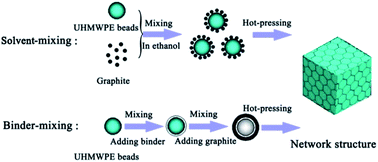
In this communication, the composites of UHMWPE and graphite flakes with a structure of UHMWPE core and graphite flake shell were prepared by a novel binder-mixing method. Vinyl acetate–ethylene (VAE) resin was used as a binder in the binder-mixing method to bond graphite flakes onto the surface of UHMWPE particles. The thermally conductive UHMWPE/graphite composites with high thermal conductivity were fabricated by a compression molding process. For comparison, UHMWPE/graphite composites were also prepared by conventional solvent-mixing method. A continuous thermally conductive network is aimed at in both solvent-mixing method and binder-mixing method. However, the segregated structures constructed by the binder-mixing method are more continuous and more homogeneous than that constructed by the solvent-mixing method. Also, the thermally conductive paths in the composites prepared by the binder-mixing method are wider. The composites prepared by this binder-mixing method can reach a higher thermal conductivity at the volume fraction less than 20 vol%. The binder-mixing method can be easily extended to other polymer systems and is highly possible to be widely used for the facile fabrication of polymer-based thermal conductive materials.
UHMWPE (GUR4150), with an average particle size of 120 μm and the molecular weight of 9 × 10⁶ g mol−1, was obtained from Celanese Diversified Chemical Co., Ltd. (Nanjing, China). Graphite flakes with an average particle size of 4 um and an apparent density of 2.25 g cm−3, were from Qingdao Shengda Carbon Machinery Co., Ltd. (Qingdao, China); VAE resin (VAE707), was purchased from Shanghai Yingjia Industrial Development Co., Ltd. (Shanghai, China). The preparation of the segregated composites by the binder-mixing method and conventional solvent-mixing method is schematically depicted in Fig. 1.
For the composites by solvent-mixing method, the graphite flakes was suspended in ethanol and ultrasonically treated for 1 h; after mixing with UHMWPE particles in the ethanol system under ultrasonic treatment for another 1 h, the mixture was evaporated at 60 °C for 12 h. For the composites by the binder-mixing method, VAE707 and UHMWPE particles (UHMWPE
:
VAE707 = 6
:
1, w/w) were mixed by using a high speed mixer (FC-400D, Sake, China) for 10 min at 25 °C. The VAE707 is a binder to adhesive graphite flakes. Then, graphite flakes were added into the high speed mixer and mixed for 15 min. The compounds were then dried under vacuum at 60 °C for 12 h before compression molding. Lastly, the graphite flakes coated UHMWPE particles prepared by binder-mixing method and solvent-mixing method were compression-molded into 100 × 100 × 2 mm3 sheets at 200 °C and 10 MPa for 15 min. The thermal conductivity of the composites was measured by a Hot Disk instrument (2500-OT, Sweden) at 25 °C. The sample size for the thermal conductivity coefficient measurement was 20 × 20 × 2 mm3. The morphology of composites was studied by scanning electron microscope (SEM, Quanta 250, Quanta 250 FEG, FEI, Oregon, USA) and optical microscopy (OM, Keyence VHX-1000C, Japan).
Fig. 2 shows the SEM micrographs of UHMWPE particles coated by graphite flakes with the solvent-mixing method and the binder-mixing method, with numerous individual graphite flakes spreading on the UHMWPE particle surface. Fig. 2c and d show the SEM images of UHMWPE particles coated by graphite flakes by the binder-mixing method. The images clearly illustrate that graphite flakes closely overlapped on the surface of UHMWPE particles owing to that the graphite flakes were bonded on the surface of UHMWPE resin granules through the bonding effect of VAE707. In contrast, the loose coating of graphite flakes on the surface of UHMWPE particles can be observed in the SEM images (Fig. 2a and b) of the composites prepared by conventional solvent-mixing method. Because the graphite flakes were absorbed on the surface of UHMWPE resin granules by physical adsorption which did not have ability to absorb too many graphite flakes on the surface of UHMWPE resin granules. Both kinds of graphite flake coated UHMWPE particles prepared by solvent-mixing method and binder-mixing method exhibit a structure of UHMWPE core and graphite flake shell. Such a core–shell structure provides the potential for the construction of a segregated network of graphite flakes in UHMWPE composites.
The morphology of segregated structures of the composites prepared by solvent-mixing method and binder-mixing method were studied by optical microscopy. The optical image demonstrates that the segregated structure of UHMWPE/graphite composites prepared by solvent-mixing method is continuous but broken at several points (Fig. 3a). However, the segregated structure of the UHMWPE/graphite composites prepared by the binder-mixing method is more continuous and more homogeneous (Fig. 3b). Due to that the segregated structures can function as thermally conductive paths, the integrity of the segregated structures has an important role in improving the thermal conductivity of composites.25 In order to further study the detailed structure of thermally conductive paths, SEM was used to observe the ultra-thin slice of UHMWPE/graphite composites prepared by solvent-mixing method and binder-mixing method (Fig. 3c–f). As show in Fig. 3c–f the thermally conductive paths of UHMWPE/graphite composites prepared by binder-mixing method are wider than the thermally conductive paths of UHMWPE/graphite composites prepared by solvent-mixing. The thermally conductive paths of UHMWPE/graphite composites prepared by solvent-mixing method are wide in some places, but are also narrow in some other places, and there are even some broken points in the network (Fig. 3c–e). In contrast, the thermally conductive paths in UHMWPE/graphite composites prepared by binder-mixing method are more homogeneous, more continuous and wider (Fig. 3d–f). These microstructural characteristics are caused by the different dispersion state of the graphite flakes in the composites. As is shown in Fig. 2a, the graphite flakes are easily aggregated on the surface of UHMWPE particles. But in Fig. 2c, the graphite flakes was almost dispersed uniformly and compactly on the surface of particles owing to the strong mixing forces in the binder-mixing method.
Fig. 4 shows the thermal conductivities of the UHMWPE/graphite composites fabricated by the binder-mixing method and solvent-mixing method with increasing content of graphite flakes. Apparently, the thermal conductivity of composites increases with increasing filler content in the composites because higher graphite flake loading can lead to more complete thermally conductive paths in the composites. However, the UHMWPE/graphite composites fabricated by binder-mixing method show higher thermal conductivities than the composites with the same content of graphite flakes fabricated by solvent-mixing method. This difference is more significant at higher filler contents. When the volume fraction of graphite flakes in the composites is 18.83 vol%, the corresponding thermal conductivities of composites fabricated by binder-mixing method and by solvent-mixing method is 2.276 W m−1 k−1 and 1.833 W m−1 k−1, respectively. Compared with the thermal conductivities of composites prepared by solvent-mixing method, the thermal conductivities of composites fabricated by binder-mixing method improved 40.0%, 22.8% and 24.2% when the content of graphite flakes is 12.55 vol%, 15.58 vol% and 18.83 vol% and the average thermal conductivity improved by 26.27% at the volume fraction of graphite flakes from 2.22–18.83 vol%. Noted that UHMWPE/graphite composites prepared by solvent-mixing method show lower electric resistivity than that of fabricated by binder-mixing method (ESI Fig. S1†). Also, both series of composites showed comparable tensile strength (ESI Fig. S2†). The thermal properties of composites fabricated by the two different methods have been shown in ESI (Fig. S3 and Table S1†).
![]() | ||
| Fig. 4 Thermal conductivities of UHMWPE/graphite composites prepared by solvent-mixing method and binder-mixing method with different content of graphite flakes. | ||
Phonons (quantized modes of vibration occurring in a rigid crystal lattice) conduction is the primary mechanism of heat conduction in most polymers since free movement of electrons is not possible.32,33 The interfacial thermal resistance caused by the phonon mismatch at the interface of the graphite flakes and the polymer matrix results in a high interfacial thermal resistance, leading to severe phonon scattering at the interface and a drastic reduction of thermal transport properties.34 The segregated structure was constructed in the UHMWPE/graphite composites fabricated by the binder-mixing method and the solvent-mixing method. It is interesting that the segregated structures constructed by the binder-mixing method are more continuous and more homogeneous than that of the composites prepared by solvent-mixing method. SEM image shows the thermally conductive paths are wider in the composites fabricated by binder-mixing method (Fig. 3). The segregated structure forming by graphite flakes dispersing regularly in the composite provide proper pathways for phonon transport, which can result in the decrease of phonon scattering at the interface and increase the thermal conductivities of the UHMWPE/graphite composites.35
Footnote |
| † Electronic supplementary information (ESI) available: Fig. S1: the electric resistivity of UHMWPE/graphite composites with different content of graphite flakes prepared by solvent-mixing method and binder-mixing method. Fig. S2: The tensile strength of UHMWPE/graphite composites prepared by solvent-mixing method and binder-mixing method with different content of graphite flakes. Fig. S3: the thermal properties for the melting of neat UHMWPE and UHMWPE/graphite composites fabricated by binder-mixing and solvent-mixing methods. Table S1: thermal data of neat UHMWPE and UHMWPE/graphite composites fabricated by binder-mixing and solvent-mixing methods from DSC analysis. See DOI: 10.1039/c6ra13921c |
| This journal is © The Royal Society of Chemistry 2016 |