Lu Maa,
Hong Hanb,
Lun Pan*a,
Muhammad Tahirac,
Li Wanga,
Xiangwen Zhanga and
Ji-Jun Zoua
aKey Laboratory for Green Chemical Technology of Ministry of Education, School of Chemical Engineering and Technology, Tianjin University, Collaborative Innovative Center of Chemical Science and Engineering (Tianjin), Tianjin 300072, China. E-mail: panlun76@tju.edu.cn
bShandong Engineering Research Center of Chemical Intermediate, Department of Chemistry and Chemical Engineering, Jining University, Qufu 273155, China
cDepartment of Physics, The University of Lahore, 53700, Pakistan
First published on 27th June 2016
Visible-light photocatalysis has attracted much attention in environmental remediation and sustainable energy utilization, however, it is still a great challenge to develop highly efficient and stable visible-light photocatalyst. Herein, we developed Ag3PO4 quantum dots (QDs) sensitized and Ti3+-doped TiO2 nanosheets (NS) via a solvothermal/in situ precipitation method. The TiO2/Ag3PO4 ratio in the composite was tuned from 3
:
1 to 1
:
4 to optimize the dispersion and size of Ag3PO4 QDs, and the best dispersed Ag3PO4 QDs with the smallest size (ca. 2 nm) was obtained for TA1
:
3. The characterizations confirm that abundant Ti3+ defects are introduced into TiO2, and the interaction between Ag3PO4 QDs and TiO2 NS is in the form of Ag–O–Ti bonds, which benefit the visible-light absorption and accelerates the charge separation. Moreover, the well-matched band structures drive the electrons to Ag3PO4 and holes to TiO2 {001} faces, respectively. Therefore, TA1
:
3 shows a 1.7-fold, 1.4-fold and 5-fold higher activity than bulk Ag3PO4 in MO, phenol photodegradation, and PEC water splitting, respectively. In addition, the sample shows relatively high photostability. Thus, we believe that the rational design of heterostructures based on the matched band and abundant defects can fabricate the highly reactive photocatalysts.
Making composite with Ag3PO4, TiO2 nanosheets (TiO2 NS, with {001} facet mainly exposed) is one of the most potential candidates.25 Yang et al. made breakthrough in synthesizing TiO2 NS with high percentage of {001} facets.26 After that, TiO2 NS have been studied extensively in photocatalysis, such as photoelectrochemical (PEC) water splitting for hydrogen production, environmental remediation, CO2 photoreduction and solar cells,8,27–32 attributing to its high photoactivity, nontoxicity, low cost and chemical inertness.33 The in situ observation of fluorogenic reaction confirmed that,34 on a TiO2 NS, the photoinduced electrons preferentially transfer to {101} facets with the holes to {001} facets. Since the exposed surface of {001} faces is more than 80% on TiO2 NS, it can provide abundant hole-trapping sites for charge-pairs isolation. Importantly, the band structure of Ag3PO4 is well matched with TiO2, and the photoinduced holes prefer to transfer from Ag3PO4 to TiO2, with electrons reversely to Ag3PO4.19,35 Therefore, Ag3PO4 QD/TiO2 NS composite will realize the spatial isolation of photoinduced charges.
But TiO2, with the wide band gap of 3.2 eV, cannot be exited by visible light. The Ti3+ doping is an important approach to extend the visible-light absorption,36–39 because of the introduced localized Ti3+ states with energies 0.15–1.18 eV below the conduction band minimum of TiO2. And the relevant experiments confirmed the photoactivity improvement of Ti3+-doped TiO2 under visible light.40
In this work, we fabricate highly photoactive TiO2 NS via Ti3+ doping and Ag3PO4 QDs sensitization, by a solvothermal/in situ precipitation method. The TiO2/Ag3PO4 ratio was tuned to optimize the QDs' size and dispersion, and the interaction between TiO2 and Ag3PO4 was also investigated. The sensitization of Ag3PO4 QDs and introduction of Ti3+ on TiO2 NS result in low charge recombination possibility and unilateral charge transfer, giving rise to the photoactivity of degradation and photoelectrochemical (PEC) water splitting.
:
1 to 1
:
1, 1
:
3 and 1
:
4 by modulating the added amount of CH3COOAg, and the resulted samples were named as TA3
:
1, TA1
:
1, TA1
:
3, TA1
:
4, respectively. Pure Ag3PO4 was also prepared using the above mentioned method but without the addition of TiO2 NS.![]() | ||
| Fig. 1 XRD patterns of TiO2, Ag3PO4 and Ag3PO4/TiO2 composites, the standard XRD patterns of Ag3PO4 and TiO2 anatase are based on JCPDS card no. 06-0505 and no. 21-1272, respectively. | ||
The aggregation of Ag3PO4 is harmful for photoactivity, while the well dispersed nanoparticles are very promising.42 Hereby, TiO2 NS serve as the support for the well dispersed growth of Ag3PO4 nanoparticles. As shown in Fig. 3, the decorated Ag3PO4 are nanoparticles and their aggregations have been inhibited effectively. There are no obvious size changes for TiO2 NS, while the average size of Ag3PO4 nanoparticles is dependent on its deposited amount. Under low amount loading (TA3
:
1, Fig. 3a–c), Ag3PO4 nanoparticles loosely disperse on TiO2 NS, and they have the wide size range from 2–14 nm with the average size of 6 nm. With the increase of Ag3PO4 loading amount (TA1
:
1, Fig. 3d–f; and TA1
:
3, Fig. 3g–i), the average particle size of Ag3PO4 is reduced to 4.5 nm and 2 nm, respectively, and their size distribution becomes narrower, especially for TA1
:
3. However, further increase of Ag3PO4 loading amount (TA1
:
4) causes the aggregation of Ag3PO4 nanoparticles with the average size of 4.2 nm (Fig. 3j–l). Accordingly, using TiO2 NS as support, Ag3PO4 QDs have been successfully fabricated. For all samples, Ag3PO4 QDs show high degree of crystallinity with the lattice fringe spacing of 0.24 nm ((211) planes).
![]() | ||
Fig. 3 TEM images and size distribution of Ag3PO4 for TA3 : 1 (a–c), TA1 : 1 (d–f), TA1 : 3 (g–i) and TA1 : 4 (j–l). | ||
:
3 were conducted to investigate the chemical composition and status of the materials. For pure Ag3d spectra of Ag3PO4 (Fig. 4a), the peaks at ca. 373.8 eV and 367.7 eV are assigned to Ag3d3/2 and Ag3d5/2 of Ag+, respectively.19,43 After the loading of Ag3PO4 QDs on TiO2 NS (TA1
:
3, Fig. 4e), the locations of Ag3d3/2 and Ag3d5/2 attributing to Ag+ are almost the same as that of pure Ag3PO4, while the new peaks at 365.9 eV and 371.8 eV are owing to the formed Ag–O–Ti bonds.43 The low-energy shift of Ag+ binding energy in the form of Ag–O–Ti is resulted from the weaker electrical negative of Ti than that of P. The presence of the Ti–O–Ag bonds indicates a strong covalent interaction exists between Ag3PO4 QDs and TiO2 NS, confirming the formation of the heterojunction structure, which is vital for electron–hole separation.44
![]() | ||
Fig. 4 XPS spectra of Ag3PO4 (a–c), TiO2 NS (d) and TA1 : 3 (e–h): (a and e) Ag3d spectra; (b and f) O1s spectra; (c and g) P2p spectra; (d and h) Ti2p spectra. | ||
Fig. 4b shows the high-resolution O1s spectra of pure Ag3PO4, with a symmetric peak located at ca. 531.3 eV, which is attributed to O–P species.43 However, the decoration of Ag3PO4 QDs on TiO2 NS alters the chemical environments of O species (Fig. 4f). The asymmetric peak is divided into four peaks centered at 532.8 eV, 531.2 eV, 530.2 eV and 529.0 eV, which are related to oxygen species in adsorbed H2O, P–O, Ti–O–Ag and Ti–O moieties, respectively.42,43,45 Similar to the results of Ag3d spectra, the appearance of Ti–O–Ag suggests the interaction between Ag3PO4 QDs and TiO2 NS. P2p spectra of pure Ag3PO4 and TA1
:
3 are shown in Fig. 4c and g. These two materials both show one peak with the binding energy of ca. 132.5 eV, attributing to P5+ in PO43−.43
The oxidation state of Ti element in TiO2 NS is shown in Fig. 4d, two kinds of Ti species are found. The peaks at the binding energy of 458.8 eV (Ti2p3/2) and 464.3 eV (Ti 2p1/2), and their splitting of 5.7 eV are referred to Ti4+ species of bulk TiO2.27,43,45 The other is the defected Ti3+ with the binding energy centered at 457.7 eV and 463.7 eV.27,45 This kind of Ti3+ defects are caused during the hydrothermal treatment in the presence of HF. Previous calculation confirmed that Ti3+ tends to be stabilized at five-coordinated surface sites,46 and actually, all surface Ti atoms on {001} TiO2 NS are five-coordinated.47 As shown in Fig. 4h, Ag3PO4 QDs-TiO2 NS (TA1
:
3) still maintain the doped Ti3+. But the characteristic peaks of Ti2p1/2 and Ti2p3/2 become broader as compared to pure TiO2 NS, which indicates the existence of new Ti species. There are two new peaks located at 459.8 eV and 466.9 eV, which are owing to the bond of Ti–O–Ag.43 The higher binding energy of Ti in Ti–O–Ag is resulted from the stronger electrical negative of Ag than Ti. From the above XPS results of TA1
:
3, it can be seen that Ti3+–TiO2 NS and Ag3PO4 QDs are not just physically mixed, however, they have chemical bond of Ti–O–Ag, suggesting that Ag3PO4 QDs have been effectively loaded on Ti3+–TiO2 NS.
![]() | ||
| Fig. 5 (a) UV-vis DRS and (b) steady-state PL spectra of Ag3PO4 QDs-TiO2 NS composites. The inset in (a) the corresponding plots of transformed Kubelka–Munk function versus the photo energy. | ||
The efficient separation of photo-induced charges is vital for the high photocatalytic activity.3 The photoluminescence (PL) spectra of Ag3PO4 and Ag3PO4 QDs-TiO2 NS composites are tested (Fig. 5b). The emission peaks at 420 nm are corresponding to the shallow donor level of Ti3+ state to the valence band (2.95 eV). The Ag3PO4 has the strongest emission band between 450 and 750 nm, due to the rapid recombination of excited electrons and holes (2.22 eV). The results are consistent with the UV-vis absorption. Moreover, the decoration of Ag3PO4 QDs on TiO2 NS greatly influences the PL intensity, with obvious decrease of PL intensity for the composites as compared to pure Ag3PO4. Initially, the emission peak intensity gradually declines with the decrease of TiO2/Ag3PO4 ratio. Especially when the ratio of TiO2/Ag3PO4 is 1
:
3, the PL emission intensity is the lowest. However, when TiO2/Ag3PO4 ratio is lower than 1
:
3, such as TA1
:
4, the PL emission intensity increases again, but is still lower than pure Ag3PO4. The PL spectra indicate that the composition of Ag3PO4 QDs and TiO2 NS inhibits the recombination of photoinduced charge pairs, and TA1
:
3 possesses the highest charge-separation efficiency.
The photocatalytic activities of TiO2, Ag3PO4, and Ag3PO4 QDs-TiO2 NS composites were firstly evaluated by the degradation of MO and phenol under visible-light irradiation (Fig. 6a–d). Before irradiation, the samples were stirred in the dark for 20 min to reach adsorption–desorption equilibrium. Under visible-light irradiation, TiO2 NS without Ti3+, treated by 5 h thermal calcination under 500 °C, show very low visible-light activity with only ca. 1.5% MO degraded and almost no degradation of phenol observed in 100 min. But, TiO2 NS with abundant Ti3+ shows obvious visible-light-catalytic activity, with the reaction rate constant (k) of 0.002 min−1 (MO degradation) and 0.004 min−1 (phenol degradation). Therefore, Ti3+ doping plays an important role in visible-light response for TiO2. Meanwhile, Ag3PO4 shows relatively high photoactivity with k of 0.022 min−1 for (MO degradation) and 0.021 min−1 for phenol degradation, respectively.
Ag3PO4 QDs sensitized TiO2 NS exhibit much higher photocatalytic activity than TiO2 NS. With the increase of Ag3PO4 QDs amount, from TA3
:
1 to TA1
:
1 and then to TA1
:
3, the photoactivities are enhanced significantly (Fig. 6a–d). Particularly, TA1
:
3 exhibits the highest activity with k values of 0.037 min−1 for MO degradation and 0.030 min−1 for phenol degradation, which are respectively 1.7-fold and 1.4-fold higher than those of bulk Ag3PO4. However, further increasing the amount of Ag3PO4 QDs causes the decrement of photoactivity, such as TA1
:
4.
The similar trend is also observed in photoelectrochemical (PEC) water splitting (Fig. 6e), TiO2 NS exhibit the visible-light response but the photocurrent density is ca. 8 μA cm−2 (at 1.0 V vs. RHE), while that for Ag3PO4 is ca. 10 μA cm−2. Interestingly, the composite, TA1
:
3, shows very high PEC performance with the photocurrent density of ca. 52 μA cm−2 (at 1.0 V vs. RHE), which is about 5-fold higher than that of pure Ag3PO4. The above results indicate that the loading amount of Ag3PO4 QDs on TiO2 NS is very important for the high photoactivity.
With smaller size and better dispersion of Ag3PO4 QDs, TA1
:
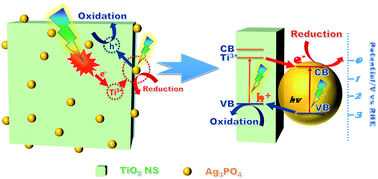
3 provides more active sites for reactant adsorption, mass transfer and further degradation. Hence, the composite structure with appropriate amount and well dispersion of Ag3PO4 QDs is optimal to achieve high photoactivity. Besides of the structure, the charge-separation efficiency also plays the important role in photocatalysis. To improve the effective charge separation, the formation of heterostructure is one of the most potential strategy.33 As shown in Fig. 7, the VB and CB edge potentials of Ag3PO4 are 2.9 eV and 0.45 eV, respectively, while those of TiO2 are 2.7 eV and −0.25 eV (for Ti3+ state), respectively, which are both negative to that of Ag3PO4.43 Therefore, Ti3+–TiO2 and Ag3PO4 can form well matched heterostructure. When the composite is irradiated by visible light, the electrons of Ag3PO4 VB can be excited to CB and creates holes in VB. Then, the holes are rapidly transferred to VB of TiO2 {001} facets, while the electrons are maintained in Ag3PO4 CB. In contrast, the photoinduced electrons of Ti3+–TiO2 will transfer to Ag3PO4 QDs, with the holes in VB. In this case, the charge-pairs separation and spatial location realize on the composite under visible light irradiation. Importantly, the key to obtain high charge-separation efficiency is the well dispersion of Ag3PO4 QDs on TiO2 NS. Therefore, TA1
:
3 shows the lowest emission intensity in PL spectra (Fig. 5b). In addition, the electrochemical impedance spectroscopy (EIS) technique was also used to elucidate the kinetics and mechanism of photocatalytic performance, and smaller arc radius implies smaller charge transfer resistance. Since the charge transfer resistance (Rct) value is inversely proportional to the electron transfer rate, TA1
:
3 has the fastest electron transfer rate, which is consistent with PL spectra and the photocatalytic performance.
![]() | ||
| Fig. 7 Schematic diagram of the photocatalytic mechanism of Ag3PO4 QDs-TiO2 NS composite under visible light irradiation. | ||
Finally, the photostability of TA1
:
3 was tested in MO photodegradation (Fig. 8a) and PEC performance (Fig. 6e). After 5 cycles for photodegradation and 10 cycles for PEC water splitting, TA1
:
3 still retains more than 90% of the initial photoactivity. For the recycled samples, no other phases besides Ag3PO4 and TiO2 anatase are observed from the XRD patterns (Fig. 8b), and the doped Ti3+ are also very stable (Fig. 8c). But the careful characterization of Ag3d XPS shows the appearance of trace Ag0 in the recycled sample (Fig. 8d), which is the reason for the indistinctively decreased stability in photocatalysis.
![]() | ||
Fig. 8 5-Cycle photodegradation of MO catalyzed by TA1 : 3 under visible light (a), XRD patterns (b), and Ti2p (c) and Ag3d (d) XPS spectra of recycled TA1 : 3. | ||
:
1 to 1
:
4 to optimize the composite heterostructure, and the well dispersed Ag3PO4 QDs with small size of ca. 2 nm was obtained for TA1
:
3. XPS data indicate Ag3PO4 QDs and Ti3+–TiO2 NS are not simply physical mixture but interact with each other in the form of Ag–O–Ti connections, which can accelerate the charge separation and transfer between the well matched band structures of Ag3PO4 QDs and Ti3+–TiO2 NS. Therefore, TA1
:
3 shows 1.7-fold, 1.4-fold and 5-fold higher activity than bulk Ag3PO4 in MO, phenol photodegradation, and PEC water splitting, respectively. In addition, Ag3PO4 QDs-TiO2 NS composite shows excellent photostability. Our work reveals that the rational design of heterostructure based on the matched band structure along with abundant defects can fabricate the efficient materials for photocatalysis.
| This journal is © The Royal Society of Chemistry 2016 |