Iodine-mediated regioselective guanylation-amination of propargylamines towards the synthesis of diversely substituted 2-aminoimidazoles

Pavel Fedoseev, Nandini Sharma, Rupesh Khunt, Denis S. Ermolat'ev and Erik V. Van der Eycken*
Laboratory for Organic & Microwave-Assisted Chemistry (LOMAC), Department of Chemistry, University of Leuven (KU Leuven), Celestijnenlaan 200F, B-3001 Leuven, Belgium. E-mail: erik.vandereycken@chem.kuleuven.be; Web: http://chem.kuleuven.be/en/research/mds/lomac

Received 23rd May 2016 , Accepted 3rd August 2016

First published on 3rd August 2016


Abstract

A diversity-oriented approach for the synthesis of 2-aminoimidazoles is presented. The method involves the cyclization of secondary propargylamines using iodine allowing the generation of diversely-substituted 2-aminoimidazoles. The iodo group generated during cyclization can be used for further modification, which is an additional asset of this method.

Introduction

Aromatic heterocyclic fragments are one of the most biologically relevant patterns found in many natural products and pharmaceuticals. Consequently considerable efforts are being done for the development of new methods for their construction. Among these, 2-aminoimidazoles are an important class of N-heterocycles, found extensively in biologically active marine natural sponge alkaloids.1 Owing to their significant biological activity, they are often used as building blocks in pharmacologically active chemical entities. For instance, polysubstituted 2-aminoimidazoles have been reported as inhibitors of the binuclear manganese metalloenzyme human arginase I[thin space (1/6-em)]2 and human β-secretase (BACE1),3 as anti-cancer agents,4 as sodium hydrogen exchanger-1 (NHE-1),5 as α-adrenoreceptor agonists,6 as antibiofilm agents,7 as 5-HT2B receptor antagonists8 and for inhibition and breaking of advanced glycation end-products (AGEs).9

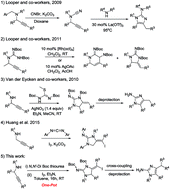
Though, a number of methods has been described to construct 2-aminoimidazoles,10 the development of new routes allowing their facile synthesis from readily available starting materials would always be a welcome addition. In recent years, the preparation of 2-aminoimidazoles from propargylic compounds via metal-catalyzed heteroannulation, has represented one of the most attractive strategies in organic synthesis.10e,11 The π-electrophilic character of the triple bond makes it a versatile entity for several chemical transformations. Moreover, propargylamines are easily prepared by the coupling of an amine, an aldehyde and an alkyne, known as the A3-coupling reaction, which at the same time serves the purpose of the final scaffold diversification reaction.12 In 2009, Looper and co-workers reported a La(III)-catalyzed guanidine–alkyne hydroamination–isomerization sequence for the rapid access to the 2-aminoimidazole core from propargylcyanamides (Scheme 1, entry 1). However, the process is limited by the availability of the starting electron-rich secondary benzylamines as well as by the harsh reaction conditions.13 Later on, the same group developed another strategy to construct substituted 2-aminoimidazoles by a silver-mediated 5-exo-dig cyclization of di-Boc protected propargylguanidines (Scheme 1, entry 2).14 However, the process suffered from poor selectivity as the 6-endo-dig product was observed in all cases. In 2010, our group reported a rapid and highly efficient silver(I)-mediated synthesis of 1,4,5-trisubstituted 2-aminoimidazoles from secondary propargylamines via a one-pot guanylation/cyclization strategy using protected S-methylisothiourea10e (Scheme 1, entry 3). The same methodology was extended to the synthesis of spiro-2-aminoimidazoles.11b In 2014, Wolfe and co-workers reported the synthesis of 2-aminoimidazoles via a Pd-catalyzed carboamination reactions of N-propargyl guanidines and aryl triflates with good product yields.10g However, the lack of diversity and the application of a multi-step synthesis of the starting material limited the facile preparation of natural product analogues containing this skeleton.


image file: c6ra13371a-s1.tif
Scheme 1 Synthesis of substituted 2-aminoimidazoles from secondary propargylamines.

Although metal-catalyzed approaches are mostly selective and high yielding, they suffer from the inherent drawback of the presence of traces of metals in the final compounds, which might hamper or alter the biological activity. Owing to this, the development of metal-free approaches for the synthesis of such biologically important heterocycles is on the rise.15 Recently, iodine-mediated metal-free cyclization approaches are gathering a lot of attention in synthetic chemistry. Iodine activates the alkyne very well, and most often, an iodo group will remain in the molecule after cyclization, allowing the introduction of additional functionalities.16 Our interest in the biological activity of 2-aminoimidazoles and the development of diversity-oriented concise routes for the synthesis of biologically important heterocycles,17 has prompted us to explore a new metal-free strategy for their synthesis. To the best of our knowledge, there is only one recently reported example of the formation of N-heterocycles based on iodocyclization18 whereby imidazoline derivatives were synthesized by reaction between secondary propargylamines and aryl-substituted carbodiimides (Scheme 1, entry 4). However, the use of substituted carbodiimides for the in situ generation of the guanidine intermediate hampers the diversification of the generated products.

The proposed synthesis is based on three key steps: an A3-coupling reaction to generate the secondary propargylamines, followed by their conversion to the corresponding guanidines using N,N′-bis-Boc-protected thiourea, and subsequent electrophilic iodocyclization to provide Boc-protected iminoimidazolidines. The generated polysubstituted compounds bear an iodo group, which can further participate in various cross-coupling reactions to enhance the diversity of the substituted pattern.

We decided to study the feasibility of the process by performing the reaction in two steps using 1a as a model substrate. For this, we carried out the guanylation of 1a with N,N′-di-Boc-protected thiourea (5) in the presence of 1-ethyl-3-(3-dimethylaminopropyl)carbodiimide (EDCI; 2 equiv.) and Hünig's base (3 equiv.) to generate compound 2a (Scheme 2, route A). Next, we studied the efficiency of iodine for the heteroannulation by attempting the cyclization of 2a using 2.0 equiv. of I2 and 2.2 equiv. of K2CO3 in dichloromethane at RT. It was observed that though the desired cyclized product 3a was formed (TLC-monitoring), the reaction could not be completed even after 12 h. Increasing the amount of both iodine (up to 2.0 equiv.) and K2CO3 (up to 2.2 equiv.) improved the reaction efficiency dramatically with completion of the reaction after 3 h to provide the desired 5-exo-dig iodocyclized product in 88% yield. Encouraged by these results, we envisioned to perform the guanylation and cyclization as a one-pot procedure as iodine could act as an activator for N,N′-di-Boc-thiourea to generate the required carbodiimide in situ. The resulting guanylated propargylamine 2a will undergo iodine-mediated cyclization resulting in the formation of the desired herein, we report a facile methodology for the regio-selective synthesis of 1,4,5-substituted 2-aminoimidazoles from propargylamines by an iodine-mediated one-iminoimidazolidine 3a (Scheme 2, route B). We started the optimization of the one-pot reaction in DCM using N,N′-di-Boc-thiourea (1.25 equiv.), iodine (2.5 equiv.) with Hünig's base (3.5 equiv.), but no product formation was observed even after 24 h (Table 1, entry 1). Substituting Hünig's base with K2CO3 resulted in only 38% yield (entry 2). A slight increase in yield was observed when the reaction was run with triethylamine (entry 3). The reaction performance can be substantially enhanced upon changing the solvent from DCM to toluene (entries 4–6). Attempts to enhance the yield by increasing the reaction time resulted in a poorer yield (entries 7–8). To our great satisfaction, we found that shortening the reaction time to 16 h provided 3a in 72% yield (entry 9), although a further reduction led to a decreased yield (entry 10). A slightly better yield could be obtained by increasing the amount of iodine to 3 equiv. (entry 11). Changing the amount of thiourea or base did not bring amelioration (entries 12 and 13). It should be mentioned that, unlike our previous report,10e where attempts to carry out guanylation and cyclization consecutively using N,N′-di-Boc-thiourea with silver catalyst, failed, this protocol could effectively provide the 5-exo-dig cyclized product.


image file: c6ra13371a-s2.tif
Scheme 2 Guanylation/iodocyclization of secondary propargylamines.
Table 1 Optimization of the reaction conditionsa

image file: c6ra13371a-u1.tif

Entry 5 (equiv.) I2 (equiv.) Base (equiv.) Solvent Time (h) Yieldb (%)
a 1a (1 mmol), 5 (as mentioned), I2 (as mentioned), base (as mentioned) in solvent (1 mL) at RT for the indicated time.b Isolated yields.
1 1.25 2.5 DIPEA (3.5) DCM 24 nd
2 1.25 2.5 K2CO3 (3.5) DCM 24 38
3 1.25 2.5 Et3N (3.5) DCM 24 45
4 1.25 2.5 Et3N (3.5) MeCN 24 30
5 1.25 2.5 Et3N (3.5) Diethylether 24 42
6 1.25 2.5 Et3N (3.5) Toluene 24 55
7 1.25 2.5 Et3N (3.5) Toluene 48 48
8 1.25 2.5 Et3N (3.5) Toluene 72 34
9 1.25 2.5 Et3N (3.5) Toluene 16 72
10 1.25 2.5 Et3N (3.5) Toluene 12 64
11 1.25 3 Et3N (3.5) Toluene 16 76
12 2 3.5 Et3N (3.5) Toluene 16 53
13 1.25 3 Et3N (4.0) Toluene 16 74


After establishing the optimized reaction conditions (Table 1, entry 11), the scope of this reaction was explored (Table 2). A small library of secondary propargylamines (1a–u) was generated using a variety of aldehydes, primary amines, and alkynes in the microwave-good yields. Electron-withdrawing groups as well as electron assisted A3-coupling under our previously reported conditions.19 They reacted smoothly to give iodo-iminoimidazolidines 3a–u in donating groups present on the alkyne moiety were well tolerated. Similarly, the nature of the amine substituent had no significant influence on the product yield. However, the substitution arising from the aldehyde during A3-coupling has significant effect on the product formation as evident from the Table 2, where aromatic are the low yielding ones. Remarkably, this protocol was further extended to a propargylamine prepared from cyclohexanone (KA2 coupling)20 giving a spiro-cyclized product 3u in moderate yield.

Table 2 Scope of reactiona,b

image file: c6ra13371a-u2.tif

a 1a–u (1 mmol), 2 (1.25 equiv.), I2 (3 equiv.), Et3N (3.5 equiv.) in toluene (1 mL) at RT for 16 h.b Isolated yields. Bn = benzyl; PMB = p-methoxybenzyl; Boc = tert-butoxycarbonyl.
image file: c6ra13371a-u3.tif


On the basis of literature reports16g,21 and our previous work,10e a plausible mechanism for the iodine-mediated heteroannulation is shown in Scheme 3. We assume that N,N′-di-Boc-thiourea upon reaction with iodine and Et3N leads to the formation of carbodiimide A by thiourea desulfurization.22 Subsequently A is trapped by propargylamine 1 providing the protected propargylguanidine 2. Iodine promoted nucleophilic attack of the guanidine on the activated alkyne led to exo-dig cyclization affording iodo-imidazole 3 via intermediate B. It may find mention here that during the course of this study Zhou and co-workers reported the synthesis of imidazolidin-2-imine derivatives from diarylcarbodiimide and propargylamines which corroborates well with our findings.18


image file: c6ra13371a-s3.tif
Scheme 3 Proposed mechanism.

Finally, to further decorate the synthesized 2-iminoimidazolidine scaffold, the iodo group was used as a convenient synthetic handle for Pd-catalyzed coupling reactions.

Using 2-iminoimidazolidine 3b (1 equiv.), substituted boronic acid (1.5 equiv.) in the presence of Pd(PPh3)4 (6 mol%) and K3PO4 (2 equiv.) in dioxane/water (9[thin space (1/6-em)]:[thin space (1/6-em)]1) at 80 °C for 24 h, compounds 5b were obtained in moderate to good yields (Table 3) without the occurrence of de-iodinated side-product.

Table 3 Suzuki cross-couplinga

image file: c6ra13371a-u4.tif

Entry R1 R2 R3 R4 Yield of 5 (%) Yield of 6 from 5 (%)
a 3 (1 mmol), boronic acid (1.5 equiv.), Pd(PPh3)4 (6 mol%), K3PO4 (2 equiv.) in dioxane[thin space (1/6-em)]:[thin space (1/6-em)]water (9[thin space (1/6-em)]:[thin space (1/6-em)]1) (1.5 mL) at 80 °C for 24 h. Deprotection was carried out using 150 equiv. of 4N HCl in dioxane[thin space (1/6-em)]:[thin space (1/6-em)]water under microwave irradiation at 70 °C and 100 W for 30 min.
1 Benzyl Ethyl Phenyl Phenyl 85 100
2 Benzyl Iso-butyl Butyl 4-Fluorophenyl 84 100
3 Iso-butyl Propyl Phenyl 3,5-Dimethylphenyl 62 100
4 Iso-butyl Iso-propyl 2-Fluorophenyl 3,5-Dimethoxyphenyl 40 100


Further, the above protocol was successfully extended to Sonogashira reaction of 3a with phenyl acetylene delivering compound 7 in 83% yield (Scheme 4, entry 1). Similarly, Stille reaction between 3b and allyltributylstannane led to the successful generation of compound 8 in 74% yield (Scheme 4, entry 2).


image file: c6ra13371a-s4.tif
Scheme 4 Cross-coupling reactions.

Conclusion

We have elaborated an efficient methodology for the direct guanylation and 5-exo-dig selective iodoamination of propargylamines in an one-pot fashion starting from highly functionalized secondary propargylamines. This convenient process provided the products with excellent regioselectivity and functional group tolerance without the need of expensive metal catalyst. The iodo group allows further functionalization giving a way to a rapid increase in molecular complexity of these multisubstituted 2-aminoimidazoles.

Acknowledgements

Support was provided by the Research Fund – Flanders (FWO) and the Research Fund of the University of Leuven (KU Leuven). PF is grateful to the University of Leuven (KU Leuven) for providing a doctoral fellowship and to Geert Hooyberghs for the fruitful discussions and his valuable suggestions. NS is grateful to the University of Leuven (KU Leuven) for obtaining a postdoctoral fellowship.

Notes and references

  1. (a) H. Hoffmann and T. Lindel, Synthesis, 2003, 1753 CAS; (b) M. Steven, Nat. Prod. Rep., 2007, 24, 931 RSC; (c) J. D. Sullivan, R. L. Giles and R. E. Looper, Curr. Bioact. Compd., 2009, 5, 39 CrossRef CAS; (d) A. Žula, D. Kikelj and J. Ilaš, J. Heterocycl. Chem., 2015, 53, 345 CrossRef.
  2. M. Ilies, L. Di Costanzo, M. L. North, J. A. Scott and D. W. Christianson, J. Med. Chem., 2010, 53, 4266 CrossRef CAS PubMed.
  3. (a) M. S. Malamas, J. Erdei, I. Gunawan, K. Barnes, M. Johnson, Y. Hui, J. Turner, Y. Hu, E. Wagner, K. Fan, A. Olland, J. Bard and A. J. Robichaud, J. Med. Chem., 2009, 52, 6314 CrossRef CAS PubMed; (b) M. S. Malamas, J. Erdei, I. Gunawan, J. Turner, Y. Hu, E. Wagner, K. Fan, R. Chopra, A. Olland, J. Bard, S. Jacobsen, R. L. Magolda, M. Pangalos and A. J. Robichaud, J. Med. Chem., 2010, 53, 1146 CrossRef CAS PubMed.
  4. K. Singh, V. Verma, K. Yadav, V. Sreekanth, D. Kumara, A. Bajaj and V. Kumar, Eur. J. Med. Chem., 2014, 84, 150 CrossRef PubMed.
  5. K. S. Atwal, S. V. O'Neil, S. Ahmad, L. Doweyko, M. Kirby, C. R. Dorso, G. Chandrasena, B. C. Chen, R. Zhao and R. Zahler, Bioorg. Med. Chem. Lett., 2006, 16, 4796 CrossRef CAS PubMed.
  6. M. E. Garst, C. Gluchowski, D. A. Harcourt and S. A. Munk, WO1995019968 A1, 1995.
  7. (a) R. W. Huigens III, J. J. Richards, G. Parise, T. E. Ballard, W. Zeng, R. Deora and C. Melander, J. Am. Chem. Soc., 2007, 129, 6966 CrossRef PubMed; (b) S. A. Rogers and C. Melander, Angew. Chem., Int. Ed., 2008, 47, 5229 CrossRef CAS PubMed; (c) T. E. Ballard, J. J. Richards, A. L. Wolf and C. Melander, Chem.–Eur. J., 2008, 14, 10745 CrossRef CAS PubMed; (d) S. A. Rogers, R. W. Huigens, J. Cavanagh and C. Melander, Antimicrob. Agents Chemother., 2010, 54, 2112 CrossRef CAS PubMed; (e) D. Linares, O. Bottzeck, O. Pereira, A. Praud-Tabariès and Y. Blache, Bioorg. Med. Chem. Lett., 2011, 21, 6751 CrossRef CAS PubMed; (f) A. Yeagley, Z. Su, K. McCullough, R. Worthington and C. Melander, Org. Biomol. Chem., 2013, 11, 130 RSC; (g) H. Steenackers, D. S. Ermolat'ev, T. T. T. Trang, B. Savalia, U. K. Sharma, A. De Weerdt, A. Shah, J. Vanderleyden and E. V. Van der Eycken, Org. Biomol. Chem., 2014, 12, 3671 RSC.
  8. R. Borman, R. Coleman, K. Clark, A. Oxford, G. Hynd, J. Archer, A. Aley and N. Harris, WO 2005012263 A1, 2005.
  9. M. A. Richardson, R. E. Furlani, B. K. Podell, D. F. Ackart, J. D. Haugen, R. J. Melander, C. Melander and R. J. Basaraba, Tetrahedron Lett., 2015, 56, 3406 CrossRef CAS PubMed.
  10. (a) S. Nakamura, I. Kawasaki, M. Kunimura, M. Matsui, Y. Noma, M. Yamashita and S. Ohta, J. Chem. Soc., Perkin Trans. 1, 2002, 1061 RSC; (b) N. S. Aberle, G. Lessene and K. G. Watson, Org. Lett., 2006, 8, 419 CrossRef CAS PubMed; (c) D. S. Ermolat'ev, V. L. Alifanov, V. B. Rybakov, E. V. Babaev and E. Van der Eycken, Synthesis, 2008, 2083 Search PubMed; (d) P. B. Koswatta and C. J. Lovely, Chem. Commun., 2010, 46, 2148 RSC; (e) D. S. Ermolat'ev, J. B. Bariwal, H. P. L. Steenackers, S. C. J. De Keersmaecker and E. Van der Eycken, Angew. Chem., Int. Ed., 2010, 49, 9465 CrossRef PubMed; (f) Z. Su, L. Peng and C. Melander, Tetrahedron Lett., 2012, 53, 1204 CrossRef CAS; (g) B. P. Zavesky, N. R. Babij and J. P. Wolfe, Org. Lett., 2014, 16, 4952 CrossRef CAS PubMed; (h) X. Guo, W. Chen, B. Chen, W. Huang, W. Qi, G. Zhang and Y. Yu, Org. Lett., 2015, 17, 1157 CrossRef CAS PubMed; (i) J. B. Gibbons, J. M. Salvant, R. M. Vaden, K.-H. Kwon, B. E. Welm and R. E. Looper, J. Org. Chem., 2015, 80, 10076 CrossRef CAS PubMed.
  11. (a) G. L. Eilrich and W. D. Dixon, US-3904395, 1975; (b) O. P. Pereshivko, V. A. Peshkov, D. S. Ermolat'ev, S. Van Hove, K. Van Hecke, L. Van Meervelt and E. V. Van der Eycken, Synthesis, 2011, 10, 1587 Search PubMed; (c) W. Jia-Jie, Y. Zhu and Z.-P. Zhan, Asian J. Org. Chem., 2012, 1, 108 CrossRef.
  12. (a) W.-J. Yoo, L. Zhao and C.-J. Li, Aldrichimica Acta, 2011, 44, 43 CAS; (b) V. A. Peshkov, O. P. Pereshivko and E. V. Van der Eycken, Chem. Soc. Rev., 2012, 41, 3790 RSC.
  13. R. L. Giles, J. D. Sullivan, A. M. Steiner and R. E. Looper, Angew. Chem., Int. Ed., 2009, 48, 3116 CrossRef CAS PubMed.
  14. M. J. Gainer, N. R. Bennett, Y. Takahashi and R. E. Looper, Angew. Chem., Int. Ed., 2011, 50, 684 CrossRef CAS PubMed.
  15. (a) S. Das, R. Borah, R. R. Devi and A. J. Thakur, Synlett, 2008, 18, 2741 Search PubMed; (b) B. Alcaide, P. Almendros, G. Cabrero, R. Callejo, M. P. Ruiz, M. Arno and L. R. Domingo, Adv. Synth. Catal., 2010, 352, 1688 CrossRef CAS; (c) W. Lee, H. Shen, W. Hu, W. Lo, C. Murali, J. K. Vandavasi and J. Wang, Adv. Synth. Catal., 2012, 354, 2218 CrossRef CAS; (d) K. Xu, Y. Hu, S. Zhang, Z. Zha and Z. Wang, Chem.–Eur. J., 2012, 18, 9793 CrossRef CAS PubMed.
  16. (a) V. P. Mehta, S. G. Modha, D. S. Ermolat'ev, K. Van Hecke, L. Van Meervelt and E. Van der Eycken, Aust. J. Chem., 2009, 62, 27 CrossRef CAS; (b) M. J. Mphahlele, Molecules, 2009, 14, 4814 CrossRef CAS PubMed; (c) S. Mehta and R. C. Larock, J. Org. Chem., 2010, 75, 1652 CrossRef CAS PubMed; (d) D. Sucunza, A. Samadi, M. Chioua, D. B. Silva, C. Yunta, L. Infantes, M. C. Carreiras, E. Soriano and J. Marco-Contelles, Chem. Commun., 2011, 47, 5043 RSC; (e) S. K. Sharma, A. K. Mandadapu, B. Kumar and B. Kundu, J. Org. Chem., 2011, 76, 6798 CrossRef CAS PubMed; (f) S. Li, Z. Li, Y. Yuan, D. Peng, Y. Li, L. Zhang and Y. Wu, Org. Lett., 2012, 14, 1130 CrossRef CAS PubMed; (g) N. M. Mishra, D. D. Vachhani, S. G. Modha and E. V. Van der Eycken, Eur. J. Org. Chem., 2013, 693 CrossRef CAS.
  17. (a) P. A. Donets, K. Van Hecke, L. Van Meervelt and E. V. Van der Eycken, Org. Lett., 2009, 11, 3618 CrossRef CAS PubMed; (b) V. A. Peskov, S. Van Hove, P. A. Donets, O. P. Pereshivko, K. Van Hecke, L. Van Meervelt and E. V. Van der Eycken, Eur. J. Org. Chem., 2011, 1837 CrossRef; (c) S. G. Modha, D. D. Vachhani, J. Jacobs, L. Van Meervelt and E. V. Van der Eycken, Chem. Commun., 2012, 48, 6550 RSC; (d) S. G. Modha, A. Kumar, D. D. Vachhani, J. Jacobs, S. K. Sharma, V. S. Parmar, L. Van Meervelt and E. V. Van der Eycken, Angew. Chem., Int. Ed., 2012, 51, 9572 CrossRef CAS PubMed; (e) S. G. Modha, A. Kumar, D. D. Vachhani, S. K. Sharma, V. S. Parmar and E. V. Van der Eycken, Chem. Commun., 2012, 48, 10916 RSC.
  18. S. Huang, Y. Shao, R. Liu and X. Zhou, Tetrahedron, 2015, 71, 4219 CrossRef CAS.
  19. J. B. Bariwal, D. S. Ermolat'ev and E. V. Van der Eycken, Chem.–Eur. J., 2010, 16, 3281 CrossRef CAS PubMed.
  20. O. P. Pereshivko, V. A. Peshkov and E. V. Van der Eycken, Org. Lett., 2010, 12, 2638 CrossRef CAS PubMed.
  21. (a) S. P. Bew and D. W. Knight, Chem. Commun., 1996, 1007 RSC; (b) G. M. M. El-Taeb, A. B. Evans, S. Jones and D. W. Knight, Tetrahedron Lett., 2001, 42, 5945 CrossRef CAS; (c) D. W. Knight, H. C. Rost, C. M. Sharland and J. Singkhonrat, Tetrahedron Lett., 2007, 48, 7906 CrossRef CAS; (d) S. P. Bew, G. M. M. El-Taeb, S. Jones, D. W. Knight and W.-F. Tan, Eur. J. Org. Chem., 2007, 34, 5759 CrossRef; (e) S. G. Wen, W. M. Liu and Y. M. Liang, Synthesis, 2007, 3295 CAS; (f) B. Gabriele, R. Mancuso, G. Salerno and R. C. Larock, J. Org. Chem., 2012, 77, 7640 CrossRef CAS PubMed.
  22. (a) A. R. Ali, H. Ghosh and B. K. Patel, Tetrahedron Lett., 2010, 51, 1019 CrossRef CAS; (b) S. Resch, A.-R. Schneider, R. Beichler, M. B. M. Spera, J. Fanous, D. Schollmeyer and S. R. Waldvogel, Eur. J. Org. Chem., 2015, 2015, 933 CrossRef CAS.

Footnote

Electronic supplementary information (ESI) available. See DOI: 10.1039/c6ra13371a

This journal is © The Royal Society of Chemistry 2016
Click here to see how this site uses Cookies. View our privacy policy here.