Mei Chen†
,
Guoyan Zhang†,
Xiao Liang,
Wanshu Zhang,
Le Zhou,
Baofeng He,
Ping Song,
Xiao Yuan,
Cuihong Zhang*,
Lanying Zhang*,
Haifeng Yu* and
Huai Yang*
Department of Materials Science and Engineering, College of Engineering, Peking University, Beijing 100871, P. R. China. E-mail: zhangcuihong@pku.edu.cn; zhanglanying@pku.edu.cn; yuhaifeng@pku.edu.cn; yanghuai@pku.edu.cn
First published on 15th July 2016
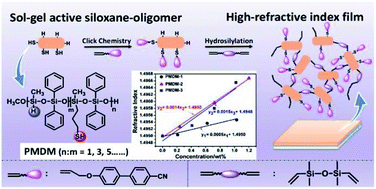
In this paper, a series of novel active silicone–oligomers (PMDM) of high refractive index (RI) with dual reactive moieties (Si–H and S–H) synthesized by nonhydrolytic sol–gel condensation are reported for the first time. The RI of the oligosiloxane can be effectively increased from 1.55 to 1.65 by varying the feed ratio between methyldimethoxysilane (MDMS) and 3-mercaptopropylmethyldimethoxysilane (MMDS). Additionally, via “thiol–ene” click chemistry and the subsequent hydrosilylation reaction under a Pt catalyst, a transparent siloxane-polymer film with enhanced refractive index (1.59) and excellent thermal stability (T5% = 381 °C) was facilely synthesized and characterized, which in turn effectively substantiated the reactivity of the dual reactive moieties in PMDM. Such active oligomers would be useful chemical intermediates and the easily processed materials have great potential in modern optical/photonic applications such as waveguides, lasers or light emitting diodes.
Silicone-based polymers with high transmittances and excellent thermal resistances have been widely applied in the fields of computer chips, adhesives, encapsulation, aerospace, etc.26–29 However, in consequence of the chemical structure (Si–O–Si), silicone-based polymers in general have low RI values of about 1.4, which is difficult to meet the requirements of many devices and greatly limits their practical applications.30 Over the past few decades, great efforts have been devoted to the development of silicone-based materials with sufficiently high RI. It has been reported that substituting aromatic and conjugated systems can increase the value of RI to a great extent.31 The RI values of several polysiloxanes synthesized by varying the content of phenyl or altering the types of aromatic groups range from 1.43–1.68.32–35 Except for the phenyl ring, employing phenyl ethers, i.e., phenyloxyphenyl ether and phenlythiophenyl ether, as the pendant groups of silicone monomer or covalently attaching the phthalimide structure into siloxane oligomers can also significantly enhance the RI of polysiloxane.36–40 Additionally, some other studies on a series of epoxy-functionalized polysiloxanes revealed that increasing the crosslink density would induce an increase in RI.41 Although the silicone resins with relatively high RIs have been paid close attention, due to limited species of the silicon-based materials with multi-functionality, researches on modulation of RI values based on silicon-based materials are difficult to obtain the significant breakthrough.
In this article, by adjusting the feed ratio between MDMS and MMDS, a series of active siloxane–oligomers (PMDM) with dual reactive groups and tunable RI ranging from 1.55 to 1.65 were successfully synthesized through sol–gel condensation for the first time. Additionally, via “thiol–ene” click chemistry and the subsequent hydrosilylation reaction under Pt catalyst, a transparent siloxane-polymer film with enhanced RI and good thermal stability was facilely synthesized and characterized, which effectively confirmed the reactivity of the dual reactive groups. The resultant siloxane–oligomers (PMDM) are therefore a representative model with dual reactive groups and further reaction could derive a variety of novel functional materials.
DPSD (2.60 g, 12.01 mmol), MDMS (0.57 mL, 4.62 mmol), and MMDS (0.83 mL, 4.62 mmol) with an optimal molar ratio of Si–OCH3/Si–OH as 1.00
:
1.30 were mixed in toluene (12.00 mL) in a flask, then barium hydroxide monohydrate, Ba(OH)2·H2O (BH) (4.02 mg, 0.02 mmol) was added as a catalyst to promote the direct condensation reaction between the methoxy radical of MDMS/MMDS and the diol radical of DPSD to form the siloxane bonds. The mixture was stirred continuously and kept at 80 °C for 4 h. After the reaction, BH was removed by a 0.45 μm pore-sized Teflon filter. The residue was evaporated by reduced pressure distillation under 50 °C to remove the by-product MeOH and toluene, then it was evaporated under 70 °C for further removal of the toluene. After that, the product (PMDM-1) was dried under vacuum at 70 °C for 48 h.
Other PMDM resins were prepared by using a similar method, the amount of the raw material for PMDM-2 and PMDM-3 is listed in Table 1.
| Sample | m(MDMS) [mol] | m(MMDS) [mol] | m(DPSD) [mol] | m(BH) [×102 mol] | m(–SiH) : m(–SH) |
Refractive index (n) | T1%d [°C] | T5%e [°C] | |
|---|---|---|---|---|---|---|---|---|---|
| Theoretical | Calculateda | ||||||||
| a Calculated according to the 1H-NMR results.b Evaluated by Abbe refractometer at 589 nm.c Measured by prism couping device at 633 nm.d 1% weight loss temperature was evaluated by TGA at a rate of 10 °C min−1.e 5% weight loss temperature was evaluated by TGA at a rate of 10 °C min−1. | |||||||||
| PMDM-1 | 1.00 | 1.00 | 2.60 | 0.23 | 1.00 : 1.00 |
1.00 : 0.97 |
1.55b | 201 | 286 |
| PMDM-2 | 1.00 | 3.00 | 5.20 | 0.92 | 1.00 : 3.00 |
1.00 : 2.76 |
1.64b | ||
| PMDM-3 | 1.00 | 5.00 | 7.80 | 1.38 | 1.00 : 5.00 |
1.00 : 4.77 |
1.65b | ||
| PMDM-1-ABC | 1.62b | ||||||||
| PMDM-1-ABC-DVTMDS | 1.59c | 324 | 381 | ||||||
CH–C, 1H); 5.372 (HHC
CH–C, 1H); 5.243 (HHC
CH–C, 1H); 4.528 (HHC
HC–CHH, 2H).
Then the oligomer PMDM-1 with dual reactive groups was modified by ABC through “thiol–ene” click chemistry. PMDM-1 (0.21 g, 0.59 mmol –SH), ABC (0.14 g, 0.59 mmol –CH
CH2), AIBN (9.90 mg, 0.06 mmol), and toluene (3.00 mL) were added into a Schlenk-type flask. After degassed by three freeze–pump–thaw cycles, the mixture was stirred continuously in a sealed flask at 65 °C for 24 h to proceed the reaction. Then, methanol was added into the mixture to precipitate the resultant product, which was further purified by dissolving in THF. This process was repeated for several times and the final precipitated product was dried under vacuum. The target product PMDM-1-ABC was obtained as an oily liquid.
Finally, the modified PMDM-1-ABC was thermally cured with the cross-linker, divinyltetramethyldisiloxane (DVTMDS), by a conventional hydrosilylation reaction under Pt catalyst in the following procedure: a mixture of PMDM-1-ABC (14.22 mmol-Si–H) and DVTMDS (3.00 mL, 14.22 mmol –CH
CH2) with Pt catalyst (50 ppm) was spin-coated onto a glass plate, followed by curing at 200 °C for 6 h under air atmosphere. Then a transparent film was obtained.
000. All GPC data were gathered by using tetrahydrofuran (THF) (HPLC grade, Fisher Scientific) as the eluent at a flow rate of 1.0 mL min−1 at 35 °C and calibrated with linear polystyrene standards. Thermogravimetric analysis (TGA) was recorded on a Perkin Elmer/TGA 4000 thermal analysis system at a heating rate of 10 °C min−1 under nitrogen. Abbe refractometer (WYA-2S) was used to measure the RIs of the PMDM solutions with different concentrations, and the refractive indices of pure PMDM and PMDM-1-ABC at 589 nm were obtained by an extrapolating method. While the refractive index of the film at 633 nm was measured on a prism coupling device (Metricon, 2010). The optical transmittance of the film was measured by a UV/VIS/NIR spectrophotometer (Perkin Elmer, Lambda 950).
:
1.00, 1.00
:
3.00, to 1.00
:
5.00 were successfully and efficiently synthesized by a facile sol–gel condensation method, as illustrated in Scheme 1. The chemical structures of the silicone–oligomers were verified by the combination of FT-IR, 1H-NMR, and 29Si-NMR spectra. The molecular characteristics of the oligomers are summarized in Table 1. GPC analysis showed that the number-average molecular weights (Mn) and the weight-average molecular weights (Mw) of the silicone–oligomers were 0.9 × 10³ g mol−1 and 1.1 × 10³ g mol−1, respectively, with the polydispersity of 1.22, confirmed their polymeric nature.
Fig. 1 and Fig. 2 show the FT-IR and NMR spectra of the PMDM, respectively. As shown in Fig. 1, the appearance of the vibrational bands at 1020–1120 cm−1 (assigned as the representative siloxane network stretching, νSi–O–Si), 3627 cm−1 and 2849 cm−1 (assigned as the terminal-group of silanol (νSi–OH) and methoxy groups on silicon atoms (νSi–OCH3), repectively), as well as the vibrational bands at 2580 cm−1 and 2160 cm−1 (attributed to the stretching vibration of –SH and –SiH, respectively), indicated the successful preparation of the PMDM resin.
Furthermore, in 1H NMR spectrum shown in Fig. 2(a), the appearance of the representative signals of –SH, –SiH, and –OCH3 in PMDM-1 at 1.54, 2.40, and 3.37 ppm, respectively, confirmed the success of the sol–gel condensation reaction. The 29Si-NMR spectrum of PMDM-1, which presented highly condensed Si species as shown in Fig. 2(b), further verified the formation of the siloxane network.30,42 Based on the 29Si-NMR measurements, the degree of condensation (DOC) of the siloxane network was calculated as 80.7%.43 Additionally, the actual molar fraction of two active groups of –SiH and –SH in a specified oligomer was calculated according to the integral area of the signals at 1.54 ppm (–SH moiety) and 2.40 ppm (–SiH moiety) (as remarked in Fig. 2(a)). The results were listed in Table 1, which was in accordance with the feed ratio.
As shown in Fig. 3, it can be clearly seen that the vibrational bands of siloxane network (νSi–O–Si) (at around 1020–1120 cm−1) and the Si–H (νSi–H) (at around 2160 cm−1) in PMDM-1 were still presented after the thiol–ene click reaction. The disappearance of the vibrational band of thiol group at 2580 cm−1 and the appearance of the vibrational band of cyano group at 2228 cm−1 indicated that “thiol–ene” click reaction was fully completed. Additionally, the appearance of the representative signal of Ar–O–CH2 in PMDM-1-ABC at about 4.00 ppm in 1H-NMR spectrum further confirmed the success of the grafting reaction of the ABC moiety onto PMDM-1 (as shown in Fig. 4).
Then, as shown in Scheme 1c and Scheme 2, the PMDM-1-ABC was facilely cured in the presence of cross-linker and Pt catalyst through hydrosilylation reaction. Finally, a transparent film of PMDM-1-ABC-DVTMDS with a highly cross-linked network structure was successfully obtained.
![]() | ||
| Scheme 2 Schematic of the preparation of the transparent film PMDM-1-ABC-DVTMDS through hydrosilylation reaction. | ||
FT-IR analysis was employed to monitor the hydrosilylation reaction process. As illustrated in Fig. 5, the disappearance of the vibrational band at 2160 cm−1 assigned as Si–H stretching in PMDM-1-ABC-DVTMDS film showed that the Si–H groups were reacted completely. Therefore, it firmly substantiated that the S–H and Si–H groups reacted independently in each step of the reaction, namely the thiol–ene click reaction and the subsequent hydrosilylation reaction, which demonstrated the independent reactivity of the Si–H and S–H groups in the active siloxane–oligomer of PMDM.
![]() | ||
| Fig. 6 TGA curves of the oligomer PMDM-1 and the cured film PMDM-1-ABC-DVTMDS (under a nitrogen atmosphere, 10 °C min−1). | ||
The n values of the synthesized active oligomers are listed in Table 1. It can be seen that attributing to the introduction of sulfur atom and aromatic ring with both low molar volumes and high molar refractions,18 the n values of the three silicone–oligomers were in the range between 1.54 and 1.65, which were higher than the commercially available silicon-based materials.31 These results confirmed that the RIs can be enhanced due to the higher sulfur content per repeat unit. Furthermore, due to the reactivity of the –SH and –SiH groups, the refractive index of the active silicone–oligomer can be further regulated and improved. Via “thiol–ene” click chemistry, a transparent oily intermediate PMDM-1-ABC was prepared and its refractive index could be measured using the same method above. The subsequent hydrosilylation reaction could obtain a transparent PMDM-1-ABC-DVTMDS film. And the refractive index of the film was measured by a prism coupling device at 633 nm at 20 °C. As illustrated in Table 1, the refractive index of PMDM-1 sample was increased effectively from 1.55 to 1.62 by the introduction of vinyl monomer ABC. While after the hydrosilylation reaction with the crosslinker DVTMDS, the refractive index value of the PMDM-1-ABC-DVTMDS film decreased to 1.59 due to the low refractive index of the cross-linker (n(DVTMDS) = 1.41).
The optical transparency of the PMDM-1-ABC-DVTMDS film (∼10 μm) on a glass substrate was investigated by UV-vis transmittance spectroscopy (as shown in Fig. 8). The PMDM-1-ABC-DVTMDS film maintained good transmittance in the visible range (400–800 nm) and the transmittance was above 80% at 550 nm, which was attributed to the effective prevention of inter-chain molecular packing deriving from the asymmetric substituent groups and rigid aromatic rings in the side chain and the introduction of branched chain. As expected, the silicon-based polymers in this study with high transmittance, excellent thermal resistance, and enhanced refractive index are strongly desired in practical applications.
Footnote |
| † These authors contributed equally to this work. |
| This journal is © The Royal Society of Chemistry 2016 |