
A. Kahnt*a,
R. Flyuntb,
S. Naumovb,
W. Knolleb,
S. Eiglercd,
R. Hermanne and
B. Abel*be
aDepartment of Chemistry and Pharmacy, Chair of Physical Chemistry I, Friedrich-Alexander-Universität Erlangen-Nürnberg, Egerlandstrasse 3, 91058 Erlangen, Germany. E-mail: axel.kahnt@fau.de
bLeibniz Institute of Surface Modification (IOM), Chemical Department, Permoserstr. 15, 04303 Leipzig, Germany. E-mail: bernd.abel@iom-leipzig.de
cDepartment of Chemistry and Pharmacy, Institute of Advanced Materials and Processes (ZMP), Friedrich-Alexander-Universität Erlangen-Nürnberg (FAU), Henkestr. 42, 91054 Erlangen, Germany
dDepartment of Chemistry and Chemical Engineering/Organic Chemistry, Chalmers University of Technology, 41296 Göteborg, Sweden
eWilhelm-Ostwald-Institute for Physical and Theoretical Chemistry, Universität Leipzig, Linne-Strasse 2, 04103 Leipzig, Germany
First published on 12th July 2016
Reduction of graphene oxide (GO) in aqueous dispersions by strongly reducing free radicals has recently been identified to be a very powerful approach, because functional groups are removed softly but efficiently, and non-volatile impurities as well as defects are largely avoided. However, the reaction mechanisms remained somewhat speculative. Recently we showed that GO can be efficiently reduced in water by indirect photoreduction mediated by (CH3)2˙C(OH) radicals generated via the reaction of triplet acetone with isopropanol. Those radicals efficiently defunctionalize oxo-groups of GO forming the carbon lattice without generating additional defects. In this comprehensive study we shed more light on the reaction mechanism of reduction of GO by H˙, CO2˙−, (CH3)2˙C(OH) and CH3C˙H(OH) by combining pulsed radiolysis and determine its overall energetics via quantum-chemical calculations. In time-dependent experiments mechanistic insights have been obtained and unknown intermediates have been discovered. Moreover, different reduction mechanisms, such as radical addition, electron-transfer, concerted water elimination and HCO3− elimination are identified. Here we show that all mechanisms lead to sp2-carbon formation and therefore high quality graphene by reductive defunctionalization.
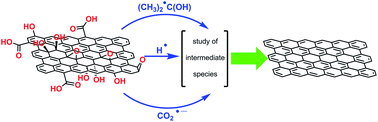
The reduction of GO using reducing free radicals formed by radiation chemical or photochemical approaches attracted attention in the last few years. Among all methods of free radical generation radiation chemistry provides the best choice to generate radicals of defined structure in a wide range of solvents and temperatures. Recent studies17–21 provided solid evidence for the feasibility of the reduction of GO in aqueous dispersion using radiation- or photochemical methods.
Recently, we highlighted the large benefits and softness of free radical reduction of GO. In this study different GO samples were efficiently reduced with photochemically generated (CH3)2C˙(OH).22 The obtained rGO from this approach showed conductivity values up to 5500 S m−1, which indicates the efficiency of the method. Moreover, it is extremely simple to realize and up-scale the reduction method.22 Unfortunately, the mechanism and kinetic details of the reduction processes remained elusive. Information on molecular mechanisms, kinetics, and energetics are needed, however, to understand why the GO reduction employing free radicals leads to high-quality rGO, containing only a very small amount of residual functional groups,17,22 as well as for any serious up-scaling attempts. Considering up-scaling as a longer term perspective, precise knowledge of mechanisms and rate constants is required for drawing mass and heat balances as well as selecting the right photo reactor type etc. In spite of their apparent importance it is surprising that detailed mechanistic studies for the relevant chemical reduction reactions are only rarely spotted in the literature,23 such as a recent study focusing on the reduction of GO by solvated electrons (eaq−) in water.21
In the light of the latter we selected four reductive free radicals with a vide rage of reduction potentials (2.3–1.2 V vs. NHE) namely H˙, CO2˙−, (CH3)2C˙(OH), and CH3C˙H(OH). All of them known in the literature for their general feasibility to reduce GO efficiently.17–23 All selected reducing radicals are easy and exclusively accessible in aqueous GO dispersions using pulse radiolysis, which allows for monitoring the reactions of the radicals with GO spectroscopically and kinetically. This in mind, we performed a combined spectroscopic and kinetic study based on pulse radiolysis complemented by quantum chemical calculations. The latter is giving insights into the energetics of the investigated reactions. Moreover the quantum chemical studies allow to investigate multistep reactions of GO, in which the GO flake reacts after the initial reaction with a reducing free radical with further reducing free radicals. This is helpful since the concentration of free radicals formed by pulse radiolysis is much lower than the GO concentration, hampering the time resolved observation of these further reaction steps.
| ˙OH + H2 → H2O + H˙ | (2) |
| eaq− + H+ → H˙ | (3) |
The advantage of this approach instead utilizing the solvated electrons from the water radiolysis, is the higher yield of H atoms (the corresponding radiation-chemical yields are equal to 6.4 × 10⁻⁷ mol J−1 and 3.5 × 10⁻⁷ mol J−1, respectively).§
Immediately after the electron pulse the transient spectra of the products of the water radiolysis are observed, but they are promptly converted into H˙. Hydrogen atoms show an absorption deep in the UV region of the optical spectrum.35 However, it can be hardly observed in solutions containing substantial amount of GO which shows strong absorption in the UV region.
The reaction of H˙ with oxo-G1 is showing the formation of a broad transient absorption in the range between 400 nm and 1050 nm with a maximum around 520 nm (Fig. 1a). This transient absorption is stable over the detection range of our experimental setup (up to 1 ms). The plot of the pseudo-first-order rate constants derived from the mono-exponential rise of the transient absorption around 520 nm vs. oxo-G1 concentration shows a linear relation resulting in a second-order rate constant of k2 = 5.6 × 10⁶ ml mg−1 s−1.
Please note: GO is a label for a number of different heterogeneous materials (with very different defect numbers and features, i.e., functional groups), for which no classical solution concentration of the reactant in terms of mol l−1 can be given. Instead we give rate constants (in ml mg−1 s−1) as a function of the dispersed GO amount in solution (mg ml−1). For the compilation of the determined rate constants of the reaction of GO with reducing free radicals see Table 1.
| Reducing species | Reduction potential of the reducing transient vs. NHEa | Oxo-G1 k2/ml mg−1 s−1 | CT-GO k2/ml mg−1 s−1 | NI-GO k2/ml mg−1 s−1 |
|---|---|---|---|---|
| a Values taken from ref. 34.b Values taken from ref. 21.c Value taken from ref. 33.d ND – not determined. | ||||
| eaq− | −2.8 V | 2.8 × 10⁷b | 1.2 × 10⁷b | 2.3 × 10⁷b |
| H˙ | −2.3 Vc | 5.6 × 10⁵ | NDd | ND |
| CO2˙− | −2.0 V | 2.5 × 10⁴ | 4.5 × 10⁴ | 5.0 × 10⁴ |
| (CH3)2C˙(OH) | −1.4 V | 5.2 × 10⁴ | 1.2 × 10⁵ | 8.1 × 10⁴ |
| CH3C˙H(OH) | −1.2 V | 7.7 × 10⁴ | ND | ND |
Since the rate constant for the reaction of ˙OH with H2 is only 3.9 × 10⁷ M−1 s−1,36 a reference experiment, adding a small amount (2 mM) of tert-butanol (t-BuOH) was performed. This amount of t-BuOH is capable scavenging efficiently ˙OH since the rate constant for the reaction of t-BuOH with ˙OH is ∼6 × 10⁸ M−1 s−1 and with H˙ is ∼1 × 10⁵ M−1 s−1.37 Therefore, at these conditions the ˙OH radicals will not interfere reactions on the μs time scale. On the other hand, the selected t-BuOH concentration is too small to interfere with the reaction between H˙ and GO, since the reaction between t-BuOH and H˙ would occur on the ms timescale. In a second reference experiment, the reaction of GO, with ˙OH was probed and lead to a transient absorption maximizing at 560 nm (Fig. S1 in the ESI†). The outcome of these reference experiments is providing solid evidences that the transient absorption with the maximum around 520 nm results from the reaction of H˙ with GO and is not related to the reaction of GO with ˙OH.
Noteworthy is the fact, that this transient absorption obtained by the reduction of GO with H˙ is not matching with the absorption of reduced graphene oxide (rGO). The latter is the only end product of the GO reduction by reducing free radicals independently from their nature. The reduction of GO in aqueous solution is characterized by an overall increase of the absorption with a maximum around 260 nm (see Fig. S2† as an example).17–22 Therefore, the most feasible rational would be, that the reduction occurs in a multi-step mechanism and the observed transient absorption (Fig. 1a) shows intermediate of the GO reaction. In line with our theoretical studies three different mechanisms for the reaction of H˙ with GO are considered. They are (i) a concerted reaction of H˙ with GO forming directly GO˙ and H2O (eqn (4)), (ii) a radical addition of the H˙ onto the GO basal plane (eqn (5)) and (iii) an electron transfer from H˙ to GO resulting in GO˙− and H+ (eqn (6)).
| H˙ + GO → GO˙ + H2O | (4) |
| H˙ + GO → ˙GO–H | (5) |
| H˙ + GO → GO˙− + H+ | (6) |
As shown by our theoretical calculations (see section Quantum chemical calculations, Fig. 5) all three proposed reaction pathways are energetically feasible and leading in follow up reactions to rGO.
Taking the feasibility of all three reaction pathways into account the rate constant of the reaction of GO with H˙ should be considered as the overall rate constant for the reactions (4–6).
Another very powerful reductant, namely CO2˙− (−2.0 V vs. NHE)34 was generated via reactions (7) and (8) in N2O-saturated, aqueous solutions containing 5 × 10⁻³ M HC(O)ONa. Under such conditions the solvated electrons from the water radiolysis (eqn (1)) are quantitatively scavenged by N2O and transformed into ˙OH (eqn (7)). The H˙ and ˙OH radicals react with HC(O)O− under hydrogen abstraction affording CO2˙− (eqn (8)).38
| eaq− + H2O + N2O → ˙OH + OH− + N2 | (7) |
| ˙OH (H˙) + HC(O)O− → H2O (H2) + CO2˙− | (8) |
The transient absorption obtained directly after the electron pulse shows the initial products of the water radiolysis, promptly converted into CO2˙− with its characteristic transient absorption in the UV region of the optical spectrum.38 The reaction of CO2˙− with GO results in the decay of the transient absorption of CO2˙− accompanied by the rise of a new broad transient absorption band in the visible and NIR region of the optical spectrum with an isosbestic point around 400 nm, clearly indicating that the formation of the new transient absorption relates to the reaction of GO with CO2˙−. This new transient absorption appears on the microsecond time scale and the pseudo-first-order rate constants obtained from the mono-exponential fitting of the rise at 800 nm are linearly dependent on the GO concentration. From the slope of this dependence the second-order rate constants of 2.5 × 10⁴ ml mg−1 s−1 (oxo-G1), 4.5 × 10⁴ ml mg−1 s−1 (CT-GO) and 5.0 × 10⁴ ml mg−1 s−1 (NI-GO) were derived (see Fig. 2 for oxo-G1 and S3 and S4† for CT-GO and NI-GO, respectively).
As already described for the reaction of GO with ˙H, the transient absorption formed by the reaction of GO with CO2˙− is not matching with the absorption of rGO even through the successful reduction of GO to rGO utilizing CO2˙− is well established by steady state electron beam radiolysis.17 Again a more complex reaction mechanism should be taken into account. As possible first reaction steps, radical addition (followed by elimination of CO2) (eqn (9)), a direct electron transfer (eqn (10)) or a hydrogen carbonate formation (eqn (11)) should be considered. Reaction (eqn (9)) (radical addition) takes into account, that it is well known from inorganic radiation chemistry, that CO2˙− reacts preferably in an “inner sphere” electron transfer mechanism39 which would favour the proposed addition/elimination mechanism. However, our quantum chemical calculations (see quantum chemical studies Fig. 6) showed that the direct electron transfer (eqn (10)) and the formation of HCO3− (eqn (11)) are the only energetically feasible mechanisms (vide infra) which allow in subsequent follow–up reaction steps forming rGO.
| CO2˙− + GO → GO–[CO2˙−] | (9) |
| CO2˙− + GO → GO˙− + CO2 | (10) |
| CO2˙− + GO → GO˙ + HCO3− | (11) |
In the third approach (CH3)2C˙(OH) yet another powerful reductant with a somewhat lower reduction potential (−1.39 V vs. NHE)34 compared to H˙ and CO2˙− was investigated. (CH3)2C˙(OH) is formed in a standard procedure irradiating N2O-saturated aqueous solutions containing 5 vol% 2-propanol. The basic chemistry is similar to the formate-containing system discussed above and is described by eqn (7) and (12).40
| ˙OH (H˙) + (CH3)2CH(OH) → H2O (H2) + (CH3)2C˙(OH) | (12) |
In this system an initial transient absorption in the UV region can be addressed to (CH3)2C˙(OH) species. It is decaying with an isosbestic point around 410 nm and gives rise to a broad transient absorption in the visible to NIR regions of the optical spectrum (see Fig. 3 for oxo-G1 and S5 and S6† for CT-GO and NI-GO).
This kinetics is well fitted to a monoexponential rise. Second-order rate constants of 5.2 × 10⁴ ml mg−1 s−1 (oxo-G1) 1.2 × 10⁵ ml mg−1 s−1 (CT-GO) and 8.1 × 10⁴ ml mg−1 s−1 (NI-GO) were obtained in analogy to the systems described above.
Again, this new transient is not matching with the absorption spectrum of rGO, although the formation of rGO as final product was proved by steady state electron beam or gamma radiolysis,17–20 pointing to a multistep reaction mechanism as well.
Here three pathways should be considered: a concerted reaction of (CH3)2C˙(OH) with GO resulting in GO˙, H2O and (CH3)2CO (eqn (13)), a radical addition/reductive elimination mechanism and a direct electron transfer with the release of OH−. From our theoretical calculations (see quantum chemical studies Fig. 7) we conclude, that only the concerted reaction (13) is energetically feasible and leads to rGO.
| (CH3)2C˙(OH) + GO → GO˙ + (CH3)2CO + H2O | (13) |
Finally, CH3C˙H(OH) with an even lower reduction potential (−1.25 V vs. NHE)34 was tested. These species are generated as a major product (89% yield) of the reaction of ˙OH with ethanol in N2O-saturated aqueous solution.40
Again, the transient absorptions of the primary products of the water radiolysis and subsequently of the formed reducing transient – here CH3C˙H(OH) – was observed. The transient absorption of CH3C˙H(OH) which essentially dominates the UV region is decaying in GO containing solutions, giving rise to a new transient absorption in the visible and NIR region of the optical spectrum (see Fig. 4). The formation of this transient can be well fitted to a mono-exponential rise and a second-order rate constant of 7.7 × 10⁴ ml mg−1 s−1 was received for the reaction of oxo-G1 with CH3C˙H(OH). The transient spectrum with an maximum at 675 nm, observed for the reaction of CH3C˙H(OH) with GO does not fit to the absorption of rGO, efficiently formed in steady state electron beam radiolysis.17,18
In fact as corroborated by theoretical studies (vide infra) the reduction occurs in a multi-step mechanism. The initial step of the GO reduction by CH3C˙H(OH) is an concerted reaction of the CH3C˙H(OH) with GO under the release of water (eqn (14)). The formation of a radical adduct on the basal plane is excluded, since our quantum chemical studies show that this reaction if strongly endergonic.
| CH3C˙H(OH) + GO → GO˙ + H2O + CH3CHO | (14) |
From the reducing species studied, the hydrated electrons possess the highest reactivity toward GO. For example, in the reaction with oxo-G1 its second-order rate constant is 50 times higher than the corresponding one for H˙. The latter value is yet more than 20 times higher compared to the reaction of CO2˙−, resulting in a more than 1000-fold lower reactivity of the latter species compared to eaq−.23 This sequence of the reactivities is correlating with reduction potentials of the discussed species changing from −2.8 V to −2.0 V (see Table 1). However, the reducing radicals derived from 2-propanol and ethanol, with much lower reduction potentials (−1.4 and −1.2 V), do not follow anymore the above mentioned trend.
This is a strong indication for different mechanisms involved. Our quantum-chemical calculations (vide infra) show that for H˙ and CO2˙− electron transfer reactions are a major feasible pathway (see Fig. 5 and 6), whereas (CH3)2C˙(OH) and CH3C˙H(OH) react in a concerted reaction releasing water (see Fig. 7 and 8).
It is noteworthy to point out, that only small differences (at most by a factor of ca. 2.3, see Table 1) were seen for the rate constants for the reactions of one particular reducing radical with different GO types. Commercial GO (CT-GO/NI-GO) contain around 5–10% C(O)OH/COO− groups and have a highly defective surface. On the other hand, oxo-G1 exhibits an average density of defects of only 0.3% within the carbon skeleton.13 Therefore, we can conclude that the defect density in GO does not play any significant role for the kinetic of its reduction by free radicals.
Summarizing our experiments (Fig. 1–4), it should be pointed out that transient absorptions with three different shapes were observed, namely the transient absorption for the reaction of GO with H˙, CO2˙− and the α-hydroxy-alkyl radicals (CH3C˙H(OH) and (CH3)2C˙(OH)). This finding is well in a line with our theoretical studies. These studies predict, depending on the particular reaction partner, three different GO intermediates to be formed. In case of the reaction of GO with H˙ the parallel formation of all three different intermediates (GO–H)˙, GO˙ and GO˙− is feasible and the obtained transient absorption is most likely the sum of the transient absorption of all three proposed intermediates. Whereas the reaction of GO with CO2˙− leads only to the formation of GO˙− and GO˙, the reaction of the α-hydroxy-alkyl radicals (CH3C˙H(OH) and (CH3)2C˙(OH)) leads practically exclusively to the formation of GO˙. This in regards, depending on the reductive free radical three different intermediates are formed, which lead, nevertheless, to the formation of rGO as final product based on our experimental17,18 and theoretical studies (see below).
The quantum chemical calculations for the reaction of H˙ with GO (Fig. 5) revealed three energetically feasible multi step reaction mechanism (electron transfer, radical addition and a concerted reaction). The formed products are GO˙ (concerted reaction), GO˙− (electron transfer) and ˙GO–H. The latter two (GO˙−) and (˙GO–H) react under the release of OH− and H2O respectively to GO˙. In order to obtain rGO, GO˙ necessitates to undergo further transformations, i.e., for our model GO the reaction with a second ˙H. This can occur following two energetically feasible reaction pathways, either by an electron transfer and the subsequent release of OH− or by a concerted reaction with the release of water (Fig. 5).
When turning to CO2˙− for which the reduction of GO is well established, only the electron transfer from CO2˙− to the GO flake as well as the concerted reaction of CO2˙− with the GO flake under the release of HCO3− is highly exergonic (see Fig. 6). The former reaction (electron transfer) results in GO˙− whereas the latter results in GO˙. GO˙− may react further under OH− release to GO˙, for which a reaction with a second CO2˙− will result in the rGO formation. Here again the CO2˙− can react in both ways either via electron transfer forming a GO− which can react under release of OH− to rGO or in a concerted reaction forming rGO and HCO3−. A radical addition of CO2˙− onto the GO π-system was excluded since no stable geometry for such radical adduct was found. When turning to the alpha-hydroxy radicals (CH3)2˙C(OH) (Fig. 7) and CH3˙CH(OH) (Fig. 8). The energetically most feasible is the concerted reaction of (CH3)2˙C(OH) and CH3˙CH(OH) with GO releasing water. The electron transfer reaction is only slightly exergonic (−9/−2 kcal mol−1) compared to the concerted reaction which shows a strong driving force (−74/−78 kcal mol−1) and is therefore much more likely to happen. The reaction results in the formation of GO˙. The further reaction of GO˙ to rGO can in case of (CH3)2˙C(OH) and CH3˙CH(OH) only occur in a concerted reaction since the electron transfer reaction lacks of any driving force. A radical addition onto the GO π-system followed by a reductive elimination was also considered of the reaction of GO with (CH3)2˙C(OH) and CH3˙CH(OH) but these reactions are highly endergonic and ΔG values of +36 ((CH3)2˙C(OH)) and +13 kcal mol−1 (CH3˙CH(OH)) were obtained, rendering these reactions energetically unfeasible.
Taking the results obtained by the quantum chemical study into concert with the results from the pulse radiolysis the obtained transient absorption of GO von H˙ with it maximum at 520 nm is most likely the sum of the transient absorption of ˙GO–H, GO˙− and GO˙. All three intermediates are likely to be formed. The transient absorption observed from the reaction of CO2˙− with its maximum at 800 nm, is in the light of the quantum chemical calculation best explained as the sum of the transient absorption of GO˙− and GO˙ since both reactions are energetically feasible and likely to happen. The reaction of GO with (CH3)2˙C(OH) and CH3˙CH(OH) was in both cases showing transient absorption spectra with maxima around 700 nm, which are in line with our quantum chemical calculations in both cases exhibiting GO˙ as the only energetically feasible intermediate for the GO reduction.
Our combined experimental and theoretical approaches corroborated that the rGO formation occurs in a multistep mechanism forming GO˙, GO˙− and ˙GO–H respectively, which react further with the particular reducing radicals to rGO. All observed reaction mechanisms have in common that they reduce GO by the removal of the oxygen functionality from the GO flake but spare the carbon atom. Other simple methods such as thermal treatments or direct photoexcitation also removes the oxygen functionalities by releasing CO2 and CO. However it is not leading to a substantial repair of the carbon π-system.41
In contrary the indirect reduction using reducing free radicals is avoiding the loss of the carbon atoms from the carbon framework and, moreover, recreating the carbon π-system – in other words the graphene oxide becomes repaired towards graphene. This repair can be simply followed by conductivity measurements accompanied by XPS measurements where values of 5500 S m−1 and C/O-atom rations up to 10.9 were obtained for the reduction of oxo-G1 by (CH3)2˙C(OH).22 Even for commercial CT-GO, which bears large holes in the GO basal plain, conductivity values of 500 S m−1 were observed.22
Footnotes |
| † Electronic supplementary information (ESI) available: UV/vis spectra upon electron beam radiolysis, pulse radiolysis spectra and time absorption profiles. See DOI: 10.1039/c6ra13085b |
| ‡ The G-value, i.e., the yield per absorbed energy is 0.6 × 10⁻⁷ mol J−1 for H˙ and 2.9 × 10⁻⁷ mol J−1 for eaq− and ˙OH which under our conditions results that the concentration of the reactive transients is much lower than the GO concentration making a pseudo-first order approximation feasible. This assumption is further corroborated by the fact that the observed kinetics was independent from the aborted dose and a linear relation between the GO concentration and the pseudo-first order rate constant was observed. |
| § G(H˙)overall ≈ G(˙OH) + G(eaq−) + G(˙H)from water radiolysis with G(˙OH) = 2.9 × 10⁻⁷ mol J−1, G(eaq−) = 2.9 × 10⁻⁷ mol J−1, and G(H˙)from water radiolysis = 0.6 × 10⁻⁷ mol J−1 under the assumptions that the solvated electrons are qualitatively converted into H˙ by H+ as well as ˙OH react with H2 exclusively to H˙. Under the chosen conditions, these assumptions are reasonable. When 2 mM t-BuOH is added ˙OH is quenched efficiently and G(H˙)overall ≈ G(eaq−) + G(˙H). |
| This journal is © The Royal Society of Chemistry 2016 |