Yanjing Yang*a,
Yang Baia,
Fengqi Zhao*a,
Ergang Yaoa,
Jianhua Yia,
Chunlei Xuana and
Sanping Chenb
aScience and Technology on Combustion and Explosion Laboratory, Xi'an Modern Chemistry Research Institute, Xi'an 701165, China. E-mail: zhaofqi@163.com; yyj.zju.91@gmail.com
bKey Laboratory of Synthetic and Natural Functional Molecule Chemistry of Ministry of Education, College of Chemistry and Materials Science, Northwest University, Xi'an, Shaanxi 710069, China
First published on 11th July 2016
A metal organic framework (MOF) material, Fe-benzene-1,3,5-tricarboxylate (Fe-BTC), was investigated as a candidate for the combustion catalyst of solid propellants containing ammonium perchlorate. The thermal decomposition of ammonium perchlorate (AP) was found to be evidently enhanced in the presence of Fe-BTC. Unlike the pristine AP, the thermal decomposition and phase transition of AP in the AP/Fe-BTC system occur at almost the same temperature, resulting in a reduced decomposition temperature of 243 °C, which is 36 °C lower than that of the pristine AP. Moreover, introducing 1.0 wt% of Fe-BTC to BAMO–THF propellant with AP as the oxidizer could improve its combustion performance by effectively decreasing the pressure exponents.
Metal organic frameworks (MOFs), which are porous compounds composed of central metal cations and organic linkers, have attracted sustainable attention in many potential applications including heterogeneous catalysis.19 MOFs possess exceptionally high specific surface areas, metal dispersion and uniform pore and cavity sizes, which are important catalytically relevant features shared with zeolites, another important class of catalytic porous materials. In addition, the easily tunable topologies and compositions of MOFs as well as their high contents of unsaturated metal sites also make them attractive candidates for heterogeneous catalysts.20 On the other hand, it was revealed that, Fe-based compounds, including iron(III) oxide (Fe2O3), Fe2O3-based composites, ferrocene-based compounds and ferrocene-grafted HTPB,8,21–24 are effective catalysts for thermal decomposition of AP. Especially, the nano catalysts such as nano metal oxides exhibit superior catalytic activities to their bulk counterparts.25,26 More interestingly, decrease in the particle sizes of nano combustion catalysts leads to an increase in their catalytic activities.25 This phenomenon is believed to due to the occurrence of reactions on surfaces of catalysts since that higher specific areas of nano materials are favourable for the contact of catalysts with the reactants. Therefore, due to the high specific areas and even dispersion of metal sites, Fe-based MOFs would also be able to promote thermal decomposition of AP and improve combustion performances of solid propellants containing AP.
However, it should be pointed out that, for the practical application of MOFs as combustion catalysts, their mass production should be achieved first since kilograms of combustion catalysts would be needed for only one propellant charge. According to Czaja et al. and Majano et al., only a few MOFs materials including Cu-benzene-1,3,5-tricarboxylate (Cu-BTC), Fe-benzene-1,3,5-tricarboxylate (Fe-BTC), Zn-2-methylimidazolate, Mg-formate, Al-fumarate and terephthalate, have met scale-up requirements and are currently in production.27,28 Among them, the yield of the Fe-based MOF material Fe-benzene-1,3,5-tricarboxylate (Fe-BTC), produced by BASF SE and commercially known as Basolite F300, is 20 kg per m3 per day. Fe-BTC possesses a big Langmuir surface area of 1300–1600 m2 g−1 and exhibits catalytic capabilities in Lewis acid reactions and oxidation reactions.20,29 More encouragingly, Fe-BTC displays biocompatible features, thus lowering toxicity concerns and favouring its practical applications in solid propellants either.30
In this work, Fe-BTC was selected as a candidate for combustion catalysts of solid propellants with AP and its effects on thermal decomposition of AP and combustion properties of BAMO–THF propellant were investigated.
| Compositions | Content (wt%) | |
|---|---|---|
| BAMO–THF | Binder | 13.5 |
| Ammonium perchlorate (AP) | Oxidizer | 62–63 |
| Aluminium (Al) | Metal fuel | 10 |
| A3 | Plasticizer | 13.5 |
| Fe-BTC/Fe2O3 | Combustion catalyst | 0–1 |
The AP/Fe-BTC combination system used for thermal analysis was prepared by physically mixing AP and Fe-BTC evenly using pestle and mortar.
The propellant samples were prepared in 800 g batches using a vertical planetary mixer of 5 L capacity. All batches were mixed and cast under vacuum by a slurry process. After BAMO–THF and A3 were mixed evenly, AP was carefully introduced to the mixture followed by additional mixing. Then, Al powders (and Fe-BTC/Fe2O3 when combustion catalysts were used) were added to the sample and mixed evenly. The propellants were cured at 50 °C for 72 h in a water jacketed oven.
The vibrational characteristics of chemical bonds were determined using a Bruker Tensor 27 Fourier Transform Infrared (FTIR) spectrometer. The spectra of the samples (as KBr pellets with a KBr to sample mass ratio of approximately 30
:
1) were acquired in the range of 4000–400 cm−1 in transmission mode with a resolution of 4 cm−1.
X-ray photoelectron spectroscopy (XPS) analysis was conducted on an ESCALAB 250 Xi XPS microprobe (Thermo Scientific, UK). The sample was prepared by sprinkling powder on a carbon rape attached to the sample holder. XPS spectra were recorded using monochromatic Al-Kα (186.6 eV) X-ray sources under an ultimate pressure of 5 × 10⁻¹⁰ mbar. All data were calibrated using the adventitious C 1s signal at 284.8 eV as a reference.
The Raman spectra of samples were collected on a InVia Raman Microscope spectroscopy (RENISHAW, UK). The measurements were carried out using the green line of an argon ion laser (λ = 514.5 nm) with a resolution of 1 cm−1.
Strand burning rate of the propellants were determined in the pressure range of 0.5–20 MPa by utilizing the fuse-wire technique. This method involves the combustion of strands (ignited by a nichrome wire) with dimensions of 150 mm × 5 mm × 5 mm in a nitrogen pressurized stellar bomb.
O stretching mode. In addition, the band at 1276 cm−1 is believed to originate from the C–O bond and the detection of bands at 940, 713 and 761 cm−1 is due to the existence of C–CO2 bond.31
Thermal stability is of significant importance for materials used as ingredients of solid propellants. The as-received Fe-BTC was subjected to thermogravimetric analysis (TGA) to evaluate its thermal stability as shown in Fig. 2. For Fe-BTC, a three-stage decomposition behaviour with weight loss originating from gas release was observed with an onset temperature of 311 °C, confirming its good thermal stability as reported previously.27,32 This thermal decomposition behaviour fits well with the previous report,32 and the absence of weight loss at temperature lower than 300 °C is due to that no hydrated water exists in Fe-BTC of this work. A weight loss of 10.5 wt% is reached at 311–436 °C for the first decomposition stage. The second stage is initiated at 436 °C and gradually accelerates at 466 °C. The weight loss during this stage is 18.2 wt%. It should be noted that temperature ranges of the first decomposition stage and the second one partially overlap with each other, indicative of the relatively poor kinetics of the first stage. Upon further heating, a third decomposition stage is detected at 575 °C with a weight loss of 13 wt%. Totally, till 850 °C, weight loss from the Fe-BTC amounts to 41.8 wt%.
Investigation on pyrolysis behaviours of Fe-BTC is essential for evaluating its catalytic mechanism for decomposition of AP. DSC measurements and mass spectroscopy were utilized to investigate the thermal degradation characteristics of Fe-BTC. As shown in Fig. 3a, thermal decomposition reactions of Fe-BTC are endothermic and the third reaction stage consumes the most amount of energy. The MS results are exhibited in Fig. 3b, CO and CO2 were detected during thermal decomposition of Fe-BTC. In addition, a signal with m/z = 16 was also detected and attributed to CH4 instead of H2O since no signal with m/z = 18 was observed. Different gas-release behaviours of CO, CO2 and CH4 were observed. CO and CH4 are released in the second and third stages, whereas for CO2, its release can be detected in the whole decomposition process. Moreover, it is noticed that there is more CO released in the third stage than in the second one. This is reasonable since the carbon content is higher than oxygen content in Fe-BTC (C9H3FeO6) and there is no sufficient oxygen for generation of CO2 after two decomposition stages with significant CO2 release. As for CH4, however, the gas-release amount is higher in the second stage. Evolution of CH4, CO and CO2 indicates the breakdown of benzene-1,3,5-tricarboxylate structure, thus it is proposed that thermal decomposition of Fe-BTC leads to the formation of Fe2O3 supported on carbon, similar to the TiO2@C catalyst reported for hydrogen storage of NaAlH4.33
In order to further understand the decomposition behaviours of Fe-BTC, a decomposition product of Fe-BTC was prepared by heating Fe-BTC to 650 °C followed by dwelling for 1 h, and then it was subjected to structural characterizations. XRD pattern of the products is shown in Fig. 4a, it exhibits poor crystallinity and only two weak diffraction peaks from Fe2O3 are discernable on the pattern, suggesting the generation of Fe2O3 upon decomposition of Fe-BTC. Further XPS measurements were conducted on the decomposition product to characterize the chemical states of Fe and C. Fig. 4b shows the high-resolution spectra of C 1s and Fe 2p. It is observed that the C 1s spectrum could be resolved into three signals at 284.8, 285.8 and 286.8 eV by peak fitting. The signal at 284.8 eV is attributed to the carbon tape used for tests, whereas the one at 285.8 eV should be due to amorphous carbon as reported previously.34 This amorphous carbon detected is believed to result from the decomposition of Fe-BTC. Moreover, the detection of an additional C 1s signal at 286.8 eV indicates that there are oxygen bonded to carbon in the decomposition product.35 As for the Fe 2p spectrum, it can be resolved into a set of 2p3/2–2p1/2 spin–orbit doublet at 723.9 and 710.8 eV, which corresponds to Fe3+ oxidation state of Fe2O3.36
Raman spectroscopy result of this decomposition product was also obtained (Fig. S1†). It is noticed that no bands of Fe2O3 were detected, possibly due to its small particle size. On the other hand, two bands of carbon appear at 1598 and 1343 cm−1, corresponding to the graphite sp2 (E2g) carbon band (usually labelled as G band) and the defect sp3 carbon band (usually labelled as D band), respectively.37–39 The band at 1598 cm−1 suggests the existence of ordered graphitic crystallites of carbon (sp2-coordinated), whereas the one at 1343 cm−1 is indicative of the defects and disordered portions of carbon (sp3-coordinated). This phenomenon indicates the dual amorphous/crystalline nature of carbon in the product. The intensity ratios of D band to G band (ID/IG) are closely related to the diameter of graphitic cluster and the amounts of defects in carbon of the decomposition product.40 The ID/IG ratio is calculated to be about 1.71 in this work, thus leading to a graphitic cluster diameter of about 2.4 nm.40 Moreover, the high ID/IG ratio of 1.71 indicates a significant amount of disordered sections and defects. The above results confirm the above assumption that the decomposition product of Fe-BTC at 650 °C is composed of Fe2O3 and highly disordered carbon.
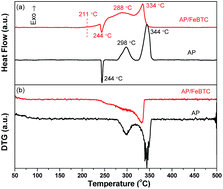
1.0 wt% of Fe-BTC was mixed evenly with AP to generate a AP/Fe-BTC system. The system was then subjected to DSC and TG measurements to evaluate the effects of Fe-BTC on thermal decomposition of AP. Fig. 5 presents the DSC and DTG curves of AP with 1.0 wt% of Fe-BTC, results of the pristine AP are also exhibited for comparison. As shown in Fig. 5a, three thermal events are detected for the pristine AP from room temperature to 500 °C. An endothermic event was detected at 244 °C due to transition of AP from the low-temperature orthorhombic modification to the high-temperature cubic modification. Upon further heating, AP decomposes via a two-step reaction with an onset temperature of about 277 °C. An exothermic peak at 298 °C, which originates from low-temperature decomposition of AP, is followed by another exothermic event peaked at 344 °C due to its high-temperature decomposition. The DTG curve of the pristine AP in Fig. 5b confirms this decomposition behaviour. By adding Fe-BTC to AP, a big change occurs to the decomposition characteristics. As exhibited in Fig. 5a and b, the exothermic decomposition of the AP/Fe-BTC system is initiated at 211 °C, 66 °C lower in comparison with the pristine AP. In addition, although it is believed that AP still decompose via two stages in the existence of Fe-BTC, both the low- and high-temperature decomposition of AP shift to lower temperatures by about 10 °C. Downshifts of peak temperatures from 298 °C and 344 °C to 288 °C and 334 °C were observed for the low- and high-temperature processes, respectively. Moreover, the relatively sharp exothermic peak of low-temperature decomposition of the pristine AP is replaced by a broad one as shown in Fig. 5a. The above results suggest that the decomposition of AP is evidently enhanced by Fe-BTC. However, it should be noticed that, on the DTG curve of the AP/Fe-BTC system, no variation is observed before 224 °C (as seen in the enlarged view of TDG curves, Fig. S2†), which is higher than the onset temperature for exothermic decomposition on the DSC curve (Fig. 5a) at 211 °C and the onset temperature for gas release (Fig. 6b) at 207 °C. This phenomenon is believed to due to the slow gas release and small amount of gases released in this temperature range, which make the variation in differential of weight losses (DTG) indiscernible.
The gaseous products released during thermal decomposition of the AP/Fe-BTC system were determined to further evaluate the effects of Fe-BTC, and the MS spectra of the pristine AP were also presented for comparison. As shown in Fig. 6a, gas release from the pristine AP starts at about 275 °C. NO, N2O, O2 and H2O could be detected in both the first and second decomposition stages, but hydrogen chloride (HCl), another major product of AP decomposition, was only observed in the second one. As for the AP/Fe-BTC system, an apparent discrepancy in gas-release behaviour was observed in comparison with the pristine AP. Upon heating to 207 °C, a gaseous product with m/z = 44, which could be CO2 or N2O, was released from the system. However, due to the detection of another MS signal with m/z = 28 which is assigned to N2O at 243 °C, the gas with m/z = 44 released at 207 °C is believed to be CO2. Obviously, the CO2 release originates from the decomposition of Fe-BTC. The lowered decomposition temperature of Fe-BTC in comparison with the pristine sample (311 °C) suggests that the existence of AP could promote its pyrolysis. On the other hand, further increasing in the temperature to 243 °C, close to the phase-transition temperature of 244 °C, results in evolution of N2O, NO, O2 and H2O, indicative of the decomposition of AP. The occurrence of decomposition and phase transition of AP at almost the same temperature confirms the significantly enhanced thermal decomposition of AP by introduction of Fe-BTC, since phase transition occurs prior to decomposition for the pristine AP. As a consequence, there is an mutual decomposition enhancement for AP and Fe-BTC in their combination system. Moreover, considering the fact that Fe-BTC decomposes prior to AP in the combination system, it is hypothesized that the decomposition intermediate of Fe-BTC and/or its decomposition product plays a critical role to enhance the thermal decomposition of AP.
As mentioned above, decomposition of Fe-BTC leads to generation of a composite composed of Fe2O3 and carbon (Fe2O3@C). Thus, in order to further understand the role of Fe-BTC in AP/Fe-BTC combination system, a Fe2O3@C sample was prepared and added to AP. Fig. 7 demonstrates the DSC curve of AP/Fe2O3@C, the results of AP/Fe2O3 (commercial), AP/Fe-BTC and the pristine AP were also exhibited. For AP with Fe2O3@C and commercial Fe2O3, a phase-transition temperature of 244 °C was identified, identical to those of AP/Fe-BTC and the pristine AP. Both Fe2O3@C and the commercial Fe2O3 are found to be able to promote the decomposition of AP. However, Fe2O3@C is noticed to be more effective than the commercial Fe2O3 in enhancing decomposition of AP, confirming the higher catalytic activities of smaller Fe2O3 particles. Decomposition of AP in the AP/Fe2O3@C system initiates at about 264 °C, evidently higher than that of AP in the existence of Fe-BTC at 243 °C. This phenomenon suggests that some decomposition intermediate of Fe-BTC is also capable of promoting the pyrolysis of AP. On the other side, however, the AP/Fe2O3@C system shows similar decomposition behaviours to those of AP/Fe-BTC, except for its higher onset temperature for decomposition, suggesting that their reaction mechanisms are similar. Therefore, it is reasonable to propose that, in the initial reaction stage, some decomposition intermediate of Fe-BTC promotes decomposition of AP, resulting in a lower onset temperature. Nevertheless, due to the limited stability of Fe-BTC, it would then fully decompose to produce Fe2O3@C, the catalyst for subsequent reactions. As a consequence, Fe-BTC is believed to be a catalyst precursor for decomposition of AP.
The structural characteristics of Fe-BTC are closely related to its effects on AP decomposition. As proposed above, the Fe2O3@C composite, which is the decomposition product of Fe-BTC, is a very effective catalyst for AP decomposition and plays a very important role in the decomposition of AP/Fe-BTC system. We believe that, it is the high dispersion of Fe3+ sites in Fe-BTC that is essential for the formation of small Fe2O3 particles, which is responsible for the high catalytic activity of Fe2O3@C.33
Burning rates of the BAMO–THF propellant utilizing Fe-BTC as combustion catalyst in the pressure range of 0.5–20 MPa were determined and shown in Fig. 8. In addition, the same experiments were also conducted on the basic formulation and the formulation with Fe2O3, which is well known to be able to promote thermal decomposition of AP. As expected, the burning rates of all three propellant samples increase with an increase in pressure. The propellant with basic formulation exhibits a burning rate of 4.45–16.2 mm s−1 at 0.5–20 MPa. At low pressures (0.5–3 MPa), no big discrepancy in burning rates was found among the three formulations. Nevertheless, at pressures higher than 3 MPa, addition of 1.0 wt% of Fe2O3 leads to an evident increase in burning rate. As for the formulation with 1.0 wt% of Fe-BTC as combustion additive, only a slightly increase was observed for burning rate at pressures of 5–15 MPa. This phenomenon is believed to due to the much lower iron content in Fe-BTC (21.24 wt%) than Fe2O3 (69.94 wt%).
Interestingly, however, it was found that Fe-BTC could decrease the pressure exponent of BAMO–THF propellant. It is well-known that a low pressure exponent of burning rates is critical for practical applications of solid propellants. As shown in Table 2, at pressures higher than 5 MPa, the pressure exponent of the basic formulation lies between 0.33 and 0.41. Upon addition of Fe2O3 as the combustion catalyst, although the burning rates of the formulation are enhanced, the pressure exponents are also increased evidently when compared with the basic formulation. In particular, the pressure exponent of the propellant with Fe2O3 reaches 0.46 in the pressure range of 5–20 MPa. Such a high pressure exponent is not favourable for its practical application in solid rocket. On the other hand, when Fe-BTC was utilized as the combustion catalyst, the pressure exponents were lower than those of the basic propellant formulation and, of course, the formulation with Fe2O3 as combustion catalyst. The exponents are 0.33 in the pressure range of 5–15 MPa and only 0.30 in the range of 5–12 MPa, which satisfy the requirements for practical applications. It is proposed that the decreased pressure exponent of the formulation containing Fe-BTC is possibly due to the in situ formation of carbon during its decomposition.
| Pressure range (MPa) | Propellants | ||
|---|---|---|---|
| BAMO–THF | Fe2O3 | Fe-BTC | |
| 5–8 | 0.35 | 0.41 | 0.29 |
| 5–10 | 0.33 | 0.40 | 0.29 |
| 5–12 | 0.36 | 0.40 | 0.30 |
| 5–15 | 0.37 | 0.41 | 0.33 |
| 5–17 | 0.40 | 0.40 | 0.33 |
| 5–20 | 0.41 | 0.46 | 0.36 |
Footnote |
| † Electronic supplementary information (ESI) available. See DOI: 10.1039/c6ra12634k |
| This journal is © The Royal Society of Chemistry 2016 |