
Ewa Drożdż
AGH University of Science and Technology, Faculty of Materials Science and Ceramics, al. A. Mickiewicza 30, 30-059 Krakow, Poland. E-mail: edrozdz@agh.edu.pl; Fax: +48 12 617 52 36; Tel: +48 12 617 25 37
First published on 26th August 2016
This paper is concerned with ternary solid state ZrO2–Y2O3–MgO where the zirconia tetragonal phase is stabilized by incorporation of yttrium and/or magnesium in the ZrO2 lattice. This subject is especially important due to the broad application of yttria stabilized zirconia (YSZ) in (among others) electroceramic systems in particular as potential component of the composite anode material for SOFC technology. A series of samples with a starting composition corresponding to 3 mol% yttria-stabilized zirconia (3YSZ) and increasing substitution of yttrium by magnesium were synthesized. The resulting samples were examined in terms of structural properties, phase composition, electrical properties and chemical stability. The obtained results show close correlation between the amount of incorporated magnesium and structural parameters of the tetragonal phase as well as electrical properties of all samples. The substitution of yttrium with magnesium in the 3YSZ system leads to a significant decrease of conductivity and the appearance of a monoclinic phase in the system for x > 0.015 (3 mol% of Mg2+). Moreover, it was confirmed that exposing the ZrO2–Y2O3–MgO ternary system to a CO2 and H2O atmosphere can significantly decrease its chemical stability. From the point of view of both, basic and application research, these studies make an important contribution to the current knowledge of the properties of the ZrO2–Y2O3–MgO ternary solid solution system.
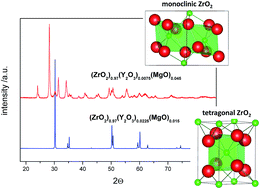
The best examined doped ZrO2 system is 3 mol% yttria-stabilized zirconia (3YSZ) which is abundantly used in various applications due to its thermal and chemical stability, mechanical durability and high ionic conductivity. By doping zirconia with MgO one can obtain material with thermal expansion coefficient (TEC) significantly higher than in the case of pure ZrO2 or Y2O3–ZrO2 solid solution (since TEC for pure 3YSZ and MgO is equal to 10.5 × 10⁻⁶ K−1 and 13.9 × 10⁻⁶ K−1 (ref. 4) respectively, the incorporation of certain amount of magnesia to 3YSZ should improve its thermal properties without significant change of other important ones). Therefore thorough examination of ternary solid solution MgO–Y2O3–ZrO2 is very important, especially that this system is considered as a good material for electrochemical devices, in particular as potential component of the composite material of anode for SOFC technology. Recent studies also indicate that the introduction of MgO to the system will result in improvement of catalytic activity of the anode reforming reaction of hydrocarbons.5,6 In contrast, double systems of solid solutions of yttria-stabilized zirconia (YSZ)7–10 and magnesia – stabilized zirconia11,12 as well as composite system YSZ – MgO13,14 – mainly for magnesia amount well over 20 mol% – have already been examined intensively and used in practical applications, there is still quite difficult to find information about this ternary system for composition range related to full solubility of all these three components. As long as you can occasionally find such information. Similar studies has been previously conducted for such ternary system, but for regular system (8YSZ – 12YSZ), thus since it is well known that mechanical strength of 3YSZ system is superior comparing to 8YSZ one (while unfortunately electrical conductivity is smaller in the former one15), it is worth to study ternary system MgO – 3YSZ from the point of view of possible improvement of electrical properties of pure 3YSZ system.
| Sample label | Number of Y3+ mole substituted by Mg2+ (in 3YSZ)/mol% | Number of Y2O3 remaining in ZrO2 lattice/mol% | x value in the formula of (ZrO2)0.97(Y2O3)0.03−x(MgO)2x | Mol% of metal atoms | ||
|---|---|---|---|---|---|---|
| Zr | Y | Mg | ||||
| Mg0.5_YSZ | 0.5 | 2.75 | 0.0025 | 94.175 | 5.340 | 0.485 |
| Mg1.0_YSZ | 1 | 2.5 | 0.005 | 94.175 | 4.854 | 0.971 |
| Mg1.5_YSZ | 1.5 | 2.25 | 0.0075 | 94.175 | 4.369 | 1.456 |
| Mg2.0_YSZ | 2 | 2.0 | 0.01 | 94.175 | 3.883 | 1.942 |
| Mg2.5_YSZ | 2.5 | 1.75 | 0.0125 | 94.175 | 3.398 | 2.427 |
| Mg3.0_YSZ | 3 | 1.5 | 0.015 | 94.175 | 2.913 | 2.913 |
| Mg3.5_YSZ | 3.5 | 1.25 | 0.0175 | 94.175 | 2.427 | 3.398 |
| Mg4.0_YSZ | 4 | 1.0 | 0.02 | 94.175 | 1.942 | 3.883 |
| Mg4.5_YSZ | 4.5 | 0.75 | 0.0225 | 94.175 | 1.456 | 4.369 |
| Mg5.0_YSZ | 5 | 0.5 | 0.025 | 94.175 | 0.485 | 5.340 |
| Mg6.0_YSZ | 6 | 0.0 | 0.03 | 94.175 | 0.000 | 5.825 |
After sintering the samples were left in furnace for cooling to room temperature. The citric method was chosen for materials preparation as the most suitable one, due to required properties of potential SOFC anode materials (high porosity, small grains). The resulting samples, after sintering at 1200 °C consist of nanocrystallites and have the total porosity (as determined by relative geometrical density measurements method) equal to 12.5 ± 2%.
The energy dispersive X-ray spectrometer (EDS-Oxford Instruments) coupled with scanning electron microscopy (SEM) was used to determine the presence of magnesium and yttrium in the samples. Bulk and grain boundaries conductivity were determined using impedance spectroscopy method (Solartron SI 1260 Impedance/Gain-Phase Analyzer). The measurements were carried out at 400, 500 and 600 °C in the flow of mixture 5% H2/95% Ar and Pt-paste applied as the electrode, for frequency range 0.1 Hz to 106 Hz and amplitude of the sinusoidal voltage set to 10 mV. The impedance spectra were analysed using ZPLOT software package delivered by Solartron.
Termogravimetry (TG) with simultaneous recording of mass spectra (MS) of released gaseous products was used for evaluation of chemical stability of obtained samples in CO2 and H2O atmosphere. TG measurements were carried out by means of SDT 2960 TA Instruments and mass spectrometry analysis using QMD 300 ThermoStar (Balzers). The samples with two chosen compositions (Mg2.0_YSZ and Mg6.0_YSZ) were exposed to the atmosphere enriched in CO2 and H2O (7% of CO2 in air, 100% RH) at around 20 °C for about 700 h (four weeks). The fragments of pallets (of mass about 45 mg) after exposition test were heated in synthetic air atmosphere in platinum crucible with 10 deg min−1 heating rate. SDT apparatus was coupled with quadruple mass spectrometer by quartz capillary which was heated (up to 200 °C) during all measurements and used for determination of mass loss and identification of released gases for samples before and after exposition test.
![]() | ||
| Fig. 1 XRD analysis of samples after sintering at 1300 °C. m – peaks corresponding to monoclinic phase. | ||
The problem of tetragonal phase stabilization is very complicated – due to the insufficient data and degree of complex processes and factors involved in stabilization process it is difficult to give fully convincing, unambiguous explanation of behaviour as shown in Fig. 2 but the following reasoning, based on available information provides well justified explanation.
Taking into account the results reported by Fabris et al.,19 which show that dominant factor in the stabilization of the tetragonal phase are oxygen vacancies (with an increase in the number of vacancies, the degree of stabilization of the tetragonal phase increases) the addition of yttrium to ZrO2 results mainly in an increase in the number of oxygen vacancies (created spontaneously in order to neutralize total charge of the system) and does not lead to significant changes in local dopant's environment in cationic sublattice in comparison with the host lattice – this is due to the same electronic configuration of Zr4+ and Y3+ cations, and hence the tendency to form the same type of bonds (directional covalent-ionic) in the same coordination polyhedral (distorted cube).
As a result, the larger the addition of yttrium, the stronger the effect of stabilization of higher symmetry phase. The results of magnesium introduction into cation sublattice are significantly different due to two mutually oppositely operating factors: the introduction of magnesium results in oxygen vacancies formation, analogously as in the case of yttrium doping (but the amount of vacancies is twice per mole bigger than in the case of yttrium) acting as stabilizing factor and, on the other hand, due to the completely different nature of chemical bonds between magnesium and surrounding oxygen atoms (spherically symmetric and strong non-directional ionic bonds) and magnesium preference for 6-fold coordination (according to Pauling's rules rMg/rO = 0.464 – hence octahedron as a coordination polyhedron) magnesium introduction acts in destabilizing way, strongly disturbing its local (as well as neighbouring host cations') environment.
For substantially larger amounts of magnesium first factor probably becomes dominant so that it is possible to stabilize the higher symmetry phases of ZrO2 by doping with sufficiently large amount of magnesium or – by analogy – calcium. In the latter case destabilizing effect of alkali earth metal introduction is significantly reduced due to specific properties of Ca2+ cations – larger ionic radius and hence weaker ionic interactions with surrounding oxygen ions and a tendency to adopt 6- or 8-fold coordination (the higher coordination for partial charge transfer, due to covalent bonding of oxygen ions with zirconium cations and thus also net charges smaller than formal ones – exactly the case here).
Based on the above analysis, one can expect that when we remove yttrium from the structure by substituting it with magnesium, the destabilizing effect coming from magnesium cation starts to dominate and at x > 0.015 this effect is already strong enough for monoclinic phase to appear (since such amount of magnesium is far too small for stabilizing effect of oxygen vacancies began to dominate the destabilizing influence of magnesium cations).
Further substitution of magnesium for yttrium leads to creation of larger quantities of monoclinic phase and the likely migration of part of magnesium cations into this phase resulting in an increase of the unit cell size of tetragonal phase. The latter hypothesis can be justified by the comparison of cation coordination polyhedra in both phases: in the case of undoped tetragonal phase17 such polyhedron (distorted cube) is created by 8 bonds, 4 longer (approx. 2.10 Å) and 4 shorter (approx. 2.38 Å) with the average bond length of 2.23 Å, whereas in the case of monoclinic phase18 polyhedron is formed by 7 bonds, each one of different length (from 2.05 Å to 2.28 Å) with the average bond length of 2.15 Å. Taking into account that in MgO ionic crystal20 the length of Mg–O bonds is equal to 2.11 Å and thus very similar to the average Mg–O bond length in monoclinic phase, one can infer that the transfer of magnesium from tetragonal to monoclinic phase will reduce the local stresses in respective magnesium coordination polyhedra (due to 7-fold instead of 8-fold coordination, closer to preferred by magnesium octahedral one and smaller variance of bond lengths and more uniform distribution of neighboring oxygen ions) and thus will be energetically more favourable.
As expected, incorporation of Mg2+ ions in the ZrO2 tetragonal lattice leads to decrease of a cell parameter as a result of magnesium ion radius being smaller than zirconium one (Fig. 3).
Taking into account ionic radii of 8-coordinate Zr4+, Y3+ and Mg2+ (as in t-ZrO2) – 0.98 Å, 1.16 Å and 1.03 Å respectively,21 one could expect some decrease of cell parameters and volume after Y3+ substitution by Mg2+. However, as it can be observed in Fig. 3, up to x = 0.015 cell volume decreases with increasing amount of magnesium substitution for yttrium and then starts to increase. Careful analysis of cell parameters in tetragonal structure (Fig. 3) shows that such behaviour of cell volume change is connected with an increase of c parameter accompanying the changes of a value and closely connected with structural changes in MgO–Y2O3–ZrO2 system.
Comparing the changes of crystallite sizes in tetragonal phase with composition (Fig. 4), one can observe that crystallite sizes are similar in the case of samples with x from 0.0025 to 0.0125 (for which only tetragonal phase exists in the system). For x between 0.0175 and 0.03 the crystallite sizes drastically decrease and this is correlated with an increase of cell volume.
At the same time additional, monoclinic phase appears in samples, with crystallite sizes (estimated by means of Scherrer formula based on FWHM of most intensive peak) equal to 26 nm, 29 nm, 32 nm and 48 nm for Mg3.5_YSZ, Mg4.0_YSZ, Mg4.5_YSZ and Mg6.0_YSZ samples, respectively. Taking into account the above results we can propose the hypothesis that when magnesium content exceeds x = 0.015, due to insufficient stabilization in the bulk of tetragonal crystallites, statistically distributed nanodomains of monoclinic phase begin to form, resulting in an effective decrease of the size of crystallites of tetragonal phase, “separated by” monoclinic phase crystallites (which additionally stabilizes tetragonal phase, since as it is well known, in smaller crystallites tetragonal phase is preferred over monoclinic one).
To sum up, one can observe that for x ≥ 0.0175 to x = 0.03 the ratio of Mg/Y dopants in the system is not sufficient for effective stabilization of tetragonal form. The weaker stabilization effect of magnesium in comparison with yttrium can be explained on the basis of electronic structure of these metals – the presence of d-orbitals in yttrium valence shell allows formation of directional, covalent bonds with oxygen atoms, which is impossible in the case of s-type valence orbitals in magnesium (spherically symmetric ionic interactions). Therefore, coordination polyhedra formed around yttrium cations are more stable than magnesium ones. Moreover, the effect of tetragonal phase stabilization by ZrO2 particle sizes (below critical diameter) seems to be – at least – of equal importance. The amount of t-ZrO2 phase decreases, in favour of m-ZrO2, with increasing amount of Mg2+ (and thus depletion of Y3+) which is at the same time related to an increase of crystallite sizes of tetragonal phase.
The obtained impedance spectra (Fig. 6 as an example of Nyquist plots for Mg0.5_YSZ and Mg3.5_YSZ samples) consist of three semicircles related to bulk conductivity (σb), grain boundary conductivity (σgb) and electrode conductivity. In the case of analysed samples, irregular complex semicircle composed of two (or three) semicircles corresponding to appropriate conductivity can be observed. The bulk conductivity (σb) and the grain boundary conductivity (σgb) were calculated concerning the geometry of the sample and bulk resistance (Rb) or grain boundary resistance (Rgb) obtained based on the EIS measurements: σb = L/(ARb) and σgb = L/(ARgb), where L and A are the sample thickness and the electrode area respectively. The results of analysis of these spectra for the measurements carried out at 500 °C are shown in Fig. 7. There are two series of points here – one related to σb the other to σgb. One can observe that the values of both, σb and σgb decrease at first, with addition of magnesium up to x = 0.0175 (Mg3.5_YSZ sample), then conductivities slightly increase and for x = 0.03 (Mg6.0_YSZ) strongly decline. The local minima at the curves (corresponding to Mg3.5_YSZ sample) can be related to unpredicted appearance of monoclinic phase (resulting in some disorder in previously ordered tetragonal phase). Generally, incorporation of further amounts of magnesium in the place of yttrium results in conductivity decrease and complete substitution of Y3+ by Mg2+ leads to a drop of both, σb and σgb by approx. two orders of magnitude.
![]() | ||
| Fig. 7 The comparison of values σb and σgb for the all samples (dashed line separates single phase tetragonal samples from two-phase, tetragonal and monoclinic ones). | ||
![]() | ||
| Fig. 8 TG curves and selected ionic currents (MS spectra) registered during TG measurements for original and after exposition samples (a) Mg2.0_YSZ; (b) Mg6.0_YSZ sample. | ||
| This journal is © The Royal Society of Chemistry 2016 |