Unstable crack propagation in LAPONITE® gels: selection of a sinusoidal mode in an electric field

Somasri Hazraa, Sudeshna Sircar*a, Tajkera Khatunb, Moutushi Dutta Choudhurya, Abhra Giria, Sanat Karmakara, Tapati Duttac, Shantanu Dasd and Sujata Tarafdara
aCondensed Matter Physics Research Centre, Physics Department, Jadavpur University, Kolkata 700032, India. E-mail: linkin.sudeshna@gmail.com
bPhysics Department, Charuchandra College, Kolkata 700029, India
cPhysics Department, St. Xavier's College, Kolkata 700016, India
dReactor Control Division, Bhabha Atomic Research Centre, Trombay, Mumbai 400085, India

Received 10th May 2016 , Accepted 26th June 2016

First published on 29th June 2016


Abstract

We report observation of wavy cracks and naturally patterned fracture surfaces in drying LAPONITE® paste. Desiccation cracks are shown to follow undulating, corrugated paths even when the speed of crack propagation is lower than the sound velocity in the medium by two orders of magnitude. Fast Fourier transform of the wavy crack path shows that it is a superposition of several sinusoidal modes and their harmonics. When the paste is exposed to a DC electric field during drying, by imposing a 50 V potential, some of the modes are suppressed. Increasing the voltage to 100 V results in survival of only one pure sinusoidal mode of wavelength ∼292 μm. We suggest that an effective mixed mode loading develops as a result of faster evaporation at the upper surface of the paste, and this is responsible for the instability leading to the wavy contour of the crack. The present study provides an insight into the mechanism of wavelength selection under an electric field of sufficient strength. We also show that unstable crack propagation may have similarity with the mechanism that exists in an auxiliary experiment: breaking of a perspex sheet.

1 Introduction

Study of fracture or crack formation is important in various disciplines such as, engineering, geology, physics.1,2 Recently, desiccation cracks have drawn significant attention due to novel technological applications and interesting effects of external perturbations, which may be mechanical, electrical or magnetic.3 The study of fracture or cracking started primarily with attempts to eliminate crack formation. However, recently, useful applications of fracture networks are being proposed. In the age of micro and nano patterning, tailored crack formation is shown to be a useful tool, for example Nam et al.4 have used magnetic fields to guide cracks into desired shapes while Gupta et al.5 use crack templates to produce transparent conducting sheets. Our present study shows that desiccation cracking can produce sinusoidally modulated surfaces, with tunable periodicity, which may be useful in devices or as templates.

It is well known that ‘stable’ crack propagation proceeds without changing direction, unless there are forces driving it to change its path.1 This is true of desiccation cracks as well. Instabilities can arise from different sources, making a crack bend, twist out of plane, or maybe follow a spiral or wavy path.3 Directional drying can lead to a set of parallel straight cracks and a subsequent set of wavy cracks appears later between each pair of straight cracks. This has been explained by a model which predicts that a crack can bend to maximize the energy release rate.6 Pauchard et al.7 have observed cracks which bend and arch. Two parallel cracks approaching each other from opposite directions bend towards each other to form a typical ‘en passant’ crack configuration.8 Spiral cracks have also been observed in drying egg albumin.9,10 Besides desiccation, other fracture processes also show wavy cracks, e.g. Yuse and Sano11 have reported wavy cracks in glass plates induced by thermal gradients.

Instabilities can arise for very fast propagating cracks. A theoretical analysis by Mokhtar et al.12 suggested that cracks can follow an oscillatory path, if they travel with speeds approaching the order of sound wave velocity in the medium. Sound travels in normal solid media at velocities of around several thousand m s−1. This implies that crack speeds large enough to produce instability are at least of the order of several hundred m s−1. Such crack speeds are difficult to measure experimentally, since extremely high speed cameras would be needed. A. Livne et al. have used the clever idea of preparing a gel medium where the velocity of sound is quite low (shear wave velocity ∼ 5.9 m s−1 and longitudinal wave velocity ∼ 11.8 m s−1),13 the corresponding crack speed sufficient to generate instability was measurable in this case using a high speed camera. The material used in the present work is also a gel, so instabilities may develop relatively easily.

The present work reports, for the first time, the observation of remarkable oscillatory paths of crack trajectories developed in drying LAPONITE® gels. All cracks formed in a sample may not be wavy, even different parts of the same crack may be either wavy or straight. The fraction of wavy cracks is about 20–50% of the total crack length and increases on applying an electric field.

The undulations when present, show highly regular oscillations on the fracture surface. Since LAPONITE® gel is transparent, it is easy to follow and photograph the crack tip as it moves through the medium. We try to understand the origin of the instability that is responsible for generating the oscillations. The crack path appears to be a superposition of several sinusoidal modes. Fast Fourier Transforms (FFT) are used to identify the wavelengths and relative amplitudes of the modes involved.

Applying an electric field on the sample during drying has a significant effect, as reported previously for LAPONITE®14,15 This has prompted us to study the effect of static electric fields on wavy-crack propagation for two different field strengths corresponding to 50 and 100 V. The applied voltage reduces the number of distinct modes. For 50 V, crack contours consist of pure sine curves as well as superposition of various pure modes. Surprisingly, the wavy cracks developed under an applied voltage of 100 V are almost purely sinusoidal with only one dominating wavelength.

Two alternative possibilities come to mind as the driving force behind the instability – (i) high crack propagation speeds of the order of sound wave propagation in the medium and (ii) mixing of fracture modes, e.g. simultaneous presence of mode I (opening) and either of mode II (sliding) or mode III (tearing). We look into both these processes as possible agents for inducing oscillation in the growing crack.

In the next section we describe the experiments performed. The desiccation crack formation experiment is supplemented by other experiments which provide further insight into the driving mechanism behind unstable crack propagation. Experimental results are described in Section (3). In Section (4) we analyse the results and try to understand the origin of the wavy cracks. The FFT analysis identifying the modes which compose the wavy cracks is given in Section (5) while discussions are given in Section (6) and final conclusions are drawn in Section (7).

2 Materials and methods

2.1 Desiccation cracks in LAPONITE®

LAPONITE® RD has been procured from Rockwood Additives. LAPONITE® is a synthetic clay which consists of disc-like platelets of diameter ∼25 nm and thickness ∼0.92 nm. It forms a gel when stirred in deionized water at a concentration of 6.29 wt%.16 The concentration is chosen such that gelation can occur and the gel formed is of homogenous nature. At concentration ∼7 wt%, clumps appear in the film and its homogeneity is lost. At lower concentrations i.e. below 6 wt%, it takes a very long time to gel. In such a case, desiccation becomes more prominent than externally applied electric field.

In the experiments reported here, 6.4 g of LAPONITE® is added to 102.4 ml of deionized water (to prepare the solution of concentration 6.29 wt%) and stirred in a magnetic stirrer for about 30 s. The solution is immediately poured into a rectangular perspex box of length 30 cm and width 6.7 cm, and allowed to gel for about 4–5 minutes before the electric field is switched on. The temperature and humidity is maintained at around 20–27 °C and 43–52%, respectively. Crack formation is observed under two different configurations – Set A normal drying and Set B drying under an electric field – for B1 the applied voltage is 50 V and for B2 it is 100 V. In each case, four sets of experiments were repeated for each voltage and for each set, FFT calculations were done for four wavy cracks.

The electric field is applied through aluminium foil electrodes lining the two opposite longer sides of the rectangular box, so the field acts along the breadth of a rectangular sample (Fig. 1a). To keep conditions identical as far as possible, the electrodes are kept in place for the Set A experiments as well, only the power is not switched on. Fig. 1b shows the actual experimental setup.


image file: c6ra12116k-f1.tif
Fig. 1 (a) A schematic showing the experimental set-up used to perform the experiments. (b) Top view of the crack pattern observed in LAPONITE® film under an applied voltage of 100 V.

The crack propagation has been recorded on video, using Nikon CoolPix L120. The motion of the crack tip is measured by separating successive frames of the video. We see that the crack tip does not move with a uniform speed. For intervals of time of the order of several minutes the crack tip may not move at all, then start moving and continue to move for 5–10 s. The average speed is measured over these intervals of several seconds when the crack tip covers a distance of the order of 1–2 mm.

2.2 Auxiliary experiment: breaking a perspex sheet

As an auxiliary experiment, we perform a simple mechanical breaking experiment with perspex sheets. We label this set of experiments as Set C. Two perspex sheets are broken manually in a configuration similar to the 3-point loading set-up.17 The sheets have thickness 1 mm and lengths of about 10–20 cm. For each sheet we use two sections for FFT analysis. We show later that the results of these experiments have a similarity with desiccation crack formation in LAPONITE®.

3 Results

3.1 Characteristics of crack patterns

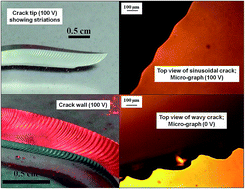
It is seen that some regions of the cracks are smooth, while other regions show prominent oscillations (Fig. 2 and 3). In this paper the oscillating nature of crack propagation is our focus, so we describe the wavy regions in detail.
image file: c6ra12116k-f2.tif
Fig. 2 Photographs of wavy cracks for – (a) sample without electric field, showing striations in a straight crack which are parallel to the growing crack tip. (b) Shows the effect of electric field of 50 V, where both wavy surface (arrow 1) and striations of a non-wavy nature (arrow 2) are present. (c) and (d) are for cracks formed in an electric field of 100 V. (d) Shows the wavy surface near a bend on a crack, the surface is prominently visible in coloured light. (e) Shows striation marks on the edge of a perspex sheet broken as discussed in the text.

image file: c6ra12116k-f3.tif
Fig. 3 Micrographs of crack outlines, top views in electric fields of 100 V and 50 V in (a) and (c), respectively, and without field (e). In (c) both complementary surfaces of the crack are seen. The inset in (e) shows the rounded sections breaking off. Side views of the fracture surface taken normally in electric field (b) for 100 V and (d) for 50 V, and without field (f). The oscillatory nature of the crack persists nearly half-way through the thickness of the sample in (f).

When observed by the naked eye, for some short ranges of the crack trajectory, the appearance of the crack wall near its tip looks like a series of almost periodic marks parallel to the crack tip, as seen in the Fig. 2b and c. It is to be noted that the direction of these marks is opposite to the direction of striation marks normally seen on fracture surfaces.2,15,18 In the case of the usual striations, the crack front moves normal to the direction of the striation lines. The regions with the marks are viewed under high magnification using optical microscope, Leica DM750. We show micro-graphs of the top view as well as of the fracture surface, viewed normally (Fig. 3) for cracks formed with and without the electric field.

It is observed that at certain regions of some of the cracks the outline is wavy when viewed from the top of the desiccating sample. In some cracks, moreover, wavy propagation is observed initially near the tip, but it disappears as the tip moves on, while in some other cases the waviness persists. However, the signature of the wavy nature persists clearly in the structure of the vertical fracture wall. When a portion of the wall is removed and placed normally under the microscope, strong undulations are evident as in Fig. 3b and d. We note that waviness appears more prominently near bends on a crack, though it is present in straight cracks as well.

3.1.1 Cracks for normal drying – without electric field. In the Set A experiments, the average time required for cracks to start is about 48 hours. The cracks are directed randomly and usually appear first from any of the corners of the rectangular perspex box. These are generally seen to propagate along the edges of the box. This maybe due to the fact that maximum stress is accumulated near the corners and edges of the system and in the absence of any other driving force cracks are formed due to the boundary effect alone.

The top view of the contour of the crack paths in the wavy regions, for several cracks developed without the electric field are shown in Fig. 3e and f. In regions where the crack does not follow a straight path, a repeated pattern is present which seems to be a superposition of several harmonic modes. The repeating motif has peaks which are sharp on the LAPONITE® side and rounded on the void i.e. the crack side, as shown in Fig. 3e. This feature is interesting. In brittle crack formation when a crack develops across a sample, as it widens the two separating interfaces should be complementary as if they fit each other like jigsaw puzzle pieces. But in our experiments complementary interfaces with rounded peaks and pointed troughs on the LAPONITE® side are rarely seen. We see instead (Fig. 3e inset) that on the other wall of the asymmetric crack, convex LAPONITE® pieces break off and shift downward, settling further down on the slanting fracture surface. Thus the opposite LAPONITE® interface which moves away is nearly smooth.

With the formation of an undulating crack, the vertical fracture surface is also expected to bear some signature of the undulations as seen in the side view of the crack wall. The crack walls are not exactly vertical, but sloping, so that the cross-section of the crack is V- or wedge-shaped. In the Set A experiments, the structure of the crack wall is very complex. As shown in Fig. 3f, it appears that the undulations do not travel through the full thickness of the clay layer. They stop at some distance above the substrate marked by an oscillating boundary. The lower part of the fracture surface is relatively smooth with some river-line patterns2 visible.

3.1.2 Cracks formed for 50 V (B1) and 100 V (B2). When an external electric field (DC) is applied to the system, cracks are seen to form in a particular pattern and initiate at an earlier time than when there is no field. The cracks are always seen to originate at the positive electrode and these are several in number. Amongst these cracks, a few travel an almost straight path towards the negative electrode, while the rest curve and bend to join the straight ones or each other, forming a tree like structure, as can be seen in Fig. 1b. Very rarely, at a much later time, a few cracks originate at the negative end also, but these are mainly due to the effect of desiccation.

In experimental Set B1, a DC (direct current) voltage of 50 V is applied. Since the width of the container is 6.7 cm, this corresponds to a field of 746 V m−1. The first crack originates about 32 minutes after the electric field is switched on. We find that the crack contours now look more regular than that for Set A. The percentage of oscillating cracks is higher (about 40%). Some of these look like pure sinusoidal curves while others are more complex. The complex contours on opposite sides of a crack are complementary, like pieces of a jigsaw puzzle which fit each other, as shown in Fig. 3c. The fracture surface shows undulations as in Fig. 3d. FFT analysis gives a more precise quantification of the patterns.

When the DC electric supply of 100 V is switched on (Set B2), a field of approximately 1492 V m−1 acts on the sample, and the first crack appears about 20 minutes after the field is applied. Now the wavy crack pattern undergoes a significant change. Instead of asymmetric and complex oscillating contours, we see now wavy outlines which appear purely sinusoidal, characterized by a single wavelength (Fig. 3a). The opposite LAPONITE® interfaces are now complementary as in Set B1.

The undulations on the vertical crack walls are now very clearly visible in both top and side views, as shown in Fig. 3b.

Average crack speeds were measured over time intervals of typically 5–10 s, when the crack tip travelled distances of 1–2 mm without stopping. The average crack speeds thus measured lie in the range 0.05–0.50 mm s−1. In addition to the fluctuations, the estimated error in speed measurement is about 20%, so we get effectively an ‘order of magnitude’ estimate of the average crack speed.

3.2 Breaking by three point loading

We observe the fracture surfaces of the perspex pieces broken as shown in Fig. 4a. On the broken surface we see striation marks very similar to those observed on the LAPONITE® crack walls. In the perspex sheets the striations are more closely spaced than on the LAPONITE® layers. The striations were photographed by camera (Nikon Coolpix) as shown in Fig. 2e. A parallel may be drawn between the perspex sheet breaking experiment and desiccation cracking of LAPONITE® from the following argument (Fig. 4). The breaking of the sheet, shown in Fig. 4a generates opposing torques tending to bend the two ends of the sheet downward, with the center of the sheet fixed. As the breaking stress of the material is exceeded, a crack appears on the upper surface, which then progresses. The torque forces the upper surface out of plane, in addition to a crack opening stress. As a result, a mixed mode crack develops and proceeds along an oscillatory path.
image file: c6ra12116k-f4.tif
Fig. 4 Cartoon depicting the manual breaking of a perspex sheet (a) which is similar to a three-point loading set-up and (b) evaporation and desiccation crack formation for a colloidal paste. Torques are generated in both cases forcing the cracking surface out of plane.

4 Analysis of results

4.1 Origin of wavy cracks

From the discussion in the previous section we infer that mode mixing is responsible for the generation of wavy cracks in our experiments. When the stress driving the growth of a crack acts normally to an existing crack, the edges are drawn apart and the crack extends in the opening mode. In this case the crack proceeds straight ahead. If sliding (mode II) or tearing (mode III) modes are compounded with the opening mode the crack may deviate from its straight path and oscillate.1

Mode-mixing may happen in the standard three-point loading set up17 where an out-of-plane stress is added to the opening stress. Our experiments, studying fracture surfaces of perspex sheets broken into two parts by such loading, show a striated surface, where the crack does not proceed straight. The striation marks on the broken perspex surface are qualitatively similar to the waviness seen in Fig. 2. A cartoon comparing the breaking of the solid sheet with a desiccating gel layer (Fig. 4) brings out the similarity between the two fracture processes.

Fig. 4 illustrates the parallel between the breaking experiment (a) and drying of the colloid (b). As the water evaporates, the upper surface dries and tends to shrink, while the lower layers are still moist. The stress generated by drying decreases with depth within the sample, as shown in the Fig. 4b. The net effect is to produce opposing bending moments, very similar to the situation in Fig. 4a.

An alternative mechanism for wavy cracks could be an instability driven by an abnormally large speed of crack propagation, even in the absence of any deflecting agent. The theoretical upper limit for crack propagation speed is set by the speed of sound, or Rayleigh waves in the medium. Speeds with magnitude of about 40% of this limiting speed are large enough to trigger an instability.13,19

Our observations are that there are short bursts of speed, during which the crack moves with an average speed ∼0.05–0.50 mm s−1. In the intervening time intervals the crack remains stationary. So the motion is somewhat like stop-go or stick-slip motion.2

A rheological study of the LAPONITE® gel was carried out, the essentials of which are given in the ESI and details are to be reported elsewhere.20 Frequency dependence of the storage and loss modulus were measured and a visco-elastic Boltzmann model incorporating a non-integer time derivative was fitted to the data.

The best fit parameters of the Boltzmann model are the two elastic moduli of the springs and the viscosity of the dashpot fluid, which are E0 = (10.055 ± 0.126) × 103 Pa, E1 = (12.155 ± 0.185) × 103 Pa, η = (14.63 ± 0.181) × 103 Pa s, respectively. The order of the fractional derivative q = 0.8. The results remain invariant upto a change of the order of 0.001 in the value of q. The relaxation time of the material from this model is given by

 
τ = η/E1 (1)
and comes out to be 1.20 s.

The sound wave velocity in the LAPONITE® gel, has been calculated from the visco-elastic model, fitting the rheology data. The velocity lies in the range 2500 to 3500 mm s−1 for frequencies varying from 0.1 to 100 Hz. So, measured crack velocities, even during the high speed bursts, are about 5 orders of magnitude lower than the 40% of sound wave velocity required for unstable crack propagation, according to H. Gao.21 Considering the above argument we may infer mode-mixing to be responsible for producing the wavy cracks.

5 Dominant wavelengths from fast Fourier transform (FFT)

A Fast Fourier Transform (FFT) analysis has been done on the observed waveforms to identify the wavelengths present and their composition. Mathcad (PTC) software was used for the analysis. The crack contours from the top view for without (Set A) and with (Sets B1 and B2) electric fields corresponding to 50 and 100 V respectively are strikingly different (Fig. 3). The Set A contours look like a superposition of several sinusoidal modes of varying wavelength and amplitude, while Set B2 appears to be pure sinusoids of a single wavelength, B1 contours are mixed, with some pure modes and others superposed. This is verified convincingly through Fourier analysis. The method of analysis is as follows. The crack contour in top view is selected by ImageJ software. Mathcad is used to identify the harmonic modes, i.e. pure sine waves present in the crack outline. Fig. 5 shows the process, where the original crack photograph, the edge extracted by ImageJ and the FFT showing relative amplitudes for the modes of different wavelengths are shown for the cracks, one of Set A, two of Set B1, one of Set B2 and one of Set C.
image file: c6ra12116k-f5.tif
Fig. 5 The column on the left shows the original photographs taken by optical microscope. The second column shows the extracted outlines of the original photographs and the column on the right is the FFT of corresponding outline. (a) Crack outlines and corresponding FFT for a crack in Set A sample, without electric field. (b) and (c) show the crack outlines and corresponding FFTs for Set B2 samples (50 V), (d) shows the same for a Set B2 sample (100 V) and (e) is for the fractured perspex surface.

It is quite clear that several modes with different wavelengths and comparable amplitude are present in Set A, where there is no electric field as well as in Set B1, where the field is weak. In Set B2 there is only one dominating wavelength, as if the strong electric field selects one mode, suppressing the others. The fracture contour for Set C on the broken perspex sheet is the most noisy with many modes of comparable amplitude present. These wavelengths, are all much smaller than the wavelengths in Sets A and B. For Set B micro-graphs of the fracture surface also show clear undulations which are nearly periodic (Fig. 3b). Estimates of the average wavelength of the undulations on the surface agree with the largest wavelength obtained from the FFT analysis for experimental Set B2.

The dominant wavelengths for a number of Set A, Set B and Set C cracks are listed in Table 1. For Set A we show wavelengths of four modes with the largest amplitudes which are comparable. For Set B we show only the wavelength of the mode with largest amplitude, the others have amplitudes smaller by a factor of about 3. Scrutiny of the table shows that several of the modes are in fact harmonics, and common to Sets A, B1 and B2. The values of the wavelengths and their harmonics agree upto two decimal places, as shown in Table 1. The distinct and independent wavelengths for LAPONITE® are the following: 146.19 μm (with harmonics 292.39, 584.79); 97.46 μm (with harmonics 194.93) and 116.95 μm, including all results with and without electric field. Of these the mode with wavelength 292.39 μm occurs most frequently in the table. Harmonics can also be identified in the data for perspex (Set C). In perspex, many peaks with comparable amplitude are present in FFT.

Table 1 Wavelengths (fundamental and harmonics) from FFT of wavy crack outlines in LAPONITE® gel (with and without external electric field) and perspex sheet
Experimental set Voltage (volt) Wavelength (μm)
A 0 (1) (a) 584.79, (b) 292.39, (c) 146.19, (d) 116.95
(2) (a) 584.79, (b) 292.39, (c) 194.93, (d) 146.19
(3) (a) 292.39, (b) 194.93, (c) 146.19, (d) 116.95
(4) (a) 292.39, (b) 146.19, (c) 116.95, (d) 97.46
B1 50 (1) (a) 292.39, (b) 97.46
(2) (a) 146.19, (b) 584.79
(3) (a) 146.19, (b) 194.93, (c) 97.46
(4) (a) 584.79, (b) 194.93, (c) 116.95
B2 100 (1) 292.39
(2) 194.93
(3) 292.39
(4) 292.39
C (1) (a) 118.92, (b) 58.27, (c) 38.85, (d) 29.13, (e) 19.42
(2) (a) 58.27, (b) 38.85, (c) 29.13, (d) 23.31, (e) 19.42
(3) (a) 58.27, (b) 38.85, (c) 29.13, (d) 23.31, (e) 19.42
(4) (a) 58.27, (b) 38.85, (c) 29.13, (d) 19.42, (e) 14.56


Cerda and Mahadevan22 have derived a relation between wavelengths and amplitudes for wavy cracks which suggests that there is a linear relation between the two. We plot the amplitude against wavelength for several Set A and Set B1 cracks and show that an approximately linear relation holds here as well, as shown in Fig. 6.


image file: c6ra12116k-f6.tif
Fig. 6 The amplitude and wavelengths of the cracks follow a roughly linear relationship as shown for four cracks formed without electric field (open symbols) and three cracks for an electric field of 50 V (closed symbols). The different symbols correspond to different cracks. The errors in measurement are less than the symbol sizes.

5.1 Wavelength selection

The wavelength in wavy desiccation cracks usually depends on typical length scales of the system.21 These may be geometric, such as the thickness of the layer of drying paste, or may arise from material properties. The preference of the system for the wavelength 292.39 μm, appears very striking in our observations and we try to understand its significance as follows. The rheological data indicate a relaxation time of 1.20 s as mentioned before. For the propagation of a sinusoidal wave, which in this case is the undulating crack, we may write
 
υ = (2)
with crack velocity υ, frequency v and wavelength λ, which can be written in terms of the relaxation time as
 
v = λ/τ (3)
substituting λ = 292.39 μm and τ = 1.20 s, we have υ ∼ 0.24 mm s−1, which matches the order of magnitude of our measured crack velocity. This gives a tentative justification of the most frequently observed wavelength in the experiment.

In our experimental Sets (A, B1 and B2), the layer thickness ∼1 mm has been kept constant. Work is in progress to assess the effect of varying the layer thickness.

The question why the presence of a strong electric field induces a single sinusoidal mode, rather than a number of superposed modes is interesting. One possible answer may be suggested along the lines of the study by Cerda and Mahadevan.22 They show periodic undulations in the central portion of a laterally stretched thin elastic sheet, clamped along two sides. In the region closer to the clamped sides the stress is less and here a sinusoidal undulation with one wavelength is observed, but closer to the center where stress is higher, additional modes with different wavelengths get superposed on the original. In our experiments, when the field is not present less cracks form and stress can build up, whereas with the field on, more cracks form rapidly, releasing the stress. The less residual stress in Set B2 experiments may lead to observation of one dominant wavelength rather than a superposition of many, as in Set A. The trend of decrease in number of modes is evident in Set B1 as well.

6 Discussion

LAPONITE® being a synthetic clay has properties not found in most natural clays. It consists of nano-sized disc-shaped particles and can form arrested phases at concentrations as low as Cw = 0.003 with ageing.23 There is still debate about the nature of its arrested phase, whether it is an attractive gel or repulsive glass, or maybe either depending on concentration and other conditions.23–25 In this paper we refer to the arrested phase simply as a gel. The presence of short range attractive and long range repulsive forces lead to an interesting and complex phase diagram. Properties of LAPONITE® gels have been shown to change on ageing.23 Recent dynamic light scattering (DLS) experiments26 show a parallel between relaxation times of ageing LAPONITE® and dynamics of supercooled liquids approaching glass transition.

In our experiments, however, ageing of LAPONITE® is not very prominent. After preparing the solution, it is immediately poured into the rectangular box and a waiting time of 4–5 minutes is allowed for even spreading and gelation before applying electric field. As gel is formed within this time, there is no chance of ageing of LAPONITE®. Thus, the solution is allowed to dry immediately, without allowing it to stand over a long period of time. Hence, no particular age of LAPONITE® suspension is mentioned. However, with the drying of the gel, the film starts to harden.

Considerable work has been done on desiccation crack formation in LAPONITE®14,27 but formation of wavy cracks has not yet been reported. Most natural clays are polydisperse with micron-sized particles and form opaque slurries, unlike LAPONITE®, which consists of nearly mono-disperse nano-sized platelets and forms a transparent gel. This may be the reason why wavy cracks with short wavelength sinusoidal modes (∼μm) have not been identified in other clays. Previous experiments on LAPONITE®–methanol slurries14 have not shown wavy cracks either as methanol and LAPONITE® do not mix to form a homogeneous gel and the rheology of the system is quite different.

It is however pertinent to ask if other transparent gels show such wavy-cracks. A preliminary study on desiccating films of gelatinized potato starch and aqueous gelatin have not revealed wavy cracks. In these cases the dried layers de-bond from a glass or perspex substrate and the familiar crack network in clays with polygonal peds does not form. In general, the highly cohesive nature of such sticky materials makes crack formation rare. However, the micro-structure of the sample might play a crucial role here. The starch gels and gelatin have a network structure composed of long-chain polymers, which might resist cracking in general. Straight cracks in particular, cannot form without breaking the tough polymer macro-molecules. Clays on the other hand have flat disc or plate-shaped particles, which stack together, and cleave relatively easily. Studies on clay–polymer composites support this argument.28 Brittle perspex sheets, though made of polymeric material are dry and solid, so mechanically breaking such a sheet is different from desiccation cracking. Rapid crack propagation with oscillations may occur in this case. PMMA (polymethyl methacrylate) or perspex has previously shown periodic behaviour in dynamic fracture.29

The wavelengths of oscillating cracks may depend on parameters such as thickness of the clay layer, drying conditions e.g. ambient temperature and humidity. These features remain to be studied. Detailed investigation of these features is in progress.

7 Conclusion

We conclude that visco-elastic LAPONITE® gels show desiccation cracks which often exhibit wavy undulations, while drying in the presence of electric field. The wavy cracks are generally a superposition of several sinusoidal modes. If a high enough DC electric field (∼1.5 kV m−1) is switched on during drying, one sinusoidal mode is selected. The wavelength of the selected mode is determined by the crack velocity and the rheological relaxation time of the drying material. A linear relation between the wavelength and the amplitude of the oscillating crack is also observed.

We suggest the probable mechanism tending to curve the cracks, as mode mixing during the desiccation process. Another alternative explanation may be the low sound velocity in the visco-elastic material, which makes it relatively easy for a fast moving crack to become unstable and move along a wavy path. The latter mechanism is less probable since desiccation cracks do not normally reach 40% of sound wave speeds – the magnitude necessary for instability to set in. An external perturbation such as an electric field can induce cracks to follow wavy paths more easily and wavy sections are found more often near bends. In this case we see that a particular wavelength is selected and the resulting crack contour is perfectly sinusoidal. Further work is under way to understand the origin and nature of wavy crack formation completely.

Acknowledgements

This work is supported by DST, Govt. of India. Sudeshna Sircar is grateful to DST for grant of a Junior Research Fellowship and Somasri Hazra is grateful to the Alumni Association, Jadavpur University for a research grant. The authors are grateful to Prof. Tuhinadri Sen, Coordinator of DSA phase III and UPE II programme, UGC India and his students Mr Sudipto Mukherjee and Mr Suman Haldar (Pharmaceutical technology department) for their help in rheological measurements.

References

  1. B. R. Lawn, Fracture of Brittle Solids, Cambridge University Press, Cambridge, 2nd edn, 1993 Search PubMed.
  2. D. Hull, Fractography, Cambridge University Press, Cambridge, 1999 Search PubMed.
  3. L. Goehring, A. Nakahara, T. Dutta, S. Kitsunezaki and S. Tarafdar, Desiccation Cracks and Their Patterns, Wiley, VCH, Germany, 2015 Search PubMed.
  4. K. H. Nam, I. H. Park and S. H. Ko, Patterning by controlled cracking, Nature, 2012, 485, 221–224 CrossRef CAS PubMed.
  5. R. Gupta, K. D. M. Rao, K. Srivastava, A. Kumar, S. Kiruthika and G. U. Kulkarni, Spray Coating of Crack Templates for the Fabrication of Transparent Conductors and Heaters on Flat and Curved Surfaces, ACS Appl. Mater. Interfaces, 2014, 6, 13688–13696 CAS.
  6. L. Goehring, W. J. Clegg and A. F. Routh, Wavy cracks in drying colloidal films, Soft Matter, 2011, 7, 7984 RSC.
  7. L. Pauchard, M. Adda-Bedia, C. Allain and Y. Couder, Morphologies resulting from the directional propagation of fractures, Phys. Rev. E, 2003, 67, 027103 CrossRef CAS PubMed.
  8. M. Fender, F. Lechenault and K. Daniels, Universal Shapes Formed by Two Interacting Cracks, Phys. Rev. Lett., 2010, 105, 125505 CrossRef PubMed.
  9. M. Hirata, Kirin no Madara – Dapples of Giraffes (in Japanese), Chuokoron Inc, 1975 Search PubMed.
  10. Drying egg albumin shows interesting crack patterns, www.youtube.com/watch?v=F-s6WX6YOmQ, accessed March 2014.
  11. A. Yuse and M. Sano, Transition between crack patterns in quenched glass plates, Nature, 1993, 362, 329–331 CrossRef.
  12. M. Adda-Bedia, R. E. Arias, E. Bouchbinder and E. Katzav, Dynamic Stability of Crack Fronts: Out-of-Plane Corrugations, Phys. Rev. Lett., 2013, 110, 014302 CrossRef PubMed.
  13. A. Livne, E. Bouchbinder and J. Fineberg, Breakdown of Linear Elastic Fracture Mechanics Near the Tip of a Rapid Crack, Phys. Rev. Lett., 2008, 101, 264301 CrossRef PubMed.
  14. D. Mal, S. Sinha, T. R. Middya and S. Tarafdar, Desiccation crack patterns in drying Laponite gel formed in an electrostatic field, Appl. Clay Sci., 2008, 39, 106–111 CrossRef CAS.
  15. T. Khatun, T. Dutta and S. Tarafdar, Crack formation in Laponite gel under AC elds, Appli. Clay Sci., 2013, 86, 125–128 CrossRef CAS.
  16. H. Z. Cummins, Liquid, glass, gel: the phases of colloidal Laponite, J. Non-Cryst. Solids, 2007, 353, 3891–3905 CrossRef CAS.
  17. I. L. Lim, I. W. Jhonston, S. K. Choi and J. N. Boland, Fracture Testing of a Soft Rock with Semi-circular Specimens Under Three-Point Bending Part 2-Mixed-mode, Int. J. Rock Mech. Min. Sci. Geomech. Abstr., 1994, 31(3), 199–212 CrossRef.
  18. S. Kitsunezaki, Crack Propagation Speed in the Drying Process of Paste, J. Phys. Soc. Jpn., 2009, 78(6), 064801 CrossRef.
  19. E. Bouchbinder, T. Goldman and J. Fineberg, The dynamics of rapid fracture: instabilities, nonlinearities and length scales, Rep. Prog. Phys., 2014, 77, 046501 CrossRef PubMed.
  20. S. Majumdar, S. Hazra, S. Sircar, M. Dutta Choudhury, S. Das, T. Dutta and S. Tarafdar, in preparation.
  21. H. Gao, Surface roughening and branching instabilities in dynamic fracture, J. Mech. Phys. Solids, 1993, 41(3), 457–486 CrossRef.
  22. E. Cerda and L. Mahadevan, Geometry and Physics of Wrinkling, Phys. Rev. Lett., 2003, 90, 074302 CrossRef CAS PubMed.
  23. B. Ruzicka, L. Zulian and G. Ruocco, Ergodic to non-ergodic transition in low concentration Laponite, J. Phys.: Condens. Matter, 2004, 16, S4993–S5002 CrossRef CAS.
  24. B. Ruzicka, L. Zulian and G. Ruocco, Routes to Gelation in a Clay Suspension, Phys. Rev. Lett., 2004, 93, 258301 CrossRef CAS PubMed.
  25. A. Mourchid and P. Levitz, Long-term gelation of Laponite aqueous dispersions, Phys. Rev. E, 1998, 57, R4887 CrossRef CAS.
  26. D. Saha, Y. M. Joshib and R. Bandyopadhyay, Investigation of the dynamical slowing down process in soft glassy colloidal suspensions: comparisons with supercooled liquids, Soft Matter, 2014, 10, 3292 RSC.
  27. T. Khatun, M. Dutta Choudhury, T. Dutta and S. Tarafdar, Electric-field-induced crack patterns: experiments and simulation, Phys. Rev. E, 2012, 86, 016114 CrossRef PubMed.
  28. S. Nag, S. Sinha, S. Sadhukhan, T. Dutta and S. Tarfadar, Crack patterns in desiccating clay–polymer mixtures with varying composition, J. Phys.: Condens. Matter, 2010, 22, 015402 CrossRef PubMed.
  29. P. D. Washabaugh and W. G. Knauss, Non steady, periodic behavior in the dynamic fracture of PMMA, Int. J. Fract., 1993, 59, 189–197 CrossRef CAS.

Footnote

Electronic supplementary information (ESI) available. See DOI: 10.1039/c6ra12116k

This journal is © The Royal Society of Chemistry 2016
Click here to see how this site uses Cookies. View our privacy policy here.