Qi Cai,
Gaosheng Liang,
Yufang Xu,
Xuhong Qian* and
Weiping Zhu*
State Key Laboratory of Bioreactor Engineering and Shanghai Key Laboratory of Chemical Biology, School of Pharmacy, East China University of Science and Technology, 130 Meilong Road, Shanghai, 200237, P. R. China. E-mail: wpzhu@ecust.edu.cn; xhqian@ecsut.edu.cn; Fax: +86-21-64252603
First published on 20th June 2016
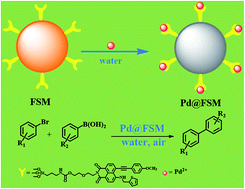
Herein, we report a heterogenous catalyst (Pd@FSM) by immobilization of a novel Pd2+ sensor as promoter over mesoporous silica. Pd@FSM with a high palladium loading of ca. 11 mg g−1 exhibited superior catalytic activity for Suzuki–Miyaura cross-couplings and a catalyst loading of 0.05 mol% is typically sufficient to achieve excellent reaction yields. Notably, the reaction is typically carried out in water without removing atmospheric oxygen. The catalyst is conveniently recycled and remains highly active even after being recycled 5 times. During this process, loss of palladium from the solid support of the catalyst is negligible. Furthermore, the catalyst can be stored in air for at least three months without loss of its catalytic activity. This work provides a new approach to developing heterogeneous palladium catalysts by combing materials and fluorescent sensors.
Various ligands that have been immobilized for chelating of palladium ions include thiol groups, heterocyclic ring structure, multi-oxygen or nitrogen groups and other groups.11,19–23 In recent years, the fluorescent probes for the detection and separation of heavy metal ions, such as palladium ions, has gained extensive interest. These studies have inspired constructing multifunctional platforms for ion detection, separation and reusability onto host materials.24–26 Recently, Bhalla group reported a multi-functional hetero-oligophenylene derivative, which could detect palladium ions and induce to form palladium nanoparticles as novel catalysts for carbon–carbon coupling.27 In another aspect, various nanoparticles or micro-particles have been reported and widely used as the carrier of solid catalysts.10,11,16,19,20,28,29 Among those materials, the mesoporous silica nanoparticles is highly attractive by virtue of its large specific surface area, facile modification for diverse functions and heat- and hydro-stability.30–32 Amini et al. reported a heterogeneous palladium catalyst by anchoring tridentate pyridine ligand to mesoporous silica, which showed good capacity in catalyzing Mizoroki–Heck and Suzuki–Miyaura reaction with 1 mol%.It could be recycled for four times but loss of catalytic activity after each recycle was noted.33 Furthermore, Lin et al. reported a magnetic palladium catalyst, exhibiting much higher activity with only 0.02 mol% and excellent recyclability for more than 20 times without notable loss of activity. However, the leaking of palladium and requiring the use of organic co-solvent are still concerns.34 Combination of selective and specific fluorescence probes with various matrixes is highly desirable endowing them excellent performance, such as broader linear detection range, convenience and reusability in separation or even lower detection limit.24–26,35
We previously reported a fluorescent material FSM by anchoring a palladium fluorescent probe on mesoporous silica for detection and separation of palladium ions in various solutions.35 Further investigation showed that the palladium ions were tightly bound with FSM, and could not be easily pulled down by the H+, EDTA or other chelating agents. The high stability of the complex has promoted us to test its potentials as a heterogeneous palladium catalyst. Herein, based on the palladium fluorescent probe FSM, we report a reusable heterogeneous catalyst Pd@FSM for Suzuki–Miyaura reaction. The catalyst exhibited excellent ability in catalyzing the Suzuki–Miyaura cross-coupling reactions of aryl halides with phenylboronic acids in water with only 0.05 mol% amount and kept its activity stable even after exposed to the air for three months or recycled for five times without palladium leaking.
Firstly, we examined the catalytic activity of Pd@FSM with a different amount of catalyst loading in water under air atmosphere. The results showed that Pd@FSM of 0.01 mol% can afford the product in 90% yield in 24 h. Raising the catalyst loading to 0.05 mol% led to improving the reaction yield to 97% but only in 10 h. These outcomes illustrate the much higher activity of Pd@FSM than those homogeneous or heterogeneous palladium catalysts under the condition of water solution and air atmosphere.11,36,40 After that, the conversion rate had no significant increase even with much more catalyst (Table 1). Besides, the results also proved that the presence of oxygen does not inhibit the catalytic activity of Pd@FSM. This is an important feature in practical industrial application. Therefore, the following catalysis experiments were all carried out with 0.05 mol% of palladium under 80 °C in water for 10 h in ambient air.
A broad substrate scope plays an essential role in evaluating the efficiency of a catalyst. Therefore, we screened different aryl halides with phenylboronic acid to further explore the catalyzing capability of Pd@FSM. As shown in Table 2, Pd@FSM had good performance for different substrates with high yields in water, especially for bromo- and iodo-benzenes. It could achieve uniformly high yields for a wide selection of substrates in pure water. And a lower catalyst loading is used compared with other palladium catalysts.40,41
Besides, the results in Table 2 showed that substitution on the ortho-/para of aryl halides had no obvious regular effect on the yields, no matter it was electron-drawing (acetyl-, nitro- and cyan-) or donating group (methoxy-, methyl-). The above phenomenon was further confirmed by the results in Table 3 (entries 12 and 13). However, we also found that the sterically demanding ortho-position on the phenylboronic acids would significantly lower the yields (Table 3, entries 14 and 15), considering the equal contribution of methoxyl group to electron density increase in ortho- and para-position. The steric hindrance from both the ortho-substituted substrates caused sharp reduction of the product (Table 3, entry 18).
Furthermore, we probed Pd@FSM catalyst in phenylboronic acids with various substitutions by reacting with 4-bromo-acetophenone which had relatively higher activity compared with other aryl halides (Table 2, entry 4). Phenylboronic acids substituted with methyl-, fluoro-and chloro-groups are all well tolerated even much higher yields (Table 4, entry 19–26), while the cyan-group in para-position came up with slight decrease of the yield (Table 4, entry 27). The formyl- and nitro-groups in the meta-position caused significant decrease of the yields of products (Table 4, entries 28 and 29). Besides, we also achieved the hydroxythio-group substituted product in the para-position for the first time.
| Entry | R1–X | R2–B(OH)2 | Yieldb (%) |
|---|---|---|---|
| a Condition: 1.0 mmol 4-bromoacetophenone, 1.5 mmol boronic acid R2–B(OH)2, 2.0 mmol K2CO3 and Pd@FSM (0.05 mol% Pd) in 5 mL water solution under 80 °C for 10 h.b Isolated yield, mean of three experiments. | |||
| 19 | ![]() |
![]() |
>99 |
| 20 | ![]() |
![]() |
>99 |
| 21 | ![]() |
![]() |
>99 |
| 22 | ![]() |
![]() |
>99 |
| 23 | ![]() |
![]() |
94 |
| 24 | ![]() |
![]() |
>99 |
| 25 | ![]() |
![]() |
99 |
| 26 | ![]() |
![]() |
96 |
| 27 | ![]() |
![]() |
91 |
| 28 | ![]() |
![]() |
32 |
| 29 | ![]() |
![]() |
69 |
| 30 | ![]() |
![]() |
48 |
Heavy metal pollution to the products, like drugs and food additives, have been an important problem for palladium catalysts due to the difficulty in extraction of homogeneous catalysts from the solution or palladium leaking from heterogeneous catalysts which although could relieve that problem to a certain extent, not to mention the increasing costs.42–45 Among those heterogeneous catalysts' advantages, easy separation and recyclability are the key solution to this issue, and naturally become the standard in assessing the performance of catalysts. Even though, Soomro once reported the dissolution and redeposition mechanism in the catalyzing process of heterogeneous palladium catalysts, which caused the palladium leaching and decrease of catalysis effcience.46,47 In this research, the activity of Pd@FSM kept remained even after recycled for five times without the leaking of palladium observed in the product (Table 5). We supposed that the rich electron ligands (alkyne and thiophenemethylamine) and proper cavity size in FSM provided high combing ability for Pd2+. The post processing of prepared Pd@FSM by washing with methanol under reflux and difficulties in pulling Pd2+ down by other palladium chelating agents could also be good evidences.
Stability of one catalyst in the air is another concern. Pd(PPh3)4, the most commonly applied homogeneous palladium catalyst, was limited in application due to its sensitivity to oxygen. Therefore, the protection by inert gas during the process is necessary and leads to a raise in cost. In this research, Pd@FSM could achieve high yield using even lower catalyst loading in water at 80 °C without argon protection. In comparison, the catalytic activity of Pd(PPh3)4 dropped markedly if the reaction is carried out without deoxygenation, and the PdCl2 could only achieve 81% yield even with 5 mol% amount. Nevertheless, when the palladium ions were captured by the FSM from the water phase of PdCl2 catalyzed solution after extracted with chloroform, they showed remarkable activity with only 0.05 mol%. These studies clearly confirmed the advantages of the specific and selective palladium fluorescence probe which could not only anchor the Pd2+ to the solid part, but also perform as the ligand assisting the catalytic process with significantly increased activity. Moreover, Pd@FSM could also remain its catalytic performance even after exposed to the air for three months (Table 6), which was unprecedented.48
| a Pd@FSM was exposed to air for 3 months before used. | ||||||
|---|---|---|---|---|---|---|
| Catalyst | Pd@FSM | Pd@FSMa | (Ph3P)4Pd | (Ph3P)4Pd | PdCl2 | Pd@silica (ref. 11) |
| Yield (%) | 97 | 97 | 58 | 99 | 81 | 96 |
| Cat. (mol%) | 0.05 | 0.05 | 0.1 | 0.1 | 5 | 0.2 |
| Solvent | Pure water | Pure water | DMF | DMF | Water | Organic/water |
| Atmosphere | Air | Air | Air | Argon | Air | Not mentioned |
| Recyclability | Yes | Yes | No | No | No | Yes |
Footnote |
| † Electronic supplementary information (ESI) available. See DOI: 10.1039/c6ra11736h |
| This journal is © The Royal Society of Chemistry 2016 |