
Yuqing Huang,
Jia Huo,
Shuo Dou,
Kui Hu and
Shuangyin Wang*
State Key Laboratory of Chem/Bio-Sensing and Chemometrics, College of Chemistry and Chemical Engineering, Hunan University, China. E-mail: shuangyinwang@hnu.edu.cn
First published on 4th July 2016
A novel carbon felt electrode modified with carbon nitride (C3N4) was developed to improve the electrochemical performance with a VO2+/VO2+ redox pair. The graphitic C3N4 on carbon felt exhibited an excellent performance in an all-vanadium redox flow battery. This work, for the first time, demonstrates the electrocatalytic properties of C3N4 for use in VRFBs.
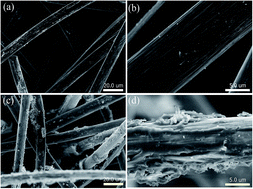
Due to the high cost and limited mineral resources of Ir metal, this method becomes too unwieldy. Wu et al. used microwave-treated graphite felt as the positive electrode with an activated surface.10 Park et al. employed porous metal foams as the electrodes.11 In our previous work, we have synthesized nitrogen-doped carbon nanotube/graphite felts as electrode materials for VRFBs with excellent performance.12 However, the harsh synthesis conditions limit the wide large-scale production of VRFBs with these electrode materials. Graphitic carbon nitride (C3N4) with a graphite-like structure has drawn plenty of scientific interest due to its excellent chemical and thermal stability,13 high in-plane nitrogen content, and appealing electronic structure. C3N4 has been widely investigated for a range of applications such as photocatalysis, CO2 reduction, electrocatalysis, and bio-imaging applications.14–16 To the best of our knowledge, there are not any reports on the use of this material for VRFBs. Therefore, it is of essential interest to observe the electrocatalytic behavior of graphitic C3N4 for V(IV)/V(V) and V(II)/V(III) redox reactions and thus for VRFBs.
The functional groups of the C3N4-CF samples were monitored using FTIR spectroscopy, and the spectra are presented in Fig. 2. Compared with the pure CF, three new strong absorption bands appeared at 807 cm−1, 1200–1600 cm−1 and 2800–3400 cm−1.18–20 The peak at 807 cm−1 was assigned to the bending vibration of tri-s-thiazine. Typical absorption bands for C3N4 of a triangular C–N(–C)–C unit at 1180 cm−1 and bridging C–NH–C units at 1239 cm−1 could be found for the C3N4-CF sample. N–H bending and C–H stretching peaks can be seen at 1386 cm−1 and 1543 cm−1, respectively, while a C
O stretching peak was discovered at 1728 cm−1. In addition, there are three possible sources for the peaks at 3180 cm−1: (1) primary amines, (2) secondary amines, and (3) O–H stretching vibrations of water molecules.19 All this evidence directly indicates that C3N4 was successfully synthesized on the surface of the CF, which is consistent with the SEM results in Fig. 1, Raman results in Fig. S2, and XPS results in Fig. S3.†
Cyclic voltammetry (CV) measurements were conducted to measure the electrochemical activity of the C3N4-CF toward the VO2+/VO2+ couple for VRFBs. As demonstrated in Fig. 3a, redox reactions of the V(IV)/V(V) couple can be detected on the electrodes with a sweeping voltage range of 0.4–1.4 V vs. SCE for the pure CF and C3N4-CF. It could be clearly found that C3N4-CF shows a better electrochemical performance than the pure CF with a higher peak current density and lower onset potential. The corresponding electrochemical performance parameters are summarized at Table S1.† The anodic and cathodic peak currents (Ipa and Ipc) were 10.5 and 5.48 mA for the pure electrode, and 12.95 and 13.84 mA with the C3N4-CF electrode. The peak potential separations of the VO2+/VO2+ reactions were 0.59 and 0.16 V for the pure and C3N4-CF electrode, respectively. The electrochemical characterization suggests that the electron transfer kinetics for the VO2+/VO2+ reaction with carbon felt are significantly enhanced by the presence of the graphitic C3N4.21 This result clearly demonstrates that C3N4 can act as an efficient electrocatalyst to catalyze the VO2+/VO2+ redox reactions. From the oxidation process used to assess these electrodes, the onset potentials are 1.18 and 0.91 V for the pure CF and C3N4-CF electrodes, respectively, which means the electrocatalytic kinetics of the oxidation process for the reaction of VO2+/VO2+ on the electrodes are in the order of C3N4-CF > pure.21 We could obtain the same result from the reduction process in Fig. 3a. Moreover, the onset potential for both the anodic and cathodic processes was improved after the growth of C3N4, which would be favorable for the electron transfer kinetics and beneficial for increasing the energy storage efficiency.22
The reversibility of the redox reaction can be estimated from the ratio of the peak currents (Ipa/Ipc) and the peak potential separation for the oxidation and reduction (ΔE = Vpa − Vpc). It could be obviously observed that after the growth of C3N4, the Ipa increased from 10.5 mA for pristine CF to 12.95 mA for the C3N4-CF and the ΔE reduced to 0.43 mV, indicating that the electrochemical properties are improved significantly. Compared with the pure sample, the value of the Ipa/Ipc for the C3N4-CF at the positive electrode was lower (0.93), indicating that it is close to the value (1.00) for a reversible redox reaction.23 Meanwhile, the ΔE associated with polarization decreased from 0.59 to 0.16 V, resulting in an enhanced reversibility for vanadium redox couples using graphitic C3N4. The excellent electrochemical performance should be attributed to the unique polymeric melon structure of C3N4, with the C and N atoms having lone pair electrons in the p orbitals, these electronic interactions can form a similar π-conjugated structure to benzene rings to form a highly delocalized conjugated system.24
To further study the performance of the C3N4-CF electrode in a VRFB, charge–discharge tests for all the electrodes were conducted. Fig. 3b presents the charge–discharge curves of the cells assembled with the pure CF and C3N4-CF electrodes at a current density of 50 mA cm−2. It can be seen that the C3N4-CF electrode shows the lowest charge voltage plateau and the highest discharge voltage plateau. The coulombic efficiency (CE), voltage efficiency (VE), and overall energy efficiency (EE) of the VRFBs obtained with the different electrode materials are displayed in Fig. 3c. The difference in the EE could reflect the different electrocatalytic activities of the electrode materials. It could be observed in Fig. 3c that the energy efficiency (EE) for the C3N4-CF electrode is 85%, which is 9.1% higher than that of the pure CF. The cell cycling stability is shown in Fig. S1.† These results present that with C3N4 grown on CF as the electrode, the performance of the cell is superior to that with pure CF, further indicating the efficiency of the graphitic C3N4 catalyst. Fig. 3d shows the continuous charge–discharge cycles of VRFBs with various electrode materials at a constant current density of 50 mA cm−2. After continuous cycling for 25 cycles, the C3N4-CF exhibited a much higher capacity than that of the pure CF, indicating the excellent stability of C3N4.
In order to gain additional supporting evidence, EIS measurements of the electrodes (pure CF and C3N4-CF electrodes) in a 0.1 M VOSO4 + 2 M H2SO4 solution at the open-circuit potential were recorded to further investigate the catalytic activity, and the corresponding Nyquist plots are shown in Fig. 4. The Nyquist plot of the electrode is composed of a large semicircle in the high frequency region and a sloped line in the low frequency region. In the equivalent circuit (Fig. 4), Rs is used to represent the resistance composed of contact resistance, electrode resistance and the solution resistance. From the data obtained and shown in Table S2,† the Rs (1.64, 1.53 Ω) values for the pristine carbon felt and the modified carbon felt are almost equivalent, which indicates that C3N4 does not seriously increase the resistance of the batteries. Rp (53.1, 23.1 Ω) represents the charge transfer resistance across the electrode–electrolyte interface. The fitted Rp for the C3N4-CF was lower than that for the pristine CF, which indicates that the charge transfer process was faster with the C3N4-CF. The constant-phase element Qm is representative of the electric double-layer capacitance of the electrode/solution interface, while Qt represents the diffusion capacitance attributed to the diffusion processes of VO2+ and VO2+. As total values Y1 (0.722 and 1.10 mMho) and Y2 (0.68 and 1.35 Mho), the larger values occur for the C3N4-CF, which is favorable for ion and electron transport, and so the polarization is dramatically alleviated and the reversibility is greatly improved. The impedance analysis is consistent with the CV results and battery performance mentioned above.
![]() | ||
| Fig. 4 Nyquist spectra from electrochemical impedance spectroscopy of the electrodes, obtained using 0.1 M VOSO4 + 2 M H2SO4 solutions. | ||
In summary, C3N4 exhibits an excellent electrocatalytic redox reversibility with positive VO2+/VO2+ couples for VRFBs. An enhanced electrochemical performance was demonstrated in terms of the higher peak current density from CV and the value of Ipa/Ipc almost remains constant at about 0.93. Additionally, from another aspect, the charge transfer resistance is significantly reduced due to the introduction of C3N4, whose polymeric melon structure could accelerate electron transport and ion diffusion at the electrode/electrolyte interface with CF. The as-prepared C3N4 on CF hybrid represents a significant strategy for the development of highly effective VRFB electrode materials.
Footnote |
| † Electronic supplementary information (ESI) available. See DOI: 10.1039/c6ra11381h |
| This journal is © The Royal Society of Chemistry 2016 |