Liangliang Dong,
Yue Wang,
Mingqing Chen*,
Dongjian Shi,
Xiaojie Li,
Chunfang Zhang and
Hui Wang
Key Laboratory of Food Colloids and Biotechnology, Ministry of Education, School of Chemical and Material Engineering, Jiangnan University, Wuxi 214122, P. R. China. E-mail: mqchen@jiangnan.edu.cn; Fax: +86-510-85917763; Tel: + 86-510-85917019
First published on 15th June 2016
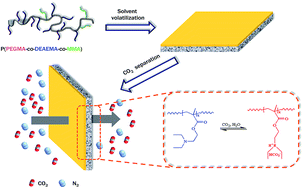
We report a high performance and CO2-philic, comb copolymer consisting of poly(ethylene glycol) methyl ether methacrylate (PEGMA), polymethyl methacrylate (PMMA) and poly(N,N-dimethylaminoethyl methacrylate) (PDMAEMA) for use in composite membranes for CO2/N2 separation. Since the copolymers contain ethylene oxide (EO) groups and amino groups, the separation performance was expected to be enhanced by the synergistic effect of (1) the increased solubility of CO2 by dipole–dipole interactions between CO2 and EO units and (2) the enhanced CO2 transport by reversible reactions between CO2 and amino groups. The best separation performance was obtained from the PEDM5 composite membrane with 25 mol% of PEGMA, at which the CO2 permeability was 308 barrer and CO2/N2 selectivity was 38, which displays a potentially promising alternative for CO2 separation from N2.
It is well known that polar groups such as ethylene oxide (EO) groups possess an excellent affinity with CO2 due to dipole–quadruple interaction between them, which improves CO2/gas selectivity. Therefore, many researchers have focused on developing poly(ethylene oxide) (PEO)-based polymers to exploit CO2 separation membranes.7–9 On the other hand, due to reversible reactions between CO2 and amino groups, the incorporation of amino groups into membranes can enhance CO2 permeability.10–14 Therefore, if the properties of EO groups and amino groups are combined together, the membranes are expected to possess both high CO2 permeability and high CO2/gas selectivity. Y.M. Cao groups have made a great deal of pioneering work in this field.15–19 They successfully prepared a series of crosslinked copolymers containing ether oxygen groups and amino groups based on N,N-dimethylaminoethyl methacrylate (DMEMA) and polyethylene glycol methyl ether methyl acrylate (PEGMEMA). These copolymers exhibited good CO2 permeability and CO2/N2 selectivity.15 But, the introduction of crosslinking agent in these copolymers caused densification of polymer chains, resulting in reduced CO2 permeability.20
In this work, we have firstly synthesized and characterized comb copolymer membranes comprising poly(ethylene glycol) methyl ether methacrylate (PEGMA), polymethyl methacrylate (PMMA) and poly(N,N-diethylaminoethyl methacrylate) (PDEAEMA). A series of P(PEGMA-co-DEAEMA-co-MMA) comb copolymers was synthesized via one-step free radical polymerization. In this membrane, the PEGMA was PEO-based polymer, which was expected to improve CO2/N2 selectivity. The PDEAEMA was amino-rich polymer, which was aimed to enhance CO2 permeability. And the PMMA was “hard segment”, which improved mechanical properties of copolymer membranes. We anticipated that the synergetic effect of EO groups and amino groups would improve CO2 separation performance. These comb copolymers were characterized using Fourier transform infrared spectroscopy (FT-IR), 1H nuclear magnetic resonance (NMR), and gel permeation chromatography (GPC). The thermal properties and crystalline structure of comb copolymers were characterized using differential scanning calorimetry (DSC), X-ray diffraction (XRD) and atomic force microscopy (AFM). The P(PEGMA-co-DEAEMA-co-MMA) comb copolymer was directly coated onto a microporous polyvinylidene fluoride (PVDF) support to prepare composite membranes, and the performance of the composite in CO2/N2 separation was tested at 25 °C. We expected that our work may provide a facile approach for the rational design of membrane materials and efficient intensification of membrane separation performance.
:
DEAEMA
:
MMA were used including 1
:
06
:
14, 2
:
06
:
14, 3
:
06
:
14, 4
:
06
:
14, 5
:
06
:
14 and 5
:
06
:
0, and (after polymerization) these were referred to as PEDM1, PEDM2, PEDM3, PEDM4, PEDM5 and PEDM6, respectively. Three monomers were completely dissolved in 25 mL of 1,4-dioxane, and then 1.5 mol% of AIBN out of the total mole of three monomers was added to the solution as an initiator. The mixed solutions were purged with nitrogen gas for 0.5 h and were placed in a 65 °C oil bath for 12 h. After the free-radical polymerization, all PEDM solutions were precipitated in anhydrous ether. To purify the copolymers, this precipitation process was repeated three times for each sample, and then the copolymers were dried completely in a vacuum oven.
![]() | (1) |
The densities of prepared membranes without PVDF support were determined by specific pycnometer at 25 °C and three parallel measurements were carried out for each sample. The density was accurate to three decimal places. Prior to density measurement, the films samples were dried in vacuum oven at 25 °C for 3 days. The film density (ρ, g cm−3) was calculated by using the following equation:
![]() | (2) |
![]() | (3) |
The permeability ratio for gas A and gas B which is called gas pair selectivity25,26 was determined as follows.
![]() | (4) |
![]() | ||
| Scheme 2 Schematic illustration for the preparation of P(PEGMA-co-DEAEMA-co-MMA) composite membranes. | ||
The successful polymerization of PEDM comb copolymers was confirmed using FT-IR spectroscopy, as shown in Fig. 2(a). A strong band at 1730 cm−1 was observed in all PEDM copolymers due to the stretching vibration of carbonyl (C
O) bonds, and the position of this band did not change with changes in composition. A strong band at 1150 cm−1 was observed in the PEDM comb copolymers. This band was assigned to the stretching vibration mode of the ether (C–O–C) groups. Additionally, the intensity of the PEO peaks (e.g., 2870 cm−1) increased with increasing PEO weight content, as expected.29
The composition and complete polymerization of PEDM comb copolymers were confirmed by 1H NMR, as shown in Fig. 2(b) and S1.† The intensity of PEGMA peaks (i.e., peaks g, h and j) increased with increasing PEGMA content, indicating that the copolymerization was successfully synthesized in this study. The weight average molecular weights (Mw) and polydispersity index (PDI) of PEDM comb copolymers were tested using GPC and are summarized in Table 1. The Mw of the PEDM comb copolymers ranged from 48
000 to 52
000 g mol−1 with a PDI of 1.4–1.9. The PEDM5 had the maximum Mw (52
000 g mol−1). Mechanical properties of the PEDM copolymer films without PVDF support in terms of elongation and tensile strength were listed in Table 1. As PEGMA content increased from 5 to 25 mol%, tensile strength decreased while elongation increased. For example, PEDM1 had the lowest elongation but the highest tensile strength, which meant that the membrane was very robust. A flexible membrane was achieved at the 25 mol% of PEGMA (PEDM5), suggesting that the copolymers became thermoplastic elastomer at high PEGMA contents. However, because of the absence of MMA, the physical state of PEDM6 was a highly viscous liquid-like state shown in Fig. S1.† Therefore, the membrane prepared by PEDM6 had not enough mechanical stability to be handled and used in stretching tests and followed gas permeation test. The difference in mechanical properties suggested that the presence of MMA segment could improve mechanical properties of copolymer membranes.
| Sample | PEDM1 | PEDM2 | PEDM3 | PEDM4 | PEDM5 | PEDM6 |
|---|---|---|---|---|---|---|
PEGMA : DEAEMA : MMA (mol) |
1 : 06 : 14 |
2 : 06 : 14 |
3 : 06 : 14 |
4 : 06 : 14 |
5 : 06 : 14 |
5 : 06 : 0 |
| Density (g cm−3) at 25 °C | 1.252 | 1.233 | 1.227 | 1.202 | 1.193 | — |
| d-Spacing (Å) | 5.62 | 5.54 | 5.39 | 5.34 | 5.28 | — |
| Mn (g mol−1) | 23 000 |
34 000 |
35 000 |
35 000 |
36 000 |
13 000 |
| Mw (g mol−1) | 48 000 |
49 000 |
49 000 |
48 000 |
52 000 |
36 000 |
| PDI (Mw/Mn) | 1.9 | 1.4 | 1.4 | 1.4 | 1.5 | 2.7 |
| Tensile strength (MPa) | 8.7 | 6.4 | 5.4 | 3.8 | 3.6 | — |
| Elongation (%) | 73 | 338 | 436 | 512 | 550 | — |
The thermal stability of a polymeric material is always a key issue and needs careful consideration.30 Fig. 3(A) showed the thermal stability of PEDM comb copolymers. For all the copolymers, the three discrete thermal degradation steps were observed. The first slightly thermal degradation began at 100 °C, which attributed to volatilization of solvent (e.g. chloroform and water). The second stage thermal degradation started at around 250 °C. This indicated that PEO chains and PMMA chains thermally decomposed.31,32 The last stage thermal degradation started at around 420 °C. This indicated that PDEAEMA chains thermally decomposed.33 In a N2 atmosphere, all the copolymers were stable up to 300 °C, indicating that the polymers had good thermal stability. Surface hydrophilicity of the copolymer membranes was analyzed via contact angle measurements, as shown in Fig. 3(B), contact angle continuously decreased with the amount of PEGMA component increasing from 5 to 25 mol%, indicating gradually increased surface hydrophilicity.
![]() | ||
| Fig. 3 TGA curves (A), contact angle (B) and XRD (C) of PEDM comb copolymers with various compositions (TGA: (a) PEDM1, (b) PEDM2, (c) PEDM3 (d) PEDM4 and (e) PEDM5). | ||
As the crystallinity of membrane is known to affect membrane performance, the crystal structures of the comb copolymers depending on the composition were investigated using XRD analysis. The XRD curves for the copolymers were shown in Fig. 3(C), where the intensity of X-ray scattering was plotted against the diffraction angle, 2θ. It can be clearly seen that the diffraction patterns of all copolymers were very similar except for the reflection peak angles having slightly shift to right. It has been reported that the XRD pattern of pure PEO had sharp characteristic peaks at 2θ values around 17–19° and 22–24° for crystals.34 But, there were no sharp crystalline peaks around these angles observed in all comb copolymers, indicating that all copolymers were the amorphous nature at room temperature. These results were in accordance with the DSC analysis shown in Fig. S3.† This is good for gas transport in membrane, as the higher the crystallinity in the polymer matrix, the more difficult the penetrant diffusion is.35 Generally, the broad peak center on XRD represents the average intersegmental distance of polymer chains.36 The d-spacing has been widely used to characterize the average inter-segmental distance directly in polymers. The value of d-spacing can be calculated from eqn (1). The values of d-spacing were also given in Table 1. It indicated that increasing the content of PEGMA decreased the d-spacing and the average inter-segmental distance. The similar phenomena were reported by Kim et al.20 when they studied CO2/N2 separation performance of PBEM-g-POEM comb copolymer membranes and Park et al.37 when they investigated gas diffusivity, solubility and permeability of polysulfone–poly(ethylene oxide) random copolymer membranes. The decreased d-spacing may restrict the diffusion of larger molecules and favor the diffusion of small molecules with less resistance, improving permselectivity for small penetrants.38
Cross-sectional SEM images of PEDM composite membranes were observed using SEM, as shown in Fig. 4. The thickness of the PEDM upper layer was between 30 and 40 μm for PEDM1 to PEDM5 membranes, and the upper layer slightly permeated into the microporous support, indicating good interface compatibility between copolymer layer and PVDF layer. This good interface compatibility could prevent mechanical separation between the two layers and could also enhance the long-term stability and durability of the membrane during operation.
![]() | ||
| Fig. 4 Cross-section SEM images of PEDM composite membranes (a and b) PEDM1 (c and d) PEDM3 and (e and f) PEDM5 (HM was defined as the SEM images of membranes obtained at high magnification). | ||
The surface morphology of copolymer membranes were imaged with AFM. AFM phase images along with the height images of the PEDM copolymer membranes with various compositions were shown in Fig. 5. As shown in the AFM phase images (top row in Fig. 5), no obvious phase-separated pattern can be observed in the phase images for all copolymer membranes, indicating that the hard and soft segments were randomly distributed throughout the membrane. This observation was in accordance with the DSC results, where only one glass transition temperature was detected, and no melting/crystallization peaks were observed for all PEDM copolymer membranes. AFM height images (bottom row in Fig. 5) showed that all films had smooth surfaces with roughness values of less than 5 nm (film thickness of ∼60 μm).
![]() | ||
| Fig. 5 AFM phase images (the top row) and height images (the bottom row) of PEDM comb membranes (a) PEDM1, (b) PEDM3, and (c) PEDM5. | ||
The pure gas permeability and CO2/N2 ideal selectivity of PEDM/PVDF composite membranes were shown in Fig. 6 as a function of comb copolymer composition. For all composite membranes, the CO2 permeability increased rapidly while the N2 permeability increased slowly as the PEGMA content increased. The enhancement of CO2 permeability was due to follow four reasons. Firstly, it is well known that FFV of polymers can be related with their densities. Decreased density will increased FFV of copolymer, causing loose structure, which is good for gas diffusion.39 As shown in Table 1, the density of PEDM composite membrane was decreased with the increase of PEGMA content, suggesting that the composite membrane had bigger FFV and more loose structure and consequently facilitating CO2 diffusion. Secondly, according to the DSC results in Fig. S3,† increased PEGMA content lead to lower Tg values of PEDM comb copolymers, favoring CO2 permeance.40–42 Last but not least, the soft PEGMA segment of the PEDM comb copolymer contains a large number of ethylene oxide (EO) groups which had high affinity for CO2 molecules due to dipole–quadrupole interactions, increasing the CO2 solubility in the membrane.23,43,44 At last, amine groups of PEDM comb copolymer had reversible reactions with CO2, enhancing the CO2 transport through the membrane.45–47 Although the first two reasons also improved the N2 permeability, this increase was smaller than that of CO2 permeability due to larger kinetic diameter of N2 (3.6 Å) than that of CO2 (3.3 Å). Additionally, the last two reasons only selectively enhanced the CO2 solubility. As a result, a more profound increase in CO2 permeability was observed when compared with the N2. Accordingly, the ideal CO2/N2 selectivity increase almost monotonically with PEGMA content due to the same reasons. The best separation performance was obtained from the PEDM5 composite membrane with 25 mol% of PEGMA, at which the CO2 permeability was 308 barrer and CO2/N2 selectivity was 38. These values were higher than that of reported polymer membranes shown in Table 2, which was attributed to synergistic effect of EO groups and amino groups that the EO groups enhanced the solubility of CO2 and the amino groups can efficiently facilitate CO2 transport in the membranes.
| Ref. | Membrane | CO2 permeability (barrer) | Selectivity (CO2/N2) | Typea |
|---|---|---|---|---|
| a EO presented PEO-based membranes, FTM represented facilitated transport membranes, EO + FTM represented the membranes containing ethylene oxide groups and reactive carriers simultaneously. | ||||
| 15 | PDMAEME-PEGMEMA-90 | 112.77 | 31.02 | EO + FT |
| 54 | Ps-b-PEO/M1 | 214.6 | 1.46 | EO + FT |
| 55 | PDMAEMA/Psf | 30 | 53 | FT |
| 56 | PEIE | 231.3 | 70 | FT |
| 57 | PVAm | 73.8 | 70 | FT |
| 29 | Pent-PI-PEO2000 (60%) | 39 | 46 | EO |
| 20 | PBEM-g-POEM | 58.6 | 73.3 | EO |
| 8 | Psf-PEG6000-6 | 6.27 | 48.5 | EO |
| 50 | PEGBEM-g-POEM | 43.8 | 84.7 | EO |
| 58 | PEO-PBT/PDMS/PAN | 90 | 750 | EO |
| 51 | PCZ-r-PEG | 50.7 | 42.2 | EO |
| 59 | PVC-g-POEM | 100 | 49 | EO |
| This work | PEDM5 | 308 | 38 | EO + FT |
The effect of operating pressure on gas separation performance was shown in Fig. 7. The CO2 permeability decreased with the increase of feed gas pressure. Unlike the CO2 permeation behavior with pressure, the N2 permeability was only slightly changed with increasing feed pressure. The similar phenomenon was reported by Wu et al. when they studied the gas separation performance of PEG–PEI–GO doped mixed matrix membranes.47 They thought that difference in the permeability of CO2 and N2 implied that transport of CO2 followed both facilitated transport mechanism and solution-diffusion mechanism, while the permeability of nonpolar N2 only followed the solution-diffusion mechanism.47 Generally, if a gas permeates through the membrane following the ideal solution-diffusion mechanism, its permeability is independent of concentration driving force across the membrane.48 CO2/N2 selectivity show a decreased trend mainly due to the decrease of CO2 permeability.
The effect of temperature on CO2 permeability, N2 permeability and CO2/N2 selectivity was also investigated as shown in Fig. 8. The temperature used for the effect of temperature ranged from 25 °C to 65 °C. Both the CO2 and N2 permeabilities increased with the temperature. As the temperature rised, the chain mobility of polymer increased, resulting in reduced gas transport resistance and then accelerating CO2 and N2 transports through polymer membrane. The decreased CO2/N2 selectivity was mainly due to faster permeability of N2 than that of CO2, which was in good agreement with the previous results.20,47,49 Even though the gas CO2/N2 selectivity was 30.0 with the CO2 permeability being 370 barrer at 65 °C, they were still higher than the values of many reported polymeric membranes.20,29,50–53
Separation performance of PEDM composite membranes was investigated by plotting the obtained data on Robeson upper bound graphs,60 as shown in Fig. 9. The PEDM5 composite membrane showed the highest combinations of permeability and selectivity for CO2/N2, with a CO2 permeability of 308 barrer, and CO2/N2 selectivity of 38, respectively, which was very close to the upper bound (2008). This also implied that our strategy based on synergetic effect of PEO and amino group was very effective to obtain polymer membrane with high gas separation performance. In this work, for all PEDM composite membranes we only changed the PEGMA content while keeping other contents unchanged. Therefore, we believe that relatively increasing the DEAMA content will prompt prepared composite membranes to overcome the upper bound while increasing the PEGMA content.
Footnote |
| † Electronic supplementary information (ESI) available. See DOI: 10.1039/c6ra10475d |
| This journal is © The Royal Society of Chemistry 2016 |