B. Hwang‡
ab,
M. Park‡a,
T. Kima and
S. M. Han*a
aGraduate School of Energy Environment Water and Sustainability, Korea Advanced Institute of Science & Technology, Daejeon, 305701, Republic of Korea. E-mail: smhan01@kaist.ac.kr
bBASF Electronic Materials R&D Center Asia, Suwon, 440746, Republic of Korea
First published on 8th July 2016
Graphene is known to prevent permeation of gases that can effectively prevent oxidation of Ag nanowires. In this study, the role of the reduced graphene oxide (RGO) in chemical stability and its effect on the mechanical reliability was studied for a Ag nanowire/RGO hybrid transparent electrode. Bending fatigue tests up to 800
000 cycles were performed by monitoring the in situ resistance change while imposing fixed, uniform bending strain on Ag nanowire networks with and without a RGO layer. A thin layer of RGO with an optimized thickness of ∼0.8 nm deposited on the Ag nanowire networks sustained excellent reliability of the Ag nanowire networks, where the fractional resistance increase was 2.7% after 800
000 cycles. Furthermore, adopting the RGO layer significantly lowered the oxidation of Ag nanowires, and the bending fatigue properties after exposure to ambient air for 132 h at 70 °C indicated remarkable enhancement due to suppression of the oxide formation on the surface of the Ag nanowires. Lastly, a highly reliable Ag nanowire/RGO hybrid electrode was fabricated using mechanical welding by subjecting it to bending strain in order to form localized junctions without having to go through any post annealing processes.
The major drawback of the Ag nanowire network as a transparent electrode, however, is that the Ag nanowires are easily oxidized when exposed to moist air, which results in the increase in sheet resistance of the Ag nanowire network.13–15 Therefore, a suitable protective layer is needed to suppress the oxidation of the Ag nanowires. Reduced graphene oxide (RGO) is an attractive candidate for the protective layer owing to its low permeability to gas or H2O molecules16 and excellent optical transmittance.17 A few studies so far have reported the hybrid transparent electrode of RGO layer on the surface of the Ag nanowire networks, where a remarkable chemical stability under ambient moisture without significant loss of optical properties were demonstrated.13,15,17–19
An important remaining issue in applying the Ag nanowire/RGO hybrid electrode for flexible electronics is the mechanical reliability as the RGO layer can degrade the previously reported excellent flexibility and reliability of the Ag nanowire network.12 Nevertheless, there is only a limited investigation on the cyclic deformation behavior of the Ag nanowire/RGO hybrid electrode under bending strain whereupon only the ex situ resistance measurements were reported after imposing a small number of cycles.15,20–23 Furthermore, even though the surface oxidation is expected to degrade the mechanical properties of metal nanowires24 thereby resulting in poor reliability under bending fatigue, there is no study on the change in reliability after being exposed to an oxidation environment.
In the present work, the role of RGO layer in enhancing the chemical stability and its effect on the mechanical reliability were systematically studied for Ag nanowire/RGO hybrid transparent electrode. The RGO protective layer was deposited on top of the Ag nanowire network, and the mechanical reliability of the fabricated Ag nanowire/RGO hybrid electrodes were examined using a bending fatigue tester capable of in situ resistance measurements. Large number of cycles of up to 800
000 cycles was imposed, and the resistance was monitored in situ during the bending fatigue tests. In addition, the effect of the surface oxidation of the Ag nanowires on the chemical stability as well as mechanical reliability were investigated by exposing samples to ambient air and then performing similar bending fatigue tests on the exposed Ag nanowire networks with and without RGO protective layer. Furthermore, we propose that further enhancement in the chemical stability and mechanical reliability can be achieved by replacing the thermal annealing with mechanical welding by applying simple bending strain to the Ag nanowire/RGO hybrid electrodes.
To fabricate Ag nanowire/RGO hybrid electrodes, the RGO layers were formed on the fabricated Ag nanowire electrode on PI substrate by using the same electrostatic spray system at room temperature. The sheet resistance decreased with the amount of 0.1–0.3 ohm sq−1 after the RGO deposition with the volume of 45 ml on the annealed Ag nanowire networks. The amount of transmittance decrease was confirmed as ∼2% when RGO layers were coated on the Ag nanowire network. Since the RGO was air sprayed on already formed Ag nanowire network without further annealing steps, the RGO is physically put in contact with the underlying Ag nanowires rather than relying on any functional groups on RGO interacting with the underlying Ag nanowires.
000 cycles under fixed, uniform strain conditions, while monitoring the resistance change in situ. Ag nanowire or Ag nanowire/RGO on PI specimen was mounted in between the two parallel plates using screw bolts, in which each plate has Cu pad that is in contact with the Ag nanowire network for resistance measurements during cyclic bending. To apply repeatable bending strain, the lower plate moves horizontally with a fixed plate motion distance that determines the strain induced area. A uniform strain is imposed by choosing the desired spacing between the two plates. According to ε = y/R, where y is the neutral plane which can be determined by the substrate thickness and R, the radius, means a half value of the distance between the plates, the nominal strain imposed on the nanowires for a given plate spacing is then calculated. The spacing between the plates, 2R, was fixed to 8.3 mm, which corresponds to nominal strain induced on the Ag nanowire networks of 1.5%. The number of bending cycles was chosen to be 800
000 cycles, and the tests were performed at the plate movement distances of 10 mm with the bending speed of 300 cycles per a minute. More detailed description of the cyclic bending fatigue tester can be found in ref. 12 and 33.
O bond that is characteristic of GO was hardly observed, thereby confirming that the RGO sheet prepared in this study was fully reduced to RGO.
In order to confirm that the RGO layer uniformly covers the Ag nanowire network and therefore can function as charge transport layer in the transparent electrode, conductive AFM that is capable of measuring I–V curves with nanoscale scale lateral resolution was used [ESI 02†]. Fig. S2b† indicates the measured I–V curves of Ag nanowire/RGO hybrid electrode at two locations of first on top of the Ag nanowire and then in the area in between the nanowires, as marked in Fig. S2a.† Since the region in between the nanowires is covered with RGO, current flow was detected at both locations of on top as well as in between the Ag nanowires. Although the resistivity of RGO is relatively high (10−4 ohm m) in comparison to that of Ag nanowires (3 × 10⁻⁸ ohm m), the submicron travel distance to nearby Ag nanowires, however, allowed for sufficient current flow. Therefore, the capability of the RGO in providing alternative current path was demonstrated from this simple AFM analysis.
000 cycles. The fractional resistance change ((R − R0)/R0) of Ag nanowire/RGO hybrid electrode over number of cycles is provided in Fig. 1. For comparison, a similar test was performed on bare Ag nanowire electrode without RGO protective layer, and the result is shown together in Fig. 1. Both the Ag nanowire and Ag nanowire/RGO hybrid electrodes have excellent mechanical reliability under bending fatigue that showed 1.6% and 2.7% increase in fractional resistance at the end of 800
000 cycles, respectively. The increases in fractional resistance in both cases are significantly lower than in the case for Ag thin film, which showed ∼90% increase in fractional resistance under the same test conditions [ESI 03†]. Metal nanostructures display interesting size dependent plasticity,28,29,35 and the metal nanowires limited surface defects were reported to have high strengths reaching that of the theoretical strength of E/10.30,36,37 Such high strength of the individual nanowire is one reason for excellent reliability of the Ag nanowire network, in addition to the fact that the network geometry is well suited to accommodate stretching while reducing the strain on the individual nanowires.
The change in fractional resistance in Ag nanowires with and without RGO during the bending fatigue tests observed in Fig. 1 is expected to be due to two modes of deformations. The first mode of failure involved deformation at the thermally locked-in junctions, which are formed during the thermal annealing process that is needed to remove PVP layers encapsulating the as-synthesized Ag nanowires from polyol reduction method.6,11 Since the thermally locked-in junctions are formed between two nanowires with different crystallographic orientations, grain boundaries must exist between the junction and the rest of the nanowire. Therefore, failure of the Ag nanowire networks under bending fatigue mainly occurs at thermally locked-in junctions, thereby increasing the resistance under fatigue. Although a thermal annealing step forms thermally locked-in junctions in Ag nanowire networks, there are still many Ag nanowires that do not form the locked-in junctions but rather lie on each other without contact formation for current path. Application of repeated bending strain to the stacked Ag nanowire networks can lead to the junction formations that are just enough to result in the needed electrical conductivity by mechanical welding effect as localized plasticity joins the nanowires at the contact instead of fusing the nanowires.12 The second mode of failure then involves progressive formation and subsequent failure of mechanically welded junctions. The failure of mechanically welded junctions can also cause an increase in the overall resistance under bending fatigue although mechanically welded junctions are reported to be more robust in reliability than the thermally locked-in junctions.12,38
Since both deformation mechanisms occur simultaneously during cyclic bending, however, the resistance change is dominated by which mechanism is more prominent at the cycle. In the case of the bare Ag nanowire networks of the present study, the failures occur fast at the weakest thermally locked-in junctions first, thereby, leading to the sharp increase in resistance in the initial stage of bending. Once the weakest links are eliminated from the network, however, the probability of junction formations by mechanically welding become more pronounced than the failures at the locked-in junctions. Therefore, a decrease in resistance was observed following the initially observed sharp increase in resistance. After the junction form via mechanical welding, an increase in resistance is observed at a slower rate than that in the initial stage that is indicative of further propagation of the fatigue failure near the remaining thermally locked-in junctions as well as mechanically welded junctions.
The fatigue behavior of the Ag nanowire/RGO hybrid electrodes can also be explained by the similar deformation mechanism where failure first occurs at the thermally locked-in junctions of Ag nanowire network. Fig. 2 shows a series of SEM images, which were taken for the Ag nanowire/RGO hybrid electrodes after imposing 10
000, 100
000 and 800
000 cycles at 1.5% bending strain. It revealed that the failure of the Ag nanowire/RGO hybrid electrodes occurred at the thermally locked-in junctions, which resonates well with the failure mode of bare Ag nanowire network described above. Since the thin RGO layer just covers the nanowire networks without strong adhesive strength to the Ag nanowire network or the underlying substrate, the RGO deposition did not show a significant difference in the overall reliability. The RGO layers, even with full coverage of the substrate, allowed for the Ag nanowires to freely respond to the cyclic bending strains, thereby resulting in the similar deformation mechanism to the bare Ag nanowire network.
One clear difference in the fatigue behavior between the bare Ag nanowire and the Ag nanowire/RGO hybrid transparent electrodes is that the decrease in fractional resistance shown in the bare Ag nanowire networks was not observed in the Ag nanowire/RGO hybrid transparent electrodes. The Ag nanowire/RGO hybrid electrode showed a continuous increase in fractional resistance without the decrease in resistance that was observed in the bare Ag nanowire network. Since the RGO deposition provides additional current path on top of the Ag nanowire networks before imposing a bending strain, the influence of the formation of mechanically welded junctions on the resistance decrease are negligible for the case of Ag nanowire/RGO hybrid electrodes. The current path formation by RGO was able to be confirmed by the 1–2% decrease in the sheet resistance of the Ag nanowire networks after RGO deposition, which was mentioned above.
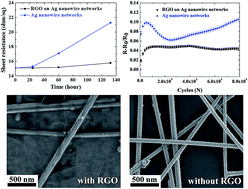
For more detailed investigation on the suppression of the surface oxidation by RGO deposition, SEM images were taken for the bare Ag nanowire and the Ag nanowire/RGO hybrid electrodes after being exposed to air at 70 °C for the different time. (Fig. 4a–c) As shown in Fig. 4a, small oxide particles covered the surface of the bare Ag nanowires after 24 h of exposure, and the number as well as the size of the oxide particles increased as the exposing time increased (Fig. 4b and c). The chemical composition of the surface particles were confirmed as silver oxide by EDX analysis (Fig. S4†), which must be Ag2O based on the chemical equilibrium.14 On the other hand, the surface oxidation was not evident in the Ag nanowire/RGO hybrid electrodes as shown in Fig. 4d and e. Only the specimen that was exposed for an extended period of 132 h showed some oxide particle formations on the nanowire surface (Fig. 4f and S4†). Thus, suppression of the oxidation is in agreement with smaller increase in sheet resistance when exposed to ambient air.
To understand the effect of surface oxidation on the mechanical reliability under bending fatigue, bending fatigue tests were performed on the bare Ag nanowire and Ag nanowire/RGO hybrid electrodes after exposing both to air at 70 °C for 132 h. The initial sheet resistance was ∼15.3 ohm sq−1 for both specimens that increased to ∼16.0 ohm sq−1 for the Ag nanowire/RGO hybrid electrode and ∼22.0 ohm sq−1 for the bare Ag nanowire electrode after the exposure, and the bending fatigue test results for both specimens are shown in Fig. 3b. At the end of the bending cycles, the Ag nanowire/RGO hybrid electrode showed significantly smaller increase in fractional resistance, 4.2%, compared to that of the bare Ag nanowire electrode, which had 10.9% increase. In addition, the bare Ag nanowire electrode showed continuous increase in fractional resistance even at 800
000 cycles, while the Ag nanowire/RGO hybrid electrode sustained a steady-state without further increase in resistance until the end of the tests. If the fatigue progresses further to even larger number of cycles, the resistance increase is expected to be more pronounced in the bare Ag nanowire electrodes compared to that of the Ag nanowire/RGO hybrid electrodes.
Enhanced mechanical reliability of the Ag nanowire/RGO hybrid electrode after being exposed to air is attributed to the reduced surface oxidation on the Ag nanowires by the RGO layer. The failure of the Ag nanowire network is caused by the progression of plastic deformation near the locked-in junctions in response to the continuously applied bending strain.12 The brittle oxide particles on the nanowire surface, however, can act as stress concentrators near which the probability of possible crack/damage initiation increases, thereby leading to the deterioration of the mechanical properties of metal nanowires.24 Therefore, reducing the surface oxidation with RGO protective layer can minimize the mechanical properties degradation of Ag nanowires after being exposed to air that resulted in the decreased susceptibility to the fatigue failure of the Ag nanowire/RGO hybrid electrodes.
000 cycles, and the end resistance is comparable to the value achievable by thermal annealing. No increase in fractional resistance was observed even at 800
000 cycles due to the absence of thermally locked-in junctions in the un-annealed Ag nanowire/RGO hybrid electrodes. Furthermore, the RGO deposition was successfully able to suppress the surface oxidation, which enhanced the chemical stability of the un-annealed Ag nanowire/RGO hybrid electrodes without an increase in sheet resistance even after exposure to air for 288 h at 70 °C. Therefore, further enhancement of mechanical reliability and chemical stability was demonstrated by using bending strain to form mechanically welded junctions for the Ag nanowire/RGO hybrid electrodes.
Footnotes |
| † Electronic supplementary information (ESI) available. See DOI: 10.1039/c6ra10338c |
| ‡ These authors contributed equally to the research. |
| This journal is © The Royal Society of Chemistry 2016 |