Josué M. Silla and
Matheus P. Freitas*
Department of Chemistry, Federal University of Lavras, P.O. Box 3037, 37200-000, Lavras, MG, Brazil. E-mail: matheus@dqi.ufla.br
First published on 21st July 2016
The fluorine Perlin-like effect is an NMR phenomenon characterized by |1JC–Fax| < |1JC–Feq| in fluorinated six-membered rings and can be useful to determine the stereochemistry of such organofluorine compounds. The reverse fluorine Perlin-like effect is the opposite, that is |1JC–Fax| > |1JC–Feq|. The origin of the traditional Perlin effect in tetrahydropyran (1JC–Hax < 1JC–Heq) has long been explained in terms of
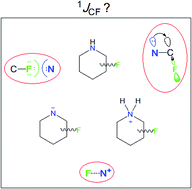
hyperconjugation, that elongates the C–Hax bond, then reduces 1JC–Hax relative to 1JC–Heq. However, dipolar interactions have recently been invoked as the dominant contribution for the Perlin effect. The effects ruling the 1JC–F coupling constant in 2-, 3- and 4-fluoro-substituted piperidines and respective cations and anions are reported in this work, because of the important role of fluorine and nitrogen (either neutral or charged) in pharmaceutical and material sciences. The proximity (either scalar or spatial) of nitrogen to fluorine affects the 1JC–F coupling constant, but the nitrogen electron lone pair and the charge on nitrogen interacting with the C–F bond or fluorine lone pairs play a major role in describing the 1JC–F transmission mechanism, rather than hyperconjugation. This is made clear upon analysis of the axial 3-fluoropiperidinium cation, which experiences the electrostatic gauche effect F⋯N+, decreasing the |1JC–Fax| relative to |1JC–Feq|, and also by investigating non-covalent interactions (NCI), canonical molecular orbitals (CMOs) and the angular dependence of 1JC–F with molecular dipole moments and
interactions for the title compounds and 1-(fluoromethyl)aziridine.
orbital, which is a good electron acceptor from antiperiplanar σC–H orbitals (Fig. 1).2 However, the electrostatic gauche effect takes place when the electronegative fluorine interacts attractively with a positive nitrogen, e.g. in the staggered conformation of 3-fluoro-γ-aminobutyric acid (3F-GABA)3,4 and 3-fluoro-N-methyl-D-aspartic acid (3F-NMDA).5
The predominant axial conformation for the 3-fluoropiperidinium cation is known to originate from the electrostatic gauche effect N+⋯F, while the intramolecular hydrogen bond NH⋯F does not play a significant role in its conformational isomerism.6,7 While these spatial interactions can affect the spin–spin coupling constant 1JC,F, the ruling effects of the 1JC,H transmission mechanism have been reviewed for six-membered rings and other systems.8 The Perlin effect can be useful to estimate the stereochemistry of substituted six-membered rings and was established upon the observation that 1JC2–Hax < 1JC2–Heq in pyranoside derivatives.9,10 This effect has been attributed to a
hyperconjugation that elongates the C2–Hax bond and, consequently, decreases 1JC2–Hax relative to 1JC2–Heq.11 The reverse Perlin effect (1JC2–Hax > 1JC2–Heq) observed in 1,3-dithiane originates from the dominant
or
stereoelectronic interactions.11–13 More recently, dipolar effects between nO and the C–H bond in tetrahydropyran have been invoked as the main cause of the Perlin effect.14 In order to probe the role of dipolar effects on one-bond coupling constants, the 1JC–F coupling constant in 2-fluorotetrahydropyran derivatives have been recently analyzed, since the C–F bond is highly polar and, therefore, the so called reverse fluorine Perlin-like effect would be significant.15 Indeed, the |1JC–Fax| coupling constants in these compounds are larger (1JC–Fax more negative) than |1JC–Feq|, whose origin was further investigated using fluorinated model systems and the 1JC–F showed angular dependence with the molecular dipole moment.16,17 It is worth mentioning that the absolute values of coupling constants have been used to define the fluorine Perlin-like effect because they are explicit on the splitting of 13C peaks.
While the interaction of fluorine with polar bonds and electron lone pairs seems to affect the 1JC–F spin–spin coupling constant (SSCC),15–17 the influence of positive (e.g. in systems experiencing the electrostatic gauche effect) and negative sites on 1JC–F, and of the orientation and distance of fluorine relative to these sites, is still unclear. Thus, this work reports a theoretical analysis of the 1JC–F SSCC in n-fluoropiperidines (n = 2, 3 and 4) and in the corresponding cations and anions (Fig. 2), in order to find the dictating effects of 1JC–F and, consequently, to obtain insight into the stereochemistry of organofluorine compounds using this SSCC.
![]() | ||
| Fig. 2 Calculated 1JC–F (Hz) coupling constants for n-fluoropiperidines (n = 2, 3 and 4) and their respective cations and anions (the Fermi contact term is given in parenthesis). Data for compounds 10 and 11 were obtained from the literature.11 | ||
Optimization and frequency calculations were performed at the ωB97X-D/6-311++g(d,p)18,19 level for compounds 1a–9b of Fig. 1. Natural orbital bond (NBO) analyses were carried out for the optimized structures at the standard B3LYP/6-311++g(d,p)19,20 level using the NBO 6.0 program,21 in order to obtain the electronic delocalization values and other parameters possibly affecting the 1JC–F coupling constant. Spin–spin coupling constant calculations were performed at the ωB97X-D/6-311+g(d,p) level. All the calculations were processed using the Gaussian 09 program22 for the gas phase. Calculations of non-covalent interactions (NCI) over the structures optimized at the ωB97X-D/6-311++g(d,p)18,19 level were performed using the NCIPLOT program.23
When 4a, 5a and 6a (all with axial F and H(N), where possible) are compared to each other, the F⋯N+ interaction in 5a (which withdraws electron density from F – see the fluorine natural charges in Table 1) causes an increasing in the |1JC–F| value relative to 4a (neutral N) and especially to 6a, where the F/N− repulsion is large and, therefore, the |1JC–F| value is minimum (1JC–F less negative). On the other hand, comparison of |1JC–F| between axial and equatorial conformers in 4, 5 and 6 does not show the expected trend if one takes into account only electrostatic effects, i.e. Δ|1JC–F(ax–eq)| should invert the sign upon going from 5 to 4 and then 6 (or, at least, Δ|1JC–F(ax–eq)| would be expected to increase according to 6 < 4 < 5). Actually, calculations show that Δ|1JC–F(ax–eq)| for 5 and 6 are similar. A possible reason is that the equatorial fluorine in the series 4b, 5b and 6b are anti to the nitrogen atom and, therefore, no spatial interaction is allowed and the effect of the nitrogen charge on 1JC–F is different when compared to 4a, 5a and 6a. Consequently, other interactions, not only electrostatic ones, participate in the 1JC–F transmission mechanism, which can include hyperconjugation and steric interactions. The solvent effect, analyzed on the basis of implicit DMSO calculations (using the polarizable continuum model24), shows that |1JC–F| decreases on going from the gas to polar solution, but the trend among compounds (4, 5 and 6) and conformers remains (Fig. 1). The experimental 1JC–F values for 3-fluoropiperidine (in CD3CN) and its corresponding hydrochloride salt (cation 5 in DMSO) are −169.0 and −170.5 Hz, respectively, which are in qualitative agreement with the calculated mean values (considering the conformational populations in implicit water obtained from the literature6): 1JC–F = −179.7 (4) and −181.2 Hz (5). Thus, despite not being quantitatively accurate, the J calculations provided a qualitatively reliable trend.
| Structure | QF | dC–F | FC | SD | PSO | DSO | Total |
|---|---|---|---|---|---|---|---|
| 1a | −0.420 | 1.408 | −224.0 | 18.9 | 18.0 | 1.0 | −186.2 |
| 1b | −0.398 | 1.388 | −232.4 | 18.0 | 16.5 | 1.0 | −196.8 |
| 1c | −0.400 | 1.390 | −227.8 | 18.5 | 17.7 | 1.0 | −190.6 |
| 1d | −0.447 | 1.437 | −244.1 | 20.5 | 22.3 | 1.0 | −200.3 |
| 2a | −0.359 | 1.361 | −255.9 | 14.5 | 1.5 | 1.0 | −238.9 |
| 2b | −0.351 | 1.358 | −262.2 | 14.3 | 1.5 | 1.0 | −245.4 |
| 3a | — | — | — | — | — | — | — |
| 3b | −0.456 | 1.435 | −196.9 | 19.5 | 23.2 | 1.0 | −153.2 |
| 4a | −0.422 | 1.409 | −225.0 | 21.9 | 30.6 | 1.0 | −171.6 |
| 4b | −0.408 | 1.400 | −239.9 | 21.2 | 29.3 | 0.9 | −188.5 |
| 4c | −0.408 | 1.399 | −231.0 | 21.4 | 29.8 | 0.9 | −178.9 |
| 4d | −0.410 | 1.400 | −232.1 | 20.8 | 27.4 | 1.0 | −183.0 |
| 5a | −0.400 | 1.400 | −230.1 | 21.5 | 28.5 | 1.0 | −179.1 |
| 5b | −0.363 | 1.375 | −245.3 | 18.9 | 22.5 | 0.9 | −203.0 |
| 6a | −0.441 | 1.421 | −224.3 | 22.1 | 32.0 | 0.9 | −169.2 |
| 6b | −0.456 | 1.438 | −255.6 | 23.7 | 36.2 | 0.9 | −194.8 |
| 7a | −0.420 | 1.409 | −226.1 | 21.9 | 30.4 | 1.0 | −172.8 |
| 7b | −0.409 | 1.402 | −234.2 | 21.0 | 29.2 | 0.9 | −183.0 |
| 7c | −0.408 | 1.400 | −233.8 | 20.9 | 28.9 | 0.9 | −183.0 |
| 7d | −0.421 | 1.409 | −226.2 | 21.9 | 30.4 | 1.0 | −172.9 |
| 8a | −0.397 | 1.394 | −232.4 | 20.7 | 26.5 | 1.0 | −184.2 |
| 8b | −0.370 | 1.377 | −243.5 | 18.8 | 21.9 | 0.9 | −202.0 |
| 9a | −0.442 | 1.426 | −221.4 | 22.9 | 33.8 | 0.9 | −163.8 |
| 9b | −0.449 | 1.434 | −228.6 | 23.1 | 36.0 | 0.9 | −168.6 |
Analysis of 2-fluoro and 4-fluoropiperidine and their respective cations and anions allows a deeper understanding of the influence of steric, electrostatic, inductive and hyperconjugation effects on 1JC–F. In general, the effect of scalar distance on 1JC–F between N and F is remarkable, since 1JC–F values for 2 (cation), 1 (neutral) and 3 (anion) (2-F derivatives) are −238.9 to −245.4 Hz (2), −186.2 to −200.3 Hz (1) and −153.2 Hz (3), while the corresponding values for 4-F derivatives are −184.2 to −202.0 Hz (8, cation), −172.8 to −183.0 Hz (7, neutral) and −163.8 to −168.6 Hz (9, anion). These results clearly indicate that scalar proximity between N and the C–F bond plays an important effect on 1JC–F so that the “positive charge” at N contributes to an increase in |1JC–F| (by withdrawing electron density from the C–F bond) and/or the negative charge contributes to decrease |1JC–F| (by donating electron density to the C–F bond). Data for 3a are omitted because this geometry converged to a distorted structure owing to the high hyperconjugation energy
, resulting in F dissociation and in a C
N double bond.
Cations 2 (2-F), 5 (3-F) and 8 (4-F) will now be considered for a comparative analysis of |1JC–Fax| and |1JC–Feq|. Since the F⋯N+ distance in the axial and equatorial conformers of 2 does not change and the fluorine atoms in these conformers are not subjected to any interaction with electron lone pairs, the value for Δ|1JC–F(ax–eq)| = −6.5 Hz is similar to that found for fluorocyclohexane (1JC–Fax = −164.6 Hz and 1JC–Feq = −169.3 Hz).25 Compound 5, which experiences the electrostatic gauche effect, exhibits a significantly higher value for Δ|1JC–F(ax–eq)| (−23.9 Hz), as mentioned and explained above. For 8, whose F⋯N+ interaction is attenuated in comparison to 5a because of its longer distance (only a weak transannular interaction is expected for the axial conformer, as revealed by the NCI plots of Fig. 3), the effect in Δ|1JC–F(ax–eq)| is smaller than in 5, i.e. Δ|1JC–F(ax–eq)| = −17.8 Hz. Thus, these results suggest that the interaction of the fluorine atom with N+ indeed induces a decrease in the |1JC–F| value. Curiously, the effect observed for anions 6 and 9 is also a negative Δ|1JC–F(ax–eq)| (Δ|1JC–F(6a–6b)| = −25.6 Hz and Δ|1JC–F(9a–9b)| = −4.8 Hz), suggesting that the effect of the interaction of fluorine with a negative charge/lone pair on Δ|1JC–F(ax–eq)| is similar to the effect of the interaction between F and N+.
The last comparative analysis will be performed for the neutral compounds 1, 4 and 7. The two axial conformers of 7 have the same calculated 1JC–F value (−173 Hz), as well as the two equatorial conformers (−234 Hz), because the interaction between N and F in 7 is negligible. In this case, the effects governing 1JC–F in 7 should be equivalent to the ones operating in fluorocyclohexane. On the other hand, the nitrogen atom in 4 seems to affect the 1JC–F values, because Δ|1JC–F(4aax–4dax)| = −11.4 Hz and Δ|1JC–F(4ceq–4beq)| = −9.6 Hz. The smaller |1JC–F| value for 4a (axial) follows the trend observed in other axial structures (excepting 1d) and in fluorocyclohexane, while the |1JC–F| value of 183.0 Hz for 4d (axial) is only smaller than 4b, and its fluorine atom experiences a 1,3-diaxial interaction with the N lone pair. Similar interaction in the 3-fluoro-tetrahydropyran has also resulted in a larger |1JC–Fax| than |1JC–Feq| (192.0 against 190.2 Hz). A similar outcome was found for 1 (Δ|1JC–F(1aax–1dax)| = −14.1 Hz and Δ|1JC–F(1ceq–1beq)| = −6.2 Hz), in which 1a (axial) showed the smallest |1JC–F| value (186.2 Hz) and 1d (axial) the largest one (200.3 Hz). The equatorial conformers (1b and 1c) showed larger |1JC–F| values than 1d. However, the F atom in 1a–c interacts spatially with the N electron lone pair, in agreement with the model of dipolar/electronic interaction proposed earlier to explain the Perlin effect involving the F atom in 2-fluorotetrahydropyran and fluorinated acetylmonosaccharides.15 The high |1JC–Fax| value in 1d compared to its conformers, which characterizes the reverse fluorine Perlin-like effect, is possibly due to the lack of interaction between F and nN. However, the role of hyperconjugation
to increase the |1JC–F| value in 1d, since the C–F bond is lengthened (Table 1), cannot be discarded yet.
It is well known that one-bond spin–spin coupling constants (total SSCCs) are described by the components shown in Table 1 and the Fermi contact (FC) term is usually its main descriptor. The FC term and, consequently, the 1JC–F coupling constant is affected by the % s-character of the C and F bond-forming orbitals (including lone pairs), as well as by the occupancies of bonding and antibonding orbitals. In addition, the canonical molecular orbital (CMO) analysis provides information on the molecular orbitals involved in the transmission mechanism of the 1JC–F coupling constant;26 the space region corresponding to each CMO (occupied or virtual) is determined by their expansion in terms of NBOs (NBO → NLMO → MO pathway). Considering the series 1a–1d, the largest
occupancy in 1d owing to the significant
hyperconjugation (23.1 kcal mol−1) decreases the s-character of the C–F bond-forming orbitals (Table 2). Such an interaction has a relationship with the well known anomeric effect (a stabilizing effect of the axial conformation of some 2-substituted tetrahydropyrans, such as some monosaccharides) and can be confirmed by the natural charge on F (more negative in 1d) and the C–F bond length (longer in 1d) (Table 1). However, the
interaction does not appear to affect 1JC–F, given the lack of correlation between 1JC–F and
in the model compound 1-(fluoromethyl)aziridine; the angular dependence of 1JC–F is rather observed with the molecular dipole moment (R2 = 0.973), which is ruled by the mutual orientation of the polar C–F bond and the nitrogen lone pair (Fig. 4). At best, an specific point of 1JC–F in the curve of Fig. 4B could be associated with the
interactions (since 1JC–F is minimal and
is maximal at H–C–N–C = 180°), but there is not a regular angular dependence of 1JC–F with the
interaction. Indeed, while dC–F is related to the anomeric effect, it does not follow a regular trend with 1JC–F for 1 (Table 1). Thus, it a spatial interaction between the C–F bond and the nitrogen electron lone pair is indicated as the dominant effect of the 1JC–F in 1 rather than hyperconjugation. It is worth mentioning that nN and nF participating in the same CMO is observed for 1a and 1b in Table 2 (and also for 4d, whose fluorine interacts with nN), confirming the role of the nN⋯F interaction in the transmission mechanism of 1JC–F.
The heteroatom (N, O, S) on the six-membered ring together with fluorine effects on the 1JC–F coupling constants can be valuable and beneficial, e.g. for pharmaceutical chemists when they need to select a proper heteroatom and fluorine substitution site for their six-membered-ring drug candidates. Thus, a systematic comparison of the neutral compounds of this study (1, 4 and 7) with tetrahydropyran (THP) and tetrahydrothiopyran (THTP) derivatives can be useful. Fluorine replacement at position 2 in THP and THTP leads to a reverse fluorine Perlin-like effect (|1JC–Fax| > |1JC–Feq|), while replacement at position 3 causes no or little reverse fluorine Perlin-like effect and, at position 4, the fluorine Perlin-like effect (|1JC–Fax| < |1JC–Feq|) takes place.17 A parallelism can be found between the 4-fluoro-substituted compounds and 7, and the effect of N on the magnitude of 1JC–F is similar to the effect of O and larger than the effect of S, in accordance with the electronegativity scale. 1JC–Fax in 2-F-THP and 2-F-THTP is consistent with 1d (not 1a), indicating that close proximity and direct interaction of F with an heteroatom lone pair indeed decreases |1JC–F|. For 4, when the axial fluorine interacts spatially with the nitrogen lone pair (4d), the effect on 1JC–F relative to 4c is similar to the effect on axial 3-F-THP and 3-F-THTP relative to the equatorial conformers, i.e. |1JC–Fax| > |1JC–Feq|.
interaction. However, hyperconjugation does not explain the behavior of 1JC–F coupling constants in the title compounds. Overall, we studied a set of theoretical 1JC–F coupling constants for the 2-, 3- and 4-fluoro-substituted piperidines, which differ in: (1) the fluorine atom distance from nitrogen; (2) the nitrogen atom charge; (3) the orientations of the fluorine atom and (in some cases) the hydrogen atom bound to the nitrogen (axial or equatorial). The following general conclusions could be assessed:
(1) The relationship between 1JC–F and the scalar distance between fluorine and nitrogen (neutral and ionized) is affected by the inductive effect: scalar approximation of positive nitrogen to fluorine increases |1JC–F|, while distancing the negative nitrogen from fluorine decreases |1JC–F|. The effect of the scalar distance between the neutral nitrogen and fluorine is weaker (|1JC–F| decreases modestly from 2-fluorpiperidine to 4-fluoropireridine).
(2) The gauche interaction between F (axial) and N affects 1JC–F, depending on the nitrogen atom charge (|1JC–F| decreases going from positive to negative nitrogen), indicating the electrostatic effect on 1JC–F. However, when neutral and ionized nitrogen atoms are compared considering the pairs of axial and equatorial isomers, electrostatic effects alone do not explain the trends in 1JC–F, suggesting that other effects (e.g. steric interactions and hyperconjugation) can also contribute to 1JC–F.
(3) The analysis of the effect of axial and equatorial fluorine on 1JC–F indicates the appearance of the fluorine Perlin-like effect (|1JC–Fax| < |1JC–Feq|) in all compounds, with a few exceptions (the pairs 1c/1d and 4c/4d). Conformer 1d coincidentally experiences the anomeric effect, whose origin has been described as being due to hyperconjugation (
interaction). However, there is no linear relationship between the angular dependence of
and 1JC–F in 1-(fluoromethyl)aziridine, but there exists a linear correlation between its molecular dipole moment and 1JC–F. This indicates that the title effect is rather described by electrostatic interactions in 2-fluoropiperidine. In 3-fluoropiperidine, which does not experience the anomeric effect, the 1JC–F is shown to be affected by the superposition of nN and nF electronic clouds, as in 4d.
Footnote |
| † Electronic supplementary information (ESI) available: Standard coordinates and absolute energies. See DOI: 10.1039/c6ra10272g |
| This journal is © The Royal Society of Chemistry 2016 |