DOI:
10.1039/C6RA10071F
(Paper)
RSC Adv., 2016,
6, 62052-62061
Gas leak diffusion induced polarization in submicro/nanoscale non-tight electrolytes of solid oxide fuel cells†
Received
19th April 2016
, Accepted 16th June 2016
First published on 16th June 2016
Abstract
Solid oxide fuel cells with submicro/nanoscale electrolytes (μSOFCs) are attracting increasing attention since the ohmic energy loss arising from an ion-resistive electrolyte decreases significantly with decreasing thickness of the electrolyte interlayers. However, gas leak diffusion can be induced due to increasing microstructural flaws such as cracks and pinholes in thin electrolytes. Evaluation of the effects of gas leak diffusion through electrolyte on cell performance is thus an urgent demand. In this work, the effect of gas leak diffusion on concentration polarizations (CPs) is investigated quantitatively for both anodes and cathodes of SOFCs under various operating conditions. The results show that gas leak diffusion through electrolyte typically induces dominant cathode CP. The direct reaction of leaked H2 and O2 correlates has a large impact on both anode and cathode CP induced by gas leak diffusion. Lowering the operating temperature decreases CP induced by gas leak diffusion. Our work provides a quantitative model to evaluate the impact of gas leak diffusion in electrolytes on SOFC performance and facilitates the rational design of high performance μSOFCs.
1. Introduction
Solid oxide fuel cells (SOFCs) utilize hydrogen and fossil gas fuels to generate electricity on a large scale, and are considered to be a promising solution to meet future sustainable energy demands of our society.1–4 In SOFCs, superior solid oxygen ionic conductors are typically employed as electrolytes.5–8 Although a large variety of oxygen ionic conductors have been developed, yttria-stabilized zirconia (YSZ) has been the most common choice of SOFC electrolyte due to its excellent chemical stability and mechanical strength.9,10 YSZ exhibits poor ionic conductivity unless it works at high enough temperatures, which are typically above 650 °C.11,12 Such high operation temperatures cause severe thermal degeneration of other components in SOFCs and influence largely the cost-effectiveness and long-term performance.12 Decreasing the thickness of YSZ is an effective and feasible way to reduce the ohmic resistance of the cells and to achieve low operation temperatures. Previous reports show that the total cell area-specific residence (ASR) attributed to electrolytes should be less than 0.15 Ω cm2, to achieve a target cell power density of 1 W cm−2.12 As shown in Fig. S1 and S2,† to satisfy this requirement, YSZ with a thickness of ∼150 μm is feasible at an operating temperature of 950 °C, and decreasing the thickness of YSZ to less than 1 μm allows SOFCs to operate at 500 °C.13,14 SOFCs with nanoscale/sub-microscale electrolytes (μSOFCs, electrolyte thickness < 1 μm) are thus attracting increasing attention.15–18 Extensive methods have been developed to fabricate μSOFCs. For instance, by combing sputtering, lithography and etching, μSOFCs with 50–150 nm YSZ or YSZ/CGO were fabricated and a peak power density of 400 mW cm−2 at 400 °C and 200 mW cm−2 at 350 °C were obtained.19 Kerman et al. fabricated SOFC devices with YSZ/Gd doped CeO2 (CGO) of 85 nm by a co-sputtering method, achieving a peak power density of 1175 mW cm−2 at 520 °C.20 Other methods such as atomic layer deposition,21,22 plasma enhanced atomic layer deposition,23 pulsed laser deposition,24–26 sputter deposition,27 and nano-powder slurry spin coating (NSC)28 have also been developed to fabricate μSOFCs. Although substantial ohmic loss reduction has been achieved by decreasing the electrolyte thickness, these thinner electrolytes exhibit typically reduced mechanical strength and thermal stability, and experience increased probability to crack.1,29 Thermal shock during continuous work cycles from the room temperature to high operation temperatures accelerates greatly such crack when the electrolyte thickness decreases.30–33 As a consequence, gas leak diffusion through electrolyte occurs, in which hydrogen gas diffuses through the electrolyte to the cathode and oxygen gas diffuses to the anode. A large gas leak diffusion leads to inefficient cell performance or even explosion since hydrogen and oxygen are mixed together at high temperatures. Although a relatively small gas leak diffusion does not damage devices, it causes severe energy loss. The open circuit voltages (OCV) are reported frequently to be much lower than the theoretical value.34–36 Materials degradation due to direct oxidation/reduction, as induced by electrolyte gas diffusion, reduce the triple phase boundary (TPB) and create mechanical stress, which impairs the cell integrity. In particular, electrolyte gas leak diffusion induces significant concentration polarization (CP) since the concentrations of reactive H2 and O2 at the electrolyte/electrode interfaces decreases due to gas leak diffusion in electrolyte. Up to this date, effect of the gas leak diffusion through electrolyte to the overall performance of SOFCs is still elusive. In this work, an electrolyte gas leak diffusion model is built for SOFCs. The effects of the gas leak diffusion rate on the concentration polarizations of both anodes and cathodes are studied quantitatively under operation current densities and temperatures when the electrolyte thickness varies from nanoscale to micro-scale. Our work facilitates the rational design of μSOFCs with improved performance.
2. Models and calculation methods
Fig. 1 shows schematics of electrolyte gas diffusion induced concentration polarization in SOFCs. Fig. 1a shows an SOFC with a porous anode, a porous cathode and a cracked electrolyte. When gas leak diffusion occurs, H2 and H2O in the anode diffuse along crack channels in the electrolyte to the cathode, whereas O2 diffuses directly to the anode. The partial pressures of H2, H2O and O2 at the electrode/electrolyte interfaces differ from those without leak diffusion, which are demonstrated in Fig. 1b.  and
and  are the partial pressures of the gas H2(H2O) in the anode-side flow field and at the anode/electrolyte interface, respectively.
  and
and  are the partial pressures of O2 in the cathode-side flow field and at the cathode/electrolyte interface, respectively.
  ,
,  and
and  are the partial pressures of H2, H2O and O2, which are induced by electrolyte gas leak diffusion.
  and
and  represent the partial pressures of H2(H2O) and O2 in the cathode-side and anode-side flow fields, respectively. The dash lines show the distributions of the partial pressures of H2, H2O and O2 with no leak diffusion in the electrolyte, whereas the solid lines correspond to the gas leak diffusion scenario.
  ,
,  , and
, and  decrease when leak diffusion through the electrolyte occurs. As a consequence, the gas leak diffusion induces concentration polarization according to the Nernst equation. The anode and cathode concentration polarization can be written as eqn (1) and (2), respectively,
| |
 | (1) |
| |
 | (2) |
where ηta(ηtc) is the total concentration polarization of the anode (cathode), F is the Faraday constant, R is the ideal gas constant, and T is the working temperature of SOFCs. To calculate ηta(ηtc), with known  ,
,  and
and  as determined by the composition of the supplied fuel/air gases,
  ,
,  and
and  must be calculated based on the gas diffusion in both porous electrodes and cracked electrolyte. As shown in Fig. 1, at a steady state, gas flux
  at the anode (cathode) is required, while gas leak diffusion flux
  occurs at the anode (cathode)/electrolyte interface due to the cracked electrolyte. The pressures of H2 and H2O in the cathode-side flow field (
 and
and  ) are assumed to be zero since the leaked H2 and H2O can be taken away by the O2–N2 flow. Likewise, the pressures of O2 and N2 in the anode-side flow field (
 and
and  ) are also assumed to be zero since the leaked O2 and N2 can be taken away by the H2–H2O flow. By assuming that the leaked O2 only reacts with H2 at the anode/electrolyte interface where a catalytic layer exists, the following equations can be obtained according to the mass conservation law,
| |
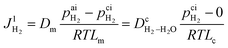 | (3) |
| |
 | (4) |
| |
 | (5) |
where  is the effective diffusivity of H2 and H2O in the cathode, and
  is the effective diffusivity of O2 and N2 in the anode. La(Lc) is the thickness of the anode (cathode). Dm and Lm are the effective diffusivity and thickness of the electrolyte. x is the ratio of O2 flux reacting with H2 at the anode/electrolyte interface to the total
  .
.
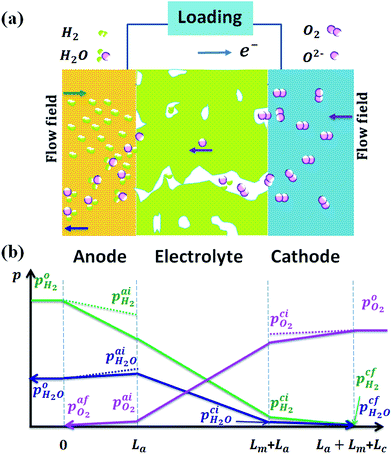 |
| | Fig. 1 Schematics of electrolyte gas leak diffusion induced concentration polarization in SOFCs. (a) A schematic shows a porous anode, a porous cathode and a crack electrolyte. A crack electrolyte not only transports O2− from the cathode to the anode, but also induces leak diffusion of H2 and H2O from the anode to the cathode and O2 from the cathode to the anode along the crack channels in the electrolyte. (b) The distribution of partial pressures of H2, H2O and O2 along the cell components. The dash lines show the case without gas leak diffusion in the electrolyte, whereas the solid lines denote the case as gas leak diffusion in the electrolyte occurs. | |
Since the gas leak diffusion fluxes and the direct reaction between H2 and O2 at the anode/electrolyte interface do not contribute to the output current of SOFCs, the correlations between the output current density and the fluxes can be presented as eqn (6)–(8) according to Fick's law,37,38
| |
 | (6) |
| |
 | (7) |
| |
 | (8) |
where
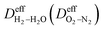
is the effective binary gas diffusivity of the anode (cathode). According to the Chapman–Enskog model,
39,40 the effective binary gas diffusivity is given as,
| |
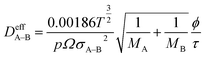 | (9) |
where A–B is either H
2–H
2O or O
2–N
2,
MA and
MB are the molecule weight of the components A and B, respectively,
p is the total pressure,
Ω is the collision integer,
σA–B is the collision diameter,
ϕ is the porosity of the porous electrode, and
τ is the tortuosity of the porous electrode. Based on the data of
Ω and
σA–B from Cussler,
39 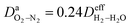
and
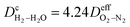
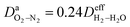
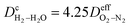
. By combing
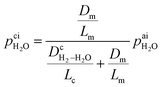
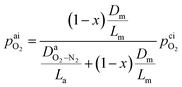
eqn (3)–(8), all parameters can be obtained to calculate the concentration polarization of SOFCs, as listed in
Table 1.
Table 1 Gas partial pressures and concentration polarizations inside SOFCsa
| Item |
No gas leak at electrolyte |
Eqn no. |
Electrolyte with gas leak diffusion |
Eqn no. |
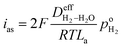
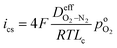
| Where ias(ics) is the anode (cathode) limiting current density (LCD). When Dm = 0, the pressure parameters and anode (cathode) concentration polarization without gas leak diffusion in the electrolyte, ηnla and ηnlc can be calculated, as shown in the 1st column of Table 1. The contribution of the electrolyte gas leak diffusion to the anode (cathode) CP, ηla(ηlc), can be obtained by eqn (30) and (31). |
| Partial pressure |
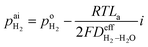 |
(10) |
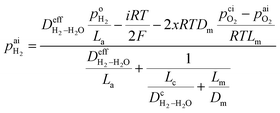 |
(11) |
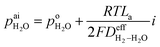 |
(12) |
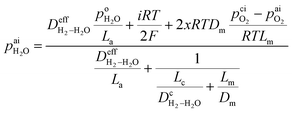 |
(13) |
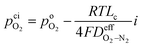 |
(14) |
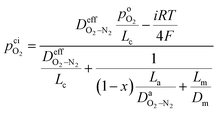 |
(15) |
 |
(16) |
 |
(17) |
 |
(18) |
 |
(19) |
 |
(20) |
 |
(21) |
| LCD |
 |
(22) |
 |
(23) |
 |
(24) |
 |
(25) |
| CP |
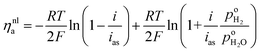 |
(26) |
 |
(27) |
 |
(28) |
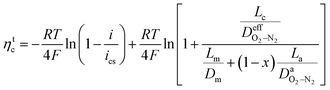 |
(29) |
In this work the parameters in the calculations are shown in Table 2.
Table 2 Parameters used in the determination of concentration polarizations of SOFCs
| Parameter |
Value (anode) |
Value (cathode) |
Value (electrolyte) |
Unit |
| The structure parameters and the effective diffusivities are adopted from ref. 40. |
| Thicknessa |
La = 0.75 |
Lc = 0.2 |
Lm = 0.01–100 × 10−3 |
mm |
| Effective diffusivitya |
 = 0.070 (800 °C), 0.060 (750 °C), 0.055 (700 °C), 0.046 (650 °C) = 0.070 (800 °C), 0.060 (750 °C), 0.055 (700 °C), 0.046 (650 °C) |
 = 0.072 (800 °C), 0.067 (750 °C), 0.062 (700 °C), 0.056 (650 °C) = 0.072 (800 °C), 0.067 (750 °C), 0.062 (700 °C), 0.056 (650 °C) |
Dm =  or or  |
cm2 s−1 |
 |
 |
| H2 partial pressure |
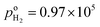 |
 |
— |
Pa |
| H2O partial pressure |
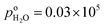 |
 |
— |
Pa |
| O2 partial pressure |
 |
 |
— |
Pa |
| N2 partial pressure |
 |
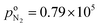 |
— |
Pa |
3. Results and discussion
When gas leak diffusion occurs in the electrolyte, the mixed H2 and O2 react directly to produce H2O due to the high working temperatures and the catalyst layer at the anode/electrolyte interface. One possibility is that the leaked H2 and O2 do not react (x = 0), and the leaked H2 and O2 can also possibly react completely (x = 1). Partial reaction between H2 and O2 occurs as 0 < x < 1.
3.1 CP of SOFCs with no reaction between leaked H2 and O2 (x = 0)
When x = 0, ias and ηta are independent of Dm and Lm, indicating that anode CP is not influenced by the electrolyte gas leak diffusion. The expressions of ias and ηta are identical to those for SOFCs with no electrolyte gas leak. Thus, the electrolyte gas leak diffusion induced anode CP, ηla, is zero. This is because the diffusion flux of H2O through the electrolyte results in a decrease of  , which is in proportional to the decrease of
  . Therefore, in the following discussion, only the cathode CP is investigated.
The effect of gas leak diffusion rate of electrolyte on cathode polarization is first investigated. The gas diffusion rate of the electrolyte is dependent on both Dm and Lm. Fig. 2a–b shows the plots of ηlc versus  and the proportion of ηlc to total cathode CP, respectively, when Lm varies from micro-scale to nano-scale with current density output fixed at 0.1 A cm−2 ηlc increases as
  increases regardless of change in Lm. At fixed
  , both ηlc and ηlc/ηtc increases as Lm decreases. Since ηnlc is independent of
  according to eqn (28), ηlc/ηtc increases with increasing
  for electrolytes with all thicknesses. Both ηlc and ηlc/ηtc reach larger plateaus when Lm is smaller. For instance, ηlc and ηlc/ηtc increase from 0 to 1.08 mV and 60%, respectively, with increasing
  from 0 to 0.1% when Lm is 100 nm. In comparison, ηlc and ηlc/ηtc increase from 0 to only 0.25 mV and 30%, respectively with increasing
  from 0 to 0.1% when Lm is 10 μm. The results indicate that that even with a small electrolyte gas leak diffusion of
  = 0.5%, more than 4 times of gas leak induced cathode CP for a 100 nm electrolyte is induced as compared to a 10 μm electrolyte. Fig. 2c–d shows the effect of electrolyte gas leak diffusion on cell polarization as SOFCs work at different current workloads. Two typical electrolyte thicknesses of 100 nm and 10 μm, are chosen, which represent frequently reported μSOFCs and conventional SOFCs (cSOFCs). According to eqn (28), (29) and (31), ηlc is independent of i. When i is zero, ηnlc is zero, and only ηlc contributes to the total concentration polarization at such open circuit circumstance. Therefore, ηlc reflects the decrease of OCV of SOFCs resulted from electrolyte gas leak diffusion. OCV for μSOFCs is typically lower than that of cSOFCs. This is a drawback of μSOFCs to be overcome. ηlc/ηtc as a function of i is studied further for both μSOFCs and cSOFCs to better understand the contribution of ηlc to the total concentration polarization. ηlc/ηtc decreases with increasing output current for both μSOFCs and cSOFCs. ηlc/ηtc of μSOFCs is larger than that of cSOFCs as the electrolyte has the same crack extent, but the difference becomes smaller with larger output currents. For instance, at i = 0.1 A cm−2 and
  = 0.1%, ηlc/ηtc is 62% and 31% for μSOFCs and cSOFCs, respectively. When i increases to 1 A cm−2, the corresponding values are ∼12% and ∼4%, respectively. The result indicates that, if the leaked H2 and O2 do not react directly, the contribution of gas leak diffusion induced cathode CP for μSOFCs is more significant than that of cSOFCs at small output currents. Nevertheless, such a contribution becomes small at larger SOFC output currents for both μSOFCs and cSOFCs.
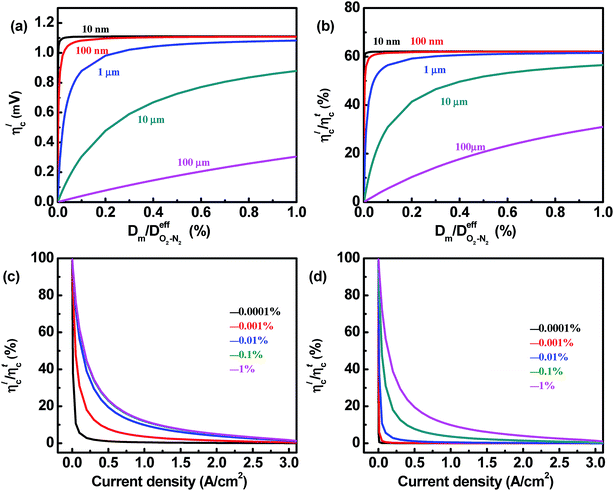 |
| | Fig. 2 (a and b) Plots of (a) ηlc, and (b) the proportion of ηlc to total cathode CP versus  . The electrolyte thickness varies from 100 nm to 100 μm. SOFCs work at a output current density of 0.1 A cm−2 and T = 700 °C. (c and d) The proportion of ηlc to the total cathode CP versus i when electrolyte thickness is (c) 100 nm and (d) 10 μm. SOFCs operate at 700 °C. It is assumed that the leaked H2 and O2 do not react (x = 0). . The electrolyte thickness varies from 100 nm to 100 μm. SOFCs work at a output current density of 0.1 A cm−2 and T = 700 °C. (c and d) The proportion of ηlc to the total cathode CP versus i when electrolyte thickness is (c) 100 nm and (d) 10 μm. SOFCs operate at 700 °C. It is assumed that the leaked H2 and O2 do not react (x = 0). | |
3.2 CP of SOFCs with reaction between leaked H2 and O2 (x = 1)
Since SOFCs typically operate at temperatures above 600 °C and the catalytic layer at electrode/electrolyte interface is active to the reaction between H2 and O2, the reaction between the mixed H2 and O2 due to electrolyte gas leak diffusion cannot be neglected in certain cases. Here, it is assumed that the leaked O2 reacted completely with H2 at anode/electrolyte interfaces. In such a case, the electrolyte gas leak diffusion induced CP is investigated. ηla is no longer zero when x is zero according to eqn (27). Fig. 3 shows the correlations between ηla(ηla/ηta) and  as well as i. As shown in Fig. 3a and b, both ηla and ηla/ηta increase with
  , and the slopes of the curves become larger when Lm decreases from 100 μm to 10 nm. For instance, at Lm = 10 μm, ηla increases from 0 to ∼16 mV and ηla/ηta from 0 to ∼25% when
  increases from 0 to 0.1%. In comparison, at Lm = 100 nm, ηla increases from 0 to >200 mV and ηla/ηta from 0 to >80% when
  increases from 0 to 0.1%. In addition, the values of electrolyte gas leak diffusion induced CP with x = 1 are much larger than those with x = 0, and such trends are more obvious as the electrolyte thickness decreases. The results indicate that the direct reaction between the leaked H2 and O2 is detrimental to SOFCs. Fig. 3c and d further shows the variation of ηla/ηta with SOFC output current density for both μSOFCs and cSOFCs, respectively. ηla/ηta decreases with increasing i firstly and then increases when i is above 1 A cm−2. This is because ηla and ηta are dependent of both i and the amount of leaked O2 according to eqn (23) and (27). At the same
  , ηla/ηta for μSOFCs is larger than that of cSOFCs. For instance, at
  = 0.01%, and i = 1 A cm−2, ηla/ηta is ∼20% for μSOFCs and only 0.3% for cSOFCs. When
  is larger than 0.1%, H2 at the anode/electrolyte interface is depleted by the leaked O2 and μSOFCs cannot work at the setting parameters. Therefore, serious anode CP by electrolyte gas leak diffusion is induced when the reaction of H2 and O2 occurs, especially for μSOFCs. Advanced techniques should be developed to fabricate μSOFCs with well controlled thickness and quality. Dense electrolyte films with dramatically decreased defects, cracks or pinholes are required as the film thickness decreases.
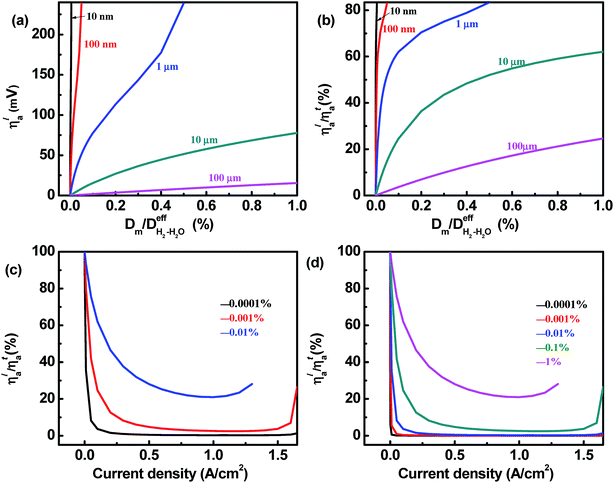 |
| | Fig. 3 (a and b) Plots of (a) ηla, and (b) the proportion of ηla to total anode CP versus  . The electrolyte thickness varies from 100 nm to 100 μm. SOFCs work at a output current density of 0.1 A cm−2 and T = 700 °C. (c and d) The proportion of ηla to the total cathode CP versus i when electrolyte thickness is (c) 100 nm and (d) 10 μm. SOFCs operate at 700 °C. It is assumed that the leaked H2 and O2 react completely (x = 1). . The electrolyte thickness varies from 100 nm to 100 μm. SOFCs work at a output current density of 0.1 A cm−2 and T = 700 °C. (c and d) The proportion of ηla to the total cathode CP versus i when electrolyte thickness is (c) 100 nm and (d) 10 μm. SOFCs operate at 700 °C. It is assumed that the leaked H2 and O2 react completely (x = 1). | |
The cathode CP induced by electrolyte gas leak diffusion is given in Fig. 4. As shown in Fig. 4a, ηlc increases with increasing  and decreasing electrolyte thickness. For instance, ηlc increases from 0 to 4 mV and 64 mV, respectively for cSOFCs and μSOFCs when
  increases from 0 to 1%. As shown in Fig. 4b, ηlc/ηtc increases from 0 to ∼35% and ∼99%, respectively, for cSOFCs and μSOFCs when
  increases from 0 to 1%. The result indicates that although ηlc is smaller than ηla under the same operation conditions, ηlc/ηtc is typically larger than ηla/ηta. Electrolyte gas leak diffusion has a larger impact on cathode CP compared to anode CP. Fig. 4c and d show the variation of ηlc/ηtc versus i for μSOFCs and cSOFCs, respectively. ηlc/ηtc decreases with increasing i for both types of SOFCs since ηlc changes little but ηnlc increases significantly when i increases. At i = 1 A cm−2, ηlc/ηtc is ∼30% for μSOFCs but is only 0.5% for cSOFCs when
  is 0.01%. When
  increases to 1%, ηlc/ηtc is ∼90% and ∼30% for μSOFCs and cSOFCs, respectively. The result illustrates that cathode CP arising from the electrolyte gas leak diffusion is dominant in the total cathode CP for μSOFCs even when the output current density is large.
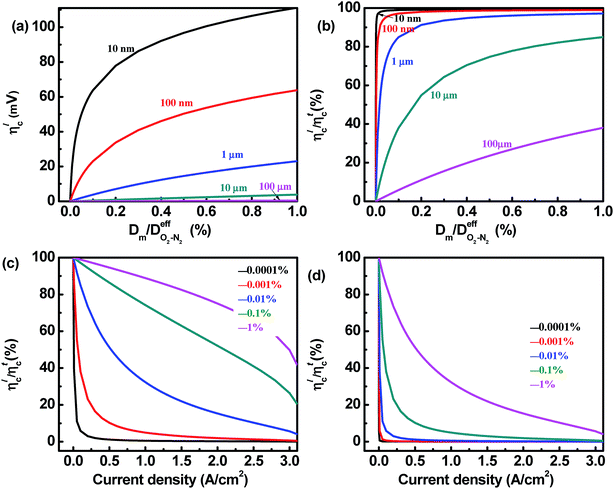 |
| | Fig. 4 (a and b) Plots of (a) ηlc, and (b) the proportion of ηlc to total CP polarization versus  . The electrolyte thickness varies from 100 nm to 100 μm. SOFCs work at a output current density of 0.1 A cm−2 and T = 700 °C. (c and d) The proportion of ηlc to the total cathode CP versus i when electrolyte thickness is (c) 100 nm and (d) 10 μm. SOFCs operate at 700 °C. It is assumed that the leaked H2 and O2 react completely (x = 1). . The electrolyte thickness varies from 100 nm to 100 μm. SOFCs work at a output current density of 0.1 A cm−2 and T = 700 °C. (c and d) The proportion of ηlc to the total cathode CP versus i when electrolyte thickness is (c) 100 nm and (d) 10 μm. SOFCs operate at 700 °C. It is assumed that the leaked H2 and O2 react completely (x = 1). | |
3.3 CP of SOFCs with partial reaction between leaked H2 and O2 (0 < x < 1)
Partial reaction between leaked H2 and O2 is also investigated when x varies between 0 and 1, as shown in Fig. 5. ηla, ηlc, ηla/ηta and ηlc/ηtc all increase with increasing x, and such trends are more obvious when the electrolyte thickness decreases. For instance, at Lm = 10 μm, ηla increases from 0 to 0.18 mV, ηla/ηta increases from 0 to ∼0.4%, ηlc holds at ∼0.004 mV, and ηlc/ηtc holds at ∼0.6% when x increases from 0 to 1. At Lm = 100 nm, ηla increases from 0 to ∼15 mV, ηla/ηta increases from 0 to ∼24%, ηlc increases from 0.3 to 0.4 mV, and ηlc/ηtc increases from 31% to 38% when x increases from 0 to 1. The result indicates that larger CPs for both anode and cathode are induced by electrolyte gas leak diffusion with increasing reaction ratio between the leaked H2 and O2, especially for anode CP of μSOFCs. Therefore, gas leak diffusion through electrolyte must be avoided for μSOFCs with catalytically active anodes and cathodes.
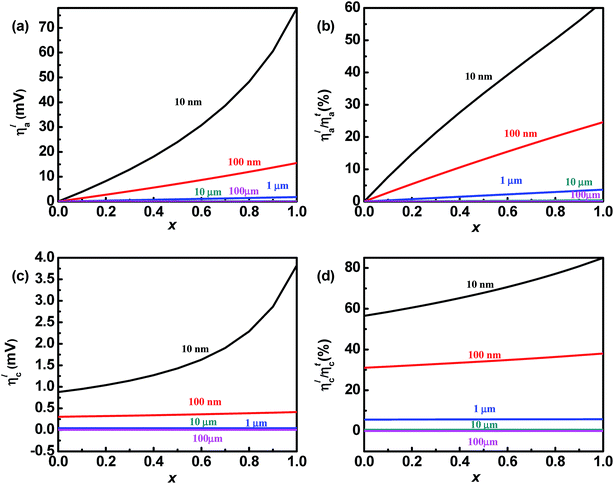 |
| | Fig. 5 Plots of electrolyte gas leak diffusion induced (a and b) anode and (c and d) cathode concentration polarization versus x. Both  and and  are kept at 0.001%. SOFCs operate at 700 °C. are kept at 0.001%. SOFCs operate at 700 °C. | |
The most promising advantage of μSOFCs is that it can reduce largely the ohmic loss when SOFCs operate at a low temperature below 500 °C.41 To evaluate the influence of the electrolyte gas leak diffusion on SOFC performance under different temperatures, the impact of operating temperature on both anode and cathode CP induced by electrolyte gas leak diffusion is also investigated, as shown in Fig. S3–S5.† ηlc and ηlc/ηtc decrease with T at x = 0, but both anode and cathode CPs induced by electrolyte gas leak diffusion vary little at x = 1. Considering that x decreases with decreasing T since the activity of catalyst at electrode/electrolyte interface decreases with lowering T, the electrolyte gas leak diffusion induced CP decreases with T, indicating that operation of μSOFCs at lower temperatures reduces the adverse impact of gas leak diffusion of the electrolyte.
Through the analysis, the key factors in designing μSOFCs are proposed, including the thickness of electrodes/electrolyte as well as the maximum tolerance of electrolyte gas leak and cell operating temperatures. It is noted that the fuel gas of H2 is used in the model. Other fuel gases such as CH4 or CO can be considered to experience similar electrolyte gas leak diffusion induced polarization. The model developed here is typically applicable to ionic electrolytes with low electronic conductivity, like YSZ. Ionic electrolytes with notable electronic conductivities, such as CeO2 and Bi2O3 based electrolytes, also suffer unignorable electronic current leakage when the electrolyte thickness falls into a nanoscale regime. The difference in the gas leak diffusivities for different types of gases is also ignored since it depends on the undefined electrolyte crack structure.
4. Conclusion
In this work, electrolyte gas leak diffusion induced polarization for both μSOFCs and cSOFCs is studied analytically. The effects of cell parameters including electrode diffusivity, electrolyte leak diffusivity, electrolyte thickness, and cell operating parameters including current density output and working temperature are discussed. Our results show that if leaked H2 and O2 do not react directly, electrolyte gas leak diffusion contributes little to anode concentration polarization due to proportional variation of H2 and H2O, but results in an increased cathode concentration polarization. Both significant anode and cathode concentration polarizations by electrolyte gas leak diffusion are induced when direct reaction between leaked H2 and O2 occurs. μSOFCs experience several orders of magnitude larger concentration polarization arising from electrolyte gas diffusion as compared with cSOFCs, suggesting that high gas-tight electrolyte sub-micro/nano films are required for μSOFCs. The electrolyte gas leak induced concentration polarization decreases with lowering cell operation temperature. In addition, other factors must be considered in the evaluation of electrode polarization in thin-film based fuel cells, including the non-trivial decrease of ohmic loss while employing sub-micro/nano-electrolyte films.
Nomenclature
 | The effective diffusivity of leaked O2 and N2 in the anode |
 | The effective diffusivity of leaked H2 and H2O in the cathode (m2 s−1) |
| DeffA–B | The effective binary diffusivity of gas species A and B (m2 s−1) |
| Dm | The effective diffusivity of gas in the electrolyte (m2 s−1) |
| F | Faraday's constant (C mol−1) |
| i | Current density (A m−2) |
| ias | Limiting current density of anode (A m−2) |
| ics | Limiting current density of cathode (A m−2) |
| JH2 | Gas flux of H2 at the anode (mol m−2 s−1) |
| JH2O | Gas flux of H2O at the anode (mol m−2 s−1) |
| JO2 | Gas flux of O2 at the cathode (mol m−2 s−1) |
 | Gas flux of H2 at the anode/electrolyte interface due to cracked electrolyte (mol m−2 s−1) |
 | Gas flux of H2O at the anode/electrolyte interface due to cracked electrolyte (mol m−2 s−1) |
 | Gas flux of O2 at the cathode/electrolyte interface due to cracked electrolyte (mol m−2 s−1) |
| La | The thickness of the anode (m) |
| Lc | The thickness of the cathode (m) |
| Lm | The thickness of the electrolyte membrane (m) |
| MA | The molecule weight of the components A (kg mol−1) |
 | The partial pressures of H2 at the anode/electrolyte interface (Pa) |
 | The partial pressures of H2O at the anode/electrolyte interface (Pa) |
 | The partial pressures of O2 at the anode/electrolyte interface (Pa) |
 | The partial pressures of O2 in the anode-side flow field (Pa) |
 | The partial pressures of N2 in the anode-side flow field (Pa) |
 | The partial pressures of H2 at the cathode/electrolyte interface (Pa) |
 | The partial pressures of H2O at the cathode/electrolyte interface (Pa) |
 | The partial pressures of O2 at the cathode/electrolyte interface (Pa) |
 | The pressures of H2 in the cathode-side flow field (Pa) |
 | The pressures of H2O in the cathode-side flow field (Pa) |
 | The partial pressures of H2 in the anode-side flow field (Pa) |
 | The partial pressures of H2O in the anode-side flow field (Pa) |
 | The partial pressures of O2 in the cathode-side flow field (Pa) |
| pt | Total pressure (Pa) |
| R | Ideal gas constant (J mol−1 K−1) |
| T | Temperature (K) |
| x | The ratio of O2 flux reacting with H2 at the anode/electrolyte interface to the total  |
Greek letters
| η | Concentration polarization (V) |
| ηla | The contribution of the electrolyte gas leak diffusion to the anode CP (V) |
| ηlc | The contribution of the electrolyte gas leak diffusion to the cathode CP (V) |
| ηnla | The anode concentration without gas leak diffusion in the electrolyte (V) |
| ηnlc | The cathode concentration without gas leak diffusion in the electrolyte (V) |
| ηta | The total concentration polarization of the anode (V) |
| ηtc | The total concentration polarization of the cathode (V) |
| σH2–H2O | Average collision diameter of H2/H2O (m) |
| ϕ | The porosity of porous electrode |
| τ | The tortuosity of porous electrode |
| Ω | The collision integral (Å) |
Superscripts & subscripts
| A | Gas species of A |
| B | Gas species of B |
| a | Anode |
| c | Cathode |
| m | Electrolyte membrane |
| t | Total |
| nl | SOFCs with no gas leak diffusion in electrolyte |
| l | SOFCs with gas leak diffusion in electrolyte |
| ai | At the interface of anode/electrolyte |
| ci | At the interface of cathode/electrolyte |
| af | In the anode-side flow field |
| cf | In the cathode-side flow field |
Acknowledgements
The work is supported by UESTC new faculty startup fund, the National Natural Science Foundation of China (grant no. 21403031 and 51501030) and the Fundamental Research Funds for the Chinese Central Universities (grant no. ZYGX2014J088 and grant no. ZYGX2015Z003).
References
- R. M. Ormerod, Chem. Soc. Rev., 2003, 32, 17–28 RSC.
- E. D. Wachsman, C. A. Marlowe and K. T. Lee, Energy Environ. Sci., 2012, 5, 5498–5509 Search PubMed.
- W. He, W. Lv and J. Dickerson, Gas transport in solid oxide fuel cells, Springer, 2014, ISBN, 978-3-319-09736-7 Search PubMed.
- T. Suzuki, H. Zahir and F. Yoshihiro, et al., Science, 2009, 325, 852–855 CrossRef CAS PubMed.
- J. Garcia-Barriocanal, A. Rivera-Calzada and M. Varela, et al., Science, 2008, 321, 676–680 CrossRef CAS PubMed.
- J. Huang, F. Xie and C. Wang, et al., Int. J. Hydrogen Energy, 2012, 37, 877–883 CrossRef CAS.
- W. He, B. Wang and J. H. Dickerson, Nano Energy, 2012, 1, 828–832 CrossRef CAS.
- Z. Shao, W. Zhou and Z. Zhu, Prog. Mater. Sci., 2012, 57, 804–874 CrossRef CAS.
- N. Mahato, A. Banerjee and A. Gupta, et al., Prog. Mater. Sci., 2015, 72, 141–337 CrossRef CAS.
- W. He, J. Zou and B. Wang, et al., J. Power Sources, 2013, 237, 64–73 CrossRef CAS.
- S. C. Singhal, Solid State Ionics, 2000, 135, 305–313 CrossRef CAS.
- E. D. Wachsman and K. T. Lee, Science, 2011, 334, 935–939 CrossRef CAS PubMed.
- B. C. H. Steele, Solid State Ionics, 1995, 75, 157–165 CrossRef CAS.
- B. C. H. Steele and A. Heinzel, Nature, 2001, 414, 345–352 CrossRef CAS PubMed.
- H. S. Noh, K. J. Yoon, B. K. Kim, H. J. Je, H. W. Lee, J. H. Lee and J. W. Son, J. Power Sources, 2014, 247, 105–111 CrossRef CAS.
- A. Evans, A. Bieberle-Hütter, J. L. M. Rupp and L. J. Gauckler, J. Power Sources, 2009, 194, 119–129 CrossRef CAS.
- D. Beckel, A. Bieberle-Hütter, A. Harvey, A. Infortuna, U. P. Muecke, M. Prestat, J. L. M. Rupp and L. J. Gauckler, J. Power Sources, 2007, 173, 325–345 CrossRef CAS.
- S. J. Litzelman, J. L. Hertz, W. Jung and H. L. Tuller, Fuel Cells, 2008, 8, 294–302 CrossRef CAS.
- H. Huang, M. Nakamura and P. Su, et al., J. Electrochem. Soc., 2007, 154, B20–B24 CrossRef CAS.
- K. Kerman, B. K. Lai and S. Ramanathan, Adv. Energy Mater., 2012, 2, 656–661 CrossRef CAS.
- C. C. Chao, C. M. Hsu and Y. Cui, et al., ACS Nano, 2011, 5, 5692–5696 CrossRef CAS PubMed.
- J. H. Shim, C. C. Chao and H. Huang, et al., Chem. Mater., 2007, 19, 3850–3854 CrossRef CAS.
- S. Ji, G. Y. Cho and W. Yu, et al., ACS Appl. Mater. Interfaces, 2015, 7, 2998–3002 Search PubMed.
- A. Evans, J. Martynczuk and D. Stender, et al., Adv. Energy Mater., 2015, 5, 1400747, DOI:10.1002/aenm.201400747.
- C. W. Kwon, J. W. Son and J. H. Lee, et al., Adv. Funct. Mater., 2011, 21, 1154–1159 CrossRef CAS.
- U. P. Muecke, D. Beckel and A. Bernard, et al., Adv. Funct. Mater., 2008, 18, 3158–3168 CrossRef CAS.
- S. Rey-Mermet and P. Muralt, Solid State Ionics, 2008, 179, 1497–1500 CrossRef CAS.
- J. C. Kim, D. Y. Lee and H. R. Kim, et al., Thin Solid Films, 2011, 519, 2534–2539 CrossRef CAS.
- C. H. Lo, C. H. Tsai and C. Hwang, Int. J. Appl. Ceram. Technol., 2009, 6, 513–524 CrossRef CAS.
- J. M. Ralph, A. C. Schoeler and M. Krumpelt, J. Mater. Sci., 2001, 36, 1161–1172 CrossRef CAS.
- K. Kerman, B. K. Lai and S. Ramanathan, J. Power Sources, 2011, 196, 2608–2614 CrossRef CAS.
- C. W. Kwon, J. I. Lee, K. B. Kim, H. W. Lee, J. H. Lee and J. W. Son, J. Power Sources, 2012, 210, 178–183 CrossRef CAS.
- H. S. Noh, K. J. Yoon, B. K. Kim, H. J. Je, H. W. Lee, J. H. Lee and J. W. Son, J. Power Sources, 2014, 249, 125–130 CrossRef CAS.
- A. C. Johnson, A. Baclig and D. V. Harburg, et al., J. Power Sources, 2010, 195, 1149–1155 CrossRef CAS.
- M. Tsuchiya, B. K. Lai and S. Ramanathan, Nat. Nanotechnol., 2011, 6, 282–286 CrossRef CAS PubMed.
- C. Ko, K. Kerman and S. Ramanathan, J. Power Sources, 2012, 213, 343–349 CrossRef CAS.
- W. He, B. Wang and A. Multisensor, Adv. Energy Mater., 2012, 2, 329–333 CrossRef CAS.
- W. Lv, N. Feng and W. Huo, et al., ChemElectroChem, 2015, 2(6), 819–823 CrossRef CAS.
- E. L. Cussler, Diffusion: mass transfer in fluid systems, Cambridge University Press, Third edn, 2009 Search PubMed.
- F. Zhao, T. J. Armstrong and A. V. Virkar, J. Electrochem. Soc., 2003, 150, A249–A256 CrossRef CAS.
- Z. Gao, L. V. Mogni and E. C. Miller, et al., Energy Environ. Sci., 2016, 9(5), 1602–1644 Search PubMed.
Footnotes |
| † Electronic supplementary information (ESI) available. See DOI: 10.1039/c6ra10071f |
| ‡ These authors contributed equally to this work. |
|
| This journal is © The Royal Society of Chemistry 2016 |
Click here to see how this site uses Cookies. View our privacy policy here. 

 and
and  are the partial pressures of the gas H2(H2O) in the anode-side flow field and at the anode/electrolyte interface, respectively.
  and
and  are the partial pressures of O2 in the cathode-side flow field and at the cathode/electrolyte interface, respectively.
  ,
,  and
and  are the partial pressures of H2, H2O and O2, which are induced by electrolyte gas leak diffusion.
  and
and  represent the partial pressures of H2(H2O) and O2 in the cathode-side and anode-side flow fields, respectively. The dash lines show the distributions of the partial pressures of H2, H2O and O2 with no leak diffusion in the electrolyte, whereas the solid lines correspond to the gas leak diffusion scenario.
  ,
,  , and
, and  decrease when leak diffusion through the electrolyte occurs. As a consequence, the gas leak diffusion induces concentration polarization according to the Nernst equation. The anode and cathode concentration polarization can be written as eqn (1) and (2), respectively,

 ,
,  and
and  as determined by the composition of the supplied fuel/air gases,
  ,
,  and
and  must be calculated based on the gas diffusion in both porous electrodes and cracked electrolyte. As shown in Fig. 1, at a steady state, gas flux
  at the anode (cathode) is required, while gas leak diffusion flux
  occurs at the anode (cathode)/electrolyte interface due to the cracked electrolyte. The pressures of H2 and H2O in the cathode-side flow field (
 and
and  ) are assumed to be zero since the leaked H2 and H2O can be taken away by the O2–N2 flow. Likewise, the pressures of O2 and N2 in the anode-side flow field (
 and
and  ) are also assumed to be zero since the leaked O2 and N2 can be taken away by the H2–H2O flow. By assuming that the leaked O2 only reacts with H2 at the anode/electrolyte interface where a catalytic layer exists, the following equations can be obtained according to the mass conservation law,


 is the effective diffusivity of H2 and H2O in the cathode, and
  is the effective diffusivity of O2 and N2 in the anode. La(Lc) is the thickness of the anode (cathode). Dm and Lm are the effective diffusivity and thickness of the electrolyte. x is the ratio of O2 flux reacting with H2 at the anode/electrolyte interface to the total
  .
.


 is the effective binary gas diffusivity of the anode (cathode). According to the Chapman–Enskog model,39,40 the effective binary gas diffusivity is given as,
 and
and  . By combing eqn (3)–(8), all parameters can be obtained to calculate the concentration polarization of SOFCs, as listed in Table 1.





 = 0.070 (800 °C), 0.060 (750 °C), 0.055 (700 °C), 0.046 (650 °C)
 = 0.072 (800 °C), 0.067 (750 °C), 0.062 (700 °C), 0.056 (650 °C)
 or
or 


 , which is in proportional to the decrease of
  . Therefore, in the following discussion, only the cathode CP is investigated.
 and the proportion of ηlc to total cathode CP, respectively, when Lm varies from micro-scale to nano-scale with current density output fixed at 0.1 A cm−2 ηlc increases as
  increases regardless of change in Lm. At fixed
  , both ηlc and ηlc/ηtc increases as Lm decreases. Since ηnlc is independent of
  according to eqn (28), ηlc/ηtc increases with increasing
  for electrolytes with all thicknesses. Both ηlc and ηlc/ηtc reach larger plateaus when Lm is smaller. For instance, ηlc and ηlc/ηtc increase from 0 to 1.08 mV and 60%, respectively, with increasing
  from 0 to 0.1% when Lm is 100 nm. In comparison, ηlc and ηlc/ηtc increase from 0 to only 0.25 mV and 30%, respectively with increasing
  from 0 to 0.1% when Lm is 10 μm. The results indicate that that even with a small electrolyte gas leak diffusion of
  = 0.5%, more than 4 times of gas leak induced cathode CP for a 100 nm electrolyte is induced as compared to a 10 μm electrolyte. Fig. 2c–d shows the effect of electrolyte gas leak diffusion on cell polarization as SOFCs work at different current workloads. Two typical electrolyte thicknesses of 100 nm and 10 μm, are chosen, which represent frequently reported μSOFCs and conventional SOFCs (cSOFCs). According to eqn (28), (29) and (31), ηlc is independent of i. When i is zero, ηnlc is zero, and only ηlc contributes to the total concentration polarization at such open circuit circumstance. Therefore, ηlc reflects the decrease of OCV of SOFCs resulted from electrolyte gas leak diffusion. OCV for μSOFCs is typically lower than that of cSOFCs. This is a drawback of μSOFCs to be overcome. ηlc/ηtc as a function of i is studied further for both μSOFCs and cSOFCs to better understand the contribution of ηlc to the total concentration polarization. ηlc/ηtc decreases with increasing output current for both μSOFCs and cSOFCs. ηlc/ηtc of μSOFCs is larger than that of cSOFCs as the electrolyte has the same crack extent, but the difference becomes smaller with larger output currents. For instance, at i = 0.1 A cm−2 and
  = 0.1%, ηlc/ηtc is 62% and 31% for μSOFCs and cSOFCs, respectively. When i increases to 1 A cm−2, the corresponding values are ∼12% and ∼4%, respectively. The result indicates that, if the leaked H2 and O2 do not react directly, the contribution of gas leak diffusion induced cathode CP for μSOFCs is more significant than that of cSOFCs at small output currents. Nevertheless, such a contribution becomes small at larger SOFC output currents for both μSOFCs and cSOFCs.
 . The electrolyte thickness varies from 100 nm to 100 μm. SOFCs work at a output current density of 0.1 A cm−2 and T = 700 °C. (c and d) The proportion of ηlc to the total cathode CP versus i when electrolyte thickness is (c) 100 nm and (d) 10 μm. SOFCs operate at 700 °C. It is assumed that the leaked H2 and O2 do not react (x = 0).
 as well as i. As shown in Fig. 3a and b, both ηla and ηla/ηta increase with
  , and the slopes of the curves become larger when Lm decreases from 100 μm to 10 nm. For instance, at Lm = 10 μm, ηla increases from 0 to ∼16 mV and ηla/ηta from 0 to ∼25% when
  increases from 0 to 0.1%. In comparison, at Lm = 100 nm, ηla increases from 0 to >200 mV and ηla/ηta from 0 to >80% when
  increases from 0 to 0.1%. In addition, the values of electrolyte gas leak diffusion induced CP with x = 1 are much larger than those with x = 0, and such trends are more obvious as the electrolyte thickness decreases. The results indicate that the direct reaction between the leaked H2 and O2 is detrimental to SOFCs. Fig. 3c and d further shows the variation of ηla/ηta with SOFC output current density for both μSOFCs and cSOFCs, respectively. ηla/ηta decreases with increasing i firstly and then increases when i is above 1 A cm−2. This is because ηla and ηta are dependent of both i and the amount of leaked O2 according to eqn (23) and (27). At the same
  , ηla/ηta for μSOFCs is larger than that of cSOFCs. For instance, at
  = 0.01%, and i = 1 A cm−2, ηla/ηta is ∼20% for μSOFCs and only 0.3% for cSOFCs. When
  is larger than 0.1%, H2 at the anode/electrolyte interface is depleted by the leaked O2 and μSOFCs cannot work at the setting parameters. Therefore, serious anode CP by electrolyte gas leak diffusion is induced when the reaction of H2 and O2 occurs, especially for μSOFCs. Advanced techniques should be developed to fabricate μSOFCs with well controlled thickness and quality. Dense electrolyte films with dramatically decreased defects, cracks or pinholes are required as the film thickness decreases.

 . The electrolyte thickness varies from 100 nm to 100 μm. SOFCs work at a output current density of 0.1 A cm−2 and T = 700 °C. (c and d) The proportion of ηla to the total cathode CP versus i when electrolyte thickness is (c) 100 nm and (d) 10 μm. SOFCs operate at 700 °C. It is assumed that the leaked H2 and O2 react completely (x = 1).
 and decreasing electrolyte thickness. For instance, ηlc increases from 0 to 4 mV and 64 mV, respectively for cSOFCs and μSOFCs when
  increases from 0 to 1%. As shown in Fig. 4b, ηlc/ηtc increases from 0 to ∼35% and ∼99%, respectively, for cSOFCs and μSOFCs when
  increases from 0 to 1%. The result indicates that although ηlc is smaller than ηla under the same operation conditions, ηlc/ηtc is typically larger than ηla/ηta. Electrolyte gas leak diffusion has a larger impact on cathode CP compared to anode CP. Fig. 4c and d show the variation of ηlc/ηtc versus i for μSOFCs and cSOFCs, respectively. ηlc/ηtc decreases with increasing i for both types of SOFCs since ηlc changes little but ηnlc increases significantly when i increases. At i = 1 A cm−2, ηlc/ηtc is ∼30% for μSOFCs but is only 0.5% for cSOFCs when
  is 0.01%. When
  increases to 1%, ηlc/ηtc is ∼90% and ∼30% for μSOFCs and cSOFCs, respectively. The result illustrates that cathode CP arising from the electrolyte gas leak diffusion is dominant in the total cathode CP for μSOFCs even when the output current density is large.
 . The electrolyte thickness varies from 100 nm to 100 μm. SOFCs work at a output current density of 0.1 A cm−2 and T = 700 °C. (c and d) The proportion of ηlc to the total cathode CP versus i when electrolyte thickness is (c) 100 nm and (d) 10 μm. SOFCs operate at 700 °C. It is assumed that the leaked H2 and O2 react completely (x = 1).
 and
and  are kept at 0.001%. SOFCs operate at 700 °C.


