Mengyujie Liu,
Chunhua Lu and
Yuemao Shen*
Key Laboratory of Chemical Biology (Ministry of Education), School of Pharmaceutical Sciences, Shandong University, No. 44 West Wenhua Road, Jinan, Shandong 250012, P. R. China. E-mail: yshen@sdu.edu.cn; Tel: +86-531-88382108
First published on 16th May 2016
Meridamycin and its naturally occurring analog normeridamycin are non-immunosuppressive macrocyclic polyketides with potent neuroprotective activity in dopaminergic neurons. Although the biosynthetic gene cluster of meridamycin has been cloned and therefore generated the analogue, C36-keto-meridamycin, the diversity of this type of unique macrolide is still undiscovered. In this paper, four meridamycin congeners, namely meridamycin A (2), meridamycin B (3), meridamycin C (4) and meridamycin D (5), together with meridamycin (1), were isolated from the agar fermentation of the strain Streptomyces sp. SR107. The structures of these compounds were elucidated on the basis of 1D-, 2D-NMR, and HRESIMS data analysis. The antibacterial activities of compounds 1–5 were also evaluated.
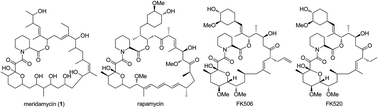
3–5 and FK520.6–8 However, it differs from rapamycin, FK506 and FK520 due to the absence of the substituted cyclohexane ring characteristic to these macrolides (Fig. 1). Meridamycin competitively inhibits the binding of FK506 and rapamycin to FK506-binding protein-12 (FKBP-12), IC50 1.0 ng mL−1. Nevertheless, it is a non-immunosuppressant FKBP-binding macrocyclic polyketide and can antagonize the immunosuppressive activity of both FK506 and rapamycin. Consequently, meridamycin has a potential use as antidote in the treatment of overdoses of immunosuppressants rapamycin and FK506, and also can be used as a neuroprotectant in a range of neurodegenerative disorders including dementia, Parkinson's disease and ischaemic stroke.9 However, only two meridamycin analogues, including 3-normeridamycin10 and C36-keto-meridamycin,11 have been reported till now. In our continuous searching for new secondary metabolites from Streptomyces sp. LZ35, a series of compounds have been identified.12–16 In the present study, meridamycin (1) and four new congeners, namely meridamycin A (2), meridamycin B (3), meridamycin C (4) and meridamycin D (5) (Fig. 2), were isolated and identified from the agar fermentation extract of the mutant strain SR107 of Streptomyces sp. LZ35.12 The antibacterial activities of compounds 1–5 were also evaluated.
Meridamycin (1) was obtained as a light yellow oil. Its molecular formula was determined to be C45H75NO12 on the basis of HRESIMS (m/z 822.5361 for [M + H]+, calcd. 822.5362, 844.5190 for [M + Na]+, calcd. 822.5181, C45H75NO12Na+) and NMR data (ESI Table S1†). The 1H, 13C NMR and HSQC spectra revealed 45 signals, corresponding to nine CH3, twelve CH2, seventeen CH and seven quaternary C-atoms. The NMR comparison with that of literature readily revealed that compound 1 was identical to meridamycin.1
Meridamycin A (2) has a molecular formula of C45H77NO13 with 18 amu more than that of meridamycin (1). A close NMR comparison (Table 1) with that of 1 revealed that the only evident difference was the upfield shift of H-6 from δ 5.38 in 1 to δ 3.99 in 2. The HMBC showed no 1H–13C long-range correlations from H-6 to C-36, which indicates a structure of seco-meridamycin (Fig. 2).
| Pos. | 2 | 3 | 4 | 5 | ||||
|---|---|---|---|---|---|---|---|---|
| 1H | 13C | 1H | 13C | 1H | 13C | 1H | 13C | |
| 1 | 1.15 d (6.1) | 21.1 (q) | 1.15 d (6.3) | 21.1 (q) | 1.15 d (6.3) | 21.2 (q) | 1.15 d (6.4) | 21.2 (q) |
| 2 | 3.52 d (6.5) | 72.9 (d) | 3.54 f (6.4, 13.0) | 72.9 (d) | 3.51 m | 72.9 (d) | 3.53 f (6.4, 13.0) | 72.9 (d) |
| 3 | 2.41 m | 41.0 (d) | 2.42 m | 41.0 (d) | 2.43 m | 41.0 (d) | 2.43 m | 41.0 (d) |
| 3a | 0.99 d (6.4) | 17.4 (q) | 0.99 d (6.7) | 17.4 (q) | 0.99 d (6.7) | 17.4 (q) | 0.99 d (6.7) | 17.4 (q) |
| 4 | 5.24 d (10.5) | 131.0 (d) | 5.25 d (9.8) | 130.9 (d) | 5.25 m | 130.9 (d) | 5.25 d (9.8) | 130.9 (d) |
| 5 | 137.9 (s) | 137.9 (s) | 137.9 (s) | 137.9 (s) | ||||
| 5a | 1.651 s | 11.9 (s) | 1.66 s | 12.0 (q) | 1.653 s | 11.9 (q) | 1.653 s | 12.0 (q) |
| 6 | 3.99 t (6.9) | 79.0 (d) | 3.99 t (7.0) | 79.0 (d) | 4.00 t (6.7) | 79.0 (d) | 3.99 t (7.1) | 79.0 (d) |
| 7 | 2.31 m | 34.0 (t) | 2.30 m | 34.1 (t) | 2.34 m | 34.1 (t) | 2.31 m | 34.1 (t) |
| 2.36 m | 2.37 m | 2.36 m | ||||||
| 8 | 5.27 d (6.6) | 123.9 (d) | 5.28 t (7.0) | 123.9 (d) | 5.29 m | 123.8 (d) | 5.28 t (7.0) | 123.8 (d) |
| 9 | 145.0 (s) | 145.0 (s) | 145.1 (s) | 145.0 (s) | ||||
| 9a | 2.07 m | 21.8 (t) | 2.08 m | 21.8 (t) | 2.06 m | 21.8 (t) | 2.10 m | 21.9 (t) |
| 9b | 1.06 t (7.1) | 14.8 (q) | 1.06 t (7.6) | 14.8 (q) | 1.06 t (7.5) | 14.8 (q) | 1.06 t (7.6) | 14.8 (q) |
| 10 | 3.68 d (6.4) | 82.3 (d) | 3.69 d (6.6) | 82.2 (d) | 3.69 m | 82.3 (d) | 3.68 d (6.0) | 82.3 (d) |
| 11 | 2.12 m | 35.2 (d) | 1.61 m | 35.2 (d) | 1.59 m | 35.3 (d) | 1.61 m | 35.3 (d) |
| 11a | 0.88 d (6.5) | 15.4 (q) | 0.88 d (6.5) | 15.4 (q) | 0.89 m | 15.4 (q) | 0.88 d (6.5) | 15.4 (q) |
| 12 | 1.25 m | 43.3 (t) | 1.10 m | 43.2 (t) | 1.09 m | 43.3 (t) | 1.09 m | 43.3 (t) |
| 1.48 m | 1.27 m | 1.25 m | 1.27 m | |||||
| 13 | 2.54 m | 30.8 (d) | 2.56 m | 30.8 (d) | 2.56 m | 30.8 (d) | 2.56 m | 30.8 (d) |
| 13a | 0.92 d (6.5) | 22.4 (q) | 0.92 d (6.2) | 22.4 (q) | 0.93 m | 22.4 (q) | 0.92 d (6.8) | 22.4 (q) |
| 14 | 5.12 d (10.1) | 132.3 (d) | 5.13 d (10.2) | 132.3 (d) | 5.13 d (7.5) | 132.3 (d) | 5.13 d (9.7) | 132.3 (d) |
| 15 | 137.9 (s) | 137.9 (s) | 137.9 (s) | 137.9 (s) | ||||
| 15a | 1.650 s | 12.6 (q) | 1.65 s | 12.5 (q) | 1.650 s | 12.6 (q) | 1.651 s | 12.6 (q) |
| 16 | 4.16 m | 74.5 (d) | 4.18 m | 74.4 (d) | 4.18 m | 74.4 (d) | 4.18 m | 74.4 (d) |
| 17 | 1.55 m | 44.0 (t) | 1.78 m | 42.4 (t) | 1.64 m | 44.3 (t) | 1.53 m | 44.3 (t) |
| 1.65 m | ||||||||
| 18 | 3.91 br s | 68.6 (d) | 3.92 m | 68.8 (d) | 3.83 m | 69.1 (d) | 3.82 m | 69.1 (d) |
| 19 | 1.62 m | 44.3 (t) | 1.61 m | 44.4 (t) | 1.57 m | 42.7 (t) | 1.47 m | 42.6 (t) |
| 1.66 m | 1.64 m | |||||||
| 20 | 4.18 m | 71.7 (d) | 4.24 m | 71.8 (d) | 4.17 m | 71.3 (d) | 4.17 m | 71.5 (d) |
| 21 | 2.15 m | 36.2 (d) | 1.58 m | 44.3 (d) | 1.55 m | 44.3 (d) | 1.69 m | 44.2 (d) |
| 21a | 0.89 m | 11.2 (q) | 0.88 d (6.5) | 11.0 (q) | 0.91 m | 10.8 (q) | 0.91 d (7.1) | 10.8 (q) |
| 22 | 3.82 t (8.6) | 71.3 (d) | 3.83 m | 71.1 (d) | 3.86 m | 71.8 (d) | 3.85 m | 71.9 (d) |
| 23 | 1.80 m | 42.5 (t) | 3.35 m | 46.1 (t) | 1.69 m | 42.5 (t) | 1.55 m | 43.1 (t) |
| 3.58 br d (3.4) | 1.85 m | |||||||
| 24 | 4.13 m | 68.0 (d) | 4.15 m | 67.8 (d) | 3.93 m | 68.7 (d) | 3.94 m | 68.4 (d) |
| 25 | 1.42 m | 33.1 (t) | 1.44 m | 33.2 (t) | 1.48 m | 36.8 (t) | 1.43 m | 36.7 (t) |
| 1.61 m | 1.62 m | |||||||
| 26 | 1.62 m | 28.3 (t) | 1.76 m | 28.2 (t) | 1.81 m | 31.3 (t) | 1.78 m | 31.2 (t) |
| 1.70 m | ||||||||
| 27 | 1.61 m | 36.4 (d) | 2.23 m | 36.2 (d) | 2.51 m | 37.2 (d) | 37.2 (d) | 40.6 (d) |
| 27a | 0.85 t (7.4) | 16.2 (q) | 0.84 t (6.5) | 15.9 (q) | 1.27 m | 17.7 (q) | 1.16 d (7.1) | 17.6 (q) |
| 28 | 100.9 (s) | 100.8 (s) | 180.8 (s) | 178.9 (s) | ||||
| 28-OMe | 3.66 br s | 52.1 (q) | ||||||
| 29 | 200.3 (s) | 200.1 (s) | ||||||
| 30 | 168.8 (s) | 169.4 (s) | ||||||
| 31 | 4.26 m | 40.1 (t) | 1.49 m | 42.5 (t) | ||||
| 4.37 d (12.0) | ||||||||
| 32 | 1.48 m | 26.1 (t) | 1.67 m | 26.0 (t) | ||||
| 1.69 m | ||||||||
| 33 | 1.44 m | 25.7 (t) | 1.77 m | 22.3 (t) | ||||
| 1.77 m | ||||||||
| 34 | 1.70 m | 27.7 (t) | 2.26 m | 27.6 (t) | ||||
| 2.29 m | ||||||||
| 35 | 3.58 d (13.4) | 46.1 (d) | 5.14 m | 52.8 (d) | ||||
| 36 | 169.3 (s) | 171.8 (s) | ||||||
| 36a-OMe | 3.77 m | 53.0 (q) | ||||||
Meridamycin B (3) has the molecular formula of C46H79NO13 with 14 amu more than that of 2. The 1H, 13C NMR spectra were similar to that of 2, except for an additional signal at δ 3.77 (s, MeO–)] attributed to a Me ester, as confirmed by the comparison of 1H and 13C NMR spectra with that of 2, and corroborated by the HMBC correlations between H-36a (δ 3.33) and C-36 (δ 171.8). Thus, the structure of 3 was determined to be 36-methyl-seco-meridamycin (Fig. 2).
Meridamycin C (4) was determined to have the molecular formula C37H68O10 based on its HRESIMS and NMR data. The 1H, 13C NMR and HSQC spectra revealed 37 signals, corresponding to nine CH3, eight CH2, sixteen CH (eight being oxygenated) and four quaternary C-atoms. The direct connectivity between protons and carbons were established by HSQC experiments (Table 1). Further NMR study on 1H–1H COSY and HMBC correlations (ESI Table S4 and Fig. S3.†) revealed that 4 was partially identical to 1 (from C-1 to C-28). Moreover, we found that the chemical shift of C-28 was downfield shifted (δ 180.8 in 4 and 101.1 in 1) and the chemical shift of C-24 was upfield shifted (δ 68.7, 3.93 in 4; and δ 72.8, 4.88 in 1), which confirmed the breakage between C-24 and C-28.
Meridamycin D (5) has the molecular formula of C38H70O10 with 14 amu more than that of 4. The 1H, 13C NMR spectra were similar to that of 4, except for an additional signal at δ 3.66 (s, MeO–)] attributed to a Me ester, which was further corroborated by the HMBC between H-28a (δ 3.33) and C-28 (δ 178.9). Thus, the structure of 5 was determined to be 28-methyl meridamycin C (Fig. 1).
The absolute stereochemistry of meridamycin has been reported. It is biosynthetically logical to assume the identical configurations for 2–5, while experiments are underway to obtain crystalline samples of 3 and 5 for X-ray diffraction analysis.
The seco-meridamycin derivatives 2–5 showed no inhibitory activity against tested microbes, whereas 1 exhibited appropriate activity against Bacillus subtilis 86315 with the inhibitory zone of 16 mm at 20 μg per disc.
Polyketide macrolides constitute a large family of bioactive natural products and include many compounds with important clinical applications in medicine. Meridamycin and normeridamycin are non-immunosuppressive macrocyclic polyketides with potent neuroprotective activity in dopaminergic neurons.10 The biosynthetic gene cluster of meridamycin (1) has been cloned from Streptomyces sp. NRRL 30748 and Streptomyces sp. DSM 4137 and is located on several overlapping cosmids.9,11 The discovery of the meridamycin congeners is important from a biosynthetic point of view because their structures grant valuable insights into the assembly of this diverse family. Meridamycins C (4) and D (5) from SR107 strain were obtained as the main components because the chain propagation in PKS module 13 stalled and led to an accumulation of the tetradecyketides, which represented pathway intermediates that were prematurely released from the modular assembly line. Although, it has been 20 years since the discovery of meridamycin,1,2 only three analogues were identified.10,11
:
15
:
5 v/v/v) to obtain the extract. Then the extract was partitioned between H2O and EtOAc until the EtOAc layer was colorless. Then, the EtOAc solution was dried over Na2SO4, and the solvent was removed under vacuum at 38 °C. The EtOAc extract was partitioned with petroleum ether (PE) and 95% aqueous MeOH until the PE layer was colorless. The MeOH solution was concentrated under vacuum at 38 °C to obtain MeOH extract. The MeOH extract (40 g) was subjected to column chromatography over Sephadex LH-20 (120 g) eluted with MeOH to obtain 5 fractions (Fr. 1–5).
Fr. 2 (15 g) was chromatographed over Sephadex LH-20 (120 g) eluted with MeOH to obtain 3 fractions, Fr. 2a–2c. Fr. 2b (7.2 g) was subjected to CC over Sephadex LH-20 (120 g) eluted with MeOH to obtain 4 fractions, Fr. 2b1–2b4. Fr. 2b3 (3.4 g) was further subjected to MPLC over RP-18 silica gel (80 g), and 14 subfractions with 200 mL for each gradient were obtained from the elution with 30%, 50%, 55%, 60%, 70% and 100% MeOH, respectively. In accordance with TLC results, 5 fractions was obtained, Fr. 2b3a–2b3e. Fr. 2b3c (995.6 mg) was chromatographed over Sephadex LH-20 (60 g) eluted with acetone to obtain 4 fractions, Fr. 2b3c1–2b3c4. Fr. 2b3c2 (343.8 mg) was further purified by CC over silica gel (4 g) eluted with gradient CH2Cl2–MeOH (75
:
1, 60
:
1, 50
:
1, 40
:
1) to yield 1 (34 mg). Fr. 2b3c3 (120.5 mg) was further purified by CC over silica gel (2.5 g) eluted with gradient CH2Cl2–MeOH (50
:
1, 40
:
1, 30
:
1, 25
:
1, 20
:
1, 8
:
1) to yield 4 (1.4 mg), 5 (2.8 mg) and 2 (8.5 mg). Fr. 2 b3d (728.6 mg) was chromatographed over Sephadex LH-20 (60 g) eluted with acetone to obtain 3 fractions, Fr. 2b3d1–2b3d3. Fr. 2b3d2 (91.2 mg) was further purified by CC over silica gel (2 g) eluted with gradient petroleum ether–acetone (20
:
1, 10
:
1, 5
:
1, 4.5
:
1, 4
:
1, 3
:
1) to yield 3 (14.8 mg).
Footnote |
| † Electronic supplementary information (ESI) available: Spectroscopic data and other relevant information for compounds 1–5. See DOI: 10.1039/c6ra09772c |
| This journal is © The Royal Society of Chemistry 2016 |