
Mengnan Qu*,
Jia Liu and
Jinmei He
College of Chemistry and Chemical Engineering, Xi'an University of Science and Technology, Xi'an 710054, China. E-mail: mnanqu@gmail.com
First published on 16th June 2016
Here, we report a type of copper-based zinc oxide nanopencil array film with high-efficiency dropwise condensation heat transfer (DCHT) performance, which can be obtained by wet-chemistry crystal growth and silane modification. Compared with a hydrophobic flat Cu surface, the nanostructure exhibits a condensate microdrop self-propelling function and maximal ∼140% enhancement in DCHT coefficient.
It is known that zinc oxide (ZnO) is a type of thermally stable materials. Here, we report a type of Cu-based ZnO nanopencil array films with high-efficiency DCHT performance, which can be obtained by diffusion-limited wet-chemistry crystal growth and fluorosilane modification. Compared with the hydrophobic flat Cu surface, the nanostructured surface exhibits the CMDSP function and ∼140% enhancement in DCHT coefficient. To our knowledge, this is the first report of utilizing ZnO nanostructures to enhance the DCHT efficiency of metal surface, which helps develop advanced heat and mass transfer nanomaterials and devices.
Firstly, ZnO aligned nanopencil structure is in situ grown on copper surfaces. To remove surface contaminants, a cylindrical copper block (99.9%) was mechanically polished and ultrasonic rinsed in acetone, ethanol and deionized water for 5 minutes, respectively. After drying with nitrogen, the sample was placed upside down to ensure that only its top surface was immersed in a 60 °C aqueous solution of 0.25 M Zn(NO3)2·6H2O and 2 M NaOH.27 The reaction lasts 120 min. After cleaning by pure water and dying by nitrogen air flow, the Cu block with in situ grown nanostructure was placed, together with a cup containing 10 μL heptadecafluorodecyltrimethoxysilane, in a glass container, which was sealed with a cap and then heated at 120 °C for 2 h. Note that the flat Cu block without surface nanostructure was used here as the contrast after the same silane modification.
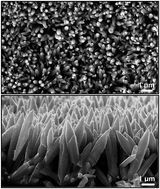
Evidently, the tip-like morphologies of nanopencils can be realized by synergetic control of the thermodynamic and kinetic conditions of crystal growth in the diffusion-limited strong alkaline reaction system.27 Note that this nanosynthesis method is very simple, without requiring trivial seed-coating and high-temperature annealing steps. Fig. 1 shows the typical scanning electronic microscopic (SEM) top-view and side-view of the as-prepared nanopencils, which are taken under the scanning electronic microscope (FEI Quanta 250 FEG, USA) at 20 kV after sputtering a layer of thin Au film with thickness of about 15 nm. These tip-like nanopencils are arranged in a nearly-vertical way with average tip diameters of ∼60 nm, interspaces of ∼880 nm and heights of ∼5.2 μm, respectively. X-ray diffraction analysis indicates that these nanopencils are made of wurtzite-structured ZnO (ESI, Fig. S1†). All diffraction peaks marked with a star can be indexed to the hexagonal phase of ZnO with lattice constants a = 0.3249 nm and c = 0.5206 nm (JCPDS card no. 36-1451). Note that peaks marked with a rhombus are from Cu substrate.
![]() | ||
| Fig. 1 SEM top-view (top) and side-view (down) images of ZnO nanopencils in situ grown on the copper surface. | ||
After low-surface-energy chemistry modification, the in situ grown nanopencil films show ideal superhydrophobic nature. Fig. 2a shows sequential optical images that a falling water droplet (4 μL) can instantly roll away from the nanosample surface without apparent lateral stickiness. Based on the usual contacting–compressing–releasing test as shown in Fig. 2b, we can easily know that the nanosample surface is fully non-sticky to the suspended water droplet (3 μL), which normal adhesive force may be negligible. Remarkably, the measured adhesive force between the water droplet and the nanosample surface is still zero (Fig. 2c) even after being severely squeezed. Such a perfect superhydrophobicity may be ascribed to the extremely low solid–liquid contact area between the aligned nanopencils and the probed droplet.28 Note that the adhesive force curves shown in Fig. 2c was measured by a micro-electromechanical balance (DataPhysics DCAT 21, Germany) while optical images as shown in Fig. 2a and b were recorded by a CCD camera of optical contact angle meters (OCA 20, DataPhysics, Germany).
Subsequently, we explore the condensation behaviors of the superhydrophobic nanostructured surface and the contrast flat hydrophobic surface using a high-speed high-resolution three-dimensional microscopic imager (Keyence VW-9000, Japan). In this case, these samples were placed on a Peltier cooling stage with substrate temperature ∼1 °C, environment temperature ∼25 °C and relative humidity ∼80%. It is easily found that the superhydrophobic nanostructured surface own desired CMDSP function. Fig. 3a shows typical time-lapse optical top-views of self-departure instant of several condensate microdrops on the horizontal nanosample surface. The self-departure events are realized by in-plane coalescence of adjacent microdrops, which is implemented by their respective growth due to the preferential condensation of ambient vapor on the surface of microdrops. As shown in Fig. 3b, the merged microdrop can eject from the vertical nanosample surface and then fall along a parabolic trajectory. Note that such a self-jumping event is independent of the nanosample's orientation. We believe that such a remarkable property may be ascribed to the extremely low solid–liquid adhesion of nanostructure surface, where the dissipation of surface energy released during the coalescence process of microdrops can be minimized to ensure the efficient self-departure of merged microdrops.24–26 It should be pointed out that the superhydrophobic nanostructure surface possesses high-density self-renewal capability of small-scale condensate microdrops during the whole condensation process (Fig. 3c). This is in contrast to the gravity-driven dropwise condensation behaviours of the flat copper surface, where condensed drops only can shed under gravity until their sizes reach the capillary length, accompanied with the dramatic decrease of residence drop density (Fig. 3d). Clearly, reducing the departure sizes of condensate drops from the millimeter scale to the micrometer can not only greatly reduce their residence period and thermal resistance but release more surface sites for performing more cycle of nucleation, growth and departure, which is conducive to more efficient transport of phase-change energy. In principle, such CMDSP nanostructure can be used for enhancing the DCHT efficiency of copper surface.
The DCHT coefficients of the nanosample and the contrast flat sample were measured by Gao's previously used method.7,8 To ensure one-dimensional axial steady-state heat transfer, a tailored fin-integrated cylindrical Cu block as shown in Fig. 4a is inserted into a Teflon insulator that divides a steel chamber into a condensation chamber and a cooling chamber. Firstly, deionized water in the boiler was de-gassed by boiling for 30 min and then gradually cooled down to 25 °C, as the inflow and release valves of vapor are kept in the closed and opened state, respectively. Then, the test chamber was vacuumed to ∼600 Pa (closing to the limit of the vacuuming capability of our setup). After closing the vapor release valve and opening the vapor inflow valve, the whole system, including the boiler, test chamber, secondary condenser and their connected pipes, was vacuumed to a fixed vapor pressure of 3.17 kPa, corresponding to the saturated vapor pressure of water at 25 °C. On the basis of above vacuuming procedures, we can exclude the influence of the difference of amounts of non-condensable gas to DCHT performance. Subsequently, the pressure of saturated vapor was regulated to a given value. Via regulating the temperature of coolant (with a fixed flow rate) under a given pressure (P) of saturated vapor (with corresponding temperature, Tv), we can measure temperature gradient (∇T) within the Cu block using equidistant K-type thermocouples (OMEGA TJ36-CASS-020U-6, USA), which is used for calculating surface temperature (Ts). At the steady state, all data were collected by a data acquisition unit (Agilent 34970A, USA). All experiments were repeated three times at the same operation conditions to ensure the repeatability. Accordingly, we can achieve the heat flux (q) and DCHT coefficients (h) at varied degrees of wall subcooling (ΔT, which is equal to the difference between Tv and Ts) according to the equations: q = k∇T and h = q/ΔT, where k is the thermal conductivity of copper, 380 W m−1 K−1.
It is known that the DCHT performance of a surface is closely related to its working condition. In this work, we mainly focus on the development of Cu-based surface nanostructures with higher DCHT efficiency at specific working conditions (e.g., 25–40 °C saturated vapor) to meet the requirement of developing high-performance flat heat pipes for electric cooling. In view of the complexity and time-consuming nature of condensation heat transfer measurement, we only choose a saturated vapor with P = 6.45 kPa and Tv = 37.5 °C as an exemplified working condition to preliminarily evaluate the DCHT performance of the as-synthesized nanopencil array structure. Fig. 4b shows the measured DCHT coefficients (h) of the nanosample and contrast flat sample at varied ΔT. The corresponding heat flux (q) data are recorded in ESI, Fig. S2.† It is easily found that the q and h values of the nanosamples are apparently much higher than that of the flat sample at all varied ΔT. The enhancement factors of DCHT coefficients, defined as (hnano − hflat)/hflat, can apparently increase with the decrease of ΔT and reach the maximum (∼1.4 for ΔT = 2 K). Clearly, much more latent heat can be transported at lower degrees of subcooling via surface nanoengineering, which is highly desired to some applications referring to condensation heat transfer, e.g., used in flat heat pipes for electronic cooling.
Footnote |
| † Electronic supplementary information (ESI) available: XRD pattern; measured heat flux curves. See DOI: 10.1039/c6ra09699a |
| This journal is © The Royal Society of Chemistry 2016 |