
Xiaotian Wangab,
Zhenxiang Cheng*b,
Jianli Wangb,
Liying Wangc,
Zheyin Yub,
Chunsheng Fangb,
Juntao Yangd and
Guodong Liu*a
aSchool of Material Sciences and Engineering, Hebei University of Technology, Tianjin 300130, PR China. E-mail: gdliu1978@126.com
bInstitute for Superconducting &Electronic Materials, University of Wollongong, Wollongong 2500, Australia. E-mail: cheng@uow.edu.au
cDepartment of Physics, Tianjin University, Tianjin 300350, PR China
dSchool of Science, Hubei University of Automotive Technology, Shiyan, Hubei 442002, PR China
First published on 8th June 2016
In this work, first-principles calculations have been used to investigate the electronic structures, magnetic properties, and half-metallic nature of the newly designed quaternary Heusler compounds ZrVTiAl and ZrVTiGa. The calculated results reveal that these two compounds are half-metallic ferrimagnets with a total magnetic moment (Mt) of 2 μB, and the Mt is in line with the Slater–Pauling curve of Mt = 18 − Zt, where Zt is the total number of valence electrons. Furthermore, via a schematic diagram of the possible d–d hybridization between the transition-metal elements Zr, V, and Ti, we discuss the origin of the half-metallic band gap in the majority spin channel. Also, we have investigated the half-metallic states versus the lattice parameter and the structural stability, i.e., the cohesion energy and formation energy of ZrVTiAl and ZrVTiGa compounds. We hope that our work may trigger Zr-based Heusler compounds for application in future spintronics devices.
It is well known that Heusler compounds have very high Curie temperatures (TC),2 compatible lattice structure to the widely used semiconductors, and easy fabrication, which make them one class of the most promising candidate materials for spintronics devices. The family of Heusler compounds has become a topic of research focus since the concept of half-metallicity arose from the band-structure calculations by de Groot et al. for half-Heusler-based NiMnSb compound in 1983.3 After that, many Heusler based compounds were predicted to be half-metals from the band-structure calculations,4–10 and this was verified experimentally.4,5
Very recently, the scope of the half-metals with Heusler structure has been extended to the compounds containing 4d elements,11–27 especially Zr-based Heusler compounds. Zr2CoZ (Z = Al, Ga, In, Si, Ge, Sn, Pb, Sb),13–16 Zr2CrZ (Z = Ga, In),17 Zr2IrZ (Z = Al, Ga, In),18 Zr2RhZ (Z = Al, Ga, In),19 Zr2MnZ (Z = Al, Ga, In),20 and Zr2VZ (Z = Al, Ga, In, Si, Ge, Sn, Pb)21–23 compounds with a Hg2CuTi-type Heusler structure have been found to be half-metals based on first-principles calculations, which has greatly enriched the potential applications of Heusler compounds. Also, the quaternary Heusler compounds ZrCoTiZ (Z = Si, Ge, Ga, Al),24 ZrFeTiZ (Z = Al, Si, Ge),25 ZrNiTiAl,25 ZrMnVZ (Z = Si, Ge),26 ZrCoFeZ (Z = Si, Ge, P),26 ZrCoVIn, ZrCoCrBe, ZrFeCrZ (Z = Ga, In), and ZrFeVGe27 have been reported to be half metals. Among these quaternary Heusler compounds mentioned above, ZrCoVIn, ZrCoCrBe, ZrFeCrIn, and ZrCoFeP compounds27 can even be regarded as spin-gapless semiconductors.28 To the best of our knowledge, a few quaternary compounds containing 4d elements, such as CoRhMnGa and CoRhMnSn,29,30 have been realized experimentally, but a large part of the current research is focused on theoretically predicting half-metallic materials containing 4d elements.
In this manuscript, we mainly focus on the electronic, magnetic, and half-metallic properties of the equiatomic quaternary Heusler compounds ZrVTiAl and ZrVTiGa. These two compounds can be regarded as combinations of Zr2VZ (Z = Al, Ga)19,20 and Ti2VZ (Z = Al, Ga)31 compounds. Although Zr2VZ (Z = Al, Ga) and Ti2VZ (Z = Al, Ga) with a Hg2CuTi-type Heusler structure have already been predicted by Gao et al. and Galehgirian et al., based on first-principles calculations, ZrVTiZ (Z = Al, Ga) compounds have not been investigated, either experimentally or theoretically. As is well known, the half-metallic band gap is the defining characteristic for the half-metals ZrVTiZ (Z = Al, Ga), and thus, we will discuss the origins of the band gap via a simple schematic diagram of possible d–d hybridizations between the transition-metal elements Zr, V, and Ti. Moreover, we will test the structural stability and the evolution of half-metallic states under two types of strain, i.e., hydrostatic strain and tetragonal strain.
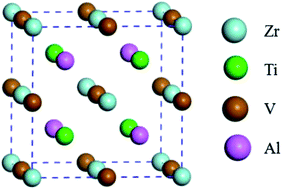
m symmetry with Wyckoff positions X: 4a (000), M: 4d (0.5, 0.5, 0.5), Y: 4c (0.25, 0.25, 0.25), Z: 4b (0.75, 0.75, 0.75). The crystal structures of the ZrVTiZ (Z = Al, Ga) compounds in our current work are plotted in Fig. 1.
The Cambridge Serial Total Energy Package (CASTEP) code is an effective ab initio program based on quantum mechanics. It can precisely simulate the ground state structure, bands, optical properties, magnetic properties, etc. In this work, all calculations were performed by using CASTEP code based on the pseudopotential method with a plane-wave basis set.33,34 Moreover, the valence electron configurations of Zr (4d25s2), V (3d34s2), Ti (3d24s2), Al (3s23p1), and Ga (4s24p1) for ZrVTiZ (Z = Al, Ga) compounds were selected. The interactions between the atomic core and the valence electrons were described by ultrasoft pseudopotentials.35 The generalized gradient approximation (GGA)36 was selected for the exchange–correction functional. For all cases, a plane-wave basis set cut-off of 450 eV was used. A mesh of 12 × 12 × 12 k-points was used for Brillouin zone integrations. These parameters ensured good convergence for total energy and the convergence tolerance for the calculations was selected as a difference in total energy within 1 × 10⁻⁶ eV per atom.
![]() | ||
| Fig. 2 Calculated total energy as a function of lattice constant for quaternary Heusler compounds ZrVTiZ (Z = Al, Ga). NM and FM correspond to nonmagnetic and ferromagnetic calculations. | ||
| Compounds | a (Å) | Mtot (μB) | MZr | MV | MTi | MZ | Ebg (eV) | Esfg (eV) | Eformation | Ec |
|---|---|---|---|---|---|---|---|---|---|---|
| ZrVTiAl | 6.54 | 2.00 | −0.72 | 2.48 | 0.36 | −0.12 | 0.49 | 0.19 | −0.26 | 25.33 |
| ZrVTiGa | 6.5 | 2.00 | −0.62 | 2.40 | 0.38 | −0.16 | 0.56 | 0.19 | −0.69 | 24.63 |
To the best of our knowledge, there are no previous experimental or theoretical data on ZrVTiZ (Z = Al, Ga) compounds. Thus, we need to investigate the structural stability of these two newly designed compounds from the aspects of cohesion energy and formation energy. The cohesion energy Ec was calculated according to the formula: Ec = EisoZr + EisoV + EisoTi + EisoZ − EtotalZrVTiZ(Z = Al,Ga), where EtotalZrVTiZ is the equilibrium total energy achieved by first principles calculations of the ZrVTiZ (Z = Al, Ga) compounds per formula unit and EisoZr, EisoTi, EisoV, and EisoZ are the energies of isolated Zr, Ti, V, and Z atoms, respectively. As is well known, the value of Ec is a measure of the strength of the force that binds atoms together in the solid state, which is correlated with the structural stability in the ground state. The calculated values obtained for the cohesion energy at the equilibrium lattice constant are 25.33 eV for ZrVTiAl and 24.63 eV for ZrVTiGa compounds, respectively. Obviously, all the values of Ec for ZrVTiZ (Z = Al, Ga) compounds are greater than 20 eV. Such high cohesion energies indicate that ZrVTiZ (Z = Al, Ga) compound crystals should be expected to be stable due to the high energy of their chemical bonds.
Formation energy refers to the stability of the compound against decomposition into its bulk constituents. The formation energy is calculated using the formula: Ef = EtotalZrVTiZ(Z = Al,Ga) − [EbulkZr + EbulkV + EbulkTi + EbulkZ], where EbulkZr, EbulkV, EbulkTi, and EbulkZ correspond to the total energy per atom for the Zr, V, Ti, and Z atoms, respectively. The values obtained for the formation energy are −0.26 eV, and −0.69 eV, respectively, and their negative formation energies also indicate the thermodynamic stability of these compounds. We also calculated the phonon spectra of ZrVTiZ (Z = Al, Ga) compounds because phonon spectrum calculations37 are always used as another method to examine the stability of compounds. The results showed, however, that the spectra have imaginary frequencies for these two compounds. Although the calculated phonon spectra indicate that these two compounds are not stable, the negative formation energies and the high energy of their chemical bonds can be used as important evidence for the structural stability of these two compounds.
With the GGA – Perdew–Burke–Ernzerhof (PBE) method, we calculated the band structures of ZrVTiZ (Z = Al, Ga) compounds along the main symmetry directions in the irreducible Brillouin zone, based on the obtained equilibrium lattice constants. The calculated results are shown in Fig. 3. For these two compounds, we can see that the bands overlap with the Fermi level in the minority spin channel. In the majority spin channel, however, a relatively wide band gap can be observed, and the Fermi level is located in the gap, reflecting its semiconducting nature. Therefore, ZrTiVAl and ZrTiVGa compounds can be regarded as half-metallic materials.
![]() | ||
| Fig. 3 ZrVTiZ (Z = Al, Ga) band structures at their equilibrium lattice constants. (The blue and red lines denote the majority and minority spin band structures, respectively.) | ||
The band gaps of ZrVTiZ (Z = Al, Ga) compounds were calculated by using the highest occupied and the lowest unoccupied bands in the majority spin channel. The results show that the band gaps of these two compounds are quite large, with values of 0.49 eV for ZrVTiAl and 0.56 eV for ZrVTiGa. Furthermore, the spin-flip gap, which is defined as the minimum between the lowest energy of the majority (minority) spin conduction bands with respect to the Fermi level and the absolute value of the highest energy of the majority (minority) spin valence bands, is 0.19 eV for ZrVTiZ (Z = Al, Ga) compounds. These spin-flip gaps are comparable to the large spin-flip gaps of a quaternary Heusler compound without a 4d transition-element, CoFeCrAl (about 0.16 eV).38 Normally, the half-metallic behaviour of 3d transition-element-based Heusler compounds is not stable and is always destroyed when the lattice is slightly strained, mainly because of the small spin-flip gap. Therefore, ZrVTiZ (Z = Al, Ga) compounds can be regarded as good candidates for practical applications as spintronic devices due to their excellent half-metallic behaviour with large spin-flip gaps.
It is well accepted that the origin of the band gap is very important for the design of new half-metallic materials. Normally, the explanations for the origin of the band gap for half-metallic materials can be divided into three types: (i) the covalent band gap; (ii) the d–d orbital hybridization band gap; and (iii) the charge transfer band gap.39 Based on the works of Skaftouros' group and Zhang et al.,40,41 we start the discussion with a possible d–d hybridization between the transition-metal atoms. Through the classical molecular orbital approach, Zr-4d and V-3d hybridization within octahedral symmetry has been considered, as presented in Fig. 4(a). Obviously, the Zr–V bonding creates five bonds and five anti-bonds, i.e., 2eu, 3t1u, 3eg, and 3t2g from top to bottom. Then, the Zr–V orbits hybridize with those of Ti-3d atoms. The eg and t2g orbitals of the Zr–V system hybridize with the dxy, dyx, dzx, dz2, and dx2−y2 orbitals of the Ti-3d atom, resulting in a lower energy bonding orbital, 3t2g/2eg, and a higher energy anti-bonding orbital, 2eu/3t1u. To further understand the mechanism for the origin of the band gap, we selected ZrVTiAl compound as an example and show the band structures in both spin channels based on the schematic diagram of d–d hybridization between the Zr, V, and Ti atoms in Fig. 4(b) and (c), and we find that the complex exchange splitting of Z–V and Zr–Ti will shift the Fermi level to the appropriate position (between the t1u and t2g bands) in the majority spin channel, and it may be responsible for the origin of the gap denoted as the t1u–t2g band gap. Fig. 5 presents the spin-projected total and atomic density of states (DOS) for ZrVTiAl and ZrVTiGa compounds. Obviously, the main contributions in the energy regions between −4 eV and −2 eV come from the p–d hybridization between the Z-p and the Zr-4d, Ti-3d, and V-3d states. The states over the range from −2 eV to 5 eV can mainly be attributed to the d–d hybridization among the Zr-4d, Ti-3d, and V-3d states, which is in good agreement with our above discussion. The p–d hybridization between the Al/Ga and Zr/V/Ti atoms is not very obvious, however, in our current calculations, as shown in Fig. 5.
![]() | ||
| Fig. 5 Spin-polarized total and atom-resolved DOSs of the quaternary Heusler compounds ZrVTiZ (Z = Al, Ga) at their equilibrium lattice constants: (a) ZrVTiAl and (b) ZrVTiGa. | ||
To test the stability of the half-metallic states against change in the lattice parameters for ZrVTiAl and ZrVTiGa compounds, we calculated a series of band structures for ZrVTiAl and ZrVTiGa compounds with different lattice parameters. The valence band maximum (VBM) and the conduction band minimum (CBM) in the majority spin channel are used to characterize the half-metallic properties because the band structures are quite similar under different degrees of lattice compression/expansion except for the band gap. Fig. 6(a) and (b) shows the energies of the CBM and VBM versus the lattice parameters. Obviously, the ZrVTiAl and ZrVTiGa compounds can keep their half-metallic properties at lattice constant values of 6.14–6.91 Å and 6.06–6.86 Å, respectively. At the lattice constants a = 6.13 Å (6.05 Å) and a = 6.92 Å (6.87 Å), the VBM of ZrVTiAl (ZrVTiGa) overlaps with the Fermi level, and the half-metallic behavior disappears, and thus, the ZrVTiAl (ZrVTiGa) compound becomes a common magnet.
It is well accepted the half-metallic properties of most Heusler compounds will be influenced and even be broken by the effect of tetragonal deformation. Therefore, we will investigate the stability of the half-metallic states under lattice tetragonalization. In order to do this, we fix the unit-cell volume at the bulk equilibrium value, i.e., V = a3, and then we change the c/a ratio. The curves of the energies of the CBM and VBM as functions of the lattice constant have been plotted in Fig. 6(a) and (b) for ZrVTiAl and ZrVTiGa, respectively, and the c/a ratio for the ZrVTiAl and ZrVTiGa compounds has been plotted in Fig. 6(c) and (d), respectively. The half-metallic properties of the ZrVTiAl and ZrVTiGa compounds exhibit a low sensitivity to tetragonalization. In detail, ZrVTiAl and ZrVTiGa compounds can maintain their half-metallic properties when their c/a ratios are changed in the range of 0.92–1.12 and 0.91–1.14, respectively.
Finally, we come to the magnetic properties of ZrVTiAl and ZrVTiGa compounds. We give the values of the total magnetic moments and atomic magnetic moments of ZrVTiAl and ZrVTiGa compounds in Table 1. The total spin magnetic moments are an integral value of 2 μB, and the atomic magnetic moments of Z (Z = Al, Ga) atoms are very small and only make a small contribution to the total magnetic moment. For these two compounds, the total magnetic moment mainly comes from the Zr, V, and Ti atoms. The atomic magnetic moments of Zr are −0.72 μB, −0.62 μB, the spin magnetic moments of V atoms are 2.48 μB, 2.40 μB, and the spin magnetic moments of Ti atoms are 0.36 μB, 0.36 μB, respectively. Comparing the atomic magnetic moments of the Zr and V/Ti atoms, we find that the atomic magnetic moments of these atoms are in antiparallel alignment, and thus, the ZrVTiAl and ZrVTiGa compounds are half-metallic ferrimagnets. The magnetic moments of the Zr and V atoms are in agreement with the theoretical data on Zr2VZ compounds.21,22 Furthermore, we know that the total magnetic moment (Mt) of the half-metallic Heusler compounds Zr2VZ and Ti2VZ21,22,31,42 scales linearly with the number of valence electrons (Zt), according to Mt = 18 − Zt. As mentioned above, the total magnetic moment is 2 μB for ZrVTiAl and ZrVTiGa compounds, which have 16 valence electrons per unit cell. Therefore, the Slater–Pauling rule Mt = 18 − Zt is suitable for these two quaternary Heusler compounds in our current work.
| This journal is © The Royal Society of Chemistry 2016 |