
A new electrolyte with good compatibility to a lithium anode for non-aqueous Li–O2 batteries

Yanqiong Shi, Rongrong Miao, Lei Li*, Jun Yang*, Jiulin Wang and Yanna Nuli
Shanghai Electrochemical Energy Devices Research Centre, School of Chemistry & Chemical Engineering, Shanghai Jiao Tong University, Shanghai 200240, China. E-mail: lilei0323@sjtu.edu.cn; yangj723@sjtu.edu.cn; Fax: +86-21-54747667; Tel: +86-21-54747667

Received 31st March 2016 , Accepted 4th May 2016

First published on 9th May 2016


Abstract

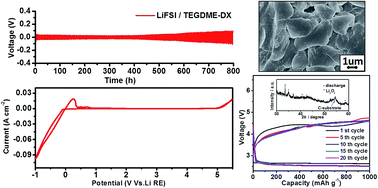
A novel LiFSI/TEGDME-DX electrolyte with good compatibility to a lithium anode is firstly proposed for the rechargeable non-aqueous Li–O2 battery, in which an improved performance with longer cycle life was achieved when compared with the conventional LiTFSI/TEGDME electrolyte.

Currently, the ever-increasing demands from new applications, especially from electronics and electric vehicles, have imposed higher requirements for energy storage systems.1,2 However, the energy density of state-of-the-art Li-ion batteries is still low for these applications, even if specific capacities close to the theoretical values of the electrode materials can be achieved.3 Therefore, rechargeable non-aqueous lithium–air (O2) batteries, as promising electrochemical power sources with an ultrahigh energy density, potentially up to 2–3 kW h kg−1 on the cell level, have captured intense interest among the battery research communities.4 Great efforts have been made to enhance the cell performance to realize potential future applications. Numerous research work on cathode materials and their structures can be found in the review paper by Ma et al.,5 and novel bi-functional catalysts for both oxygen reduction reaction (ORR) and oxygen evolution reaction (OER) have also been reported, for which lower over-potential and higher capacity were obtained.6–8 Likewise, as the other two important components of the batteries, the metallic lithium anode and electrolyte have vital effects on the cell performance and should not be neglected. The instability of lithium to the organic solvents causes low cycle efficiency and lithium dendrite formation during the discharge/charge processes; these dendrites may lead to internal short circuit and severe safety concern.9 Even if the same lithium salt was used, the SEI layer on the lithium anode might also present great differences due to the different solvents, co-solvent, as well as the working state of the cell (e.g. current density).10 Aurbach et al.11 revealed the dendrite formation on the lithium anode when carbonate solvents (e.g., propylene carbonate) were used in a Li-ion cell and the surface layers contained ROCO2Li, ROLi, and Li2CO3 species. The Li–O2 cell system faces the same challenge. Assary et al.12 investigated the stability of an ether-based electrolyte containing LiCF3SO3 salt and tetraethylene glycol dimethyl ether (TEGDME) solvent to lithium anode in an O2 environment; they identified LiOH and Li2CO3 on the surface layer, which might lead to dendrite formation and result in poor cell performance. Therefore, it is of high significance to explore new electrolytes with high compatibility to the lithium anode for the non-aqueous Li–O2 battery.

Many lithium salts, such as LiPF6, Li[N(SO2CF3)2] (LiTFSI), LiCF3SO3, LiClO4, LiBF4, LiCl, and Li[B(C2O4)2] (LiBOB), have been employed in electrolytes for the non-aqueous Li–O2 batteries;13,14 nevertheless, lithium bis(fluorosulfonyl)imide (Li[N(SO2F)2], LiFSI), which possesses high ionic conductivity and excellent chemical stability,15 has not yet been reported. It has been used as a lithium salt in Li–metal battery16 and Li–S battery17 system to modify the solid electrolyte interphase (SEI) with a higher LiF content than that in LiTFSI solution and mitigate the lithium dendrite formation. Qian et al.18 also reported a electrolyte composed of LiFSI and 1,2-dimethoxyethane (DME) achieving a high rate and stable cycling of a lithium anode at high coulombic efficiency without dendrite growth. However, the practical application of DME used in the above electrolytes will be restricted in Li–O2 cells due to its high volatility (boiling point: 83 °C). Herein, a new electrolyte system with LiFSI as the lithium salt is designed for the non-aqueous Li–O2 battery, in which less-volatile and frequently used TEGDME (boiling point: 275 °C) is chosen as the basic solvent, and 1,4-dioxan (DX, boiling point: 101.3 °C), (a symmetrically structured cyclic ether for its probably improved chemical stability) as the 2nd solvent. The electrochemical performance and morphological evolution of a lithium anode in this electrolyte are investigated, and the reversible and improved cycling behaviour of a non-aqueous Li–O2 cell based on a typical air cathode is demonstrated.

Lithium stripping–plating experiments in a symmetric Li|Li cell subjected to galvanostatic cycling at room temperature were performed to evaluate the compatibility between the electrolyte and lithium anode. Fig. 1a and b show the voltage responses of the cells with different electrolytes at a constant current density of 0.25 mA cm−2. The overvoltage profile corresponding to the commonly used electrolyte is unstable and shows a tendency to higher voltage, which finally fails after the cycling operation of ∼230 h (reaching voltage upper-limit of 3 V). In contrast, the voltage is still below 0.06 V when LiFSI replaces LiTFSI. Moreover, the addition of DX solvent further reduces the overvoltage and improves the cycling performance (Fig. 1a). The coupling effect of solvent/salt enables the cell with LiFSI/TEGDME-DX electrolyte to cycle reversibly for 850 h below the voltage of 0.15 V, extending the life cycle nearly 3-fold (Fig. 1b). Fig. S1 further proves the positive effect of DX solvent on prolonging cycling life. Fig. 1b presents the enlarged voltage trends in different electrolytes. In LiTFSI/TEGDME, the voltage fluctuation related to lithium deposition and dissolution is notable for each process; this fluctuation can be explained by the non-uniform current and voltage distribution caused by the uneven morphology and solid electrolyte interphase (SEI) layer on the lithium electrode.19 However, the voltage trends in LiFSI/TEGDME-DX are more stable, and the voltage remains below 0.06 V even after a long time cycling for ∼550 h. Fig. 1c exhibits digital photos of lithium anodes taken after cycle operation. A thick and dark resultant layer adheres to the reaction zone of the lithium disc (Fig. 1c-α) when a conventional electrolyte is used, which could lead to a high interfacial resistance and cell failure. However, the lithium anode in the proposed electrolyte remains neat with metallic brightness, even after long-term cycling of 1000 h (Fig. 1c-β).


image file: c6ra08318h-f1.tif
Fig. 1 (a) Voltage–time plots of Li|Li symmetrical cells with different electrolytes at constant current density of 0.25 mA cm−2 and 8 h for each cycle. (b) Enlarged voltage–time plots and extended cycling figure in the proposed electrolyte; (c) the digital photo of lithium anode after cycling operation (α: in LiTFSI/TEGDME, cycling for ∼300 h; β: in LiFSI/TEGDME-DX, cycling for ∼1000 h).

The interfacial property was further investigated via EIS measurements. As shown in Fig. 2a, with the increase in cycle number, the interfacial resistance with a LiTFSI-based electrolyte initially decreases due to the activation of the cell, and reaches a minimum and then increases quickly upon cycling until cell failure. In contrast, in the LiFSI based electrolyte, the resistance decreases and then stabilizes at a low value during cycling, which suggests that a relatively stable SEI film is formed, leading to the improved electrochemical stability and long cycle life. Moreover, Fig. 2b indicates that the addition of DX solvent contributes to the formation of a more stable SEI film with a lower resistance, which may be associated with DX for its extremely low reduction potential (−1.95 V vs. Li/Li+), implying a low tendency of a direct reaction between DX solvent and lithium metal. Based on the advantages obtained in the LiFSI/TEGDME-DX electrolyte, extending investigations will be focused on the comparison between this electrolyte system and the conventional LiTFSI/TEGDME system.


image file: c6ra08318h-f2.tif
Fig. 2 Nyquist plots of Li|Li cells, (a) as a function of cycling time; (b) as a function of storage time after 5 cycles.

The surface morphologies of lithium electrodes cycled in Li|Li symmetric cells with different electrolyte solutions are shown in Fig. 3. In view of the fact that a high current density promotes lithium dendrite formation, a large current density of 2 mA cm−2 is applied in this experiment. The lithium metal deposit harvested from the LiFSI/TEGDME-DX electrolyte system presents a compact accumulation of smooth particles (Fig. 3a and b), while a coarse and dendritic Li deposit forms in the LiTFSI/TEGDME electrolyte (Fig. 3c and d). The dendrite-free lithium deposition is probably attributed to the high quality of the SEI film in the proposed electrolyte. The using of less-reactive DX solvent makes the composition of surface layer dominated by FSI−1 anion reduction which could mitigate the lithium dendrite formation as reported in previous research.16


image file: c6ra08318h-f3.tif
Fig. 3 SEM micrographs of Li anode after 10 cycles with 7.2C per process at 2 mA cm−2, (a and b) in LiFSI/TEGDME-DX electrolyte; (c and d) in LiTFSI/TEGDME electrolyte.

The coulombic efficiency was determined using the Li–stainless steel (SS) cells, with the experiment performed as described in the literature;20,21 the value was calculated from the following equation:

 
CE = 100 × NQ1/(NQ1 + Q2) (1)
where CE is the average coulombic efficiency (%), Q1 is the initial amount of plated lithium (2.3 C cm−2), Q2 is the cycled fraction (0.5 C cm−2), and N is the cycle number, which is indicated by a sharp increasing of the dissolution potential. Fig. 4a clearly demonstrates the superiority of the novel electrolyte. The calculated average coulombic efficiency reaches up to 94.1%, which is much higher than the 52% obtained in the conventional LiTFSI-based electrolyte confirming the role that DX plays in preventing a lithium metal loss caused by a direct reaction between solvent and lithium. Meanwhile, the cyclic voltammetry measurements were also performed to determine the electrochemical stability window of the prepared electrolyte. As shown in Fig. 4b, the oxidative decomposition is detected at ∼4.53 V (vs. Li/Li+) in the LiTFSI/TEGDME electrolyte, while the electrolyte containing LiFSI and DX as co-solvent is electrochemical stable to as high as nearly 5 V vs. Li/Li+. We surmise that the symmetric molecular structure with hexatomic ring in DX solvent and its synergy with LiFSI will improve the anodic stability of LiFSI/TEGDME-DX solution. And the wide electrochemical window offers the possibility of its application in the non-aqueous Li–O2 cell system.


image file: c6ra08318h-f4.tif
Fig. 4 (a) Voltage–time profiles of Li|SS cells for the cycling efficiency calculation; (b) steady-state cyclic voltammograms of the electrolytes with a three-electrodes system.

In order to confirm the availability, the 2032-type coin cells were assembled for evaluating the Li–O2 cell performance. Fig. 5a and b exhibit the obvious difference in cycling stability of the cells using different electrolytes at a current density of 200 mA gCNT−1, where more than 45 cycles with fairly good reversibility are achieved by using the proposed electrolyte, in comparison with only 25 cycles for the conventional one. And a lower polarizing voltage was obtained when DX was used as co-solvent (Fig. S3), which is in accordance with the EIS results mentioned above. Moreover, when a higher current density of 500 mA gCNT−1 was applied with a higher fixing capacity to 1000 mA h gCNT−1, more than 20 stable cycles have been achieved (Fig. 5c), demonstrating a good rate capacity of the Li–O2 cell with the proposed electrolyte. And the stable charge and discharge voltage trends for 20 cycles also indicate the good electrochemical reversibility and kinetics. The XRD pattern in Fig. 5d reveals that Li2O2 is the dominated discharge product, which is essential for the reversible reaction on the oxygen electrode. Although the proposed electrolyte offers a good solution for Li anode compatibility and reversible electrode reactions for Li–O2 cell, one has to be aware that the relatively high charging polarization for the Li–O2 cell might lead to the decomposition of liquid electrolyte and limit the long-term cycle performance. To overcome this problem, better oxygen (or air) cathodes or catalytic electrolyte additives must be developed.


image file: c6ra08318h-f5.tif
Fig. 5 Galvanostatic charge–discharge profiles of Li–O2 cells with (a) LiFSI/TEGDME-DX and (b) LiTFSI/TEGDME electrolytes at a current density of 200 mA g−1 to the fixed capacity of 800 mA h g−1; (c) galvanostatic charge–discharge profiles of Li–O2 cell with LiFSI/TEGDME-DX electrolyte at a current density of 500 mA g−1 to the fixed capacity of 1000 mA h g−1; (d) XRD pattern at a discharge state in LiFSI/TEGDME-DX electrolyte.

Conclusion

Dendrite-free lithium deposition with a low over-potential and much higher Li cycling efficiency compared with the conventional LiTFSI/TEGDME electrolyte for non-aqueous Li–O2 cells can be achieved by using a LiFSI/TEGDME-DX electrolyte, in which the symmetrically structured cyclic 1,4-dioxane and its synergy with other components lead to high chemical and electrochemical stability, since DX solvent possesses not only low reactivity to lithium but also good anti-oxidation capacity. Furthermore, the long cycle life of the lithium electrode, wide electrochemical window, and successful operation with a typical oxygen cathode indicate the feasibility for employing this new electrolyte in high-energy Li–O2 batteries.

Acknowledgements

This work was supported by the National Key 973 Program of the PRC (No. 2014CB932303) and the National Natural Science Foundation of China (No. 21273146, No. 21573145).

References

  1. A. Kraytsberg and Y. Ein-Eli, J. Power Sources, 2011, 196, 886 CrossRef CAS.
  2. M. Armand and J. M. Tarascon, Nature, 2008, 451, 652 CrossRef CAS PubMed.
  3. P. G. Bruce, S. A. Freunberger, L. J. Hardwick and J. M. Tarascon, Nat. Mater., 2012, 11, 19 CrossRef CAS PubMed.
  4. D. G. Kwabi, N. Ortiz-Vitoriano, S. A. Freunberger, Y. Chen, N. Imanishi, P. G. Bruce and Y. Shao-Horn, MRS Bull., 2014, 39, 443 CrossRef CAS.
  5. Z. Ma, X. Yuan, L. Li, Z.-F. Ma, D. P. Wilkinson, L. Zhang and J. Zhang, Energy Environ. Sci., 2015, 8, 2144 CAS.
  6. G. Gnana kumar, M. Christy, H. Jang and K. S. Nahm, J. Power Sources, 2015, 288, 451 CrossRef CAS.
  7. F. Lu, Y. Wang, C. Jin, F. Li, R. Yang and F. Chen, J. Power Sources, 2015, 293, 726 CrossRef CAS.
  8. M. Lee, Y. H. wang, K. H. Yun and Y. C. Chung, J. Power Sources, 2015, 288, 296 CrossRef CAS.
  9. W. Xu, J. Wang, F. Ding, X. Chen, E. Nasybutin, Y. Zhang and J.-G. Zhang, Energy Environ. Sci., 2014, 7, 513 CAS.
  10. X.-B. Cheng, R. Zhang, C. Z. Zhao, F. Wei, J. G. Zhang and Q. Zhang, Adv. Sci., 2015, 2198 Search PubMed.
  11. Y. S. Cohen, Y. Cohen and D. Aurbach, J. Phys. Chem. B, 2000, 104, 12282 CrossRef CAS.
  12. R. S. Assary, J. Lu, P. Du, X. Luo, X. Zhang, Y. Ren, L. A. Curtiss and K. Amine, ChemSusChem, 2013, 6, 51 CrossRef CAS PubMed.
  13. J. Lu, L. Li, J. B. Park, Y. K. Sun, F. Wu and K. Amine, Chem. Rev., 2014, 114, 5611 CrossRef CAS PubMed.
  14. R. Younesi, G. M. Veith, P. Johansson, K. Edström and T. Vegge, Energy Environ. Sci., 2015, 8, 1905–1922 CAS.
  15. H. B. Han, S. S. Zhou, D. J. Zhang, S. W. Feng, L. F. Li, K. Liu, W. F. Feng, J. Nie, H. Li and X. J. Huang, J. Power Sources, 2011, 196, 3623 CrossRef CAS.
  16. R. Miao, J. Yang, X. Feng, H. Jia, J. Wang and Y. Nuli, J. Power Sources, 2014, 271, 291 CrossRef CAS.
  17. J. J. Hu, G. K. Long, S. Liu, G. R. Li and X. P. Gao, Chem. Commun., 2014, 50, 14647 RSC.
  18. J. Qian, W. A. Henderson, W. Xu, P. Bhattacharya, M. Engelhard, O. Borodin and J. G. Zhang, Nat. Commun., 2015, 6, 6362 CrossRef CAS PubMed.
  19. G. Bieker, M. Winter and P. Bieker, Phys. Chem. Chem. Phys., 2015, 17, 8670 RSC.
  20. P. C. Howlett, D. R. MacFarlane and A. F. Hollenkamp, Electrochem. Solid-State Lett., 2004, 7, A97 CrossRef CAS.
  21. D. Aurbach and Y. Gofer, J. Electrochem. Soc., 1989, 136, 3198 CrossRef CAS.

Footnote

Electronic supplementary information (ESI) available. See DOI: 10.1039/c6ra08318h

This journal is © The Royal Society of Chemistry 2016
Click here to see how this site uses Cookies. View our privacy policy here.