DOI:
10.1039/C6RA07893A
(Paper)
RSC Adv., 2016,
6, 41151-41155
High performance dye-sensitized solar cell from a cocktail solution of a ruthenium dye and metal free organic dye
Received
26th March 2016
, Accepted 18th April 2016
First published on 20th April 2016
Abstract
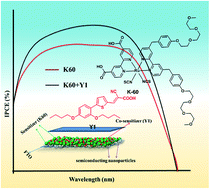
A Ru-based dye K-60 and a metal free D–A organic dye Y1 have been employed for the fabrication of a mixed dye sensitized solar cell (MDSSCs) system. The photophysical and electrochemical characterization revealed that the energy levels and absorption profiles of both the dyes are suitable for co-sensitization. We have adopted the cocktail co-sensitization method, in which a TiO2 photoanode was immersed into a mixed solution of K-60 and Y1 for 12 h. The DSSC sensitized with a mixture of K-60 and Y1 exhibited an overall PCE of 8.19% (Jsc = 14.95 mA cm−2, Voc = 0.59 V and FF = 0.71) higher than that for DSSC sensitized with a single K-60 dye (PCE = 6.26%). The higher PCE of the DSSC sensitized with K-60 + Y1 is attributed to the enhancement in both Jsc and FF and related to the high and broader IPCE spectra.
1. Introduction
Ever since the first report appeared on a ruthenium polypyridyl complex as a light harvesting unit in dye sensitized solar cells (DSSC) by O'Regan and Grätzel,1 these devices have attracted intense interest owing to their low cost and simple fabrication for conversion of solar energy into electricity.2–8 DSSC with a power conversion efficiency (PCE) as high as 13% have been achieved using a Zn–porphyrin complex as a sensitizer.9 Recently, organic inorganic hybrid perovskite sensitized solid state dye solar cells have reached a record PCE of 20.1%.10 However, the environmental and health hazards associated with the presence of the toxic metal lead in perovskite materials may undermine its future commercial application. Therefore, researchers continue their pursuits on DSSCs based on ruthenium complexes and metal free organic sensitizers. Sensitizer is one of the most important components of a DSSC device and its spectral and electrochemical properties play a crucial role for the photon absorption, electron injection improving the overall of conversion efficiencies by preventing recombinations at the interface of redox shuttle and TiO2.11–13 Ruthenium(II) polypyridyl complexes with low energy metal-to-ligand charge transfer (MLCT) transitions have surpassed the efficiency levels obtained from all other types of dyes in DSSC and N719 with organic co-sensitizer based DSSC achieved benchmark PCE of 11.4%.14 In order to improve the long term stability and PCE of DSSCs, several other alternatives strategies have been explored. Employing chromophores with higher molar extinction coefficient,15–17 thiocyanate free Ru(II) sensitizers18–24 and sensitizers with spin-forbidden singlet to triplet transition for near infrared (NIR) spectral response25–27 has been the main focus during last two decades. The use of sensitizers with high molar extinction coefficient and broader absorption profile allows thinner TiO2 layers, resulting in shorter electron transport distance that would minimize the recombination losses and increase the overall PCE. Oxygen containing electron donor, cyclic and acyclic alkoxy groups have been incorporated as new chromophores in the Ru complexes and recognized as efficient and alternative sensitizers to N719.28–31 Further substituted styryl unit are known to increase the molar extinction coefficient due to increased conjugation length and favorable alignment of the π-orbital (lone pairs) of electron donors with the conjugated system.19,32,33
Cocktail co-sensitization is one of the emerging techniques to enhance the PCE of DSSCs. Several research groups including us explored this technique and achieved higher PCE.14,34–41 In continuation of our efforts in this direction, we report here the photovoltaic performance of DSSCs from ruthenium complex K60 (ref. 42) and metal-free dye Y1 (ref. 14) as sensitizer and co-sensitizers respectively with an improved overall PCE of 8.19%. This enhancement is mainly attributed to the improvement in both Jsc (from 14.95 mA cm−2 to 18.26 mA cm−2) and Voc (from 0.59 V to 0.65 V).
2. Experimental details
2.1. Materials and instrumentation
K-60 and Y1 dyes were synthesized following reported procedures.14,42 The chemical structures of these dyes are shown in Fig. 1. Absorption spectra were recorded using Shimadzu ultraviolet-visible light (UV-Vis) spectrometer. Electrochemical data were recorded using Autolab potentiostat/galvanostat PGSTAT30. The cyclic voltammetric curves were obtained from a three electrode cell in 0.1 M Bu4NPF6 in DMF solution at a scan rate of 100 mV s−1, Pt wire as a counter electrode and an Ag/AgCl reference electrode and calibrated with ferrocene. Emission spectra were recorded on a J. Y. Horiba model fluorolog3 fluorescence spectrometer.
 |
| | Fig. 1 Structures of K-60 and Y1 sensitizers. | |
2.2. Device fabrication and characterization
The DSSC devices were fabricated employing the procedures described in the literature.14 0.1 mM of Y1 and 0.2 mM K60 dye in tert-butanol and acetonitrile mixed solvent (1
:
1) was used for the preparation of dye solution. 20 mM deoxycholic acid as a coadsorbent was added to the mixed dye solution. The electrodes were immersed in the dye solution and then kept at 25 °C for 20 h. The dye sensitized TiO2 photoanode and the platinum coated counter FTO glass were separated by a Surlyn spacer (40 μm thick) and sealed by heating the polymer frame. An electrolyte composed of 0.6 dimethylpropylimidazolium iodide (DMPII), 0.05 M I2 and 0.1 LiI in acetonitrile was used.
3. Results and discussion
3.1. Optical and electrochemical properties
The UV-visible absorption spectra of the K60 measured in DMF solution is shown in Fig. 2a and the results were summarized in Table 1. Intense MLCT peak found for K60 at 534 nm with extinction coefficient of 0.9513 × 10⁴ M−1 cm−1, can be assigned to MLCT transitions in Ru(II) complexes.43 The co-sensitizer Y1 showed strong absorption band in the wavelength range 370–420 nm, assigned to intramolecular charge transfer between donor and the acceptor.44 The dye Y1 showed a superior absorption in the wavelength 370–420 nm compared to K60. The absorption of mixed K60 + Y1 dye system showed a broader absorption profile covering from 300 nm to 700 nm.
 |
| | Fig. 2 Normalized absorption spectra of K-60, Y1 and K-60 + Y1 (a) in solution and (b) absorbed onto TiO2 film. | |
Table 1 Photophysical and electrochemical data of K-60, Y1 and K60 + Y1
| Dye |
λmaxa (nm)/(ε × 104 M−1 cm−1) |
λmaxb (nm) |
Eoxdc vs. Fe/Fe+ [V] |
Eoxdd vs. NHE [V] |
HOMO vs. NHEe (eV) |
Eo–of [eV] |
E*ox vs. NHEg [V] |
LUMOh vs. NHE (eV) |
| Absorption spectra were recorded in DMF solution. Absorption spectra were recorded on TiO2. Oxidation potentials were reported with reference to the ferrocene standard. Oxidation potentials were measured by in NHE. HOMO = −e(Eoxc + 4.8) (eV). Eo–o2 was determined from the intersection of the absorption and emission spectra in DMF. E*oxd = (Eoxc − Eo–of). LUMO2 = −e(HOMOe − Eo–of) (eV). |
| K60 |
534/(0.9513) |
543 |
0.28 |
0.99 |
−5.08 |
2.01 |
−1.02 |
−3.07 |
| Y1 |
384/(1.795) |
409 |
0.57 |
1.28 |
−5.37 |
2.84 |
−1.56 |
−2.53 |
| K60 + Y1 |
536/(0.4554) |
543 |
|
|
|
2.00 |
|
|
Fig. 2b shows the absorption spectra of K60, Y1 and a mixture of K60 and Y1 absorbed on transparent thin film of nanocrystalline TiO2 (4 μm). Both K60 and Y1 showed broad absorption spectra similar to that in solution. However, the absorption maxima were slightly redshifted due the interaction between the carboxylate group and TiO2. It can be seen from the Fig. 2b that the onset of the absorption spectra of K60 and Y1 extended to 800 nm and 550 nm, respectively. This broadening of the absorption is desirable for better light harvesting ability of the sensitizer in DSSCs. The absorption spectra of Y1 dye adsorbed onto the TiO2 film showed a well defined absorption band in the range 380–420 nm with maxima at 409 nm and higher than that for K60. The absorption of mixed dye (K60 + Y1) absorbed onto TiO2 film shows a broad absorption band in the wavelength region 460–680 nm as compared to that for K60 dye, indicating that the mixed dye system shows better light harvesting efficiency than single dye K60 in this wavelength region.
Differential pulse voltammetry (DPV) used to measure the ground state oxidation potential, corresponds to the HOMO energy level, of K60 and Y1 (Fig. 3). The electrochemical data of these dyes are compiled in Table 1. The values of Eo–o (estimated from the intersection of absorption and emission spectra) and HOMO were used to estimate the excited state oxidation potential or LUMO energy level, i.e. LUMO = HOMO − Eo–o. The ground state oxidation potential (HOMO) and excited state oxidation potential (LUMO) are summarized in Table 1. HOMO energy levels of K60 (−5.08 eV) and Y1 (−5.37 eV) are lower in energy compared to I3−/I− redox couple (−4.92 eV),45 providing sufficient driving force for dye regeneration. Moreover, the excited state oxidation state or LUMO energy levels of K60 (−3.07 eV) and Y1 (−2.53 eV) are higher in energy, compared to conduction band (CB) edge of TiO2 (−4.2 eV),37 which resulted efficient electron injection from the excited state of dye into the conduction band of TiO2. The driving force for electron injection, i.e. difference between the LUMO of the sensitizer and CB of TiO2 is higher (1.13 eV) for K60 as compared to N719 (0.43 eV), leads to higher thermodynamic free energy of electron injection for K60 and may result in higher photocurrent. However, the N719 had more negative free energy for dye regeneration, resulting in greater Voc. The HOMO and LUMO energy levels of the Y1 also indicate that there is also sufficient driving force for electron injection and dye regeneration when used as co-sensitizer for DSSC.
 |
| | Fig. 3 Differential pulse voltammetry plots of K-60 and Y1. | |
3.2. Photovoltaic properties
The photovoltaic performance of K60 on nanocrystalline TiO2 electrode was studied under standard AM 1.5 illuminations (100 mW cm−2) using a metal-mask. Fig. 4a and b show the current–voltage characteristics and IPCE spectra of the DSSCs using K60 and K60 + Y1 sensitizers and the photovoltaic parameters are compiled in Table 2. It can be seen from Fig. 4a that the K60 sensitized DSSC showed a PCE of 6.26% (with Jsc = 14.95 mA cm−2, Voc = 0.59 and FF = 0.71), while DSSC sensitized with mixed K60 + Y1 showed PCE of 8.19% (with Jsc = 18.26 mA cm−2, Voc = 0.65 V and FF = 0.69). The higher PCE for co-sensitized DSSC compared to K-60 sensitized DSSC is attributed to the enhanced values of Jsc and Voc. Fig. 4b shows the incident photon to current efficiency (IPCE) spectra for the cell fabricated with K60, where the IPCE values for each wavelength from 300 nm to 900 nm are plotted as a function of wavelength. IPCE spectra showed broad profile covering the entire visible spectrum and near IR attributed to the stronger photon harvesting capability of ancillary ligands, 4,4′-(4,4′-bis(2-(4-(1,4,7,10-tetraoxyundecyl)phenyl)ethenyl)-2,2′-bipyridine). An impressive IPCE value of up to 60–70% was achieved with K60 in the wavelength range of 350–630 nm with maximum value of about 70% at nm 430 and 540 nm. The values of Jsc estimated from the integration of IPCE spectra of the DSSCs are about 14.74 mA cm−2 and 18.08 mA cm−2, for K-60 and K-60 + Y1, which are closely resembles with the values experimentally observed in J–V characteristics of DSSCs in illumination.
 |
| | Fig. 4 (a) Current–voltage (J–V) characteristics under illumination and (b) incident photon to current conversion efficiency (IPCE) spectra of the DSSC sensitized with K-60 and K-60 + Y1. | |
Table 2 Photovoltaic parameters of DSSCs based on K-60 and K-60 + Y1
| Dye |
Jsc (mA cm−2) |
Voc (V) |
FF |
Jsca (mA cm−2) |
PCE (%) |
| Estimated from the integration of IPCE spectra. |
| K60 |
14.95 |
0.59 |
0.71 |
14.74 |
6.26 |
| K60 + Y1 |
18.26 |
0.65 |
0.69 |
18.08 |
8.19 |
As shown in the optical absorption spectra of K-60, Y1 and K60 + Y1 adsorbed TiO2 films, (Fig. 2), Y1 sensitized films showed intense absorption in wavelength range 350–450 nm, where K-60 has low absorption. Hence, the absorption spectrum of mixed dye film exhibits an extended absorption profile with panchromatic features, which can lead to increased LHE (light harvesting efficiency) and enhanced IPCE response for co-sensitized solar cells in the wide range 300–800 nm. The observed IPCE enhancement may be attributed to improved charge collection efficiency, which may be due to the dye Y1 impeding the electron leakage by an increased molecular surface coverage on TiO2 upon co-sensitization.
The dye loading amounts for the co-sensitized and K-60 sensitized photoanode were also determined. The total dye loading for the co-sensitized photoanode (4.3 × 10⁻⁷ mol cm−2) is higher than for the K-60 sensitized photoanode (3.21 × 10⁻⁷ mol cm−2). This may be understood in context with difference of the molecular sizes and anchoring units of K-60 and Y1. During the sensitization process, larger size K-60 molecules were adsorbed first onto the TiO2 surface and then smaller size molecule of Y1 are absorbed onto the surface of TiO2 in such a way they fill the gaps between the K-60 molecules and results an increased dye loading. Moreover, Y1 molecule, due to the small size exhibit a more effective binding capacity to the TiO2 surface, relative to the K-60 molecule.46,47 Further, the higher amount of dye loading form a blocking layer covering the entire TiO2 nanoparticle, which prevent the back electron recombination with the electrolyte or dye molecules. This effect leads to decrease the dark current and increase the value of Voc, as we have experimentally observed in the case of co-sensitized DSSC.
4. Conclusions
In summary, a metal free D–A organic dye Y1 with cyano-acrylic acid anchoring unit was used along with Ru-based dye K-60 for the fabrication of co-sensitized solar cell, using a cocktail sensitization method. The co-sensitized (K-60 + Y1) solar cell exhibited a significantly improved PCE (8.19%), compared to the K-60 sensitized device (PCE = 6.26%), which is attributed to the enhanced values of Jsc and Voc. The enhancement of the Jsc value of the co-sensitized DSSC is in good agreement with its enhanced IPCE spectra, which is ascribed to the improved light harvesting efficiency, with respect to the K-60 based DSSC. The increased value of Voc may be attributed to suppression of back electron recombination.
Acknowledgements
GK thanks CSIR, New Delhi for senior research fellowships. SPS acknowledge the support from Indo-UK APEX project (Phase-II). MC thanks DST, New Delhi for funding the project No. DST/TMC/SERI/FR/92.
References
- B. O'Regan and M. Grätzel, Nature, 1991, 353, 737–740 CrossRef.
- A. Hagfeldt, G. Boschloo, L. Sun, L. Kloo and H. Pettersson, Chem. Rev., 2010, 110, 6595–6663 CrossRef CAS PubMed.
- L. L. Li and W. G. Diau, Chem. Soc. Rev., 2013, 42, 291–304 RSC.
- L. L. Tan, J. F. Huang, Y. Shen, L. M. Xiao, J. M. Liu, B. Kuang and C. Y. Su, J. Mater. Chem. A, 2014, 2, 8988–8994 CAS.
- M. Grätzel and S. M. Zakeeruddin, Mater. Today, 2013, 16, 11–18 CrossRef.
- S. Zhang, X. Yang, Y. Numata and L. Han, Energy Environ. Sci., 2013, 6, 1443–1464 CAS.
- N. Sharifi, F. Tajabadi and N. Taghavinia, Chem. Phys. Chem., 2014, 15, 3902–3927 CrossRef CAS PubMed.
- Y. Ooyama and Y. Harima, Chem. Phys. Chem., 2012, 13, 4032–4080 CrossRef CAS PubMed.
- S. Mathew, A. Yella, P. Gao, R. Humphry-Baker, F. E. Curchod-Basile, N. Ashari-Astani, I. Tavernelli, U. Rothlisberger, K. M. Nazeeruddin and M. Grätzel, Nat. Chem., 2014, 6, 242–247 CrossRef CAS PubMed.
- Best Research-Cell Efficiencies, accessed Feb 2015, http://www.nrel.gov/ncpv/images/efficiency_chart.jpg.
- S. M. Feldt, E. A. Gibson, E. Gabrielsson, L. Sun, G. Boschloo and A. Hagfeldt, J. Am. Chem. Soc., 2010, 132, 16714–16724 CrossRef CAS PubMed.
- P. Gao, Y. J. Kim, J. Yum, T. W. Holcombe, K. M. Nazeeruddin and M. Grätzel, J. Mater. Chem. A, 2013, 1, 5535–5544 CAS.
- H. A. Cheema, A. Islam, L. Han and A. El Shafei, ACS Appl. Mater. Interfaces, 2014, 6, 11617–11624 CAS.
- L. Han, A. Islam, H. Chen, M. Chandrasekharam, B. Chiranjeevi, S. Zhang, X. Yang and M. Yanagida, Energy Environ. Sci., 2012, 5, 6057–6060 CAS.
- A. Shafei, M. Hussain, A. Atiq, A. Islam and L. Han, J. Mater. Chem. A, 2012, 22, 24048–24056 RSC.
- M. Hussain, A. El Shafei, A. Islam and L. Han, Phys. Chem. Chem. Phys., 2013, 15, 8401–8408 RSC.
- C. Kun, L. Jianfeng, J. Cui, Y. Shen, W. Chen, G. Alemu, Z. Wang, H. Yuan, J. Xu, M. Wang and Y. Cheng, J. Mater. Chem. A, 2014, 2, 4945–4953 Search PubMed.
- S. P. Singh, K. S. V. Gupta, G. D. Sharma, A. Islam and L. Han, Dalton Trans., 2012, 4, 7604–7608 RSC.
- K. Wu, H. Hsu, Y. Chi, K. Chen, M. Chung and W. Liu, Chem. Commun., 2010, 46, 5124–5126 RSC.
- K. Wu, W. Ku, J. N. Clifford, E. Palomares, S. Ho and Y. Chi, Energy Environ. Sci., 2013, 6, 859–870 CAS.
- T. Bessho, E. Yoneda, J. H. Yum, M. Guglielmi, I. Tavernelli, H. Imai, U. Rothlisberger, M. K. Nazeeruddin and M. Grätzel, J. Am. Chem. Soc., 2009, 16, 5930–5934 CrossRef PubMed.
- D. V. Pogozhev, M. J. Bezdek, P. A. Schauer and C. P. Berlinguette, Inorg. Chem., 2013, 6, 3001–3006 CrossRef PubMed.
- C. Dragonetti, A. Colombo, M. Magni, P. Mussini, F. Nisic, D. Roberto, R. Ugo, A. Valore, A. Valsecchi, P. Salvatori, M. G. Lobello and F. De Angelis, Inorg. Chem., 2013, 19, 10723–10725 CrossRef PubMed.
- A. Colombo, C. Dragonettia, A. Valorec, C. Coluccinid, N. Manfredid and A. Abbotto, Polyhedron, 2014, 82, 50–56 CrossRef CAS.
- T. Kinoshita, J. T. Dy, S. Uchida, T. Kubo and H. Segawa, Nat. Photonics, 2013, 7, 535–539 CrossRef CAS.
- T. Kinoshita, J. Fujisawa, J. Nakazaki, S. Uchida, T. Kubo and H. Segawa, J. Phys. Chem. Lett., 2012, 3, 394–398 CrossRef CAS PubMed.
- S. Fantacci, E. Ronca and F. De Angelis, J. Phys. Chem. Lett., 2014, 5, 375–380 CrossRef CAS PubMed.
- P. Wang, S. Zakeeruddin, J. Moser, R. H. Baker, P. Comte and V. Aranyos, Adv. Mater., 2004, 16, 1806–1811 CrossRef CAS.
- P. Wang, C. Klein, R. H. Baker, S. M. Zakeeruddin and M. Gratzel, J. Am. Chem. Soc., 2005, 127, 808–809 CrossRef CAS PubMed.
- D. Kuang, S. Ito, B. Wenger, C. Klein, J. Moser and R. H. Baker, J. Am. Chem. Soc., 2006, 128, 4146–4154 CrossRef CAS PubMed.
- A. El Shafei, M. Hussain, A. Islam and L. Han, J. Mater. Chem. A, 2013, 1, 13679–13686 CAS.
- Y. Numata, S. P. Singh, A. Islam, M. Iwamura, A. Imai, K. Nozaki and L. Han, Adv. Funct. Mater., 2013, 23, 1817–1823 CrossRef CAS.
- M. Chandrasekharam, C. Srinivasarao, T. Suresh, M. Anil reddy, M. Raghavender, G. Rajkumar, M. Srinivasu and P. Y. Reddy, J. Chem. Sci., 2011, 123, 37–46 CrossRef CAS.
- S. P. Singh, M. Chandrasekharam, K. S. V. Gupta, A. Islam, L. Han and G. D. Sharma, Org. Electron., 2013, 14, 1237–1241 CrossRef CAS.
- M. Akhtaruzzaman, A. Islam, F. Yang, N. Asao, E. Kwon, S. P. Singh, L. Han and Y. Yamamoto, Chem. Commun., 2011, 47, 12400–12402 RSC.
- F. S. Qiang, C. Kim, B. Fang, L. K. Xing, Y. G. Jun, L. C. Jiu, J. J. Kim and J. Ko, J. Phys. Chem. C, 2011, 115, 7747–7754 Search PubMed.
- Y. Q. Wang, B. Chen, W. J. Wu, X. Li, W. H. Zhu, H. Tian and Y. S. Xie, Angew. Chem., 2014, 126, 10955–10959 CrossRef.
- M. Akhtaruzzaman, H. T. Chowdhury, C. Qin, L. Han, I. M. Bedja, R. Stalder, K. S. Schanze and J. R. Reynolds, ACS Appl. Mater. Interfaces, 2016, 8, 4616–4623 Search PubMed.
- L. G. Wei, Y. Na, Y. L. Yang, R. Q. Fan, P. Wang and L. Li, Phys. Chem. Chem. Phys., 2015, 17, 1273–1280 RSC.
- Y. Numata, S. Zhang, X. Yang and L. Han, Chem. Lett., 2013, 42, 1328–1335 CrossRef CAS.
- S. Fan, X. Lu, H. Sun, G. Zhou, Y. J. Chang and Z. S. Wang, Phys. Chem. Chem. Phys., 2016, 18, 932–938 RSC.
- D. Kuang, C. Lein, S. Ito, J. E. Moser, R. H. Baker, S. M. Zakeeruddin and M. Grätzel, Adv. Funct. Mater., 2007, 17, 154–160 CrossRef CAS.
- K. Ganesh, B. Vinayak, T. Suresh, W. Guohua, J. Li, X. Fang, F. Kong, D. Songyuan, S. Niveditha, K. Bhanuprakash and M. Chandrasekharam, Dalton Trans., 2014, 43, 14992–15003 RSC.
- A. V. Rao, K. R. J. Thomas, C. P. Lee, C. T. Li and K. C. Ho, ACS Appl. Mater. Interfaces, 2014, 6, 2528–2539 Search PubMed.
- P. Qu and G. J. Meyer, Langmuir, 2001, 17, 6720–6728 CrossRef CAS.
- R. Y. Ogura, S. Nakane, M. Morooka, M. Orihashi, Y. Suzuki and K. Noda, Appl. Phys. Lett., 2009, 94, 073308–073310 CrossRef.
- L. H. Nguyen, H. K. Mulmudi, D. Sabba, S. A. Kulkarni, S. K. Batabyal, K. Nonomura, M. Grätzel and S. G. Mhaisalkar, Phys. Chem. Chem. Phys., 2012, 14, 16182–16186 RSC.
|
| This journal is © The Royal Society of Chemistry 2016 |
Click here to see how this site uses Cookies. View our privacy policy here.