Xueling Songa,
Dehua Dongb and
Ping Yang*a
aSchool of Material Science and Engineering, University of Jinan, Jinan, 250022, P. R. China. E-mail: mse_yangp@ujn.edu.cn; Fax: +86-531-87974453; Tel: +86-531-89736225
bFuels and Energy Technology Institute, Curtin University, GPO Box U1987, Perth WA6845, Australia
First published on 20th May 2016
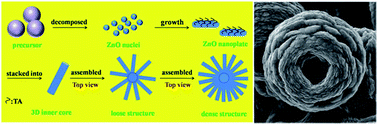
Clew-like ZnO mesocrystals comprised of ZnO nanoplates were created through a hydrothermal procedure in an aqueous solution using tartaric acid as the structure-directing additive. A detailed formation process of the nanoplate-based clew-like ZnO mesocrystal was investigated by varying reaction conditions especially the concentration of hexamethylenetetramine (HMT) and reaction time. It was found that the concentration of HMT played a significant role in the size distribution of ZnO products and the pileup degree of the nanoplates. Combined with the results obtained from the systematic time-dependent experiments, the formation of the nanoplate-based ZnO mesocrystal was mainly ascribed to the synergistic effect of the dipole moment generated among nanoplates and the electric field derived from a pre-formed inner core. The photocatalytic activity of samples synthesized using different HMT concentrations was also investigated. The results demonstrated that the adsorption percentage in the dark and degradation efficiency under UV-light irradiation were gradually improved with increasing the concentration of HMT. This was mainly ascribed to the increased specific surface area which promoted the migration of photon-generated carriers between the photocatalysts and rhodamine B (RhB) molecules.
Up to now, many research groups have fabricated various mesocrystals and discussed the corresponding formation mechanism with the emergence of mesocrystals.7–12 For instance, Song and co-workers prepared CaCO3 mesocrystals with high versatility using poly(4-styrenesulfonate-co-maleic acid) as the crystal modifier.13 Hong and co-workers synthesized nanoporous rutile TiO2 mesocrystals with wulff-shaped and nanorod-like morphologies employing sodium dodecyl benzene sulfonate as the surfactant.14 Deng and co-workers successfully fabricated Cu2O nanowire mesocrystals in the presence of o-anisidin and the Cu2O mesocrystals-based composite, reduced graphene oxide–Cu2O, exhibited enhanced sensitivity toward NO2 gas due to their high specific surface area and improved conductivity.15 The formation mechanism of the mesocrystal has also received much attention. Differing from the classical crystallization, the nonclassical crystallization provides a pathway for investigating the formation of ordered superstructures. However, the driving mechanism of mesocrystals is still demanded to investigate.16,17 Compared with the previous reported 3D mesocrystals constituted of nanoparticles or nanowires, the synthesis of mesocrystals consisted of densely stacked 2D nanoplates with high specific surface area and excellent properties is necessary to explore.
As a common semiconductor material, ZnO nanocrystals and microcrystals have obtained wide attention due to excellent photoelectrical properties as well as diverse morphology, such as nanorods, rhombic sheets and nanoplate-based 3D hierarchical structure.18–20 The formation mechanism was mainly illustrated by the classical crystallization process. Similarly, researchers have paid much attention to ZnO mesocrystals owing to their unique morphology and crystallization process. For example, Liu and coworkers first reported a novel apple-like nanoplatelet-based ZnO mesocrystals prepared by a low temperature hydrothermal method at 95 °C.11 Meanwhile, the formation mechanism of the as-obtained mesocrystal was systematically discussed and a dipole-field-driven mechanism was proposed.11 Ye and coworkers have fabricated ZnO bundled mesocrystals by a low-temperature, solution-phase approach in the presence of poly(vinyl pyrrolidone) (PVP) as a crystal growth modifier.21 Besides, ZnO mesocrystals with different morphologies were also successfully synthesized by applying different structure-directing agents, such as tetrabutyl ammonium hydroxide (TBAH), gelatin and others.22,23 However, despite the prepared various ZnO mesocrystal assembled by different subunits, it is highly desirable to synthesize ZnO mesocrystals in large scale by a simple method and to investigate their properties. Especially, no report focused on the preparation of clew-like ZnO mesocrystal microspheres. Such morphology may be advantages in tuning the performance.
Inspired by these previous reports, we prepared a novel clew-like ZnO mesocrystal microspheres comprised of densely stacked nanoplates in the presence of tartaric acid (TA) as the structure-directing additive. It was found that the size and the morphology of ZnO mesocrystal can be adjusted by varying different reaction conditions, such as reaction temperature and the concentration of raw materials. Furthermore, the formation mechanism of the ZnO mesocrystal was also discussed on the basis of the nonclassical crystallization crystal growth. In detail, the formation of such ZnO mesocrystal was depended on synergistic effect of the dipole moment generated among nanoplates and the electric field derived from the inner core. Moreover, ZnO mesocrystals prepared using 0.1 M hexamethylenetetramine (HMT) concentration exhibited the highest normalized kinetic constant compared with others. This was mainly ascribed to high specific surface area.
| Sample | Zn(NO3)2·6H2O/M | HMT/M | TA/M | Reaction temperature/°C | Reaction time/h |
|---|---|---|---|---|---|
| S1 | 0.05 | 0.05 | 0.01 | 150 | 6 |
| S2 | 0.05 | 0.05 | 0 | 150 | 6 |
| S3 | 0.05 | 0.05 | 0.008 | 150 | 6 |
| S4 | 0.05 | 0.05 | 0.015 | 150 | 6 |
| S5 | 0.05 | 0.05 | 0.01 | 200 | 6 |
| S6 | 0.02 | 0.05 | 0.01 | 150 | 6 |
| S7 | 0.05 | 0.075 | 0.01 | 150 | 6 |
| S8 | 0.05 | 0.1 | 0.01 | 150 | 6 |
| S9 | 0.05 | 0.15 | 0.01 | 150 | 6 |
| S10 | 0.05 | 0.05 | 0.01 | 150 | 0.5 |
| S11 | 0.05 | 0.05 | 0.01 | 150 | 1 |
000 rpm for 3 min to remove the photocatalyst. The concentration of RhB was monitored by recording variations of the maximum absorbance at 553 nm using the Hitachi U-4100 spectrometer.
It is well known that the reaction conditions are important in determining the formation of mesocrystals.26,27 Thereinto, the concentration of TA has significant effect on the formation ZnO mesocrystals as reported in previous literature.27 Hence, the relevant controlled experiments were carried out via changing the TA concentration. The morphologies of ZnO samples were characterized by SEM as shown in Fig. 2. Irregularly flower-like ZnO comprised by ZnO rods with hexagonal structure was obtained in the absence of TA additive as shown in Fig. 2a and b. With decreasing the TA concentration to 0.008 M from 0.1 M (Fig. 2c and d), aggregations of ZnO mesocrystals are obtained differing from well-dispersed mesocrystals as products shown in Fig. 1 and 4. To investigate the effect of increased TA concentration, the product was synthesized when the concentration of TA was increased to 0.015 M. As depicted in Fig. 2e and f, a lot of irregular particles with small amount of microspheres are observed. The result demonstrates that the concentration of TA has to be about 0.01 M to gain ZnO mesocrystals with fine dispersibility. The above result confirms that the concentration of TA plays a crucial role in the formation of clew-like ZnO mesocrystals due to that the negatively charged carboxyl groups in TA molecules are easily anchored on the Zn2+-terminated (0001) plane. When the concentration of TA was low, repulsive force among mesocrystals was weak. Thus, the formed individual ZnO mesocrystals aggregated driving by reduction of the surface free energy. Nevertheless, it is unfavourable to prepare well-dispersed ZnO mesocrystals by applying high concentration of TA. The possible reason is that the surface of precursors which will be mentioned in Fig. 5 is covered with large amount of TA molecules, leading to that the precursor is difficult to decompose. Driven by minimum surface energy, a small percentage of ZnO particles generated by decomposition of the precursor could aggregate quickly to form microspheres.
![]() | ||
| Fig. 2 SEM images of different ZnO products prepared under different concentration of TA: (a and b) in the absence of TA (S2), (c and d) with 0.008 M TA (S3) and (e and f) with 0.015 M TA (S4). | ||
![]() | ||
| Fig. 4 SEM images of ZnO mesocrystals prepared at different concentration of HMT. (a and b) 0.075 M, S7, (c and d) 0.1 M, S8, and (e and f) 0.15 M, S9. | ||
Moreover, to investigate the influence of other reaction conditions, ZnO samples with different morphologies were synthesized as shown in Fig. 3. It is worthwhile to mention that the hydrothermal temperature has a great influence on the morphology of samples.14 When the reaction system is conducted at a high temperature (200 °C), hamburger-like and football-like ZnO appear which has been labeled in Fig. 3a besides clew-like microspheres. These results indicated relatively low temperature was favorable for the formation of clew-like ZnO mesocrystals with uniform particle size distribution. This was probably due to high nucleation and growth rate at high temperature leading to inhomogeneous morphology. Interestingly, nanoplate-based ZnO microspheres with average diameter of 8.85 μm are obtained with decreasing the concentration of Zn(NO3)2 to 0.02 M on the basis of the typical experiment (Fig. 3b). Further observation on the inset of Fig. 3b indicates that the thickness of these nanoplate subunits is about 76.9 nm on average, which is 2.5 times larger than that of S1 (about 30.8 nm) shown in Fig. 1. This was attributed that the shortage of Zn(NO3)2 resulted in slow growth which was beneficial to generate ZnO thick nanoplates and self-assembled products with large dimension. The results suggested that the concentration of Zn(NO3)2 had to be adjusted to 0.05 M to create nanoplate-based clew-like ZnO mesocrystals with relatively uniform size distribution.
To get insight into the effect of the concentration of HMT, controlled experiments were carried out through simply varying HMT concentrations from 0.075 to 0.15 M with other parameters kept constant compared with the typical experiment. The SEM image in Fig. 4a indicates that the diameter of the clew-like ZnO structure is in the range of 3.17 to 4.63 μm with increasing the concentration of HMT to 0.075 M. Some ZnO products have large defect on their surface which suggests the sample are not fully developed (Fig. 4a) and thin nanoplates are also well aligned forming the clew-like ZnO (Fig. 4b). When the HMT concentration is increased to 0.1 M, the SEM image shows that the products are consisted of clew-like microspheres with 2.34–5.62 μm in diameter (Fig. 4c). Interestingly, some microspheres with large size exhibited no holes on their surface and small ones still have typical holes characteristic. Meanwhile, it can be observed that a few of the products has a more distinct hexagonal shape (Fig. 4d) compared with other ZnO samples. Actually, clew-shaped, nanoplate-based ZnO mesocrystals with uneven size distribution (2.31–7.69 μm in diameter) shown in Fig. 4e were prepared when 0.15 M of HMT was used. Furthermore, large irregular aggregates were also obtained. The phenomenon that the typical holes structure only existed in these ZnO mesocrystals with small size was consistent with the result gained from Fig. 4c. The result implies that HMT concentrations play a significant role in the size and structure of ZnO products.
In order to gain a complete understanding for the growth process of the clew-like ZnO mesocrystal, a systematic time-dependent morphology evolution study was performed at 150 °C for different hydrothermal time. In general, much important information can be provided via such time-resolved experiments for elucidating the underlying formation mechanism. In Fig. 5a, it can be observed that a large number of precursor particles displaying smooth surface with the diameter in the range of 0.9 to 1.2 μm are obtained at the primary stage of the crystallization process (i.e. nucleation stage of mesocrystal) due to fast nucleation caused by the reaction of Zn(NO3)2 and HMT. The corresponding XRD pattern suggests that the composition of S10 can be referred to Zn5(OH)8(NO3)2·2H2O by comparison with the standard pattern from JCPDS card no. 64-3411, while the broadness of the diffraction peaks implies the weak crystallinity (the red line in Fig. 5d). When the reaction time is reached 1 h, clew-like microstructures appear and coexist with a small quantity of particles in S11 (Fig. 5b and c). Further observation found that the size of particles was in a wide range of 385–769 nm, which suggested that the product shown in Fig. 5a was gradually decomposed with time. Meanwhile, some structures consisted of loosely packed nanoplates can be observed (marked by white arrows). Hereby, we speculate that the clew-like microspheres with loose structure could turn into the structures constituted of densely packed ZnO nanoplates represented in Fig. 1 with prolonging reaction time. As depicted in Fig. 5b, it is apparent that a core has been formed and nanoplates have aligned perpendicularly to the surface of the clew-like microsphere because of the influence of the core-based electric field. The result obtained from the XRD pattern of S11 (the black line in Fig. 5d) was further confirmed that the formation of a partial crystalline ZnO structure because of the decomposition of the precursor.
On the basis of the aforementioned experimental results and analysis, a plausible growth mechanism of the clew-like ZnO microspheres was proposed and the corresponding schematic model was depicted in Fig. 5e. In initial stage, ZnO nuclei were formed by the decomposition of Zn5(OH)8(NO3)2·2H2O precursors. Because the TA molecules had negatively charged carboxyl groups, they could easily adsorb onto Zn2+-terminated (0001) plane in the ZnO crystal, which was similar to previous literature.11,21,23 Therefore, this might block crystal growth along c-axis resulting in the generation of ZnO nanoplates, which has been observed in Fig. 1e. The adsorption of TA molecules can result in the aggregation of nanoplates for charge neutralization and plane stabilization.28 Driving by a strong dipole–dipole interaction between the nanoplates,29 they are inclined to stack together along the c-axis to build a 3D inner core structure. Afterwards, the effects of the electric field generated by the inner core and the minimum surface energy drive nanoplates to assemble to form clew-like ZnO microspheres with loosely packed structures. By increasing the reaction time, the dipole moment generated by the core is gradually equal to that of nanoplates with the growth of ZnO crystals. At the same time, to minimize the exposed high energy planes of nanoplates, the stack way of such subunits would alter to dense structure from loose structure. Finally, clew-like nanoplatelet-based ZnO mesocrystal microspheres are formed. From the result obtained from Fig. 2, it was observed that flower-like structure consisted of rods was generated in the absence of TA. For hexagonal ZnO crystal, it has both polar and nonpolar faces. Compared to nonpolar faces, the polar faces are thermodynamically unstable. Hence, in the hydrothermal reaction without TA, the Zn2+-terminated (0001) plane grows faster than other plans. Moreover, the generated HMT-4H+ cationic by the hydrolysis of HMT can absorb onto the O2−-terminated (000−1) plane to inhibit the growth of the (000−1) plane. Thus, the rod-like structure is easily to create. Finally, the formed ZnO rods are inclined to aggregate to produce flower-like ZnO. According to the analysis for Fig. 4, it was found that the amount of HMT plays a certain effect on the morphology of final ZnO mesocrystal. As previous reports, it usually been accepted that HMT can serve as a the nucleation-control reagent in most of the HMT-assisted hydrothermal systems.30,31 This is because HMT, as a weak base, can decompose to form protonated ammonia which in turn reacts with water to release OH− ions at elevated temperature. It has been reported that the overall reaction of HMT in the solution may be simply formulated as follows:32
| (CH2)6N4 + 6H2O ↔ 4NH3 + 6HCHO | (1) |
| NH3 + H2O ↔ NH3·H2O ↔ NH4+ + OH− | (2) |
With increasing the concentration of HMT, the above equilibrium will be inclined to the right side of those reactions, which is in favor of producing more OH− anions. With introducing more HMT into this system, the more ZnO nucleus was formed by the decomposition of Zn5(OH)8(NO3)2·2H2O precursors. Thus, non-uniform ZnO microspheres formed at high HMT concentration is attributed to the influence of abundant nuclei plus the shortage of raw materials. Moreover, the observation that the holes on ZnO mesocrystal microspheres with large size vanish by attaching nanoplates near the hole implies that the crystallization process of clew-like ZnO mesocrystals, differing from the conventional “ion-by-ion” crystal growth is non-classical crystallization since the existence of the long-range electric field that has been verified by Kniep and co-workers.33
Fig. 6 depicts the N2 adsorption–desorption isotherms and the corresponding BJH pore size distribution curves (insets) of S1 and S7–S9, respectively. All samples displayed typical IV isotherms with a hysteresis loop which is characteristic of a mesoporous structure.34 The BET surface areas and the pore size of such samples were summarized in Table 2. It is apparent that the specific surface area of ZnO mesocrystals increases monotonically with increasing concentration of HMT. Specifically, the measured surface areas of S1, S7, S8 and S9 are 11.0, 16.3, 21.5 and 23.5 m2 g−1, respectively. As observed in the BJH pore size distribution curves (insets of Fig. 6), all samples show the size of pores in the range of 5–20 nm. The average pore diameters of S1, S7, S8 and S9 are 8.2, 7.6, 6.2 and 5.2 nm, respectively, which should be mainly contributed from the pileup of the nanoplates. It could be concluded that the pore diameter could gradually decrease with the increasing of the HMT concentration. It is ascribed to that ZnO mesocrystals obtained at high HMT concentration are consisted of densely packed ZnO nanoplates, which is attributed to the high OH− concentration released from HMT (Fig. 4).
![]() | ||
| Fig. 6 BET adsorption/desorption isotherms and the corresponding BJH pore size distribution curves for different ZnO samples: (a) S1, (b) S7, (c) S8 and (d) S9. | ||
| S1 | S7 | S8 | S9 | |
|---|---|---|---|---|
| Specific surface area (m2 g−1) | 11.0 | 16.3 | 21.5 | 23.5 |
| Average pore diameter (nm) | 8.2 | 7.6 | 6.2 | 5.2 |
In general, the ZnO nanocrystals and microcrystals are excellent photocatalyst for degradation of contaminants.35–37 Moreover, organic dye RhB is a widely used cationic xanthene dye in the textile industry, which has gave rise to severe environmental pollution. Hence, considering the unique mesocrystal structure, the photocatalytic performance of the as-synthesized ZnO mesocrystal microspheres was investigated with RhB as a model pollutant. As depicted in Fig. 7a, a series of absorption spectra of the RhB aqueous solution were characterized by the Hitachi U-4100 spectrophotometer in the presence of S9 under UV light irradiation for different durations. It is found that the intensities of the maximum absorption peaks of RhB at 553 nm diminish gradually with prolonging irradiation time, which indicates the decreasing of RhB concentration. Meanwhile, the color of the aqueous solution almost disappeared when the time was reached to 5 h, signifying the decomposition of the chromophoric structure in RhB. Fig. 7b shows the comparison of the degradation efficiencies in the presence of different ZnO photocatalysts with the irradiation time of 5 h. The degradation efficiency of ZnO was here defined as C/C0, where C0 and C were the concentration after the adsorption–desorption equilibrium in the dark and the temporal concentration of RhB at different irradiation times, respectively. Therefore, a lower value of C/C0 demonstrated a higher photodegradation degree of RhB. The degradation efficiency of ZnO photocatalysts under UV light irradiation for 5 h followed the order of S9 (95.64%) > S8 (94.51%) > S7 (87.19%) > S1 (40.38%). In contrast, S9 and S8 prepared with higher HMT concentration showed higher photocatalytic activity exposed to UV light in comparison with other samples. In our previous work, the degradation efficiency of the hierarchical flower-like ZnO is only about 29.37% after UV light irradiation for 3 h.20 By comparison, the photocatalytic efficiency of S8 and S9 is improved owing to their unique clew-like morphology. However, the efficiency of S8 and S9 is relatively lower than sheet-like and butterfly-like ZnO nanostructures,20,35 which is probably attributed to their lower surface area. To obtain a better understanding about the photocatalytic efficiency, the pseudo-first order kinetics analysis of the various ZnO photocatalysts toward RhB degradation is discussed as follows. As shown in Fig. 7c, the photocatalytic reaction followed the pseudo-first order kinetics on the basis of the values of correlation coefficient (R2, inset of Fig. 7d). As shown in Fig. 7d, it is found that the kinetic constants of as-synthesized ZnO samples followed the order of S9 (0.6215 h−1) > S8 (0.5724 h−1) > S7 (0.4115 h−1) > S1 (0.1046 h−1). Furthermore, the kinetic constants normalized to the measured BET surface area of different samples followed the order of S8 (26.6 h−1 m2 mg−1) > S9 (26.4 h−1 m2 mg−1) > S7 (25.2 h−1 m2 mg−1) > S1 (9.51 h−1 m2 mg−1). The kinetic constants for S8 and S9 were about three times than that of S1 due to their higher surface area. These results showed that the photodegradation efficiency of the as-prepared photocatalysts was closely related to their specific surface area. Generally, the difference in photodegradation ability could be associated with the adsorption capacity of photocatalysts toward RhB dye. The adsorption percentage of different ZnO samples in the dark for 30 min followed the order of S8 (8.14%) > S9 (7.24%) > S7 (6.67%) > S1 (5.70%). It was well known that the lower absorption percentage implied the lower probability of photon-generated carriers transfer between the photocatalysts and the RhB molecules.
As reported in previous study, the degradation efficiency of a photocatalyst was ascribed to its microstructure, such as crystallinity degree, BET specific surface area, and others.35 Generally, a high surface area results in the good adsorption and photocatalytic performance. Therefore, the higher specific surface area of S8 and S9 is the main reason for explaining the enhanced photocatalytic activity. The relevant photocatalytic formula reactions have been reported in previous study.36,37 In our study, a series of reactions are showed in the following eqn (3)–(6) when the as-synthesized ZnO mesocrystal are exposed to a UV light. Under the light irradiation, the ZnO material is excited to produce separated electrons (e−) and holes (h+). Afterwards, the photogenerated electrons in conduction band (CB) are easily trapped by the dissolve oxygen to yield O2˙− radicals. And the photogenerated holes in valence band (VB) are reacted with H2O molecules to produce OH˙ radicals. Finally, the obtained radicals with high activity can degrade RhB into H2O and CO2 small molecules.
| ZnO + hν → ZnO(hvb+ + ecb−) | (3) |
| O2(absorbed) + ecb− → O2˙− | (4) |
| hvb+ + H2O/OH− → OH˙ | (5) |
| O2˙− + OH˙ + RhB(dye) → CO2 + H2O | (6) |
| This journal is © The Royal Society of Chemistry 2016 |