Acetate-induced controlled-synthesis of hematite polyhedra enclosed by high-activity facets for enhanced photocatalytic performance

Hao Wan abc, Tao Liuab, Xiaohe Liu*ab, Jiangling Panb, Ning Zhangb, Renzhi Ma*bc, Shuquan Liangb, Haidong Wang*a and Guanzhou Qiua
aSchool of Minerals Processing and Bioengineering, Central South University, Changsha, Hunan 410083, P. R. China. E-mail: liuxh@csu.edu.cn; joew@csu.edu.cn
bSchool of Materials Science and Engineering, Central South University, Changsha, Hunan 410083, P. R. China. E-mail: marenzhi@csu.edu.cn
cInternational Center for Materials Nanoarchitectonics (MANA), National Institute for Materials Science (NIMS), Namiki 1-1, Tsukuba, Ibaraki 305-0044, Japan

Received 25th March 2016 , Accepted 6th June 2016

First published on 28th June 2016


Abstract

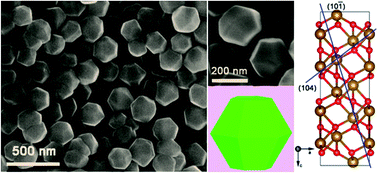
Uniform hematite polyhedra were fabricated by a facile acetate-induced solvothermal method. Based on a surface activity order of {101} > {012} > {001}, α-Fe2O3 truncated bipyramids dominantly enclosed by {101} facets showed the best performance regarding the photodegradation of RhB with a degradation rate constant of 0.01051 min−1.

Under the background of sustainable development, environmental issues have been the headlines in current society. Among the research studies on pollution problems, wastewater treatment account for quite a considerable proportion, e.g. adsorption and photocatalytic degradation.1 Therein, photocatalytic processes are a promising route that employs photocatalysts to transform inexhaustible solar energy into chemical energy towards decaying organic pollutants in wastewater.2 Since surface structure significantly influence the photocatalytic behavior of a catalyst, it's significant to rationally engineer surface structures, especially regulating the morphologies to expose more high-activity facets outwards.3 For example, it has been reported that for silver phosphate (Ag3PO4) crystals, exposed {110} facets exhibit better photocatalytic capacity than {001} facets for the degradation of methyl orange (MO) and rhodamine B (RhB) dyes4 while {002} facets for zinc oxide (ZnO),5 {001} facets for titania (TiO2)6 and {111} facets for cuprous oxide (Cu2O) show high activity.7 Thus, exposing more high-activity facets is regarded as an efficient way to enhance the photocatalytic performance.

Among photocatalysts, hematite (α-Fe2O3), has drawn intensive attention for its advantages of excellent photocatalytic performance and abundant resource in nature.8a α-Fe2O3, an ordinary semiconductor material with a favorable bandgap of 1.9–2.3 eV,9 is thermodynamically stable in all the iron oxides, even in aqueous acid solution with a relative low pH value of 3 or under high-temperature conditions. Therefore, α-Fe2O3 has been widely used in ions batteries, water splitting reactions, sensing and catalytic fields, etc.10 For α-Fe2O3 crystals, surface structure significantly influences the physicochemical properties, especially photocatalytic activity. It has been demonstrated that the photocatalytic performances of α-Fe2O3 catalysts are notably enhanced by the exposed high-activity facets. For example, Wang and co-workers have confirmed that α-Fe2O3 polyhedra with {101} facets exposed exhibit much higher catalytic activity than those with {001} facets.11 Zhou et al. have reported that α-Fe2O3 crystals enclosed by {012} facets outperform those enclosed by {001} facets in photodegradation of organic dyes.12 In addition, Ding and co-workers have declared that α-Fe2O3 crystals surrounded by {2[1 with combining macron]5} facets possess higher activity than pseudocubes of {102} facets in photogradation process.13 Among current synthetic strategy to promote the exposure of high-activity facets, toxic additives (e.g. formamide) or complicated reaction systems which may have negative effects on the environment are generally adopted to control the preferred growth direction of α-Fe2O3 crystals.14 Therefore, it's considerably significant to develop a nontoxic and facile synthetic strategy for α-Fe2O3 crystals to expose high-activity facets.

Herein, we demonstrate a novel solvothermal route by employing nontoxic univalent acetates as inducer and water–ethyl alcohol (H2O–EtOH) mixture as reaction system to promote the exposure of high-activity facets, e.g., {101} or {012}. Adjusting the acetate species in synthetic process, α-Fe2O3 polyhedra of uniform morphologies with desirable facets exposed were successfully prepared. Benefited from the exposed high-activity {101} facets, α-Fe2O3 truncated bipyramids exhibited the best catalytic performance in the photodegradation of RhB, resulting in the largest degradation rate constant.

The phase of the product obtained via a solvothermal process with potassium acetate (KAc) added was evaluated by X-ray diffraction (XRD) (black pattern shown in Fig. S1, ESI). All of the diffraction peaks are readily indexed to rhombohedral α-Fe2O3 structure (JCPDS 24-0072, space group: R[3 with combining macron]c (no. 167)) with lattice constants of a = 0.5036 nm and c = 1.3749 nm. No other peaks are detected, suggesting that the α-Fe2O3 product of high purity is successfully synthesized. The sharp diffraction peaks also show that the obtained α-Fe2O3 product is well-crystallized. To investigate morphology information, the α-Fe2O3 product was characterized by scanning electron microscopy (SEM). Fig. 1A and B depict the typical SEM images at different magnifications of the product obtained in the presence of KAc. From SEM result, it can be clearly seen that the particles have a polyhedral surface with an average size of ∼250 nm. The higher magnified SEM image in the top of Fig. 1C clearly displays the particle has truncated bipyramids morphology with a 6-fold axis and is enclosed by 12 oblique side facets and 2 flat top facets, which can be simulated as a geometric model (shown in the bottom of Fig. 1C). Fig. 1D shows a typical TEM image of the obtained product. Each particle exhibits a symmetrical structure. The inset in Fig. 1D is a select area electron diffraction (SAED) pattern collected at the marked circular region in Fig. 1D. The sharp regular spots reveal the single-crystalline nature of the α-Fe2O3 polyhedron with high crystallinity. The spots are indexed to {110}, {003} and {113} facets under the incident electron beam along [1[1 with combining macron]0] direction. It is noted that the intersection angle between {110} and {003} facets is precisely 90°, agreeing well with their crystallographic relation. The high-resolution TEM (HRTEM) image is presented in Fig. 1E. A two-dimension lattice fringes can be clearly resolved, indicating the particle is homogeneous structurally with an interplanar spacing of about 0.416 nm and 0.270 nm, which can correspond to the (10[1 with combining macron]) and (104) lattice planes, respectively, revealing that the lattice fringes were derived from the projection of α-Fe2O3 along the [010] direction (as depicted in Fig. 1F). Based on the HRTEM result, it's concluded that the 12 equivalent side facets can be attributed to {101} facets while the top and bottom facets are {001}.15


image file: c6ra07809e-f1.tif
Fig. 1 (A, B and the upper part of C) SEM images of the as-prepared α-Fe2O3 truncated bipyramids at different magnification; (the bottom of C) a model of a single particle; (D) TEM image and (E) HRTEM image of the as-prepared α-Fe2O3 product, the inset in (D) is a SAED pattern; (F) crystal structure of α-Fe2O3 product along [010] direction. Small red balls are oxygen atoms while large brown spheres stand for iron atoms.

In current synthetic approach, KAc, acting as an alkali source donator, plays a crucial role to the formation of α-Fe2O3 truncated bipyramids on basis of the reaction process: Ac + H2O ↔ HAc + OH. Under the high temperature condition, Ac ions contact with water molecule and hydrolysis, releasing OH anions slowly. The released OH anions can combine with iron ions (Fe3+) derived from ferric chloride (FeCl3·6H2O) raw material, thus, unstable Fe(OH)3 is generated. Under elevated temperature condition, Fe(OH)3 decomposes to produce the final product α-Fe2O3, accompanied with the formation of water. In the reaction system, the low content of water in H2O–EtOH mixture can limit the hydrolysis rate of Ac anions, by which the release rate of OH anions is controlled. Meanwhile, Ac anions have strong chelating effect with transition metal ions (e.g. Fe3+ ions) inherently, therefore, the excess Ac anions could coordinate with α-Fe2O3 crystals on specific planes and promote the growth along defined direction.16 On the other hand, it has been reported that the presence of divalent transition metal ions (e.g. Zn2+ and Cu2+ ions17) could tailor the growth direction as well as the shape of α-Fe2O3 crystals. Thus, it's reasonable to propose that due to the different adsorption properties to specific surface of α-Fe2O3 crystals, various univalent alkali metal ions (e.g. K+ ions) might also affect the formation of α-Fe2O3 polyhedra, leading to different featured facets. To verify this conjecture, experiments were conducted by using ammonium acetate (NH4Ac) and sodium acetate (NaAc) to replace initial KAc as additives.

The crystal structure of the products, obtained by adding NH4Ac and NaAc, respectively, were confirmed by the corresponding XRD patterns shown in Fig. S1. Both of the two patterns match well with that of α-Fe2O3 truncated bipyramids and no peaks of other impurities are observed, suggesting the products are of high purity. Fig. 2A is the SEM image of α-Fe2O3 prepared by adding NH4Ac, which shows that the α-Fe2O3 particles are well detached and have a fine uniformity with an average of ∼90 nm. The inset of Fig. 2A is a magnified SEM image, showing the powder is of pseudocube morphology, and its corresponding geometric model is depicted as the inset of Fig. 2B. Fig. 2B shows a TEM image of α-Fe2O3 pseudocubes. The particles are well-dispersed with an even size which is identical to the SEM result. The HRTEM measurement is also conducted on the transmission electron microscope to confirm the microstructure (depicted in Fig. 2C). The HRTEM image obviously shows an interlaced two-dimension lattice fringes with a dihedral angle of about 86° and an interplanar spacing of 0.368 nm, indexing to be (012) and (10[2 with combining macron]) lattice planes, respectively. The inset in Fig. 2C displays a corresponding SAED image. Likewise, the sharp spots matrix clearly shows the intrinsic single-crystal character and can conform to {012}, {10[2 with combining macron]} and {110} facets under the incident electron beam along the [2[2 with combining macron]1] direction. According to HRTEM and SAED results, the other surface is deduced to be (1[1 with combining macron]2). Thus, the exposed facets of the ideal α-Fe2O3 pseudocubes could be identical to {012}, {10[2 with combining macron]} and {1[1 with combining macron]2}. Interestingly, when KAc is substituted by NaAc, α-Fe2O3 with new morphology were also obtained. Fig. 2D and E are the SEM image and TEM image of α-Fe2O3 prepared by adding NaAc as inducer, respectively, in which hexagonal nanoplates with an average size of ∼150 nm in size are depicted. Based on the morphology results, a hexagonal nanoplate-like geometric model is built (shown as the inset in Fig. 2E). To further investigate the crystal structure, HRTEM is conducted (depicted in Fig. 2F). Similar with the HRTEM image in Fig. 2C, Fig. 2F also shows an interlaced two-dimension lattice fringes with a dihedral angle of about 60° and both of two groups of facets have an interplanar spacing of 0.252 nm, corresponding to ([2 with combining macron]10) and (110) facets, respectively. The inset in Fig. 2F is an identical SAED image, in which the spots suggest its single-crystal nature and can be signed to {[2 with combining macron]10}, ([1 with combining macron]20) and {110} facets and/or their equivalent facets under the incident electron beam along the [001] direction. Thus, the ideal model of hexagonal nanoplates is dominantly enclosed by (001) facets. From the above, adding different univalent acetates (containing K+, NH4+ or Na+ ions) in solvothermal process, α-Fe2O3 truncated bipyramids, pseudocubes and nanoplates with different activity facets exposed were successfully obtained separately. Generally, the formation of polyhedral architectures is caused by different growth rate along particular directions. Specifically, the growth rate of a defined direction is limited by surface adsorbed ions. As the hydrated radius of cations employed in this work obeys the order of Na+ < NH4+ < K+,18 the electrostatic adsorption ability on oxide surfaces in crystal nucleation and growth process may follow the opposite sequence. Induced by electrostatic interaction, univalent cations of smaller radius tend to adsorb on the surface with more oxygen atoms exposed. Thus, apart from the presence of Ac anions, the addition of univalent cations (K+, NH4+, Na+) seems to affect and regulate the growth rate of different α-Fe2O3 facets with variant density of surface atoms, as will elucidated later.


image file: c6ra07809e-f2.tif
Fig. 2 (A) SEM, (B) TEM and (C) HRTEM images of α-Fe2O3 pseudocubes, the insets in (A), (B) and (C) are a magnified SEM image, a geometric model and a SAED pattern, respectively; (D) SEM, (E) TEM and (F) HRTEM images of α-Fe2O3 nanoplates, the insets in (D), (E) and (F) are a magnified SEM image, a geometric model and a SAED pattern, respectively.

As is known, α-Fe2O3 polyhedra with specific index facets exposed tend to have considerable performance in catalytic field. And the photocatalytic activity of α-Fe2O3 materials could be assessed by the photodegradation of RhB in the presence of hydrogen peroxide (H2O2) under UV-vis irradiation. The intensity of absorption peak around 550 nm was adopted to represent the concentration of aqueous RhB solution, thus the decrease of intensity as the time prolonged was used to character the photocatalytic performance of α-Fe2O3 materials. Fig. 3A shows time-dependent UV-vis absorption spectra of RhB solution during photodegradation process in the presence of α-Fe2O3 truncated bipyramids under UV-vis irradiation, from which it can be observed visually that the high-concentration RhB solution is almost degraded completely after 30 min. The practical degradation result is shown intuitively as the inset of Fig. 3A. Obvious color change of the solution was observed and the last group seems to be colorless. The variation of photodegradation degree (signed as c/c0, wherein c and c0 are the concentration at a random reaction time and the initial concentration, respectively) of RhB solution with the irradiation time in the presence of these three classes of catalysts, α-Fe2O3 truncated bipyramids, pseudocubes and nanoplates, is compared in Fig. 3B. The photodegradation degree follows the order that α-Fe2O3 truncated bipyramids exhibit dramatically superior photodegradation activity on RhB solution to α-Fe2O3 pseudocubes, which manifest higher photocatalytic performance than α-Fe2O3 nanoplates. In the whole degradation process, α-Fe2O3 truncated bipyramids exhibits the best result continuously in comparison. Moreover, it can be seen that irradiated by Xe light for 30 min, the degradation efficiency of RhB is 98.08%, 90.30% and 81.14% for α-Fe2O3 truncated bipyramids, pseudocubes and nanoplates, respectively (while 22.63% for the blank test). In addition, Fig. 3C depicts that after continuous irradiation for 15 min, the degradation degree of RhB achieves to be 80.04% for α-Fe2O3 truncated bipyramids, which is notably higher than that for α-Fe2O3 pseudocubes (52.46%) and nanoplates (43.14%). Notably, the degradation value of 80.04% for α-Fe2O3 truncated bipyramids is obviously higher than 60% for α-Fe2O3/graphene composite with a weight ratio of 1% for GO.19


image file: c6ra07809e-f3.tif
Fig. 3 (A) Time-dependent UV-vis absorption spectra in the presence of α-Fe2O3 truncated bipyramids; (B) comparison of photodegradation of RhB by α-Fe2O3 enclosed by specific facets in 30 min; (C) photocatalytic performance of α-Fe2O3 polyhedra in 15 min; (D) kinetic curves of the degradation of the photodegradation of RhB.

Previous reports show that the degradation of RhB molecule can be regarded as a pseudo-first order reaction and the photocatalytic reaction kinetics follow the formula: ln(c0/c) = kt, where k is the degradation rate constant while t is the reaction time and c0 and c refer to the same with above statement.19 To further compare the distinctions of photocatalytic degradation activity of the three catalysts, rate constant k is adopted to evaluate the reaction rate of a photocatalytic process. The variations of the value of ln(c0/c) as a function of reaction time are shown in Fig. 3D. On basis of the calculated kinetic curves, α-Fe2O3 truncated bipyramids have the largest rate constant, 0.1051 min−1, which is about twice and three times as high as that of α-Fe2O3 pseudocubes (0.0484 min−1) and nanoplates (0.0342 min−1), separately. Generally, the photocatalytic activity of α-Fe2O3 crystals is mainly determined by surface structure and surface area, etc. In current degradation comparisons, it's obviously adverse for α-Fe2O3 truncated bipyramids in surface area due to its larger size than that of α-Fe2O3 pseudocubes and nanoplates of nanoscale. This abnormal degradation result may be ascribed probably to the surface structure of exposed facets of the three catalysts.

It's generally accepted that the surface structure, including surface electronic and atomic structure, may influence photocatalytic reactivity. UV-vis diffuse reflectance spectra (DRS) were adopted to investigate the surface electronic structure of the catalysts. After Kubelka–Munk transformation of the reflection as a function of wavelength, the spectra suggest that all the α-Fe2O3 catalysts share a comparative absorption edge at the range of 550–600 nm (shown in Fig. S2, ESI). The inset is the calculation diagram of the bandgaps, which is determined to be 2.10, 2.16 and 2.17 eV for α-Fe2O3 truncated bipyramids, pseudocubes and nanoplates, respectively. The as-prepared α-Fe2O3 catalysts show comparable surface electronic structure, meanwhile, the visual differences in photocatalytic performance could be rationalized by the intrinsic differences in atomic structures of exposed facets.

Table S1 (shown in ESI) lists the dominant exposed facets of the three α-Fe2O3 catalysts. Previous studies have shown that nanoplates mainly enclosed by {001} facets were terminated by either a single oxygen or iron layer (shown as Fig. 4A and B). In aqueous solution, the crystallographically distinct terminations could coexist and affect the reactivity. The density of surface iron atoms of {001} facets is 0 and 4.6 atoms per square nanometer for an oxygen and iron terminated layer respectively, less than 7.3 atoms per square nanometer of {012} facets. As a result, {001} facets exhibit lower photocatalytic activity than {102} ones.20 For pseudocubes, the exposed {012}, {1[1 with combining macron]2} and {10[2 with combining macron]} facets are equivalent in crystallographic arrangement and atomic structure. Thus, the photocatalytic results of α-Fe2O3 nanoplates and pseudocubes are identical with the atomic structures of the exposed facets. In addition, for the mixed oxygen and iron terminations of exposed {101} facets, the density of surface iron atoms is 8.3 atoms per square nanometer, higher than that of {102} facets. Furthermore, unlike the iron atoms in bulk, half of iron atoms of {101} facets are coordinated with five oxygen atoms and the rest are tetracoordinated (depicted as Fig. 4D) while each iron atom of {012} facets is pentacoordinated with oxygen atoms (shown in Fig. 4C). More unsaturated coordination may generate nonlinear higher electrostatic adsorption capacity for RhB. Meanwhile, the ridge-and-valley structure of exposed {101} surface is helpful for the adherence of RhB molecule on coordinatively unsaturated iron atoms. Since the degradation of RhB is greatly influenced by iron cations of +3 state, which can lead to the generation of hydroxy radicals (˙OH), to decompose dye molecules. Hence, the photocatalytic activity of exposed facets follows the order: {101} > {012} > {001}, which is identical to surface energies order of quantitative analysis previously,8b,21 while the photocatalytic performance of α-Fe2O3 polyhedra obeys the sequence of truncated bipyramids > pseudocubes > nanoplates. Compared with previous reports on photocatalysts for Fenton reaction, current finding claims that surface engineering rationally is significant in photocatalytic field.


image file: c6ra07809e-f4.tif
Fig. 4 Side views of exposed facets terminations: {001} with (A) oxygen and (B) iron atoms terminations; (C) {012} and (D) {101}. The dark arrows refer to the unsaturated iron atoms coordinated with five oxygen atoms and the light arrow is tetracoordinated iron atoms.

In summary, a solvothermal synthetic strategy was demonstrated for the controllable preparation of uniform α-Fe2O3 truncated bipyramids, pseudocubes and nanoplates by introducing KAc, NH4Ac and NaAc as inducer, respectively. Benefited from surface activity of {101} > {012} > {001} facets, α-Fe2O3 truncated bipyramids performed the best on the photodegradation of RhB under UV-vis light irradiation and had the largest degradation rate constant. This work shows great potential to tailor the exposed facets of metal oxides semiconductors by adding inorganic salts as inducer for surface engineering to enhance photocatalytic performance.

Acknowledgements

The authors acknowledge the financial support by National Natural Science Foundation of China (51372279), Hunan Provincial Natural Science Foundation of China (13JJ1005). X. L. acknowledges support from Shenghua Scholar Program of Central South University. R. M. acknowledges support from JSPS KAKENNHI (24310095).

Notes and references

  1. (a) W. Lei, D. Portehault, D. Liu, S. Qin and Y. Chen, Nat. Commun., 2013, 4, 1777 CrossRef PubMed; (b) X. Wang, M. Liao, Y. Zhong, J. Y. Zheng, W. Tian, T. Zhai, C. Zhi, Y. Ma, J. Yao, Y. Bando and D. Golberg, Adv. Mater., 2012, 24, 3421 CrossRef CAS PubMed.
  2. S. Sakthivel, B. Neppolian, M. V. Shankar, B. Arabindoo, M. Palanichamy and V. Murugesan, Sol. Energy Mater. Sol. Cells, 2003, 77, 65 CrossRef CAS.
  3. T. Yu, D. Y. Kim, H. Zhang and Y. N. Xia, Angew. Chem., Int. Ed., 2011, 50, 2773 CrossRef CAS PubMed.
  4. Y. P. Bi, S. X. Ouyang, N. Umezawa, J. Y. Cao and J. H. Ye, J. Am. Chem. Soc., 2011, 133, 6490 CrossRef CAS PubMed.
  5. (a) A. McLaren, T. Valdes-Solis, G. Li and S. C. Tsang, J. Am. Chem. Soc., 2009, 131, 12540 CrossRef CAS PubMed; (b) W. Ma, R. Z. Ma, J. B. Liang, C. X. Wang, X. H. Liu, K. C. Zhou and T. Sasaki, Nanoscale, 2014, 6, 13870 RSC.
  6. (a) H. G. Yang, C. H. Sun, S. Z. Qiao, J. Zou, G. Liu, S. C. Smith, H. M. Cheng and G. Q. Lu, Nature, 2008, 453, 638 CrossRef CAS PubMed; (b) S. W. Liu, J. G. Yu and M. Jaroniec, J. Am. Chem. Soc., 2010, 132, 11914 CrossRef CAS PubMed.
  7. C. H. Kuo, C. H. Chen and M. H. Huang, Adv. Funct. Mater., 2007, 17, 3773 CrossRef CAS.
  8. (a) J. X. Zhu, Z. Y. Yin, D. Yang, T. Sun, H. Yu, H. E. Hoster, H. H. Hng, H. Zhang and Q. Y. Yan, Energy Environ. Sci., 2013, 6, 987 RSC; (b) M. T. Niu, F. Huang, L. F. Cui, P. Huang, Y. L. Yu and Y. S. Wang, ACS Nano, 2010, 4, 681 CrossRef CAS PubMed.
  9. J. Bandara, U. Klehm and J. Kiwi, Appl. Catal., B, 2007, 76, 73 CrossRef CAS.
  10. (a) Z. L. Jian, B. Zhao, P. Liu, F. J. Li, M. B. Zheng, M. W. Chen, Y. Shi and H. S. Zhou, Chem. Commun., 2014, 50, 1215 RSC; (b) Y. Zhao, J. X. Li, Y. H. Ding and L. H. Guan, Chem. Commun., 2011, 47, 7416 RSC; (c) B. Zhang, L. X. Zheng and K. K. Jang, RSC Adv., 2014, 4, 12298 RSC.
  11. X. Wang, J. Q. Wang, Z. T. Cui, S. G. Wang and M. H. Cao, RSC Adv., 2014, 4, 34387 RSC.
  12. X. M. Zhou, Q. L. Xu, W. Y. Lei, T. T. Zhang, X. Y. Qi, G. Liu, K. Deng and J. G. Yu, Small, 2014, 10, 674 CrossRef CAS PubMed.
  13. D. H. Ding, Y. Huang, C. F. Zhou, Z. W. Liu, J. C. Ren, R. Q. Zhang, J. H. Wang, Y. J. Zhang, Z. F. Lei, Z. Y. Zhang and C. Y. Zhi, ACS Appl. Mater. Interfaces, 2016, 8, 142 CAS.
  14. (a) J. J. Ouyang, J. Pei, Q. Kuang, Z. X. Xie and L. S. Zheng, ACS Appl. Mater. Interfaces, 2014, 6, 12505 CrossRef CAS PubMed; (b) X. Liang, X. Wang, J. Zhuang, Y. T. Chen, D. S. Wang and Y. D. Li, Adv. Funct. Mater., 2006, 16, 1805 CrossRef CAS.
  15. B. L. Lv, Z. Y. Liu, H. Tian, Y. Xu, D. Wu and Y. H. Sun, Adv. Funct. Mater., 2010, 20, 3987 CrossRef CAS.
  16. A. G. Yan, X. H. Liu, R. Yi, R. R. Shi, N. Zhang and G. Z. Qiu, J. Phys. Chem. C, 2008, 112, 8558 CAS.
  17. R. M. Liu, Y. W. Jiang, H. Fan, Q. Y. Lu, W. Du and F. Gao, Chem.–Eur. J., 2012, 18, 8957 CrossRef CAS PubMed.
  18. A. G. Volkov, S. Paula and D. W. Deamer, Bioelectrochem. Bioenerg., 1997, 42, 153 CrossRef CAS.
  19. S. C. Han, L. F. Hu, Z. Q. Liang, S. Wageh, A. A. Al-Ghamdi, Y. S. Chen and X. S. Fang, Adv. Funct. Mater., 2014, 24, 5719 CrossRef CAS.
  20. X. M. Zhou, J. Y. Lan, G. Liu, K. Deng, Y. L. Yang, G. J. Nie, J. G. Yu and L. J. Zhi, Angew. Chem., 2012, 124, 182 CrossRef.
  21. H. B. Guo and A. S. Barnard, J. Mater. Chem., 2011, 21, 11566 RSC.

Footnotes

Electronic supplementary information (ESI) available. See DOI: 10.1039/c6ra07809e
These authors contributed equally to this work.

This journal is © The Royal Society of Chemistry 2016
Click here to see how this site uses Cookies. View our privacy policy here.