Mahdi Maleki*a,
Mohammadreza Shokouhimehra,
Hossein Karimianb and
Ali Beitollahi*a
aCenter of Excellence for Ceramic Materials in Energy and Environment Applications, School of Metallurgy & Materials Engineering, Iran University of Science and Technology (IUST), Narmak, Tehran 16846, Iran. E-mail: beitolla@iust.ac.ir; malekim@metaleng.iust.ac.ir; Fax: +98 21 77240480; Tel: +98 21 77459151
bSchool of Chemical Engineering, Golestan University, Gorgan, P.O. Box 45138–15739, Iran
First published on 19th May 2016
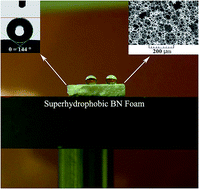
In this work, for the first time, we report the successful synthesis of three-dimensionally interconnected porous boron nitride foams (BNFs) with a high degree of crystallinity using porous sacrificial polymeric hard templates. Ammonia borane/CTAB solution were infiltrated inside highly porous preforms of poly(styrene-co-divinylbenzene) (PS), poly(acrylonitrile-co-divinylbenzene) (PAN) and poly(ethylhexyl acrylate-co-divinylbenzene) (PEHA) made using a high internal phase emulsion process. These were later subjected to pyrolysis under an ammonia atmosphere at the rather low temperature of 1150 °C for 90 minutes. The obtained products were characterized using X-ray diffraction, Fourier transformed infrared spectroscopy, N2 sorption analysis, scanning electron microscopy, scanning transmission electron microscopy and high resolution transmission electron microscopy (HR-TEM). The synthesized BNFs closely replicated and retained the open-cellular interconnected microstructure of the polymeric templates. The HR-TEM results revealed the formation of highly crystalline BN stack layers in small domains. The prepared BNF using the PS template showed superhydrophobic behavior which was typical for all of the prepared samples, with a water contact angle of ∼144° and a high adsorption capacity of 1800% for used engine oil.
Metallic foams such as nickel and copper have been used as templates for the preparation of 3D interconnected porous graphene, MnO2, MnO2/graphene and carbon nanotube/graphene composite foams.7–11 However, as obtained frameworks are usually prepared with CVD or particle assembly on the metallic foams, the final structures are usually composed of macropores rather than mesopores or micropores in the framework.8,11 Further, the process of metallic template removal is another shortcoming of such processes.
Polymeric foams (PFs) coated with inorganic compounds lend themselves as convenient templates for appropriate replication of their highly interconnected porous structures into the rigid inorganic bodies after being subjected to suitable pyrolysis conditions. Particle-stabilized high internal phase emulsions systems (HIPEs) have already been utilized for the preparation of 3D interconnected porous PFs. HIPEs are commonly defined as very concentrated emulsions, in which the volume fraction of the internal phase is more than 74% of the emulsion volume.12 The prepared porous polymers with this route are known as polyHIPEs.12 In this approach, oil phase of the emulsion gradually polymerizes into a bulk porous polymer, while the aqueous phase, initially serving as the liquid droplet template gradually evaporates, leading to the interconnected macropores framework. This procedure was also employed for the synthesis of ZnO, TiO2, graphene oxide/polymer composite and silica foamy structures.13–16 3D interconnected porous PFs have been also utilized for the synthesis of porous carbon foams (CFs) after applying appropriate carbonization process, directly.17,18
Interesting properties of boron nitride (BN) such as low density, oxidation resistance, high thermal conductivity, low dielectric constant and loss and wide band gap have attracted attentions of scientists to develop its applications for high technology devices.19–22 Various BN morphologies like nanotubes,23 nanosheets,24 nanoparticles,25 microbelts,26 BN aerogels27,28 and meso/microporous powders29 have been prepared with different preparation methods. In the case of the latter, fabrication of highly interconnected macro, meso and microporous structures lead to enhanced/fast diffusion and transport behavior of the adsorbed species. In this respect, 3D foamy structures by containing the above mentioned pore structures satisfy those conditions. However, despite many research works focusing on the synthesis of BN powders by various preparation routes, there has been less attention to the synthesis of BNF of highly interconnected pores. For this purpose, previous works have mainly employed hard template approach.
M. Rousseas et al. to obtain a high crystalline BN aerogel via carbothermal reduction of boron oxide in the presence of graphene aerogel at high temperatures (1600–1800 °C).30 This strategy has also been already employed for the synthesis of porous BN nanourchins, nanocages and mesoporous BN powders using porous carbon powders.31–33 Compared to CVD methods with hard templates such as carbon and nickel foam to make a BNF, carbothermal reduction at high temperature does not need extra washing or treatment for the removal of hard template.30 However, due to reaction between template and boron oxide at high temperatures, the resulting BN product form carbothermal reduction did not retain the original morphology of the carbon templates very well.
Well-organized 3D interconnected BNF was prepared through chemical vapor deposition of ammonia borane (AB) on the surface of hard template (nickel foam) at 1000 °C.34 Further, CFs derived from silica foams have also been employed to obtain BNFs. In this approach, polyborazylene had been infiltrated inside of CFs and followed by pyrolysis of the infiltrated CFs under nitrogen atmosphere which led to the formation of BN–C composite. Then, carbon was eliminated under ammonia atmosphere to form BNF.35 However, despite the successful synthesis of open-cellular interconnected BNF structure based on such approach, the removal of template, the use of toxic/volatile precursors and various processing stages reflect themselves as the major drawbacks for such preparation route.35
The use of sacrificial PFs as the hard template along with an appropriate BN precursor offer a novel solution to overcome such problems for the preparation of the foamy BN for different applications. In this communication, for the first time, we have utilized a new class of removable polyHIPEs templates: poly(styrene-co-divinylbenzene) (PS), poly(acrylonitrile-co-divinylbenzene) (PAN) and poly(ethylhexyl acrylate-co-divinylbenzene) (PEHA) for the synthesis of well-organized 3D interconnected porous BNFs at rather low temperature of 1150 °C.
| Materials | Weight (g) | ||
|---|---|---|---|
| Polymeric foam | |||
| PS | PAN | PEHA | |
| Water | 90 | 85 | 90 |
| CaCl2·2H2O | 0.99 | 0.94 | 0.99 |
| Potassium persulfate | 0.30 | 0.425 | 0.425 |
| Styrene | 4.83 | — | — |
| Acrylonitrile | — | 4.86 | — |
| 2-Ethylhexylacrylate | — | — | 6.88 |
| Divinylbenzene | 1.21 | 3.64 | 1.82 |
| 1,2-Dichlorobenzene | 4.37 | 6.55 | — |
| Benzoyl peroxide | — | 0.425 | — |
| Span 80 | 2 | — | 2 |
| PGPR | — | 1.5 | — |
| Sample | CTAB | AB | Tpolymerization (°C) | PolyHIPE | tpolymerization (h) | Theat treatment (°C) |
|---|---|---|---|---|---|---|
| BN.PS | 0.2 | 0.1 | 75 | PS | 16 | 1150 |
| BN.PS.A | — | 0.1 | 150 | PS | 2 | 1150 |
| BN.PEHA | 0.2 | 0.1 | 75 | PEHA | 16 | 1150 |
| BN.PAN | 0.2 | 0.1 | 75 | PAN | 16 | 1150 |
![]() | (1) |
![]() | (2) |
n and
w are the number and weight-average cell sizes, respectively and Ni is the number of cells or windows with a diameter of Di. The polydispersity index (PDI) which is a criterion of the cell or window size distribution within the polymeric foam was also determined for the studied samples.
Contact angles were measured by a contact-angle meter (OCA 15 plus, Dataphysics Co., Ltd) using a 4 μL droplet of water at room temperature. Average values of contact angle were obtained from three measurements per sponge.
In a typical sorption test, a BNF was placed in contact with an organic liquid until the foam was completely filled with the organic liquid, and then was taken out for weight measurement. The saturated foams were weighed quickly to prevent evaporation of the adsorbed organic liquid.
0) reflections of h-BN structure, respectively.38 This reflects the good crystalline nature of the as-synthesized BN foam. However, rather low intensity and sharpness of (10
0) peak suggests the lack of long-range order in c direction.28 Thus, the crystalline structure could be assigned to the turbostratic BN (t-BN) phase.28
The FT-IR spectrum of the BN.PS is displayed in Fig. 2b. The strong peak appeared at 1385 cm−1 can be attributed to the stretching vibration of the B–N bonds, while that peak appeared at 810 cm−1 can be assigned to the out-of-plane bending vibrations of B–N–B bonds.39 The weak bands around 3433 cm−1 can be also assigned to ν(N–H) or ν(BOH) vibrations.40 The lack of peaks related to B–C or C–N bonds in FTIR spectrum (C–N: 1254 cm−1, C
N: 1632 cm−1, and C
N: 2162 cm−1, B–C: 1100, 1200 cm−1) demonstrate the elimination of carbonaceous template materials.41,42 CHN analysis revealed low carbon content (2 wt%) in the prepared BNF (BN.PS).
![]() | ||
| Fig. 3 (a–c) SEM micrographs, (d–f) TEM and HRTEM images, (g) STEM micrograph, (h) B map and (i) N map of the BNF.PS. | ||
TEM and STEM micrographs (Fig. 3d, e and g) reveal the porous structure of BN.PS product. In harmony with SEM images, TEM images show the presence of many pores with different sizes distributed on the surface of BNF. The high porosity of the structures is indeed obvious. In addition to large pores, mesopores and micropores can be seen in TEM images. Micropores are clearly visible on the walls around mesopores in Fig. 3e. HR-TEM characterization of BNF (Fig. 3f) indicates that BN layers are parallel in small domains of 5–7 nm. Distorted layers and discontinuities can be seen in HR-TEM image. The interlayer spacing between adjacent (002) fringes is in the range of 0.34–0.36 nm and changes from one domain to another. However, these observations are larger than the (0002) interplanar distance in bulk h-BN (0.33 nm).43 The ordering type reported for highly porous BN structures is t-BN as an intermediate phase between classical h-BN and amorphous (a-BN) phases.28 The different d-spacing in different points could be related to misorientation of BN stack layers. In fact, lacking long-range order in c-axis is the character of t-BN phase so that some layers are rotated relative to other ones.28
The crystalline nature of the product can be attributed to poly(aminoborane) and borazine formation. D. P. Kim et al. had reported that poly(aminoborane) is graphitizable precursor in formation of BN.44 The formation of poly(aminoborane) from AB decomposition was observed when AB was aged at 70–80 °C.45 Therefore, poly(aminoborane) formation in the pores of template resulted from pretreatment at 75 °C before pyrolysis could be possibly lead to high degree of crystallinity in the obtained products. Furthermore, the use of AB as a BN precursor in CVD procedures led to high crystalline BN structures. G. Kim et al. obtained h-BN with high degree of crystallinity through low pressure chemical vapor deposition of AB on a platinum foil at 1100 °C.46 Further, high crystalline BN layers were grown on graphene layers by borazine-derived from AB.47 The formation of highly crystalline structures obtained by CVD methods presumably are due to similar conformation of polymerized borazine and BN.48 For the prepared BNFs in this work, the initial precursor sol can penetrate in the macropores and mesopores of the template. As a result of increasing the temperature in pyrolysis program, the borazine could also be formed and trapped in the highly porous template.49 The trapped borazine in the highly porous structure of polyHIPE may increase the crystallinity of the product. Fig. 3 h and i revealed the elemental mapping of boron and nitrogen. These images approved homogenous distribution of boron and nitrogen in the sample as well.
Since rapid heating of AB is accompanied with foaming and swelling,45 the sample of PS.BN.A was prepared through fast heating of AB infiltrated in PS without CTAB. For this purpose, the PS foam infiltrated with AB heated to 150 °C very fast under nitrogen atmosphere to make a continuous layer of AB decomposition products on the PS walls through AB foaming. BN.PS.A sample did not retain the microstructure of initial PS foam very well compared to BN.PS after pyrolysis at ammonia atmosphere (1150 °C) as shown in Fig. 4a. The prepared BN.PS.A sample also revealed higher shrinkage and it was more fragile to handle compared to PS.BN sample. Mokoya et al. also used AB as a BN precursor and mesoporous silica as a hard template to prepare mesoporous BN.50 Porous structure of silica was not replicated by BN even under so long heat treatment under ammonia atmosphere. This could be due to direct pyrolysis of AB without pretreatment.45,51,52
After successful synthesis of BNF with PS as the porous polymeric template, the PEHA and PAN polyHIPE foams were also utilized to prepare BNFs. The white BNFs were obtained by PEHA and PAN polyHIPE foams. SEM and TEM images in Fig. 4b and S1a and b† demonstrated that the BN.PAN prepared using PAN polyHIPE successfully replicated the microstructure of the polyHIPE foam. Despite dimensional stability of the bulk BN.PEHA, the resulting BN foam did not retain the original open-cellular microstructure of the PEHA foam very well (Fig. 4c and S1c†). The mean size of the cells and windows of the templates and the obtained BNFs are summarized in Table 3. Following pyrolysis, the mean cell and window diameter of the PS foam decreased from 82.17 to 67.35 μm and from 20.62 to 17.04 μm, respectively. The mean cell and window diameter of the BN.PAN foam decreased 4.3% and 15%, respectively. In addition, the size distribution of the cells and windows in both BN foams is almost identical to those of the polyHIPE foams. The smaller pore size of the BN foams can be attributed to shrinkage taken place during pyrolysis at high temperature.
| Foam | Cells | Windows | ||||
|---|---|---|---|---|---|---|
n (μm) |
w (μm) |
PDI | n (μm) |
w (μm) |
PDI | |
| PS | 82.17 | 97.78 | 1.19 | 20.62 | 24.25 | 1.17 |
| PEHA | 9.10 | 9.74 | 1.07 | 3.16 | 3.90 | 1.23 |
| PAN | 13.47 | 15.21 | 1.13 | 2.42 | 2.89 | 1.19 |
| BF.PS | 67.35 | 80.17 | 1.20 | 17.04 | 20.19 | 1.18 |
| BF.PEHA | Not determinable | |||||
| BF.PAN | 12.89 | 13.73 | 1.06 | 2.08 | 3.36 | 1.61 |
![]() | ||
| Fig. 5 (a) Superhydrophobic behavior of the BN.PS. The inset show contact angle of BNF, (b) withdrawal of water droplet from the BN.PS surface, (c) and (d) engine oil adsorption by BN.PS. | ||
According to literature, BN films displays the hydrophilic behavior due to ionic nature and interaction of the B–N bond with polar water molecules.28 However, superhydrophobic behavior has been observed owing to surface chemistry and surface roughness in BN nanostructures. Boinovich et al. found an increase in the water contact angle on BN film with adsorption of organic pollutant from air.53 Recently, Zettl research group verified this phenomenon for the appearance of superhydrophobicity in BN aerogel.28 Furthermore, surface roughness with a certain size leads to air entrapment between the droplet and solid surface. Such an air pocket can lead to superhydrophobicity.54 A similar behavior could also be expected for the superhydrophobicity in BNF prepared in this study as well.
When the superhydrophobic BN.PS was immersed in water, it could easily float on the surface of water. By application/removal of an external force, the foam refloats on the surface of water. This implies that the superhydrophobic BN.PS foam can be used to remove organic pollutants or solvents on water surface or for separation of oil/water mixtures. Further, it was reported that porous BN nanosheets could adsorb organic solvents and oils from the water surface.55 To examine the adsorption capacity of BN.PS foam prepared in this work, the used engine oil, cyclohexane, ethanol, gasoline, ethylene glycol, glycerin, toluene, n-propanol and dichlorobenzene were utilized. The BNF quickly adsorbed used engine oil from the surface of water (Fig. 5c and d and ESI,† Movie). Once the BN.PS foam was dropped on the oil–water surface, it immediately adsorbed the oil engine and became dark brown. Based on various experiments run for the prepared BNF samples, it was confirmed that samples can approximately absorb up to 19 times of their own weight by used engine oil. As can be seen, the BN.PS still float on the surface of water. Although the adsorption capacity was lower than that of BN nanosheets,55 the BN.PS does not suffer from the main drawback of nanosheets, i.e. powders skimming from the water surface.
The prepared BN.PS showed reasonable adsorption capacities for other oils and organic solvents. As shown in Fig. 6, used engine oil, cyclohexane, ethanol, gasoline, ethylene glycol, glycerin, toluene, n-propanol and dichlorobenzene 600 to 1900 wt% (relative to the BNF dry weight). The use of BNF seems to act as a container to pull organic compounds in its highly porous structure with high surface area (180 m2 g−1, S2†) compared to conventional BN powders. The high adsorption capacity of BNF can be due to capillarity effects and filling of the interconnected pores in the highly porous BNF. This structure with abundant pores in different sizes not only leads to a high surface roughness, but also provides enough sites to adsorb large amounts of oil.
Span 80 as Surfactant, Macromolecules, 2004, 37(9), 3188–3201 CrossRef CAS.Footnote |
| † Electronic supplementary information (ESI) available. See DOI: 10.1039/c6ra07751j |
| This journal is © The Royal Society of Chemistry 2016 |