DOI:
10.1039/C6RA07331J
(Paper)
RSC Adv., 2016,
6, 57683-57694
A predictive model for gas and vapor sorption into glassy membranes at high pressure
Received
20th March 2016
, Accepted 2nd June 2016
First published on 8th June 2016
Abstract
This work focuses on the development of a predictive model based on the non-equilibrium lattice fluid (NELF) model using the fractional free volume (FFV) for the gas and vapor sorption into glassy membranes in a large interval of pressure and temperature. For this purpose, the FFV values were calculated as a function of pressure and temperature and the NELF model was modified in terms of the FFV. The proposed model was validated with the experimental data for the sorption of various gases and vapors in the glassy membranes including polysulfone (PSf), bisphenol chloral polycarbonate (BCPC), polystyrene (PS), polycarbonate (PC), poly(methyl methacrylate) (PMMA), poly(1-(trimethylsilyl)-1-propyne) (PTMSP) and polyphenylene oxide (PPO). A very good agreement was observed between the predicted results and the experimental data for the sorption of Ar, O2, N2, CO2 and CH4 into the glassy membranes. The developed model enables predicting the effect of pressure and temperature as well as the gas critical temperature on the gas sorption into the glassy membranes without need for any adjustable parameters. A linear trend between the logarithm of gas solubility and penetrant critical temperature was observed. Furthermore, the solubility data of the organic vapors and gas mixtures in the glassy membranes were successfully predicted by the modified NELF model.
1 Introduction
In recent years, membrane processes have deserved special attention in gas separation applications due to definite advantages such as low capital cost, low maintenance requirement, low weight and space requirement, high process flexibility and simplicity as well as ease of installation and operation.1 The efficiency of the gas separation process using the membranes is determined by the properties of the gaseous molecules and the membrane, as well as by various operating parameters. It is essential to determine the mass transport mechanism through the membrane in order to accurately describe the membrane gas separation process. The solution-diffusion mechanism2 is the most relevant model that is widely used to describe the gas permeation through the dense polymeric membranes.
According to the solution-diffusion model, the gas permeation in the polymeric membrane depends on both the gas sorption and diffusion phenomena. On the other hand, the components sorption into the membrane along with their diffusion through the membrane is the most important step in the membrane gas separation process. Therefore, the prediction of sorption and diffusion in the membrane is a critical step for the mathematical modeling of the membrane gas separation process. The thermodynamic interactions between the permeating components and the membrane directly determine the level of sorption and indirectly affect the components diffusion through the membrane. Therefore, in order to describe the transport in both steps, it is necessary to employ an appropriate thermodynamic model regarding the chemical and physical nature of the feed/membrane system.
Both rubbery and glassy polymers have been extensively utilized as membrane material in different gas separation applications. The rubbery polymers which have glass transition temperatures lower than room temperature are at equilibrium state at room temperature. The gas sorption behavior into the rubbery membranes can be sufficiently explained by Henry's law.3 Due to the non-equilibrium state of the glassy polymers, the gas sorption into the glassy membranes is more complicated. The dual-mode sorption model has been widely used to describe the gas and vapor sorption into the glassy polymer membrane.4 Furthermore, various thermodynamic models such as the non-equilibrium lattice fluid (NELF) model,5–7 the non-equilibrium statistical-associating-fluid theory (NE-SAFT)8 and the non-equilibrium perturbed-hardspheres-chain (NE-PHSC) theory9 have been developed to describe the sorption behavior of gases into the glassy membranes. Generally, the NELF model can be appropriately applied to predict the solubility of gas and vapor into the glassy membranes without strong penetrant/polymer interaction. However, the NE-SAFT model has been used for systems with strong penetrant/polymer interactions.10 The NELF model that is based on the lattice fluid theory11 has been employed by some researchers to determine gas sorption into the membrane. For instance, De Angelis et al.5 predicted the infinite dilution gas sorption into the glassy membranes such as polyphenylene oxide (PPO), polycarbonate (PC), polysulfone (PSf) and poly(methyl methacrylate) (PMMA) using the NELF model. Also, Minelli and Doghieri12 used the NELF model to describe the solubility and volume swelling of different permeant/polymer pairs. Nilsson et al.10 developed a predictive model for the permeation of single gases in the PC and poly(ether–ether–ketone) (PEEK) membranes using the NELF model to estimate the solubility coefficient. The original version of the NELF model that was developed by Doghieri and Sarti6,7 was enabled to estimate the sorption of gas and vapor into the glassy polymers at infinite dilution or negligible volume swelling. Recently, Minelli and Doghieri13 modified this model by a simple relation that interprets the polymer swelling during sorption in order to increase the applicability of the NELF model at high pressure and in the case of the swollen polymers. Nabati shoghl et al.14 also employed the NELF model that enables predicting the sorption behavior of N2, O2, CO2 and CH4 into the PSf membrane.
In addition to the membrane and gas properties, the operating parameters including temperature and pressure had significant influences on the gas solubility in the polymeric membranes. For example, Sanders et al.15 observed that the sorption isotherms of various gases like Ar, CH4, N2 and CO2 in polyethersulfone (PES) membrane increased by pressure enhancement. Generally, the effect of pressure on the gas sorption isotherm depends on the penetrant/polymer system. Merkel et al.3 observed that the sorption isotherms of light gases such as He, H2, N2, O2 and CH4 into a rubbery polymer like polydimethylsiloxane (PDMS) is linear and obeys Henry's law at a wide range of operating pressure, while Singh et al.16 reported that the sorption isotherms of more condensable gases including CO2 and acetone vapor into the PDMS membrane was nonlinear, especially at high pressure. They applied the Flory–Huggins theory to describe the influence of pressure on the sorption isotherms. The effect of pressure on the gas sorption isotherms in the glassy membranes was also nonlinear and was generally described by the dual-mode sorption model.17–19 However, the pressure effect on the gas sorption isotherms into the glassy membranes at high concentration is more complicated. For example, Russell and Weinkauf20 observed that the sorption isotherm of acetone vapor into poly(vinyl acetate) film had a sigmoidal-shape.
In this work, an improvement was made on the NELF model based on the fractional free volume (FFV) in order to make this model appropriate for prediction of gas and vapor sorption into the membrane at a large interval of temperature and pressure. The developed sorption model was employed to predict the sorption of gases like O2, N2, Ar, CH4 and CO2 and vapors such as C2H6, C3H6 and C3H8 into the glassy membranes including BCPC, PSf, PC, PMMA, PPO, polystyrene (PS) and poly(1-trimethylsilyl-1-propyne) (PTMSP) and the predicted sorption values were compared with the experimental data reported in the literature. Furthermore, the proposed model was used to predict the sorption level of gaseous mixtures into the polymeric membranes.
2 Model development
The NELF model was introduced by Doghieri and Sarti7,8 based on the pseudo-equilibrium condition between external gas phase and solid glassy polymer to predict the gas sorption into the membrane. This corresponding pseudo-equilibrium condition between the equilibrium external gas phase and non-equilibrium gas phase in the glassy membrane is considered by the following relation:21| | |
μNE(s)i(T,P,wNEi,ρNEp) = μE(g)i(T,P)
| (1) |
where μNE(s)i is the non-equilibrium chemical potential of the component in the solid glassy membrane and μE(g)i is the equilibrium chemical potential in the gaseous feed. The penetrant chemical potential in the membrane is given as follows:22| |
 | (2) |
where T is operating temperature (K), Np is the number of penetrants and R is gas constant. T*, P*, and ρ* are the independent characteristic temperature, pressure and density of pure components, respectively which are determined using the PVT data. The values of these parameters for the various gases and membranes considered in this study are given in Tables 1 and 2, respectively.23,24 In the case of PTMSP, the PVT data for melt phase are not available and thus the polymer characteristic parameter cannot be found by usual procedure, i.e. the fitting of the PVT data above Tg.21 Based on this condition, the solubility of PTMSP in spite of most of penetrants cannot be calculated in a pure predictive way.
Table 1 The characteristics parameters for the gas penetrants5,23,24
| Penetrant |
T* (K) |
P* (MPa) |
ρ* (kg m−3) |
| Ar |
190 |
180 |
1400 |
| O2 |
170 |
280 |
1290 |
| N2 |
145 |
160 |
943 |
| CO2 |
300 |
630 |
1515 |
| CH4 |
215 |
250 |
500 |
| C2H6 |
320 |
330 |
640 |
| C3H8 |
375 |
320 |
690 |
| C3H6 |
345 |
379 |
755 |
Table 2 The characteristics parameters for the glassy membranes5,23,24
| Membrane |
T* (K) |
P* (MPa) |
ρ* (kg m−3) |
| BCPC |
794 |
531 |
1480 |
| PC |
755 |
534 |
1275 |
| PMMA |
695 |
560 |
1270 |
| PPO |
739 |
479 |
1177 |
| PS |
750 |
360 |
1099 |
| PSf |
830 |
600 |
1310 |
| PTMSP |
515 |
550 |
1250 |
 is the volume occupied by a mole of lattice sites of the pure component:
| |
 | (3) |
r0i is number of lattice sites occupied by a mole of pure component:
| |
 | (4) |
where
Mi is the molecular weight of the diffusing gas.
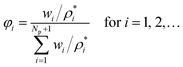
The component volume fraction (φi) in terms of the component mass fraction (wi) and the characteristic density of the pure components is calculated as:
| |
 | (5) |
Δ
P* is a binary parameter and for each gas/polymer couple, it is determined by the following approximation:
| |
 | (6) |
where
kij is binary coefficient which for solubility of hydrocarbon penetrants and light gases like O
2, N
2 and CH
4 into a hydrocarbon-based polymer is generally given by the first order approximation,
i.e. in all the calculation
kij is assumed equal to zero (
kij = 0).
![[small rho, Greek, tilde]](https://www.rsc.org/images/entities/i_char_e0e4.gif) is the reduced density of the gas/polymer mixture that is defined as:
is the reduced density of the gas/polymer mixture that is defined as:
| |
 | (7) |
The characteristic density for the mixture (ρ*) is related to the characteristic density of the pure components as follow:
| |
 | (8) |
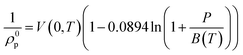
Polymer density is an input parameter to evaluate the gas solubility in the glassy membrane because the polymer density at each temperature and pressure shows a departure of polymer from equilibrium state.25,26 The multi-Tait model27–29 is used to predict density of pure polymer (ρ0p) over a wide range of temperature and pressure, as follows:
| |
 | (9) |
where
V(0,
T) is the zero-pressure isobar specific volume of polymer and
B(
T) is the temperature-dependent Tait parameter. Above the glass transition temperature, thermodynamic equilibrium can be established rapidly and
V(0,
T) is a function of temperature only, whereas
V(
0,
T) of the glassy polymers depends strongly on its thermal history. The values of these parameters for PC, PS, PSf, PPO and PMMA are given in
Table 3. In previous works,
5,6 the polymer density was assumed equal to the pure polymer density during penetrants sorption in the glassy membranes. The polymer density varies during the gas sorption, and the following approximation was used to estimate the density of the gas filled polymer by assuming negligible volume swelling in the system:
10| |
 | (10) |
Table 3 The parameters of the multi-Tait equation (temperature in °C)
| Membrane |
V(0,T) (cm3 g−1) |
B(T) (bar) |
Ref. |
| PC |
0.83748![[thin space (1/6-em)]](https://www.rsc.org/images/entities/char_2009.gif) exp(2.11 × 10⁻⁴T) exp(2.11 × 10⁻⁴T) |
338.7exp(−1.61 × 10⁻³T) |
10 |
| PS |
0.9508exp(2.86 × 10⁻⁴T) |
3994exp(−4.31 × 10⁻³T) |
27 |
| PSf |
0.8051 + 1.756 × 10⁻⁴T |
4408exp(−1.543 × 10⁻³T) |
28 |
| PPO |
0.9348exp(2.09 × 10⁻⁴T) |
3379exp(−2 × 10⁻³T) |
27 |
| PMMA |
0.8345exp(2.17 × 10⁻⁴T) |
4466exp(−4.135 × 10⁻³T) |
29 |
The penetrant chemical potential in the gaseous feed is determined as follows:6
| |
 | (11) |
where
E is the equilibrium reduced density of the pure penetrant in the gas phase that is calculated from the Sanchez and Lacombe equation of state:
30| |
 | (12) |
where
![[T with combining tilde]](https://www.rsc.org/images/entities/i_char_0054_0303.gif)
and
![[P with combining tilde]](https://www.rsc.org/images/entities/i_char_0050_0303.gif)
are the reduced temperature and pressure of pure penetrant, respectively:
| |
 | (13) |
| |
 | (14) |
The previous studies reveal that the lattice-fluid equation of state was significantly less accurate to predict the volumetric data over the wider pressure range.31 Thus, most of the works were restricted to the infinite dilution of penetrant in the glassy membranes. In order to predict the gas sorption in a large interval of temperature and pressure, the FFV was used. The FFV can be estimated using the following equation:5
| |
 | (15) |
By a combination of eqn (2), (5), (8), (10), (11) and (15) and replacing into eqn (1), the fractional free volume was calculated at a given temperature and pressure. Then, by putting the obtained fractional free volume in to the following equations, the gas solubility coefficient into the membrane at low pressure (S0) and high pressure (S) were obtained:
| |
 | (16) |
| |
 | (17) |
The derivation of eqn (16) and (17) is presented in Appendix A in detail.
Finally, to determine the solubility of the gas mixtures into the membrane, the following nonlinear algebraic equations at each pressure and temperature are solved numerically:
| |
 | (18) |
| |
 | (19) |
The amount of gas sorption from a gas mixture into the glassy membrane is calculated by the following relation:
| |
 | (20) |
3 Results and discussion
In this work, several glassy membranes with a rather broad range of free volume and chemical nature were considered. It is expected that for each membrane, the amount of sorption will differ depending on the penetrant considered. For all of the membranes, first low pressure solubility data were analyzed and then results were extended to higher pressure. In order to validate the proposed model, the model results for various membranes were compared with the experimental solubility data of gas and vapors which were reported in the previous literature.32–48
3.1. The fractional free volume as function of temperature and pressure
The non-equilibrium state of the glassy membrane can be explained based on the polymer fractional free volume. The amount of FFV explained the departure of polymer free volume from the occupied volume at absolute zero. The gas solubility values in the glassy membranes depend on the FFV. The amount of FFV as a function of temperature and pressure for penetrant/membrane systems of Ar/PC, CO2/PC, Ar/PSf and CO2/PSf are shown in Fig. 1. As shown in this figure, the FFV changed with temperature and pressure, the FFV increased by enhancement in temperature, while an increase in pressure led to lower FFV. The influence of temperature on the FFV of the polymeric membranes can be attributed to the motions of the polymer chains. Thermal motions of the polymer chains in the amorphous regions of the membrane randomly produce free volumes. As temperature enhances, the frequency and amplitude of the polymer jumping chains increase, resulting in an increase of the free volume of the membrane. Furthermore, the reduction in the FFV by pressure can be related to the membrane compactness at higher pressure.
 |
| | Fig. 1 The FFV as a function of temperature and pressure: (a) Ar in the PC membrane, (b) CO2 in PC the membrane, (c) Ar in the membrane PSf, and (d) CO2 in the membrane PSf. | |
3.2. Solubility coefficient as function of gas critical temperature
The gas sorption coefficient in various membranes including BCPC, PC, PSf, PS, PTMSP, PMMA, PPO and TMPC was calculated by the modified NELF model as a function of the gas critical temperature. The logarithm of gas sorption coefficient as a function of critical temperature is indicated in Fig. 2 and compared with the experimental data reported in the literature.33,34 As shown in this figure, there are very good agreements between the experimental solubility coefficients and predicted sorption values by the modified NELF model. It can be seen that the gas sorption level into the membrane enhanced as the gas critical temperature increased. Linear trends between ln(S0) and the critical temperature were observed for all of the membranes:where a and b are the model coefficients which are presented in Table 4 for various membranes.
 |
| | Fig. 2 The logarithm of gas sorption coefficient in various membranes as a function of the gas critical temperature. | |
Table 4 The values of the constants in eqn (21)
| Membrane |
a |
b |
R2 |
| PC |
−3.7635 |
0.0177 |
0.983 |
| PPO |
−2.6015 |
0.0159 |
0.982 |
| PMMA |
−4.4387 |
0.0185 |
0.984 |
| PSf |
−4.1643 |
0.0197 |
0.987 |
| PS |
−2.9948 |
0.011 |
0.928 |
| PTMSP |
−2.2813 |
0.017 |
0.996 |
Generally, the gas solubility coefficients in many polymeric membranes depend on the solute condensability that can be related to the critical temperature,49 normal boiling point50 or Lennard-Jones energy parameter.51 Similar results were observed in the previous studies. For example, Merkel et al.52 reported that the gas solubility coefficients in the glassy membranes like PTMSP are well described by a linear relationship between the ln(S) and the penetrant critical temperature.
3.3. The pressure effect on gas sorption
The sorption level of various gases into some glassy membranes as a function of pressure is presented in Fig. 3. All of the sorption data were considered up to a pressure of 20 bar at 308 K. It can be seen that there is good agreement between the modeling results and the experimental data and the modified NELF model is able to predict the experimental solubility data at higher pressure. The sorption isotherms in Fig. 3 are concave to the pressure axis and this trend is well predicted by the modified NELF model. The more condensable gases had higher gas sorption, and carbon dioxide showed higher sorption level, while nitrogen had lower sorption in the selected glassy membranes. This behavior can be explained based on the gas critical temperature that is a measure of the gas condensability, as discussed in the previous section. Furthermore, the amount of gas content in the membrane increased by enhancement in pressure. On the other hand, a change in pressure directly affects the sorption phenomena at the feed/membrane interface, and the gas sorption enhances with an increase in the operating pressure, especially for more condensable gases like CO2. Furthermore, the amount of gas content in the glassy membrane is explained mostly based on the dual mode sorption model.53 Based on this model, the glassy membrane shows non-equilibrium behavior which can be explained based on Henry's law (linear term) and Langmuir's law (non-linear term). Thus gas sorption in this membrane is more like the parabolic concave shape, especially for the penetrants with high gas solubility. Similar trends were also observed in the previous studies.41,53
 |
| | Fig. 3 The effect of pressure on the sorption of various gases into the BCPC (a), PC (b), PMMA (c), PPO (d), PS (e), PSf (f) and PTMSP (g) at 308 K. | |
3.4. The temperature effect on gas sorption
The sorption isotherms of different gas components as a function of pressure are indicated in Fig. 4. It can be observed that the modified NELF model exactly predicted the experimental gas solubility in various membranes without the need of adjustable parameters and the proposed sorption model is able to predict the effect of temperature on the gas sorption into the membrane. The proposed model successfully predicted the sorption of penetrant in all of the considered temperature for the glassy membranes. For the considered glassy membranes, the gas sorption level into the membrane decreased by an increase in temperature. This behavior can be attributed to the thermodynamics of the gas sorption into the polymeric membranes. Generally, the gas sorption into the polymeric membranes is an exothermic phenomenon. Therefore, an enhancement in the gas temperature results in a lower sorption level into the membrane.
 |
| | Fig. 4 The effect of temperature on the gas sorption: (a) CH4 in PC, (b) CO2 in PC, (c) CH4 in PS, (d) CO2 in PS, and (e) CO2 in PSf. | |
The gas solubility into the glassy membrane increases as the condensability of the penetrant enhances. On the other hand, more condensable gases plasticize the membrane and lead to a swelling phenomenon. A comparison between the sorption isotherms of Fig. 3 and 5 reveal that the solubility of the organic vapors into the glassy membranes are higher than light gases due to higher inherent condensability of these organic vapors. Fig. 5 shows that the proposed NELF model provides a good prediction for the vapor sorption into the glassy membranes over a broad pressure and temperature range and the model enables predicting the effect of temperature and pressure on the sorption. It can be also seen that the vapor content in the membrane was increased with an enhancement in pressure and decreased with an increase in temperature.
 |
| | Fig. 5 The sorption of organic vapor in the glassy membranes: (a) C3H8 in PC, and (b) C2H6, C3H6 and C3H8 in PPO. | |
3.5. Sorption of organic vapor
The solubility of organic vapor like C3H8 in the PC membrane and C2H6, C3H6 and C3H8 in the PPO membrane at different pressures and temperatures are presented in Fig. 5. Generally, the sorption levels of more condensable gases including hydrocarbons and organic vapors into the glassy membranes are higher than light gases such as O2, N2 and H2. The sorption level into a polymeric membrane is determined by penetrant/membrane interactions, the free volume of the membrane and the condensability of the penetrant molecule.54
It can be seen in Fig. 5 that there is a difference between the modeling results and the experimental values in the case of vapor sorption into the glassy membranes. This deviation can be attributed to the assumption of negligible volume swelling for calculation of polymer density based on eqn (10). The negligible volume swelling for the polymeric system after gas sorption is acceptable for the case of light gas sorption or sorption of condensable gas/vapor up to a relatively low content in the polymer. In fact, analysis of vapor sorption at high pressure into the glassy polymer can only be discussed after addressing the effect of polymer swelling induced by the sorption process.
3.6. Sorption of gaseous mixtures
The proposed sorption model was employed to predict the sorption of binary CH4/CO2 mixture into the PSf membrane and the modeling results were compared with the experimental data reported by Kim and Hong.55 Fig. 6 shows the sorption for a 42.5/57.5% vol CH4/CO2 mixture into the PSf membrane as a function of pressure. Similar to pure penetrant sorption, the solubility of gas mixture components into the glassy membrane increases as the pressure enhances. Also, higher sorption was observed for the more condensable penetrant. Furthermore, the predicted sorption data were in good agreement with the experimental data for the gas mixture.
 |
| | Fig. 6 The sorption of CH4/CO2 gas mixture into the PSf membrane at 303 K. | |
4 Conclusions
In this work, a predictive sorption model was developed based on the NELF model using the fractional free volume in order to enable the NELF model to predict the gas and vapor into the glassy membranes in a large interval of pressure (2–20 bar) and temperature (293–338 K). The proposed model was validated with the experimental data for sorption of various gases and vapors in some of the glassy membranes including BCPC, PSf, PS, PC, PTMSP, PMMA and PPO. The FFV values were calculated as a function of temperature and pressure. A comparative study was performed between the modeling results and the experimental results and a very good agreement was observed between the predicted results and the experimental data which were previously reported by other researchers. The proposed model enables predicting the effect of the feed pressure and temperature as well as the gas critical temperature on the gas sorption in the glassy membranes. Moreover, the sorption of high soluble penetrants such as C2H6, C3H6 and C3H8 in some glassy membranes was predicted by the modified NELF model and satisfactory agreement has been observed between the modeling and experimental results. Finally, the proposed sorption model was used to predict the sorption of gaseous mixtures in the membrane and it was observed that the predicted results were consistent with the experimental data.
Appendix A
In order to derive the relations for the gas solubility coefficient into the membranes based on the NELF model (eqn (16) and (17)), eqn (2) and (11) are inserted into eqn (1) which results in the following relation:| |
 | (A.1) |
By rearranging eqn (A.1), the following relation is obtained:
| |
 | (A.2) |
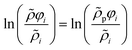
At low pressure (P → 0), the reduced density of the gas/polymer mixture () can be approximated by the reduced density of pure polymer (p), therefore the right side of eqn (A.2) is rearranged as follows:
| |
 | (A.3) |
Based on the definition of the reduced density, the following relations can be written:
| |
 | (A.4) |
| |
 | (A.5) |
On the other hand, the gas density can be related to the pressure and temperature using the following relations:
| |
 | (A.6) |
In order to consider the non-ideal behavior of penetrants at high pressure, the compressibility factor (Z) was introduced:
| |
 | (A.7) |
where
B,
C and
D are known as virial coefficients and are functions of temperature. The experimental values of virial coefficient are available in Dymond
et al.56 for a number of penetrants.
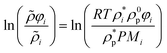
By combining eqn (A.4) to (A.6) into (A.3), the following relation is obtained:
| |
 | (A.8) |
The solubility coefficient into the membrane is defined as below:
| |
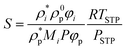 | (A.9) |
The solubility coefficient into the membrane at infinite dilution (φp → 1) is obtained as:
| |
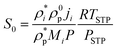 | (A.10) |
Finally, the following relation is derived by combining eqn (A.7) and (A.9) into (A.2) and using eqn (6):
| |
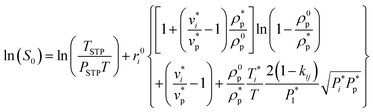 | (A.11) |
According to the definition of the fractional free volume (eqn (15)), the following relation can be derived at infinite dilution:
| |
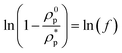 | (A.12) |
By introducing eqn (A.12) into (A.11) and after rearrangement, eqn (16) is obtained as follows:
| |
 | (A.13) |
To derive a relation for the gas sorption coefficient into the membrane at high pressure, the NELF parameters should be expressed in terms of the fractional free volume based on eqn (15). These relations are given in Table 5.
Table 5 The NELF parameters in terms of the fractional free volume
| Parameter |
Symbol |
Relation |
No. |
| Volume fraction of the permeating gas |
φi |
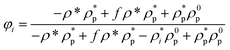 |
A.14 |
| Volume fraction of the polymer |
φp |
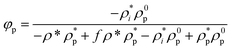 |
A.15 |
| Characteristic volume of the mixture |
V* |
 |
A.16 |
| Characteristic density of the mixture |
ρ* |
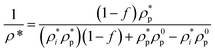 |
A.17 |
| Number of lattice sites occupied in the mixture |
ri |
 |
A.18 |
| Characteristic pressure of the mixture |
P* |
 |
A.19 |
By combining eqn (7) and (15), the following relation is obtained:
| | |
= 1 − f
| (A.20) |
Using the above relation and eqn (A.6), the right side of eqn (A.2) is rearranged as below:
| |
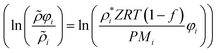 | (A.21) |
Substituting eqn (A.20) into (A.2) and using eqn (A.8) and relations in Table 5, the following relation is derived for the gas sorption coefficient into the membrane at high pressure:
| |
 | (A.22) |
Nomenclature
| B, C, D | Virial coefficients |
| C | Concentration (cm3 (STP) per cm3 (polymer)) |
| F | Fractional free volume |
| f0 | Fractional free volume at zero pressure |
| M | Molecular weight (kg mol−1) |
| P | Pressure (kg m−1 s−2) |
| Pc | Critical pressure (kg m−1 s−2) |
| P* | Lattice fluid characteristic pressure (kg m−1 s−2) |
| ΔP* | Binary parameter (kg m−1 s−2) |
| Dimensionless pressure |
| R | Gas constant (m3 bar kmol−1 K−1) |
| r0i | Number of occupied lattice site |
| S | Solubility coefficient (cm3 (STP) per cm3 bar) |
| S0 | Solubility coefficient at low pressure (cm3 (STP) per cm3 bar) |
| T | Temperature (K) |
| Tc | Critical temperature (K) |
| Dimensionless temperature |
| T* | Lattice fluid characteristic temperature (K) |
| V | Molar volume (m3 mol−1) |
| v* | Lattice fluid characteristic volume (m3 mol−1) |
| W | Weight fraction |
| Z | Compressibility factor |
Greek symbol
| μi | Chemical potential |
| ρ | Density (kg m−3) |
| Dimensionless density |
| ρ* | Lattice fluid characteristic density (kg m−3) |
| ρ02 | Pure polymer density (kg m−3) |
| φ | Volume fraction |
| Ψ | Binary adjustable parameter |
Subscripts
| i | Component |
| p | Polymer |
| 1 | Penetrant |
| STP | Standard condition |
Superscripts
| E | Equilibrium |
| NE | Non-equilibrium |
References
- M. G. Buonomenna, RSC Adv., 2013, 3, 5694–5740 RSC.
- M. S. A. Rahaman, L. Zhang, L.-H. Cheng, X.-H. Xu and H.-L. Chen, RSC Adv., 2012, 2, 9165–9172 RSC.
- T. Merkel, V. Bondar, K. Nagai, B. Freeman and I. Pinnau, J. Polym. Sci., Part B: Polym. Phys., 2000, 38, 415–434 CrossRef CAS.
- S. Najari, S. S. Hosseini, M. Omidkhah and N. R. Tan, RSC Adv., 2015, 5, 47199–47215 RSC.
- M. De Angelis, G. Sarti and F. Doghieri, J. Membr. Sci., 2007, 289, 106–122 CrossRef CAS.
- F. Doghieri and G. C. Sarti, J. Membr. Sci., 1998, 147, 73–86 CrossRef CAS.
- F. Doghieri and G. C. Sarti, Macromolecules, 1996, 29, 7885–7896 CrossRef CAS.
- M. G. De Angelis, F. Doghieri, G. C. Sarti and B. D. Freeman, Desalination, 2006, 193, 82–89 CrossRef CAS.
- F. Doghieri, M. G. De Angelis, M. G. Baschetti and G. C. Sarti, Fluid Phase Equilib., 2006, 241, 300–307 CrossRef CAS.
- F. Nilsson, K. Hallstensson, K. Johansson, Z. Umar and M. Hedenqvist, Ind. Eng. Chem. Res., 2012, 52, 8655–8663 CrossRef.
- I. C. Sanchez and R. H. Lacombe, J. Phys. Chem., 1976, 80, 2352–2362 CrossRef CAS.
- M. Minelli and F. Doghieri, Ind. Eng. Chem. Res., 2012, 51, 16505–16516 CrossRef CAS.
- M. Minelli and F. Doghieri, Fluid Phase Equilib., 2014, 381, 1–11 CrossRef CAS.
- S. N. Shoghl, A. Raisi and A. Aroujalian, RSC Adv., 2015, 5, 38223–38234 RSC.
- E. Sanders, J. Membr. Sci., 1988, 37, 63–80 CrossRef CAS.
- A. Singh, B. Freeman and I. Pinnau, J. Polym. Sci., Part B: Polym. Phys., 1998, 36, 289–301 CrossRef CAS.
- V. Bondar, Y. Kamiya and Y. P. Yampol'Skii, J. Polym. Sci., Part B: Polym. Phys., 1996, 34, 369–378 CrossRef CAS.
- M. Tlenkopatchev, J. Vargas, M. A. Almaraz-Girón, M. López-González and E. Riande, Macromolecules, 2005, 38, 2696–2703 CrossRef CAS.
- L. Wang, J.-P. Corriou, C. Castel and E. Favre, Ind. Eng. Chem. Res., 2012, 52, 1089–1101 CrossRef.
- S. Russell and D. Weinkauf, Polymer, 2001, 42, 2827–2836 CrossRef CAS.
- M. Galizia, M. G. De Angelis and G. C. Sarti, J. Membr. Sci., 2012, 405, 201–211 CrossRef.
- M. G. De Angelis, R. Gaddoni and G. C. Sarti, Ind. Eng. Chem. Res., 2013, 52, 10506–10520 CrossRef CAS.
- M. Minelli and G. C. Sarti, J. Membr. Sci., 2013, 435, 176–185 CrossRef CAS.
- M. G. De Angelis and G. C. Sarti, Annu. Rev. Chem. Biomol. Eng., 2011, 2, 97–120 CrossRef PubMed.
- F. Doghieri, M. Quinzi, D. Rethwisch and G. Sarti, Desalination, 2004, 144, 73–78 CrossRef.
- M. G. Baschetti, M. De Angelis, F. Doghieri and G. Sarti, Chemical Engineering: Trends and Developments, Wiley, Chichester, UK, 2005, pp. 41–61 Search PubMed.
- P. Zoller and H. Hoehn, J. Polym. Sci., Polym. Phys. Ed., 1982, 20, 1385–1397 CrossRef CAS.
- P. Zoller, J. Polym. Sci., Polym. Phys. Ed., 1978, 16, 1261–1275 CrossRef CAS.
- M. Schmidt and F. H. Maurer, J. Polym. Sci., Part B: Polym. Phys., 1998, 36, 1061–1080 CrossRef CAS.
- R. H. Lacombe and I. C. Sanchez, J. Phys. Chem., 1976, 80, 2568–2580 CrossRef CAS.
- P. A. Rodgers, J. Appl. Polym. Sci., 1993, 48, 1061–1080 CrossRef CAS.
- J. McHattie, W. Koros and D. Paul, J. Polym. Sci., Part B: Polym. Phys., 1991, 29, 731–746 CrossRef CAS.
- W. Koros, A. Chan and D. Paul, J. Membr. Sci., 1977, 2, 165–190 CrossRef CAS.
- W. Vieth and J. Eilenberg, J. Appl. Polym. Sci., 1972, 16, 945–954 CrossRef CAS.
- J. Chiou and D. Paul, J. Appl. Polym. Sci., 1986, 32, 4793–4814 CrossRef CAS.
- R. Chern, F. Sheu, L. Jia, V. Stannett and H. Hopfenberg, J. Membr. Sci., 1987, 35, 103–115 CrossRef CAS.
- M. Shibasaki and Y. Yamamoto, Multimetallic catalysts in organic synthesis, John Wiley & Sons, 2006 Search PubMed.
- R. Wissinger and M. Paulaitis, J. Polym. Sci., Part B: Polym. Phys., 1987, 25, 2497–2510 CrossRef CAS.
- N. Muruganandam and D. Paul, J. Polym. Sci., Part B: Polym. Phys., 1987, 25, 2315–2329 CrossRef CAS.
- A. Erb and D. Paul, J. Membr. Sci., 1981, 8, 11–22 CrossRef CAS.
- K. Ghosal, R. T. Chern, B. D. Freeman and R. Savariar, J. Polym. Sci., Part B: Polym. Phys., 1995, 33, 657–666 CrossRef CAS.
- Y. Kamiya, T. Hirose, K. Mizoguchi and Y. Naito, J. Polym. Sci., Part B: Polym. Phys., 1986, 24, 1525–1539 CrossRef CAS.
- Y. Ichiraku, S. Stern and T. Nakagawa, J. Membr. Sci., 1987, 34, 5–18 CrossRef CAS.
- A. Y. Alentiev, Y. P. Yampolskii, V. Shantarovich, S. Nemser and N. Plate, J. Membr. Sci., 1997, 126, 123–132 CrossRef CAS.
- E. Sada, H. Kumazawa, H. Yakushiji, Y. Bamba, K. Sakata and S. T. Wang, Ind. Eng. Chem. Res., 1987, 26, 433–438 CrossRef CAS.
- C. Carfagna, L. Nicodemo, L. Nicolais and G. Campanile, J. Polym. Sci., Part B: Polym. Phys., 1986, 24, 1805–1812 CrossRef CAS.
- J. A. Barrie, M. Williams and K. Munday, Polym. Eng. Sci., 1980, 20, 20–29 Search PubMed.
- O. Ilinitch, G. Semin, M. Chertova and K. Zamaraev, J. Membr. Sci., 1992, 66, 1–8 CrossRef.
- R. Barrer and G. Skirrow, J. Polym. Sci., 1948, 3, 564–575 CrossRef CAS.
- G. Van Amerongen, J. Polym. Sci., 1950, 5, 307–332 CrossRef CAS.
- A. S. Michaels and H. J. Bixler, J. Polym. Sci., 1961, 50, 393–412 CrossRef CAS.
- T. Merkel, V. Bondar, K. Nagai and B. Freeman, J. Polym. Sci., Part B: Polym. Phys., 2000, 38, 273–296 CrossRef CAS.
- C. Aitken, W. Koros and D. Paul, Macromolecules, 1992, 25, 3424–3434 CrossRef CAS.
- V. Bondar, B. Freeman and I. Pinnau, J. Polym. Sci., Part B: Polym. Phys., 2000, 38, 2051–2062 CrossRef CAS.
- H.-J. Kim and S.-I. Hong, Korean J. Chem. Eng., 1997, 14, 382–389 CrossRef CAS.
- J. H. Dymond, K. N. Marsh, R. C. Wilhoit and K. C. Wong, Virial Coefficients of Pure Gases and Mixtures, in Numerical Data and Functional Relationships in Science and Technology, ed. W. Martienssen, Springer-Verlag Berlin Heidelberg, Germany, 2002 Search PubMed.
|
| This journal is © The Royal Society of Chemistry 2016 |
Click here to see how this site uses Cookies. View our privacy policy here. 


 is the volume occupied by a mole of lattice sites of the pure component:


