Akifumi Okadaa,
Yoshitomo Nagasawaa,
Tomoaki Yamaguchia,
Eiji Yamaguchia,
Norihiro Tadaa,
Tsuyoshi Miurab and
Akichika Itoh*a
aGifu Pharmaceutical University 1-25-4, Daigaku-nishi, Gifu 501-1196, Japan. E-mail: itoha@gifu-pu.ac.jp; Fax: +81-58-230-8108
bTokyo University of Pharmacy and Life Sciences, 1432-1 Horinouchi, Hachioji, Tokyo 192-0392, Japan. E-mail: tmiura@toyaku.ac.jp; Fax: +81-42-676-4479; Tel: +81-42-676-4479
First published on 25th April 2016
This report describes a mild method for the direct transformation of β-oxoesters to the corresponding 2-hydroxymalonic esters, tartronic esters, using singlet oxygen produced by a catalytic amount of methylene blue and visible light irradiation using fluorescent lamps. In addition, β-oxoamides were also converted to the corresponding 2-hydroxymalonic ester amides.
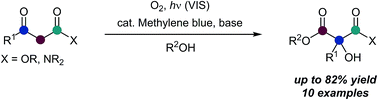
Tartronates, hydroxymalonates, are versatile compounds such as biodegradable organic building materials for surfactants.4 In general, tartronates are obtained by the oxidation of the corresponding malonates with stoichiometric amounts of oxidant such as O3,5 PIFA,6 heavy-metal oxidants,7–10 peracid derivatives.11–13 In addition, molecular oxygen, which is promoted by stoichiometric amounts of additives11,14–16 or catalysed by various catalysts,17–21 gave the corresponding tartronates. Although these reactions are reliable methods for the synthesis of the tartronates, they require the stoichiometric amounts of reagents, transition metal catalysts or high oxidation level substrate, tricarbonyl compound. Recently, we reported the direct transformation of β-oxoesters to the corresponding 2-hydroxymalonates catalyzed by calcium iodide under irradiation by visible light.22 However, it requires relatively high catalytic amounts of CaI2. We thought that it is possible to develop an alternative methodology with higher atom efficiency because singlet oxygen is known to oxidize the α-position of carbonyl groups.23 Thus, we hypothesized that singlet oxygen oxidation can be used to transform β-oxoesters to 2-hydroxymalonates.
In this study, we have found that the use of methylene blue (MB) with calcium hydroxide and molecular oxygen under visible-light irradiation furnished the corresponding 2-hydroxymalonates from β-oxoesters (Scheme 1). In addition, β-oxoamides were also converted to the corresponding 2-hydroxymalonic ester amides. Herein, we report the details of this tandem transformation reaction.
We selected methyl 3-oxoheptanoate (1a) as a test substrate to optimize reaction conditions for the synthesis of dimethyl 2-butyl-2-hydroxymalonate (2a) (Table 1). Among the sensitizers examined, 1.0 mol% of MB was found to produce 2a in the highest yield (entries 1–6). Although the other dyes could produce singlet oxygen under visible-light irradiation, MB might fit the wavelength of the fluorescent lamp we used (see ESI† for the details about the fluorescent lamp). Furthermore, among the various additives examined, only calcium hydroxide gave 2a in high yield, whereas other bases did not furnish the corresponding α-hydroxymalonate in sufficient yields (entries 6–11). As a result of these detailed examinations, it was determined that 2a was obtained in high yield using 2.0 mol% of MB solution (entries 6, 12 and 13) and 0.1 equivalents Ca(OH)2 was the most effective (entries 13–15). When the reaction time was 5 hours, the best isolated yields of 2a were obtained (entries 13, 16 and 17).‡ The concentration of MB in MeOH, the amount of Ca(OH)2 and the reaction time were found by the product yield and extinction of the substrate. So the optimal conditions were obtained for the reaction conducted in the presence of MB (2.0 mol%) and Ca(OH)2 (0.1 equiv.) for 5 hours (entry 16). Table 2 shows the scope and limitations of the tandem transformation of various β-oxoesters under the optimized reaction conditions. The reaction progressed regardless of substituted group (entries 2–5). Unfortunately, methyl 3-oxo-3-(3-pyridinyl)propanoate (1f) was converted into the corresponding 2-hydroxymalonate, albeit in low yield (entry 6).
| Entry | Sensitizer (mol%) | Time (h) | Additive (equiv.) | Yieldb (%) | ||
|---|---|---|---|---|---|---|
| a Reaction conditions: a mixture of methyl 3-oxoheptanoate (1a: 0.3 mmol), sensitizer, and additive in MeOH (5 mL) was irradiated with four of fluorescent lamps under an oxygen atmosphere.b 1H NMR yields were determined by 1,1,2,2-tetrachloroethane as an internal standard. | ||||||
| 1 | TPP | (1.0) | 10 | Ca(OH)2 | (0.2) | 58 |
| 2 | Rose bengal | (1.0) | 10 | Ca(OH)2 | (0.2) | 53 |
| 3 | Eosin Y | (1.0) | 10 | Ca(OH)2 | (0.2) | 19 |
| 4 | Thionine acetate | (1.0) | 10 | Ca(OH)2 | (0.2) | 64 |
| 5 | Erythrosine B | (1.0) | 10 | Ca(OH)2 | (0.2) | 47 |
| 6 | MB | (1.0) | 10 | Ca(OH)2 | (0.2) | 67 |
| 7 | MB | (1.0) | 10 | Mg(OH)2 | (0.2) | 0 |
| 8 | MB | (1.0) | 10 | Co(OH)2 | (0.2) | 0 |
| 9 | MB | (1.0) | 10 | CaCO3 | (0.2) | 0 |
| 10 | MB | (1.0) | 10 | K2CO3 | (0.2) | 14 |
| 11 | MB | (1.0) | 10 | Cs2CO3 | (0.2) | 15 |
| 12 | MB | (5.0) | 10 | Ca(OH)2 | (0.2) | 60 |
| 13 | MB | (2.0) | 10 | Ca(OH)2 | (0.2) | 70 |
| 14 | MB | (2.0) | 10 | Ca(OH)2 | (0.1) | 78 |
| 15 | MB | (2.0) | 10 | Ca(OH)2 | (0.05) | 32 |
| 16 | MB | (2.0) | 5 | Ca(OH)2 | (0.1) | 76(80) |
| 17 | MB | (2.0) | 1 | Ca(OH)2 | (0.1) | 28 |
| Entry | Substrate | Time (h) | Product | Yieldb (%) | |
|---|---|---|---|---|---|
| a Reaction conditions: a mixture of substrate (1: 0.3 mmol), methylene blue (2.0 mol%) and Ca(OH)2 (0.1 equiv.) in MeOH (5 mL) was irradiated with four of fluorescent lamps under an oxygen atmosphere.b Isolated yields. | |||||
| 1 | R = n-Bu | 1a | 5 | 2a | 80 |
| 2 | R = Et | 1b | 5 | 2b | 60 |
| 3 | R = n-Pr | 1c | 5 | 2c | 79 |
| 4 | R = i-Pr | 1d | 5 | 2d | 82 |
| 5 | R = -p-C6H4NO2 | 1e | 40 | 2e | 74 |
| 6 | R = -3-pyridinyl | 1f | 10 | 2f | 34 |
In contrast to β-oxoesters, when N,N-dimethylacetoacetamide (1g) was used as a substrate, only 8% yield of 2g was obtained (Table 3, entry 1). It was thought to be the cause that β-oxoamides were lower nucleophilicity than β-oxoesters. So the stronger base was required for this reaction to form enolate from β-oxoamides. Thus, a more detailed study of the reaction conditions was conducted, and the base was changed from Ca(OH)2 (0.1 equiv.) to LiOH (0.5 equiv.) to enable the efficient conversion of β-oxoamide to 2-hydroxymalonic ester amides (Table 3, entries 1–6).
| Entry | Additive (equiv.) | Yieldb (%) | |
|---|---|---|---|
| a Reaction conditions: a mixture of N,N-dimethylacetoacetamide (1a: 0.3 mmol), sensitizer, and additive in MeOH (5 mL) was irradiated with four of fluorescent lamps under an oxygen atmosphere.b 1H NMR yields were determined by 1,1,2,2-tetrachloroethane as an internal standard. | |||
| 1 | Ca(OH)2 | (0.1) | 8 |
| 2 | Co(OH)2 | (0.1) | 2 |
| 3 | Mg(OH)2 | (0.1) | 2 |
| 4 | KOH | (0.1) | 12 |
| 5 | LiOH | (0.1) | 27 |
| 6 | LiOH | (0.5) | 63(59) |
Under these optimal conditions, N,N-dimethylacetoacetamide (1g), N,N-diethylacetoacetamide (1h), N-acetoacetylmorpholine (1i), and 1-acetoacetylindoline (1j) were converted into the corresponding 2-hydroxymalonic ester amides in moderate to good yields, respectively (Table 4, entries 1–4).
| Entry | Substrate | Time (h) | Product | Yieldb (%) | |
|---|---|---|---|---|---|
| a Reaction conditions: a mixture of substrate (1: 0.3 mmol), methylene blue (2.0 mol%), and LiOH (0.5 equiv.) in MeOH (5 mL) was irradiated with four of fluorescent lamps under an oxygen atmosphere.b Isolated yields. | |||||
| 1 | R = -N(Me)2 | 1g | 10 | 2g | 59 |
| 2 | R = -N(Et)2 | 1h | 10 | 2h | 72 |
| 3 | R = -N-morphyl | 1i | 20 | 2i | 68 |
| 4 | R = -N-indolyl | 1j | 20 | 2j | 75 |
We performed several control experiments in order to elucidate the reaction mechanism. Without MB, 2a was not obtained. This suggested that MB was involved (eqn (1), Scheme 2). Next, as a result of having examined the reaction under the presence of quencher of singlet oxygen such as 1,4-diazabicyclo[2.2.2]octane (DABCO), 2a was suppressed.24 It was suggested that singlet oxygen was necessary for the reaction (eqn (2), Scheme 2). Using 1.0 equiv. P(OEt)3 as a reductant, it gave 2-hydroxy-β-oxoester (3a).24 It was thought that peroxidation at α-position of carbonyl could proceed at first step of the reaction (eqn (3), Scheme 2). These results indicated that singlet oxygen was trapped by nucleophilic addition of enolate which formed in situ. Furthermore, when we used MeCN as a solvent, we have confirmed a little amount of α,β-dioxoester by 1H NMR which was possibly thought to be the intermediate.22
![]() | ||
| Scheme 2 Study of the reaction mechanism. aYields are determined by 1H NMR. bThe isolated yield after treating with TFA (see ESI†). | ||
From these results and our previous work,22 the plausible mechanisms for the tandem transformations of β-oxoesters are proposed (Scheme 3). First, β-oxoester 1 forms to enolate 5 with the base. The enolate attacks the singlet oxygen generated by photoirradiation in the presence of MB25 and molecular oxygen to form a tricarbonyl compound 4. The resulting compound 4 is attacked by alcohol in the presence of base and rearranges to produce tartaronic ester 2.26
Footnotes |
| † Electronic supplementary information (ESI) available. See DOI: 10.1039/c6ra07084a |
| ‡ General procedure: a dry methanol solution (5 mL) of 1a (0.3 mmol) and methylene blue (2.0 mol%) in a Pyrex test tube equipped with an O2 balloon, was irradiated with stirring condition for 10 h with four of 22 W fluorescent lamps, which was set from the test tube in the distance of 80 mm. The reaction mixture was concentrated under the reduced pressure. The crude product was analyzed by 1H NMR with 1,1,2,2-tetrachloroethane for the NMR yields. The pure product 2a was obtained in 80% yield (49.0 mg) after column chromatography. |
| This journal is © The Royal Society of Chemistry 2016 |