
Eunjik Leea and
Young-Uk Kwon*ab
aSKKU Advanced Institute of Nanotechnology, Sungkyunkwan University, Suwon, 440-746, Republic of Korea. E-mail: ywkwon@skku.edu; Fax: +82 31 290 7075; Tel: +82 31 290 7070
bDepartment of Chemistry, Sungkyunkwan University, Suwon, 440-746, Republic of Korea
First published on 9th May 2016
In this work, we have synthesized Pd/MoS2 samples in which about 7 nm sized Pd NPs are formed on a MoS2 surface with the Pd content varied from 14.4 wt% to 33.6 wt% and studied their electrocatalytic activity for oxygen reduction reaction (ORR) in an alkaline medium. The syntheses were achieved by single-step sonochemical reactions between palladium acetylacetonate and 2H-MoS2 in ethylene glycol. Based on the structural characterization data, the Pd NPs are firstly grown epitaxially on the MoS2 surface in the [1−10]Pd||[100]MoS2 and (111)Pd||(001)MoS2 relationship. As the Pd-content increases, Pd NPs are formed on top of the first layer of Pd NPs as well as on the available MoS2 surface. The epitaxially grown Pd NPs experience a tensile strain and charge-transfer to MoS2, which raises the d-band center of Pd, lowering the on-set potential in ORR. On the other hand, the enhanced adsorption of O2 on MoS2 can facilitate the ORR kinetics of Pd NPs. The observed ORR data on Pd/MoS2 can be explained as the net result of these two opposing effects of the MoS2 support.
On the other hand, there have been only a few papers that report the use of MoS2 as a support for electrocatalysts in fuel cells.8–10 Although small in number, all of them indicate that the electrocatalytic performance of noble metal nanoparticles (NPs) can be enhanced by MoS2 supports. For instance, Yuwen et al. showed that the methanol oxidation reaction on Pd NP electrocatalyst is enhanced by a MoS2 support.8 Wang et al. reported a synergy effect between Au NPs and a MoS2 support in ORR.9 Apparently, MoS2 is a promising candidate that can replace the predominant porous carbon supports which suffer from corrosion during the cell operation.11 These positive effects of MoS2 supports also suggest that there are certain interactions between MoS2 and noble metal NPs, for which the details are not yet fully understood.
In attempts to observe the effects of MoS2 on the electronic structures of noble metal NPs on it and, hence, the electrochemical performance of the noble metal catalysts, noble metal NPs grown epitaxially on the MoS2 basal plane have been investigated theoretically and experimentally.10,12 Saidi investigated epitaxial M–MoS2 contacts (M = Pd and Pt) by using the density functional theory (DFT) calculations.12 They showed that the strain caused by the lattice mismatch between M and MoS2 and the thickness of M affected the electronic structure of M. Huang et al. synthesized and characterized epitaxially grown Au, Pt and Pd NPs on the MoS2 basal plane.10 The epitaxial growth is achieved mainly through sharing the MoS2 (001) plane with the (111) planes of the face-centered cubic lattices of noble metals. The lattice mismatches are ∼13%. They also showed that their Pt/MoS2 had excellent electrocatalytic activity for HER. However, understanding on the effects of MoS2 as a support material is still far from completion.
The purpose of the present paper is to investigate the effects of a MoS2 support on the electrocatalytic properties of Pd NPs. Towards this goal we have devised a new synthesis method to prepare Pd NPs epitaxially on delaminated MoS2. In this method, Pd/MoS2 samples with various Pd loadings from by 14.4 wt% to 33.6 wt% were synthesized by single step sonochemical reactions. We found that the electronic structure and lattice strain of Pd are strongly affected depending on the Pd loading. These changes were directly correlated with the ORR activity of the Pd/MoS2 samples. The details of synthesis and characterization data will be discussed herein.
Fig. 1(a) shows the XRD patterns of Pd/MoS2 samples and those of MoS2 and Pd black as references. All of the Pd/MoS2 patterns can be explained with 2H-MoS2 (JCPDS no. 77-1716) and Pd (JCPDS no. 87-0645). As in the case of the sonicated MoS2 explained above, the MoS2 (002) peak at ∼14.5° is considerably reduced compared with the other peaks of MoS2. The two broad peaks at ∼39.5° and ∼47.0° are the (111) and (200) diffractions of Pd. These two peaks increase in intensity as the Pd-content increases. Since the Pd (111) peak overlaps with the MoS2 (103) peak, they are deconvoluted to extract the information on the Pd (111) peaks (Fig. 1(b)). In fact, analyses of the Pd (200) peaks would be better because they do not overlap with the MoS2 peaks. However, unfortunately, this peak in Pd(14.4)/MoS2 is too weak to be analyzed (Fig. S3†). The Pd (111) peaks are located at lower 2θ than that of Pd black indicating lattice expansion upon forming Pd/MoS2. Pd(14.4)/MoS2, the one with the lowest Pd-content, shows the largest peak shift and the magnitude of peak shift decreases slightly as the Pd-content increases. By using the position of this peak, the lattice constants of Pd in Pd/MoS2 samples are calculated to be 0.393–0.396 nm, larger than that of Pd black (0.389 nm). It is well known that Pd can absorb hydrogen atoms.15,16 The lattice constant of hydrogen-containing Pd is in the range of 0.396–0.399 nm depending on the H-content.16 Therefore, the expanded Pd lattices in Pd/MoS2 samples can be understood as a result of hydrogen uptake. Alternatively, the epitaxial relationship between Pd on MoS2 to be discussed below can induce the expansion of Pd lattice. Probably, these two effects occur simultaneously and the epitaxial relationship provides an additional stability to the hydrogen-absorbed Pd. The crystallite sizes, estimated by applying the Scherrer equation to the widths of these peaks, are 7.2 nm for Pd(14.4)/MoS2 and 7.0 nm for Pd(25.6)/MoS2 and Pd(33.6)/MoS2, slightly smaller than that of Pd black (9.6 nm). The structural information on the samples is summarized in Table 1.
![]() | ||
| Fig. 1 (a) XRD patterns of samples and (b) magnified view to highlight the deconvolution between Pd (111) (red lines) and MoS2 (103) peaks (blue lines) on Pd/MoS2 samples. | ||
| Samples | Crystallite sizea (nm) | Lattice constanta (Å) | Pd–Pd distancea (Å) | ECSAsb (m2 per gmetal) |
|---|---|---|---|---|
| a Crystallite size, lattice constant and Pd–Pd distance of samples were calculated from the (111) peaks of XRD patterns of samples.b ECSAs of samples were determined by using the HUPD. | ||||
| Pd(14.4)/MoS2 | 7.2 | 3.96 | 2.80 | 17 |
| Pd(25.6)/MoS2 | 7.0 | 3.95 | 2.79 | 18 |
| Pd(33.6)/MoS2 | 7.0 | 3.93 | 2.78 | 14 |
| Pd black | 9.6 | 3.89 | 2.75 | 11 |
The TEM images of the three Pd/MoS2 samples are shown in Fig. 2. In these low magnification images, one can see that the MoS2 surface is covered by Pd NPs of sizes smaller than 10 nm. The NPs are well dispersed over the entire MoS2 surface. The MoS2 parts in these images are light in darkness indicating that they are thin, an indication of delaminated or even exfoliated MoS2. In Pd(14.4)/MoS2 sample of the lowest Pd-content, some NPs are isolated from the other ones but the majority appears to be connected to one another in the horizontal direction. As the Pd-content increases, the surface coverage by Pd NPs increases and the degree of horizontal interconnection between NPs also increases as shown in insets of Fig. 2. In addition, there are NPs stacked on top of the other one, as judged by the darkness, whose population also increases as the Pd-content increases. The increasingly darker image with the Pd-content, therefore, can be understood as due to the increase of the electron density by the thickening of the Pd NP layers on both sides of MoS2. On the other hand, the size of the primary Pd NPs does not appear to change significantly in agreement with the estimation based on the XRD peak widths.
![]() | ||
| Fig. 2 Low magnified transmission electron microscopy images of (a) Pd(14.4)/MoS2, (b) Pd(25.6)/MoS2 and (c) Pd(33.6)/MoS2. Inset shows enlarged images of dot marked area. | ||
Pd(33.6)/MoS2 sample was characterized by HRTEM, HAADF, and EDS line profiling. Fig. 3(d) shows a HAADF-TEM image of Pd(33.6)/MoS2. Since the brightness in HADDF images is proportional to the square of atomic number (Z2),17 the bright part can be identified as Pd NPs on MoS2 support. The identity of Pd of this part is further proven by the STEM-EDS line profile overlapping with the HAADF image. There are also much bright places, which we believe to be the stacking of Pd NPs on the ones below them.
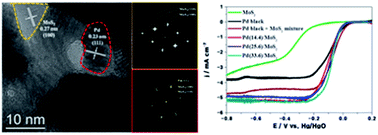
The HRTEM image (Fig. 3(a)) shows regions with roughly three different levels of darkness. In the brightest regions as the one encircled by a yellow line, the lattice fringe pattern has d-spacing of 0.27 nm that can be identified as the MoS2 (100) planes. The ED pattern generated by fast-Fourier transformation (FFT-ED patterns) on this lattice fringe image (Fig. 3(b)) shows that this region is single crystalline with the hexagonal symmetry. Evidently, the brightest regions show the pristine MoS2 substrate with no Pd on it. In the regions of intermediate level of darkness such as the one encircled in red, the lattice fringe pattern has d-spacing of 0.23 nm that corresponds to Pd (111) planes.8 The FFT-ED pattern of this image (Fig. 3(c)) shows two sets of ED patterns, both in the hexagonal symmetry. One of them matches well with that of MoS2 in Fig. 3(b) and the other can be explained as the 〈111〉 projection of the diffraction pattern of Pd. This FFT-ED also indicates that the Pd crystal is grown epitaxially on MoS2 in the [1−10]Pd||[100]MoS2 and (111)Pd||(001)MoS2 relationship. The darkest regions in Fig. 3(a) show more complicated lattice fringe patterns most likely because of the stacking of Pd NPs on top of other NPs. The FFT-ED patterns generated from these regions show the characteristics of a multiple crystalline sample in agreement with this understanding (data not shown).
We estimated the surface coverage of Pd NPs on MoS2 by inspecting the FFT-ED patterns generated on the 8 × 8 = 64 grids made on the HRTEM image as shown in Fig. S4–S6.† Each FFT-ED pattern can be identified as that of pure MoS2, single crystalline Pd on MoS2, or multi-crystalline Pd on MoS2. The proportion of the latter two types of grids to the total of 64 grids will be a rough estimate for the surface coverage of Pd on MoS2. The corresponding plot is shown in Fig. 3(e). By this estimation, the surface coverage of Pd(33.6)/MoS2 is 95%. The surface coverage on the other two samples was estimated to be 55% and 75% for Pd(14.4)/MoS2 and Pd(25.6)/MoS2, respectively. With these, one can see that the surface coverage increases with the Pd-content but is not exactly proportional to the Pd-content, which suggests that the proportion of multiple stacking of Pd NPs increases as the Pd-content increases.
The electronic structures of the elements in Pd/MoS2 are probed by XPS. In Fig. 4(a)–(c), the Pd 3d, S 2p and Mo 3d regions of XPS spectrum taken on Pd(33.6)/MoS2 are shown. The doublet of Mo4+ band at 229.5 eV and 232.6 eV in the Mo 3d region of XPS agree well with that of MoS2 in the literature.18,19 Contrary to Mo, Pd and S species undergo changes in binding energy (BE) upon forming Pd/MoS2 samples. The S 2p regions of the spectra of Pd/MoS2 samples show one set of peaks of S 2p1/2 and S 2p3/2 (Fig. 4(b)) with the respective BEs of 162.2 and 163.4 eV. These can be assigned to S2− in MoS2, but are slightly red-shifted from those of pure MoS2 (S 2p3/2 = 162.4 eV) suggesting charge transfer from Pd to MoS2.20 The absence of other types of sulfur such as SO42− indicates that the chemical identity of MoS2 is intact under the UPS condition. The Pd 3d regions of the spectra are deconvoluted to three sets of peaks as shown in Fig. 4(a). The Pd 3d5/2 peaks at 335.5 eV, 336.8 eV and 338.4 eV correspond to Pd0, Pd2+ and Pd4+, respectively.21 Compared with metallic Pd (3d5/2 = 335.1 eV), the peak assigned to Pd0 is blue-shifted, implying charge transfer from Pd to MoS2.20 Interestingly, however, within the three Pd/MoS2 samples, the Pd 3d peak is red-shifted as the Pd content decreases. Probably, this behavior of Pd BE is related with the variation of the thickness of Pd NPs on MoS2. While the Pd NPs in direct contact with MoS2 electronically interact with MoS2, those on top of the first layer of Pd NPs do not experience such interaction. It is in agreement with the ab initio DFT calculations results reported by Saidi in which the d-band center of the top Pd layer is down-shifted as the number Pd atom layers on MoS2 increases through.12
In recent papers, MoS2 has been used as a support for noble metal NP catalysts.8,9 However, from the view point of the changes of electronic structure of the noble metal, epitaxial growth appears to give a number of drawbacks. The catalytic properties of noble metals in alloys or composites are explained by ligand effect and/or strain effect.22,23 In case of Pd, a charge transfer to Pd or a strain effect that squeezes Pd–Pd distances can increase the catalytic properties of Pd.24 According to this view, the observed changes of Pd by forming Pd/MoS2 are in the opposite directions for enhancement of the catalytic properties of Pd. That is, there is charge transfer from Pd, not to Pd, and the Pd NPs experience tensile strain, not compressive strain. Therefore, Pd/MoS2 samples are expected to have inferior catalytic properties to Pd black.
We have tested the catalytic properties of Pd/MoS2 samples for ORR in an alkaline medium. Cyclic voltammograms (CVs) of samples were recorded in N2-saturated 0.1 mol L−1 KOH aqueous solution with scan rate of 50 mV s−1 (Fig. 5(a)). All Pd-based samples showed the oxide formation peak at 0.05 V and reduction peak −0.2 V. In general, the electrochemical surface areas (ECSAs) of samples are calculated by using the integrating of hydrogen desorption peak area.25 Unfortunately, Pd-based samples do not have hydrogen desorption peaks. Therefore, we have obtained the ECSAs of samples by integrating of reduction peak area of oxide species. The literature value of 420 μC cm−2 for polycrystalline Pd was used as the reference.26 The ECSAs of samples were summarized in Table 1.
As shown in Fig. 5(b), the on-set potential of ORR on Pd(14.6)/MoS2 is 0.05 V lower than that of Pd black, which can be understood as a consequence of the up-shift of the d-band center of Pd. As the Pd-content increases, the proportion of Pd NPs that are not in epitaxial relation with MoS2 increases. This makes the on-set potential close to that of Pd black. A physical mixture between Pd black and MoS2 (Pd + MoS2) would make a situation in which Pd NP are in the pristine state, which would be better suited for catalysis. Indeed, the electrode made of Pd + MoS2 shows a higher on-set potential than Pd/MoS2 in agreement with the prediction in Fig. 5(b). This electrode also shows a higher on-set potential than Pd black, which cannot be explained by the electronic structure of Pd. It has been shown that MoS2 can function as a co-catalyst. Wang et al. showed that a physical mixture between Au NPs and exfoliated MoS2 shows a synergy effect between them with a high ORR on-set from Au NPs and a facilitated kinetics from MoS2.9 However, they did not give any explanation on how MoS2 facilitates the ORR kinetics. In the literature, MoS2 is reported to be a good substrate to adsorb oxygen molecules at the edges.27 Through this property, it seems that MoS2 can produce high O2 concentration environment for the Au NPs in the neighborhood. It seems that the same mechanism works for the Pd + MoS2 electrode in the present work. In fact, all of Pd/MoS2 electrodes show improved kinetics, which also seem to originate from the O2 adsorbing property of MoS2.
Footnote |
| † Electronic supplementary information (ESI) available. See DOI: 10.1039/c6ra07064g |
| This journal is © The Royal Society of Chemistry 2016 |