DOI:
10.1039/C6RA06538D
(Paper)
RSC Adv., 2016,
6, 47178-47184
Highly sensitive and selective CO gas sensor based on a hydrophobic SnO2/CuO bilayer
Received
11th March 2016
, Accepted 6th May 2016
First published on 9th May 2016
Abstract
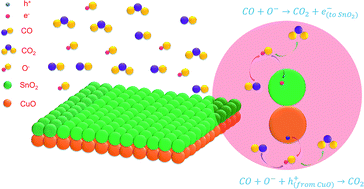
Here, we have deposited bare SnO2 and SnO2/CuO bilayer thin films directly on porous anodic alumina (AAO) by pulsed laser deposition and then used them as a gas sensor without additional processing. The bilayer sensor shows remarkably high and selective responses to CO gas compared with bare SnO2 in a low detection range 5–500 ppm. Sensor response, selectivity, and stability studies reveal excellent sensing of the thin films. The working principle and role of hydrophobicity behind their good performance was discussed.
1. Introduction
Over the past few years, environmental safety has attracted the significant attention of the science and technology community due to the release of dust particles, highly toxic gas species (e.g. CO, NOx, H2S and NH3) and greenhouse gases (CO2) in our environment.1,2 Amongst all pollutants, CO is identified as a major threat for the human health even at low concentrations of 35 ppm.3 Since CO is a colourless, odourless, and tasteless gas that is slightly less dense than air it can't be detected by human senses. Therefore, an extremely sensitive, selective and stable gas sensor is required for the detection of CO gas in the environment.4
Among the various types of gas sensors, the chemiresistive gas sensors which have espoused transition metal oxides as gas sensing materials grasp a significant position due to their advantages of high sensitivity and selectivity towards analyte gases, low cost, environmental benignity, good sensitivity, simplicity and portability.5,6 For chemiresistive gas sensors, the sensing mechanism is based on the change in the electrical resistance with effective diffusion and strong adsorption to the target gas molecules at the surface of nanomaterials.7,8 In spite of advantages, SnO2 exhibits the CO sensing response in relatively high temperature range (300–400 °C).9 Therefore, enhancing the sensing response at relatively low temperature has become a great challenge for the researchers. Hence, tremendous efforts have been made to reduce the operating temperature of SnO2 sensors via formation of p–n heterojunction at the interface and enhancing the sensor response characteristics by improving the adsorption and desorption rate of target gas over the sensor surface, making it better than those of single structure counterparts.10 Based on these investigations the SnO2/CuO bilayer thin film can be developed as sensing material which can be attributed for the low detection (ppm) of CO gas in sensing device applications.2,11,12 The additives of oxide materials with opposite conduction type demonstrated the more promising conditions to improve the sensitivity as well as selectivity of the metal oxide based gas sensors.13–15 Many methods such as chemical vapour deposition, electro-spinning, hydrothermal, thermal decomposition, electrochemical deposition and physical vapour deposition have been used to fabricate n–p heterojunction.16–24 Physical vapour deposition (PVD) techniques, particularly pulsed laser deposition (PLD) has been considered as an effective way to fabricate contamination free, stoichiometric growth, and highly porous uniform heterojunction thin films.25
Here, we report the fabrication of porous hydrophobic SnO2 and SnO2/CuO bilayer thin films on porous alumina by PLD. There microstructure and sensing properties of CO under low detection limit (5–500 ppm) have been thoroughly investigated. Furthermore, we have also investigated the changes in sensing response in different humidity conditions for CO gas at 100 ppm. The role of hydrophobicity during sensing mechanism was also discussed.
2. Experimental
2.1 Materials and chemicals
SnO2 and CuO targets (2′′ diameter) of high purity (99.99%) were made from powder purchased from Sigma Aldrich. Oxalic acid (99% pure), and aluminium foil (0.3 mm thick, 99.9% pure) were obtained from Merck, India.
2.2 Fabrication of sensor
Bare SnO2 and SnO2/CuO bilayer sensing films were prepared as follows. Aluminium foil was first degreased in acetone by ultrasonication for 15 min and rinsed in deionized water. The anodizing step employed 0.3 M oxalic acid under a constant dc voltage of 80 V for 1 hour at 0 °C. The schematic of anodizing cell is shown in author's previous study.26 After anodization, deionized water rinsed porous AAO substrate was kept in the PLD chamber at a distance of 5 cm from the SnO2 and CuO targets. Prior to deposition the chamber was evacuated to a base pressure of 2 × 10⁻⁶ Torr with a turbo molecular pump backed by a rotary pump. The working pressure of chamber was kept constant at 50 m Torr by constant flow of O2 gas (99.9% pure) using mass flow controller (MKS). Thereafter, the SnO2 and SnO2/CuO bilayer thin films were directly synthesized on porous AAO substrates by ablating the SnO2 and CuO targets sequentially using KrF excimer laser source (Lambda Physik COMPex Pro, λ = 248 nm) with laser fluence of 1.5 J cm−2, repetition rate of 5 Hz at 100 °C. Here, porous alumina offer flexibility and versatility in terms of structure and design.27 For electrical measurements, Pt top contacts of 0.2 mm were made by sputtering on top surface of sensing layer.
2.3 Characterization
The X-ray diffraction (XRD) patterns were recorded using X-ray diffractometer (Bruker AXS, D8 advance) with CuKα radiation (λ = 1.5418 Å). The Raman of bilayer was acquired with in via Raman Spectrophotometer (Renishaw, United Kingdom) using 514 nm laser as an excitation wavelength. The morphologies of sensing layer were characterized by field emission scanning electron microscopy (FE-SEM, Carl Zeiss Ultra plus). The water droplet contact angles were measured using contact angle goniometry (Kruss DSA 100 easy drop). All gas sensing measurements were carried out in situ with the help of two-probe technique using a nanovoltmeter (Keithley 2182 A) and source meter (Keithley 2400) in a custom made sensing setup equipped with PID controlled electric heater. The volume of the sensing chamber is approximately 300 cm3. Before sensing test, the sensing chamber was evacuated to 5 × 10⁻² Torr with a rotary pump. Thereafter, mixed ratio of high purity CO gas (99.9%) and synthetic air (99.9%) were introduced into the sensing chamber at a rate of 50 cm3 min−1 controlled by mass flow controller (MKS, USA) under different humidity conditions. The sensor response was defined as the ratio of the electric resistance of device in synthetic air (Ra) to the device resistance (Rg) after exposure to target gas. The sensing setup is described elsewhere.26
3. Results and discussion
3.1 Structural properties
As shown in Fig. 1a, XRD patterns of bare SnO2 and SnO2/CuO bilayer sensing film consists of tetragonal phase of SnO2 corresponding to (110), (101), (200), and (112) planes at 26.71°, 33.70°, 38.41°, and 65.03° (JCPDS ICDD No. 00-041-1445) along with rhombohedral phase of Al2O3 corresponding to (113) and (119) planes at 44.76° and 78.21° (JCPDS No. 00-001-1243). The SnO2/CuO bilayer sensing film also consists of monoclinic phase of CuO corresponding to (112) plane at 51.95° (JCPDS ICDD No. 00-005-0661). In addition, Fig. 1b shows the Raman spectra of SnO2/CuO bilayer. The peak position observed at 298 cm−1 belongs to the Raman active optical phonon Ag mode of monoclinic CuO.28 The weak band observed at 630 cm−1 can be assigned to the fundamental Raman active vibrational A1g mode corresponds to the expansion and contraction of Sn–O stretching vibrational mode of tetragonal rutile SnO2 structure.29,30 According to Dieguez et al. & Scott et al., the presence of weak band at 630 cm−1 is corroborated to the reduced crystallite size and low temperature synthesis of SnO2, which lead to the lower wave number shift of mode A1g.31,32 The observed Raman spectra is in good agreement with the XRD data.
 |
| | Fig. 1 (a) XRD pattern of bare SnO2 and SnO2/CuO bilayer thin films, and (b) Raman spectra of SnO2/CuO bilayer thin film. | |
Fig. 2a and b depicts the FE-SEM microstructure and their corresponding cross-sections of bare SnO2 and SnO2/CuO bilayer sensing films. The uniformly distributed grains of as-deposited SnO2 and SnO2/CuO thin films indicate the porous structure which is corroborated to the low temperature synthesis of these films.33,34 The thickness of SnO2 and SnO2/CuO bilayer thin films were found to be 150 and 250 nm respectively. Fig. 2c shows the EDAX spectra of the SnO2/CuO bilayer sensing film. The EDAX measurements show that sensing layer contain about 18.4 atomic% Sn, 64.4 atomic% O, and 17.2 atomic% Cu.
 |
| | Fig. 2 Surface microstructures and their corresponding cross sections (inset) of (a) bare SnO2, (b) SnO2/CuO bilayer thin films, and (c) EDAX spectra of SnO2/CuO bilayer thin film. | |
3.2 Contact angle measurements
Hydrophobic surfaces exhibit water-repellency, with water droplets residing on them with contact angle greater than 90°.35 As shown in Fig. 3a and b, the contact angles (using sessile drop method) for bare SnO2 and SnO2/CuO bilayer were found to be 98°(±2.15) and 118°(±2.15), respectively. Hydrophobicity of bare SnO2 and SnO2/CuO bilayer thin film samples was determined by measuring the contact angle of a water droplet contacting a surface on five different positions. The surface energy of bare SnO2 and SnO2/CuO bilayer were found to be 14.10, and 4.25 mN m−1 respectively, which were calculated by using two liquids (water and diiodomethane) and calculated by Owens and Wendt methods.26
 |
| | Fig. 3 Contact angle images of (a) bare SnO2 and, (b) SnO2/CuO bilayer thin films. | |
3.3 Sensing performance
To further explore the resistive characteristics, we have measured I–V properties of bare SnO2, and SnO2/CuO bilayer thin films as shown in Fig. 4a. The result shows the rectifying behaviour. The sensing response of the bare SnO2 and SnO2/CuO bilayer thin film gas sensors exposed to 100 ppm CO in dry air as a function of temperature is plotted in Fig. 4b. It can be seen that the gas sensors exhibit pronounced increase in response with increasing the temperature. Bare SnO2 thin film sensor shows maximum response at 260 °C, while SnO2/CuO bilayer thin film sensor shows maximum response at 180 °C. The reason for high response of SnO2/CuO bilayer to CO at low temperature is increase in number of charge carriers at depletion layer leading to the significant improvement of the response. Small response at low temperatures was observed due to slow chemical activation between adsorbed gas molecules and film surface. On the other hand, when the operating temperature is too high, the absorbed gas molecules may escape before reactions take place, resulting in a poor response as well.36 Further investigation of sensing measurements were done on SnO2/CuO bilayer sensor. The response curve of SnO2/CuO bilayer thin film gas sensor exposed to various concentration of CO gas at 180 °C is shown in Fig. 4c. This result indicates that the gas sensor is able to detect concentration of CO down to 5 ppm and has a good response in the range of 5–500 ppm at 180 °C. The response and recovery time defined as the time required to reach 90% change between the initial and final equilibrium values.37 Fig. 4d reveals the response and recovery time characteristics at different CO gas concentrations. A very fast response within 18 s was achieved with the recovery time of 78 s at 100 ppm of CO.
 |
| | Fig. 4 (a) I–V characteristics of bare SnO2 and SnO2/CuO bilayer thin films at 180 °C, (b) gas response curve of bare SnO2 and SnO2/CuO bilayer thin films sensors vs. operating temperatures to 100 ppm CO gas, (c) gas response curve of SnO2/CuO bilayer thin film sensor as a function of the CO gas concentration (2–500 ppm) at 180 °C, and (d) response and recovery time versus CO gas concentrations. | |
Fig. 5a depicts the stable response over 25 cycles towards 100 ppm of CO at 180 °C, justifying the previous results.38 The selectivity of CO gas with respect to other potentially interfering gases such as hydrogen (H2), and ammonia (NH3) at 100 ppm in dry air was investigated (Fig. 5b). The sensor exhibited an enormously high CO response (Ra/Rg ∼ 9.5 ± 0.3) with respect to weak response (Ra/Rg < 3.2 ± 0.2) towards the other gases at 100 ppm concentration, confirming the high CO selectivity for SnO2/CuO bilayer sensor.14 The influence of moisture on the sensor response to CO gas was investigated with 100 ppm CO in air with different relative humidity (0–60%) conditions at 180 °C (Fig. 5c). An enhancement in the response of approximately 7% was observed for SnO2/CuO sensor under the high humidity (60% RH) conditions. The increased response is mainly attributed to the water molecules present in humid air, which react as reducing agent for bilayer film.39,40 Here, hydrophobic nature of SnO2/CuO thin film plays vital role to prevent the water vapor adsorption on oxide surface during CO exposure, which leads to fast response/recovery and baseline stability of the sensor.26 Fig. 5d, reveals the stability of SnO2/CuO bilayer sensor measured at 180 °C in 100 ppm CO concentration for 90 days. The bilayer sensor exhibits nearly constant response signal (∼10% changes) during the measurements, indicating the significant long term stability of the sensor. These outcomes establish the SnO2/CuO bilayer thin films as potential candidate for CO gas sensing application.
 |
| | Fig. 5 (a) Cyclic response curve of SnO2/CuO bilayer thin film sensor towards CO with a gas concentration of 100 ppm at 180 °C, (b) gas selectivity curves of SnO2/CuO bilayer thin film sensor to 100 ppm of different gases at 180 °C, (c) gas response of SnO2/CuO bilayer thin film sensor to 100 ppm of CO gas in different relative humidity conditions (0–60%) at 180 °C, and (d) response time behaviour for 90 days, implying the superior long-term stability of the sensor. | |
3.4 Sensing mechanism
The reaction mechanisms responsible for the resistance changes of bare SnO2 layer towards CO involves following steps: generally, the oxygen molecules (presented in air) can be adsorbed on the surface of SnO2 surface, capturing the electron, and leading a reduction in electron concentration in conduction band of n-type SnO2 semiconductor, caused the increases in initial resistance (Ra).41 When the oxide surface is exposed to CO gas, these chemisorbed oxygen species react with the CO gas molecules and releasing the electron back to the conduction band of SnO2 layer results in decrease in the resistance of sensing layer.42
| O(adsorbed) + e(from SnO2)− → O− |
| CO(adsorbed) + O− → CO2 + e(to SnO2)− |
| CO(adsorbed) + O− + h(from CuO)+ → CO2 |
CO sensing mechanism on SnO2/CuO bilayer is different from that of bare SnO2 layer due to the formation of p–n heterojunction. When two p-CuO and n-SnO2 semiconducting materials have an electrical connection, the electrons will flow from higher energy states to unoccupied lower-energy states across the interface until the Fermi levels have equilibrated. This is due to electron–hole recombination at the p–n junction which leads to formation of depletion region at the interface. Therefore, a potential energy barrier develops at the interface due to the band bending caused by the difference in Fermi levels of the materials.43 A schematic of this mechanism is shown in Fig. 6. At the p–n heterostructure interface the depletion region extended towards n-SnO2 layer, as a result reducing the width of charge conduction channel which leads to enhance the initial resistance.4 Here, the remarkable improvement of sensing response towards CO gas could be recognized to the formation of p–n junction between p-type CuO and n-type SnO2 nanostructures. There are two contributing mechanisms at p–n junction to explain this (as shown in Fig. 7): when the SnO2/CuO hetero-junction sensor is exposed to CO gas, the adsorbed oxygen ions react with CO molecules and release the electrons back to SnO2/CuO bilayer leading to a decreased hole concentration in valance band of CuO and increased electron concentration in conduction band of SnO2, as a result overall decrease in sensor resistance.43 Hence both the factors contribute to large decreases in sensor resistance causes to enhance the sensing response. During recovery process, in absence of CO gas the concentration of electrons decreases which leads to recover the original resistance of the sensor.15
 |
| | Fig. 6 Schematic diagram of the band structure of SnO2/CuO bilayer. | |
 |
| | Fig. 7 Schematic illustration of CO gas sensing mechanism of SnO2/CuO bilayer sensor explaining the resistive sensing. | |
4. Conclusion
We have developed a highly sensitive and selective CO gas sensor based on SnO2/CuO bilayer thin film. The sensing is based on the resistance change of the sensor when exposed to CO gas. The sensor shows an excellent response towards 5–500 ppm CO gas, respectively, at a very fast response/recovery time of a few seconds to few minutes. Hydrophobic nature, fast response, stability, selectivity, low temperature operation and reproducibility make this sensor excellent as compared to the sensors reported in the literature. The films show stable response over 3 months and can be used many times without affecting the sensing efficiency. Hence, the application of these films is promising as simple, robust, and cost-effective for low to higher detection of CO gas.
Author contributions
A. K. and A. S. designed and carried out the experiments. To analyse the data, preparation and reviewing manuscript, all authors contributed equally.
Conflict of interest
The authors declare no competing financial interests.
Acknowledgements
The authors would like to acknowledge the financial support from the University Grant Commission, India (Grant No. 7412-32-044).
References
- L. Dang, G. Zhang, K. Kan, Y. Lin, F. Bai, L. jing, P. Shen, L. Li and K. Shi, J. Mater. Chem. A, 2014, 2, 4558–4565 CAS.
- F. Shao, M. W. G. Hoffmann, J. D. Prades, R. Zamani, J. Arbiol, J. R. Morante, E. Varechkina, M. Rumyantseva, A. Gaskov, I. Giebelhaus, T. Fischer, S. Mathur and F. Hernández-Ramírez, Sens. Actuators, B, 2013, 181, 130–135 CrossRef CAS.
- K. Sircar, J. Clower, M. k. Shin, C. Bailey, M. King and F. Yip, Am. J. Emerg. Med., 2015, 33, 1140–1145 CrossRef PubMed.
- T. Li, W. Zeng and Z. Wang, Sens. Actuators, B, 2015, 221, 1570–1585 CrossRef CAS.
- Z. Dai, L. Xu, G. Duan, T. Li, H. Zhang, Y. Li, Y. Wang, Y. Wang and W. Cai, Sci. Rep., 2013, 3, 1669 Search PubMed.
- S. Jain, A. Sanger, S. Chauhan and R. Chandra, Mater. Res. Express, 2014, 1, 035046 CrossRef.
- G. Sakai, N. Matsunaga, K. Shimanoe and N. Yamazoe, Sens. Actuators, B, 2001, 80, 125–131 CrossRef CAS.
- Y. K. Gautam, A. Sanger, A. Kumar and R. Chandra, Int. J. Hydrogen Energy, 2015, 40, 15549–15555 CrossRef CAS.
- X.-T. Yin and X.-M. Guo, Sens. Actuators, B, 2014, 200, 213–218 CrossRef CAS.
- S.-W. Choi, A. Katoch, G.-J. Sun, J.-H. Kim, S.-H. Kim and S. S. Kim, ACS Appl. Mater. Interfaces, 2014, 6, 8281–8287 CAS.
- H. Kim, C.-S. Park, K.-M. Kang, M.-H. Hong, Y.-J. Choi and H.-H. Park, New J. Chem., 2015, 39, 2256–2260 RSC.
- L. Zhang, Z. Cui, Q. Wu, D. Guo, Y. Xu and L. Guo, CrystEngComm, 2013, 15, 7462–7467 RSC.
- J.-H. Kim, A. Katoch, S.-H. Kim and S. S. Kim, ACS Appl. Mater. Interfaces, 2015, 7, 15351–15358 CAS.
- W. Guo, L. Mei, J. Wen and J. Ma, RSC Adv., 2016, 6, 15048–15053 RSC.
- D. R. Miller, S. A. Akbar and P. A. Morris, Sens. Actuators, B, 2014, 204, 250–272 CrossRef CAS.
- S.-W. Choi, A. Katoch, J. Zhang and S. S. Kim, Sens. Actuators, B, 2013, 176, 585–591 CrossRef CAS.
- Y. Zeng, Y.-f. Bing, C. Liu, W.-t. Zheng and G.-t. Zou, Trans. Nonferrous Met. Soc. China, 2012, 22, 2451–2458 CrossRef CAS.
- K.-T. Lee, C.-H. Lin and S.-Y. Lu, J. Phys. Chem. C, 2014, 118, 14457–14463 CAS.
- Y.-C. Her, B.-Y. Yeh and S.-L. Huang, ACS Appl. Mater. Interfaces, 2014, 6, 9150–9159 CAS.
- P.-C. Hsu, C.-J. Hsu, C.-H. Chang, S.-P. Tsai, W.-C. Chen, H.-H. Hsieh and C.-C. Wu, ACS Appl. Mater. Interfaces, 2014, 6, 13724–13729 CAS.
- J. J. Lee, J.-Y. Ha, W.-K. Choi, Y. S. Cho and J.-W. Choi, ACS Comb. Sci., 2015, 17, 247–252 CrossRef CAS PubMed.
- J. Pan, R. Ganesan, H. Shen and S. Mathur, J. Phys. Chem. C, 2010, 114, 8245–8250 CAS.
- M. K. Verma and V. Gupta, Sens. Actuators, B, 2012, 166–167, 378–385 CrossRef CAS.
- S. Park, H. Ko, S. Kim and C. Lee, ACS Appl. Mater. Interfaces, 2014, 6, 9595–9600 CAS.
- J. Huotari, R. Bjorklund, J. Lappalainen and A. Lloyd Spetz, Sens. Actuators, B, 2015, 217, 22–29 CrossRef CAS.
- A. Sanger, A. Kumar, S. Chauhan, Y. K. Gautam and R. Chandra, Sens. Actuators, B, 2015, 213, 252–260 CrossRef CAS.
- D. J. Wales, J. Grand, V. P. Ting, R. D. Burke, K. J. Edler, C. R. Bowen, S. Mintova and A. D. Burrows, Chem. Soc. Rev., 2015, 44, 4290–4321 RSC.
- K. M. Chahrour, N. M. Ahmed, M. R. Hashim, N. G. Elfadill and M. Bououdina, Sens. Actuators, A, 2016, 239, 209–219 CrossRef CAS.
- A. Yu and R. Frech, J. Power Sources, 2002, 104, 97–100 CrossRef CAS.
- P. Sangeetha, V. Sasirekha and V. Ramakrishnan, J. Raman Spectrosc., 2011, 42, 1634–1639 CrossRef CAS.
- A. Diéguez, A. Romano-Rodríguez, A. Vilà and J. R. Morante, J. Appl. Phys., 2001, 90, 1550–1557 CrossRef.
- J. F. Scott, J. Chem. Phys., 1970, 53, 852–853 CrossRef CAS.
- H.-Y. Li, Z.-X. Cai, J.-C. Ding and X. Guo, Sens. Actuators, B, 2015, 220, 398–405 CrossRef CAS.
- C. S. Dandeneau, Y.-H. Jeon, C. T. Shelton, T. K. Plant, D. P. Cann and B. J. Gibbons, Thin Solid Films, 2009, 517, 4448–4454 CrossRef CAS.
- P. Roach, N. J. Shirtcliffe and M. I. Newton, Soft Matter, 2008, 4, 224–240 RSC.
- L. Liu, S. Li, J. Zhuang, L. Wang, J. Zhang, H. Li, Z. Liu, Y. Han, X. Jiang and P. Zhang, Sens. Actuators, B, 2011, 155, 782–788 CrossRef CAS.
- C. Wang, X. Li, F. Xia, H. Zhang and J. Xiao, Sens. Actuators, B, 2016, 223, 658–663 CrossRef CAS.
- Q. Wang, C. Wang, H. Sun, P. Sun, Y. Wang, J. Lin and G. Lu, Sens. Actuators, B, 2016, 222, 257–263 CrossRef CAS.
- H.-R. Kim, A. Haensch, I.-D. Kim, N. Barsan, U. Weimar and J.-H. Lee, Adv. Funct. Mater., 2011, 21, 4456–4463 CrossRef CAS.
- N. Bârsan and U. Weimar, J. Phys.: Condens. Matter, 2003, 15, R813 CrossRef.
- K. Suematsu, N. Ma, M. Yuasa, T. Kida and K. Shimanoe, RSC Adv., 2015, 5, 86347–86354 RSC.
- Z. Guo, G. Chen, G. Zeng, L. Liu and C. Zhang, RSC Adv., 2015, 5, 54793–54805 RSC.
- D. Ju, H. Xu, Q. Xu, H. Gong, Z. Qiu, J. Guo, J. Zhang and B. Cao, Sens. Actuators, B, 2015, 215, 39–44 CrossRef CAS.
|
| This journal is © The Royal Society of Chemistry 2016 |
Click here to see how this site uses Cookies. View our privacy policy here.