A first-principles study on the magnetic properties of Sc, V, Cr and Mn-doped monolayer TiS3

Huiling Zheng, Mingfeng Zhu, Jianmin Zhang, Xiaobo Du and Yu Yan*
Key Laboratory of Physics and Technology for Advanced Batteries (Ministry of Education), Department of Physics, Jilin University, Changchun 130012, China. E-mail: yanyu@jlu.edu.cn

Received 11th March 2016 , Accepted 1st June 2016

First published on 2nd June 2016


Abstract

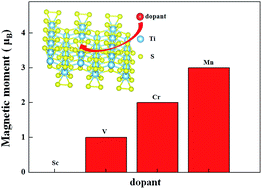
The geometrical structure, electronic structure and magnetic properties of Sc, V, Cr, Mn-doped monolayer TiS3 are investigated using first-principles calculations in the framework of density functional theory. The results show that the substitutional doping of Sc, V, Cr and Mn atoms in monolayer TiS3 is possible under Ti poor conditions and all of the doped systems are stable at room temperature. Furthermore, it is found that the ground states of V, Cr and Mn doped systems are magnetic and the magnetic moments induced by the dopant mainly come from the 3d orbitals of the dopants with a partial contribution from the 3p orbitals of neighboring S atoms around the dopants and the 3d orbitals of neighboring Ti atoms around the dopants. In particular, the magnetic coupling between the moments induced by two V and Mn is long-range ferromagnetic and the coupling can be attributed to the hybridization interaction involving polarized electrons, whereas the coupling between the moments induced by two Cr is anti-ferromagnetic. The last result suggests that the substitutional doping of V and Mn atoms can induce the room temperature ferromagnetism in monolayer TiS3.

1. Introduction

Since the initial isolation of graphene in 2004, two-dimensional (2D) materials have attracted a surge of interest due to their outstanding physicochemical properties and promising applications.1–12 For achieving prospective low-dimensional spintronic applications, considerable efforts have been devoted to investigate the magnetic properties of 2D materials.13–21 As is known, spintronic devices require generation and detection of tunable spin currents, which can ideally be done using a ferromagnetic semiconductor. Thus the zero band gap of graphene limits its applications in spintronic devices and many 2D materials with a band gap, such as transition metal dichalcogenides (TMDs) and phosphorene, have been explored.22–28 Recently, a new class of 2D material, monolayer TiS3, has been successfully isolated by mechanical exfoliation from its bulk crystal.29–31 In particular, the monolayer TiS3 is a direct band gap semiconductor with a band-gap of ∼1.1 eV,32,33 which makes monolayer TiS3 a promising material for future applications in spintronics. However, the pristine monolayer TiS3 is intrinsically nonmagnetic.33 Therefore, developing approaches to effectively induce and manipulate the magnetism of monolayer TiS3 are required for its prospective applications in low-dimensional spintronic devices.

A number of researches showed that the substitutional doping of transition metal (TM) atom is an appealing and conventional technique to induce and manipulate magnetism in the nonmagnetic 2D materials.34–44 For example, the substitution of Cr, Mn and Cu atoms can induce magnetization in graphene and monolayer ZnO.34,35 Likewise, it was found that various TM dopants can be incorporated into the TMDs monolayer and can result in a magnetic state.36–42 Moreover, Hong et al. reported that the substitutional doping of Ti, V, Cr, Mn, Fe and Ni in phosphorene can produce the magnetism.44 In this regards, it was experimentally demonstrated that the substitutional doping of many 2D materials, such as graphene, BN sheets, and monolayer MoS2, may be achieved by creating atomic-scale vacancies in preselected positions of 2D materials with a focused electron beam and then filling the vacancies with substitutional atoms.45–47

Very recently, the first-principles calculations found that the TiS3 ribbons along the a axis show ferromagnetic metallic behavior.48 Also Iyikanat et al. have reported that Ti vacancy, double S vacancy, and TiS vacancy can produce a magnetic moment in monolayer TiS3.33 Up to now, the effects of substitutional doping of TM atom on the electronic structure and magnetic properties of monolayer TiS3 have not been explored. In this paper, we systematically investigate the geometrical structure, electronic structure and magnetic properties of doped monolayer TiS3 with some TM atoms, such as Sc, V, Cr and Mn, by using first-principles calculations and discuss the mechanism about the doping of these TM atoms inducing magnetism in monolayer TiS3.

2. Computational details

All calculations were performed using Vienna ab initio simulation package (VASP).49,50 The ion–electron interaction was described by the projector-augmented wave (PAW) method.51 The cutoff energy for the plane-wave basis was chosen to be 500 eV. Perdew–Burke–Ernzerhofs version of generalized gradient approximation (GGA/PBE) was used for describing the exchange correlation functional.52 The doped monolayer TiS3 is modeled with a 3 × 5 supercell, which contains 120 atoms in total, as shown in Fig. 1. The Brillouin zone was sampled by a 3 × 3 × 1 Monkhorst–Pack k-point mesh. In order to hinder interlayer interaction within the periodic images, a vacuum spacing of 20 Å between adjacent layers was chosen. The conjugate-gradient method was used for geometrical optimization until the force on each atom was smaller than 0.02 eV Å−1. The formation energy Ef of dopant X substituting for Ti in monolayer TiS3 is defined as follows:
Ef = E(Ti29XS90) − E(Ti30S90) − μx + μTi
here, E(Ti29XS90) and E(Ti30S90) are the total energy of doped and corresponding pristine monolayer TiS3, respectively. μX and μTi are the chemical potentials of a doping atom X and Ti atom, respectively. We take μX as the energy per atom in bulk X metal. The value of μTi is defined within a range of values corresponding to Ti-rich or S-rich growth conditions. Under a Ti-rich condition, μTi is taken as the energy of a Ti atom in bulk Ti, while under a S-rich condition, μTi is determined from the difference in energy between three S atoms in bulk S and one formula unit of pristine monolayer TiS3.

image file: c6ra06486h-f1.tif
Fig. 1 Top (a) and side (b) view of structure of the monolayer TiS3 supercell. Light blue, yellow and red balls represent Ti, S and doping atoms, respectively. The numbers label doping atoms and neighboring S and Ti atoms around doping atom at site 0 in order to reference below.

To check the stability of the doped monolayer TiS3 systems, ab initio molecular dynamics (MD) simulation at 300 K is performed with the VASP. For the MD simulations, the canonical ensemble (NVT) is adopted and the simulation time is limited to 2.0 ps with a time step of 1.0 fs. The Nosé–Hoover method is applied to control the temperature at 300 K.

3. Results and discussion

To assess the effect of the substitutional doping on the electronic and magnetic properties of monolayer TiS3, we first investigated the structural, electronic and magnetic properties of the pristine monolayer TiS3. As shown in Fig. 1, the monolayer TiS3 has a rectangle unit cell and every Ti atom is bonded with 3 neighboring base S atoms and 1 neighboring chain S atom. Our calculations show that the optimized lattice constants of pristine monolayer TiS3 are a = 5.04 Å and b = 3.43 Å. The Ti–S bond lengths are 2.46 Å, 2.50 Å and 2.67 Å, respectively, as shown in Fig. 1(b). Since GGA/PBE functional is known to underestimate the band gap of semiconductors, we calculate the band structures of monolayer TiS3 using the hybrid HSE06 functional53 as implemented in the VASP. Our HSE06 calculation indicates that the monolayer TiS3 is a semiconductor with a direct band gap of 1.08 eV at the Γ point and the general features of the band structures of monolayer TiS3 calculated by GGA/PBE and HSE functional are similar except for the band gap. These calculated results are in good agreement with previous calculations,32,33,48 indicating that our computational methodology is reasonable and reliable. In agreement with the reported result by ref. 33, the calculated energy difference between the spin polarized and non-spin polarized state suggests that the pristine monolayer TiS3 is nonmagnetic. As shown in Fig. 2(a–c), one Ti atom in monolayer TiS3 is bonded with eight neighboring S atoms, including S3, S4, S5, S6, S7, S8, S9 and S10, which means that the four valence electrons of each Ti atom are all saturated due to the bonding interaction with the electrons of three neighboring base S atoms and one neighboring chain S atom. Therefore pristine monolayer TiS3 is intrinsically nonmagnetic.
image file: c6ra06486h-f2.tif
Fig. 2 Differential electron density for pristine monolayer TiS3 and doped monolayer TiS3 systems Ti29XS60 (X = Sc, V, Cr and Mn). The red and blue indicate the electron accumulation and depletion, respectively. The color scale is in the units of e Å−3. Light blue, yellow and red balls represent Ti, S and doping atoms, respectively. The numbers label doping atom and its neighboring P atoms in order for reference below.

Next, we investigated the TM atoms doped monolayer TiS3 systems Ti29XS60 (X = Sc, V, Cr, and Mn), in which a doping atom X occupies site 0 in the supercell, as shown in Fig. 1. Fig. 3 shows the optimized atomic structure of the doping site in doped monolayer TiS3. In order to examine whether the substitutional doping is energetically favorable, we calculate the formation energy Ef of substitutional dopant in doped monolayer TiS3 systems and the results are shown in Fig. 4. It can be seen from Fig. 4 that all of the formation energy are negative values under the S-rich condition and the S-rich condition is more energetically favorable for the substitutional doping at the Ti site compared to the Ti-rich one. Combined with the experimental reports that the substitutional doping in 2D materials can be achieved by filling the vacancies with impurity atoms,45–47 it appears that a promising scheme for atom doping at the Ti site in monolayer TiS3 may be that of growing Ti poor samples and then of filling the vacancies with an appropriate Ti replacement. Furthermore, we checked the stability of the doped monolayer TiS3 systems by MD simulation using a 3 × 5 supercell. Due to the large unit cell size and many types of doped systems, we limit the simulation time to 2.0 ps, as reported by Tománek et al. in the ref. 54. As shown in the movies of the MD simulation at 300 K of doped monolayer TiS3 systems in the ESI, the doping atom and its neighboring atoms only vibrate around the equilibrium position and the structure of the doped systems do not spontaneously disintegrate until the end of the MD simulation, which confirm that all of substitutionally doped systems Ti29XS60 (X = Sc, V, Cr, and Mn) are stable at a temperature of 300 K.


image file: c6ra06486h-f3.tif
Fig. 3 Top view of optimized structures of the doping site in Sc, V, Cr and Mn doped monolayer TiS3. Light blue, yellow and red balls represent Ti, S and doping atoms, respectively. The numbers label doping atom and its neighboring S and Ti atoms in order for reference below.

image file: c6ra06486h-f4.tif
Fig. 4 Formation energy Ef of dopant X substituting for Ti in doped systems Ti29XS60 (X = Sc, V, Cr, Mn).

For exploring stability of magnetic state, the energy differences between the spin polarized and non-spin polarized states for Ti29XS60 (X = Sc, V, Cr and Mn), ΔEspin = EspEnsp, are calculated and the calculated results are listed in Table 1. As listed in Table 1, ΔEspin of Sc-doped monolayer TiS3 are almost zero, suggesting that Sc dopant cannot induce the magnetism in doped monolayer TiS3. In contrast, Table 1 shows that the spin-polarized state of V, Cr and Mn-doped systems is more stable in energy than non-spin polarized one and stability of the spin-polarized state is large. Moreover, the magnetic moments induced by a doping V, Cr and Mn atoms were 1.0, 2.0 and 3.0 μB, respectively.

Table 1 The energy difference (ΔEspin) between the spin polarized and non-spin polarized state, the magnetic moment of the supercell (Msup) and the distance between Y1 and Y2 atoms (dY1−Y2) for pristine monolayer TiS3 and doped systems Ti29XS60 (X= Sc, V, Cr and Mn)
System ΔEspin (meV) dX0−S3(4) (Å) dX0−S5(7) (Å) dX0−S6(8) (Å) dX0−S9 (Å) dX0−S10 (Å) Msup (μB)
Ti30S60 0.00 2.46 2.50 2.50 2.67 2.67 0
Ti29ScS60 0.00 2.58 2.62 2.62 2.77 2.77 0
Ti29VS60 −119.05 2.43 2.45 2.46 2.62 2.61 1
Ti29CrS60 −317.47 2.41 2.44 2.40 2.42 3.18 2
Ti29MnS60 −405.41 2.38 2.43 2.43 2.82 2.82 3


We now turn to discuss the origin of the magnetism for V, Cr, and Mn doped systems. To quantify the local structure deformation in monolayer TiS3 caused by substitutional doping, Table 1 list the distance between Y1 and Y2 atoms, dY1−Y2, in pristine and doped monolayer TiS3. For V and Mn doped systems, Table 1 reveals that the doping of V and Mn can cause some structure deformation at the doping sites of TiS3 monolayer. But the bonding configuration of the V/Mn dopant in doped systems is still same with that of the Ti atom in pristine monolayer TiS3, as shown in Fig. 2(a–c), (g–i) and (m–o). Different from V and Mn doped systems, the substitutional Cr locates closer to neighboring S9 atom, as shown in Fig. 3(c). As a result, dX0−S10 sharply increases, while dX0−S9 greatly decrease, in comparison with those of the pristine TiS3 monolayer, as listed in Table 1. Correspondingly, the charge density difference of Cr doped monolayer TiS3 in Fig. 2(j–l) show that the doping Cr atom is bonded with each of its seven neighboring S3, S4, S5, S6, S7, S8, and S9 atoms, while it is not bonded with the neighboring S10 atom. It's worth noting that the bond between Cr and S9 atom in Cr doped system is stronger than that between Ti and S9 atom in the pristine TiS3 monolayer, as shown in Fig. 2(c) and (l), which suggests that the produced excess electrons by the broken Cr–S10 bond are transferred to strengthen Cr–S9 bond. Thus, the number of the bonding electrons of Cr in Cr doped system is almost same with those of Ti in the pristine monolayer TiS3. It is known that the number of valence electrons of Ti, V, Cr and Mn are four, five, six and seven, respectively, which means that one, two and three additional valence electrons of V, Cr and Mn with respect to Ti are nonbonding and unpaired, respectively, thus a doping V, Cr and Mn atom in doped TiS3 monolayer produce the magnetic moment of 1.0, 2.0 and 3.0 μB, respectively. It can be seen from the DOS of Ti29XS60 (X = V, Cr and Mn) in Fig. 5(a–c) that the 3d states of dopant X, the 3p states of the neighboring S atoms around dopants, and the 3d states of the neighboring Ti atoms around dopants overlap near the Fermi level, which suggests that the dopant hybridizes with its neighboring S and Ti atoms. As a result, the unpaired electron induced by dopant X not only occupies the 3d orbitals of X, but also partially occupies the 3p orbitals of the neighboring S atoms around X and the 3d orbitals of Ti atoms around X. Furthermore, the introduced unpaired electrons in the 3d orbitals of the dopants can couple with the 3p orbitals of the neighboring S atoms around the dopants and the 3d orbitals of neighboring Ti atoms around the dopants through p–d hybridization exchange interaction, which suggests that the main part of the magnetic moments induced by X come from dopant X with a partial contribution from the neighboring S and Ti atoms around X. The calculated spin density distribution in the relaxed Ti29XS60 (V[double bond, length as m-dash]V, Cr and Mn) systems can also demonstrate this magnetic moment distribution, as shown in Fig. 6(a–c).


image file: c6ra06486h-f5.tif
Fig. 5 Total DOS of doped monolayer TiS3 systems Ti29XS60 (X = V, Cr and Mn) and corresponding partial DOS of the 3d orbits of doping X atom, 3p orbitals of a neighboring S atoms around X and 3d orbits of Ti atoms around X. The Fermi level is indicated by the vertical dashed line.

image file: c6ra06486h-f6.tif
Fig. 6 Spin density distribution of the relaxed Ti29XS60, Ti29XS59VS17 and Ti29XS59VS20 (X = V, Cr and Mn). The pink and pale green iso-surfaces correspond to the majority- and minority-spin densities. Light blue, yellow and red balls represent Ti, S and doping atoms, respectively.

In the following, we discuss the reason for the absence of magnetism in Sc doped monolayer TiS3. The charge density difference in Fig. 2(d–f) shows that one Sc atom is bonded with eight neighboring S atoms, which is same with the bonding configuration of the V dopant in doped systems. The band structure of the Sc and V doped systems are shown in Fig. 7. In contrast to Ti29VS60, the band crossed by the Fermi level for Sc doped system show a large dispersion along the high-symmetry lines, as shown in Fig. 7(a), indicating extended character of the band crossed by the Fermi level. Furthermore, it is found that the band crossed by the Fermi level for Sc doped system is mainly composed of the 3p orbital of the S atoms around Sc, while that for V doped system is mainly composed of the 3d orbital of V atom. Usually, compared to the valence electrons in 3d orbital, those in 3p orbital have strong extended nature. As known, the extended states usually favor non-spin polarization due to the higher kinetic energy. This is the reason why the substitutional doping of Sc cannot induce the magnetism in doped TiS3 monolayer.


image file: c6ra06486h-f7.tif
Fig. 7 Band structure of Sc and V doped monolayer TiS3 systems. The Fermi level is indicated by the horizontal dashed line.

In view of report by Iyikanat et al.,33 wherein S vacancy with low formation energy has a much higher probability to form as compared to a Ti vacancy, the effects of S vacancy on magnetism of the doped systems Ti29XS60 (X = Sc, V, Cr and Mn) are investigated. As shown in Fig. 1, we consider two different S vacancy positions in the supercell, where an S atom is removed from S17 (VS17) or S20 site (VS20), defined the systems Ti29XS59VS17 and Ti29XS59VS20 (X = Sc, V, Cr and Mn), respectively. Our calculations show that neither vacancy VS17 nor vacancy VS20 induces magnetism in Sc-doped monolayer TiS3. In addition, a doping V, Cr and Mn atom in doped systems Ti29XS59VS17 and Ti29XS59VS20 produce the magnetic moment of 1.0, 2.0 and 3.0 μB, respectively, which is consistent with the magnetic moment produced by a doping atom in Ti29XS60 (X = V, Cr and Mn). As shown in Fig. 6, the spin density distribution of the relaxed Ti29XS59VS17 and Ti29XS59VS20 (X = V, Cr and Mn) systems is almost same with that of the Ti29XS60 (X = V, Cr and Mn) systems. Therefore, our calculations demonstrate that the effects of S vacancy on magnetism in Ti29XS60 (X = Sc, V, Cr and Mn) is negligibly little. It is noticed that the energy of Ti29XS59VS17 (X = V, Cr, Mn) is lower than that of Ti29XS59VS20 (X = V, Cr, Mn) about 20.18 meV, 50.63 meV, 13.83 meV, respectively, which suggests that S vacancy tends to locate near the doping X (X = V, Cr, Mn) atom.

To further study the magnetic coupling between the moments induced by dopants, we investigated the doped monolayer TiS3 systems Ti28X2S60 (X = V, Cr and Mn), in which two Ti atoms are substituted by dopant X in a supercell. Here we consider two positional configurations of the dopants in the supercell, where one dopant occupies site 0 and another occupies the 1 or 2 sites, respectively, as shown in Fig. 1. The two configurations are labeled as (0, 1) and (0, 2). For each configuration, ferromagnetic (FM) and antiferromagnetic (AFM) calculations are performed by specifying parallel and anti-parallel alignment of the moments induced by two dopants in the supercell, respectively. The calculations show that for all configurations of Ti28X2S60 (X = V, Cr and Mn), the value of magnetic moments induced by each dopant X in the FM and AFM state and the corresponding magnetic moments distribution are almost the same as those for Ti29XS60 (X = V, Cr and Mn), as shown in Fig. 6(a–c) and 8(a–c). Table 2 list the energy difference between FM and AFM states, ΔEm = EFMEAFM, the relaxed distance between the two dopants in the supercell, and the magnetic moment of the supercell in FM/AFM state for each configuration of doped systems. It can be seen from Table 2 that for two configurations of V doped systems and the configuration (0, 2) of Mn doped systems, their ground states are FM, while the ground state of the configuration (0, 2) of Cr-doped system is AFM. As for the configuration (0, 1) of Cr and Mn-doped systems, the magnetic coupling between the moments induced by two Cr/Mn is very weak. More importantly, Table 2 shows that for V and Mn doped systems, ΔEm of the configuration (0, 2) with large distance between the dopants is a large negative value, which suggest that room temperature ferromagnetism is likely achieved in monolayer TiS3 by doping V and Mn. Furthermore, we also investigate the influences of S vacancies on the magnetic coupling between moments induced by dopants X in configurations (0, 1) and (0, 2), as reported by Wang et al.55 As shown in Fig. 1, in doped systems Ti28X2S58 (X = V, Cr and Mn), first S vacancy is located in near S17 site around X and second is in near S18 and S19 site around the other X, labeled the configurations VS (0, 1) and VS (0, 2), respectively. It can be seen from the Table 2 and Fig. 8 that the magnetic moments and corresponding moment distribution of the doped systems Ti28X2S58 (X = V, Cr and Mn) is almost same with those of the doped systems Ti28X2S60 (X = V, Cr and Mn), respectively. Moreover, except for the (0, 1) configuration of V doped systems, S vacancies have little effect on the magnetic coupling of doped systems. For (0, 1) configuration of V doped systems, S vacancies change the magnetic coupling between the moments induced by two Cr from weak FM coupling to weak AFM coupling.


image file: c6ra06486h-f8.tif
Fig. 8 Spin density distribution of FM/AFM ground state for the configuration (0, 2) of relaxed Ti28X2S60 and the configuration VS (0, 2) of relaxed Ti28X2S58 (X = V, Cr, and Mn). The pink and pale green iso-surfaces correspond to the majority- and minority-spin densities. Light blue, yellow and red balls represent Ti, S and doping atoms, respectively.
Table 2 The relaxation distance (d) of two dopants, the energy difference (ΔEm), and the magnetic moment of the supercell (Msup) in FM/AFM ground state for doped system Ti28X2S60 and Ti28X2S58 (X = V, Cr and Mn)
System Configuration (0, i) d (Å) ΔEm (meV) Msup (μB)
Ti28V2S60 (0, 1) 6.23 −8.14 2.00
(0, 2) 6.84 −119.3 2.00
Ti28Cr2S60 (0, 1) 6.10 −0.96 4.00
(0, 2) 6.83 12.21 0.00
Ti28Mn2S60 (0, 1) 6.33 −1.08 6.00
(0, 2) 6.85 −55.34 6.00
Ti28V2S58 VS (0, 1) 6.29 8.41 0.00
VS (0, 2) 6.76 −115.89 2.00
Ti28Cr2S58 VS (0, 1) 6.19 −1.49 4.00
VS (0, 2) 6.83 11.26 0.00
Ti28Mn2S58 VS (0, 1) 6.38 −0.31 6.00
VS (0, 2) 6.85 −65.65 6.00


The mechanism of long-range magnetic coupling between the magnetic moments induced by dopants can be explained by analyzing the calculated DOS and spin density distribution. The calculated spin density in Fig. 8(a–c) shows that the S and Ti atoms around each dopant X are polarized to different degrees and the spins orientations of the S and Ti atoms around dopant X are parallel or anti-parallel to that of dopant X under the p–d hybridization exchange interaction.56–58 As a result, the electrons localized around the S and Ti atoms between two dopants X in the supercell are polarized, as shown in Fig. 8(a–c). As reported by ref. 56, these polarized electrons are able to effectively mediate indirect magnetic coupling between the magnetic moments induced by two dopants. Meanwhile it can be seen from DOS of Ti28V2S60 and Ti28Mn2S60 in Fig. 9(a) and (c) that the states at the Fermi level are almost states of one spin channel and they are partially occupied, while another spin states are insulating. Consequently, when the spin of the V/Mn atoms are parallel to each other, the spin-conserving hopping for electrons from the 3d orbits of one doping atom to those of other neighboring doping atom can lower the kinetic and exchange energies relative to the antiparallel spin alignment due to the strong intra-atomic exchange interaction between the electrons in 3d level, which results in indirect long-range FM coupling between the magnetic moments induced by dopants V/Mn. In contrast, DOS of Ti28Cr2S60 in Fig. 9(b) shows that the majority-spin 3d states of Cr atom near the Fermi level are fully occupied and the unoccupied higher energy minority-spin 3d states of Cr atom are closest to the Fermi level. As mentioned above, the spin-conserving hopping for electrons from the occupied 3d orbitals of one Cr atom to the same-spin unoccupied 3d orbits of other neighboring Cr atom lowers energy of system when the spin alignment of the two Cr is antiparallel while such hopping is not allowed when the spin alignment is parallel, thus resulting in a AFM coupling between the magnetic moments induced by two Cr.


image file: c6ra06486h-f9.tif
Fig. 9 Total DOS of FM/AFM ground state for the configuration (0, 2) of Ti28X2S60 (X = V, Cr, and Mn) and corresponding partial DOS of the 3d orbits of doping X atom, 3p orbits of a neighboring S atoms around X and 3d orbits of Ti atoms around X. The Fermi level is indicated by the vertical dashed line.

It is well known that semi-local DFT functional over-delocalize electrons in 3d transition metal atoms and DFT+U functional can give improved results.59,60 Therefore, we do a spot-check on Sc and Cr doped monolayer TiS3 by using GGA/PBE+U functional. The value of parameter U for 3d states of transition metal is taken to be 2.5 eV, which is the same with the values used in ref. 61. GGA/PBE+U calculations reveal that dopant Sc doesn't induce magnetism in doped monolayer TiS3 and the general features of the band structures of Cr-doped monolayer TiS3 calculated by GGA/PBE and GGA/PBE+U functional are similar, as shown in Fig. 7(a) and 10. For Cr doped system, the calculated magnetic moments and corresponding moment distribution of the doped systems by GGA/PBE+U functional are similar with those by GGA functional, as shown in Fig. 6(b), 8(b) and 11. Moreover, for the configuration (0, 2) of the Cr-doped system Ti28Cr2S60, although the energy difference ΔEm calculated by GGA/PBE+U functional increases from 12.21 meV to 29.88 meV, its ground state is still AFM.


image file: c6ra06486h-f10.tif
Fig. 10 Band structure of Sc doped monolayer TiS3 system by using GGA/PBE+U functional (U = 2.5 eV). The Fermi level is indicated by the horizontal dashed line.

image file: c6ra06486h-f11.tif
Fig. 11 Spin density distribution of the relaxed Ti29CrS60 and AFM ground state for the configuration (0, 2) of relaxed Ti28Cr2S60 by using GGA/PBE+U functional (U = 2.5 eV).

4. Conclusions

In summary, the substitutional doping of Sc, V, Cr and Mn atoms in monolayer TiS3 are possible under the S-rich condition and all of the doped systems are thermo-dynamically stable at room temperature. The substitutional doping of Sc can not produce magnetism in monolayer TiS3 due to extended character of the band crossed by the Fermi level. Different from Sc doped monolayer TiS3, it is found that a V, Cr and Mn dopant in doped monolayer TiS3 can induce the magnetic moments of 1.0, 2.0 and 3.0 μB, respectively, which mainly come from the unbonding 3d electrons of V, Cr and Mn atoms. Furthermore, the magnetic coupling between the moments induced by two V and Mn is long-range ferromagnetic and the coupling can be attributed to the hybridization interaction involving polarized electrons. In contrast, an AFM coupling occurs between the moments induced by two Cr. These results suggest that the substitutional doping of TM atom is an effective approach to tune the magnetism of monolayer TiS3 monolayer.

Acknowledgements

This work was supported by the National Natural Science Foundation of China (11174104) and Special Program for Applied Research on Super Computation of the NSFC-Guangdong Joint Fund (the second phase) (nsfc2015_179). The authors acknowledge the computational support provided by High Performance Computing Center of Jilin University, China.

References

  1. K. S. Novoselov, A. K. Geim, S. V. Morozov, D. Jiang, Y. Zhang, S. V. Dubonos, I. V. Grigorieva and A. A. Firsov, Science, 2004, 306, 666–669 CrossRef CAS PubMed.
  2. A. K. Geim and K. S. Novoselov, Nat. Mater., 2007, 6, 183–191 CrossRef CAS PubMed.
  3. S. Lebègue, T. Björkman, M. Klintenberg, R. M. Nieminen and O. Eriksson, Phys. Rev. X, 2013, 3, 031002 Search PubMed.
  4. C. Ataca, H. Şahin and S. Ciraci, J. Phys. Chem. C, 2012, 116, 8983–8999 CAS.
  5. B. Radisavljevic and A. Kis, Nat. Mater., 2013, 12, 815–820 CrossRef CAS PubMed.
  6. J. Hong, Z. Hu, M. Probert, K. Li, D. Lv, X. Yang, L. Gu, N. Mao, Q. Feng, L. Xie, J. Zhang, D. Wu, Z. Zhang, C. Jin, W. Ji, X. Zhang, J. Yuan and Z. Zhang, Nat. Commun., 2015, 6, 6293 CrossRef CAS PubMed.
  7. S. Das, M. Demarteau and A. Roelofs, ACS Nano, 2014, 8, 11730–11738 CrossRef CAS PubMed.
  8. L. Li, Y. Yu, G. J. Ye, Q. Ge, X. Ou, H. Wu, D. Feng, X. H. Chen and Y. Zhang, Nat. Nanotechnol., 2014, 9, 372–377 CrossRef CAS PubMed.
  9. W. Hu, T. Wang and J. Yang, J. Mater. Chem. C, 2015, 3, 4756–4761 RSC.
  10. H. Zheng, B. Yang, D. Wang, R. Han, X. Du and Y. Yan, Appl. Phys. Lett., 2014, 104, 132403 CrossRef.
  11. O. V. Yazyev, Rep. Prog. Phys., 2010, 73, 056501 CrossRef.
  12. Y. Ding and Y. Wang, J. Phys. Chem. C, 2015, 119, 10610–10622 CAS.
  13. H. Zheng, J. Zhang, B. Yang, X. Du and Y. Yan, Phys. Chem. Chem. Phys., 2015, 17, 16341–16350 RSC.
  14. B. Huang, H. Xiang, J. Yu and S. H. Wei, Phys. Rev. Lett., 2012, 108, 206802 CrossRef PubMed.
  15. H.-P. Komsa, S. Kurasch, O. Lehtinen, U. Kaiser and A. V. Krasheninnikov, Phys. Rev. B: Condens. Matter Mater. Phys., 2013, 88, 035301 CrossRef.
  16. H. Shi, H. Pan, Y.-W. Zhang and B. I. Yakobson, Phys. Rev. B: Condens. Matter Mater. Phys., 2013, 88, 205305 CrossRef.
  17. H. Zheng, B. Yang, H. Wang, Z. Chen and Y. Yan, J. Magn. Magn. Mater., 2015, 386, 155–160 CrossRef CAS.
  18. Y. Du, H. Liu, B. Xu, L. Sheng, J. Yin, C. G. Duan and X. Wan, Sci. Rep., 2015, 5, 8921 CrossRef CAS PubMed.
  19. S. Chintalapati, L. Shen, Q. Xiong and Y. P. Feng, Appl. Phys. Lett., 2015, 107, 072401 CrossRef.
  20. Y. S. Liu, X. Zhang, X. F. Yang, X. K. Hong, J. F. Feng, M. S. Si and X. F. Wang, Phys. Chem. Chem. Phys., 2015, 17, 10462–10467 RSC.
  21. H. Zheng, H. Yang, H. Wang, X. Du and Y. Yan, J. Magn. Magn. Mater., 2016, 408, 121–126 CrossRef CAS.
  22. L. Jiao, L. Zhang, X. Wang, G. Diankov and H. Dai, Nature, 2009, 458, 877–880 CrossRef CAS PubMed.
  23. F. Schwierz, Nat. Nanotech., 2010, 5, 487–496 CrossRef CAS PubMed.
  24. K. S. Novoselov, D. Jiang, F. Schedin, T. J. Booth, V. V. Khotkevich, S. V. Morozov and A. K. Geim, Proc. Natl. Acad. Sci. U. S. A., 2005, 102, 10451–10453 CrossRef CAS PubMed.
  25. B. Radisavljevic, A. Radenovic, J. Brivio, V. Giacometti and A. Kis, Nat. Nanotech., 2011, 6, 147–150 CrossRef CAS PubMed.
  26. M. Xu, T. Liang, M. Shi and H. Chen, Chem. Rev., 2013, 113, 3766–3798 CrossRef CAS PubMed.
  27. H. Liu, A. T. Neal, Z. Zhu, Z. Luo, X. Xu, D. Tománek and P. D. Ye, ACS Nano, 2004, 8, 4033–4041 CrossRef PubMed.
  28. Z. Zhu and D. Tománek, Phys. Rev. Lett., 2014, 112, 176802 CrossRef PubMed.
  29. J. O. Island, M. Buscema, M. Barawi, J. M. Clamagirand, J. R. Ares, C. Sánchez, I. J. Ferrer, G. A. Steele, H. S. J. van der Zant and A. Castellanos-Gomez, Adv. Opt. Mater., 2014, 2, 641–645 CrossRef CAS.
  30. J. O. Island, M. Barawi, R. Biele, A. Álmazan, J. M. Clamagirand, J. R. Ares, C. Sánchez, H. S. van der Zant, J. V. Álvarez, R. D'Agosta, I. J. Ferrer and A. Castellanos-Gomez, Adv. Mater., 2015, 27, 2595–2601 CrossRef CAS PubMed.
  31. A. Lipatov, P. M. Wilson, M. Shekhirev, J. D. Teeter, R. Netusil and A. Sinitskii, Nanoscale, 2015, 7, 12291–12296 RSC.
  32. J. Dai and X. C. Zeng, Angew. Chem., Int. Ed., 2015, 54, 7572–7576 CrossRef CAS PubMed.
  33. F. Iyikanat, H. Sahin, R. T. Senger and F. M. Peeters, J. Phys. Chem. C, 2015, 119, 10709–10715 CAS.
  34. A. V. Krasheninnikov, P. O. Lehtinen, A. S. Foster, P. Pyykkö and R. M. Nieminen, Phys. Rev. Lett., 2009, 102, 126807 CrossRef CAS PubMed.
  35. J. Ren, H. Zhang and X. Cheng, Int. J. Quantum Chem., 2013, 113, 2243–2250 CrossRef CAS.
  36. K. Dolui, I. Rungger, C. D. Pemmaraju and S. Sanvito, Phys. Rev. B: Condens. Matter Mater. Phys., 2013, 88, 075420 CrossRef.
  37. Y. C. Cheng, Z. Y. Zhu, W. B. Mi, Z. B. Guo and U. Schwingenschlögl, Phys. Rev. B: Condens. Matter Mater. Phys., 2013, 87, 100401 CrossRef.
  38. B. Yang, H. Zheng, R. Han, X. Du and Y. Yan, RSC Adv., 2014, 4, 54335–54343 RSC.
  39. A. Ramasubramaniam and D. Naveh, Phys. Rev. B: Condens. Matter Mater. Phys., 2013, 87, 195201 CrossRef.
  40. R. Mishra, W. Zhou, S. J. Pennycook, S. T. Pantelides and J.-C. Idrobo, Phys. Rev. B: Condens. Matter Mater. Phys., 2013, 88, 144409 CrossRef.
  41. W. S. Yun and J. D. Lee, Phys. Chem. Chem. Phys., 2014, 16, 8990–8996 RSC.
  42. J. Zhang, H. Zheng, R. Han, X. Du and Y. Yan, J. Alloys Compd., 2015, 647, 75–81 CrossRef CAS.
  43. L. Seixas, A. Carvalho and A. H. Castro Neto, Phys. Rev. B: Condens. Matter Mater. Phys., 2015, 91, 155138 CrossRef.
  44. A. Hashmi and J. Hong, J. Phys. Chem. C, 2015, 119, 9198–9204 CAS.
  45. J. A. Rodríguez-Manzo, O. Cretu and F. Banhart, ACS Nano, 2010, 4, 3422–3428 CrossRef PubMed.
  46. X. Wei, M.-S. Wang, Y. Bando and D. Golberg, ACS Nano, 2011, 5, 2916–2922 CrossRef CAS PubMed.
  47. H.-P. Komsa, J. Kotakoski, S. Kurasch, O. Lehtinen, U. Kaiser and A. V. Krasheninnikov, Phys. Rev. Lett., 2012, 109, 035503 CrossRef PubMed.
  48. J. Kang, H. Sahin, H. D. Ozaydin, R. T. Senger and F. M. Peeters, Phys. Rev. B: Condens. Matter Mater. Phys., 2015, 92, 075413 CrossRef.
  49. G. Kresse and J. Hafner, Phys. Rev. B: Condens. Matter Mater. Phys., 1993, 47, 558 CrossRef CAS; G. Kresse and J. Hafner, Phys. Rev. B: Condens. Matter Mater. Phys., 1994, 49, 14251 CrossRef.
  50. G. Kresse and J. Furthmüller, Comput. Mater. Sci., 1996, 6, 15 CrossRef CAS; G. Kresse and J. Furthmüller, Phys. Rev. B: Condens. Matter Mater. Phys., 1996, 54, 11169 CrossRef.
  51. P. E. Blöchl, Phys. Rev. B: Condens. Matter Mater. Phys., 1994, 50, 17953 CrossRef.
  52. J. P. Perdew, K. Burke and M. Ernzerhof, Phys. Rev. Lett., 1996, 77, 3865 CrossRef CAS PubMed.
  53. J. Heyd, G. E. Scuseria and M. Ernzerhof, J. Chem. Phys., 2003, 118, 8207–8215 CrossRef CAS.
  54. Z. Zhu and D. Tománek, Phys. Rev. Lett., 2014, 112, 176802 CrossRef PubMed; J. Guan, Z. Zhu and D. Tománek, Phys. Rev. Lett., 2014, 113, 046804 CrossRef PubMed.
  55. Q. J. Wang, J. B. Wang, X. L. Zhong, Q. H. Tan, Z. Hu and Y. C. Zhou, Appl. Phys. Lett., 2012, 100, 132407 CrossRef.
  56. L. Shen, R. Q. Wu, H. Pan, G. W. Peng, M. Yang, Z. D. Sha and Y. P. Feng, Phys. Rev. B: Condens. Matter Mater. Phys., 2008, 78, 073306 CrossRef.
  57. L. X. Guan, J. G. Tao, C. H. A. Huan, J. L. Kuo and L. Wang, J. Appl. Phys., 2010, 108, 093911 CrossRef.
  58. W. Z. Xiao, L. L. Wang, L. Xu, Q. Wang and A. L. Pan, Solid State Commun., 2010, 150, 923 CrossRef CAS.
  59. P. Guss, M. E. Foster, B. M. Wong, F. P. Doty, K. Shah, M. R. Squillante, U. Shirwadkar, R. Hawrami, J. Tower and D. Yuan, J. Appl. Phys., 2014, 115, 034908 CrossRef.
  60. V. I. Anisimov, F. Aryasetiawan and A. I. Lichtenstein, J. Phys.: Condens. Matter, 1997, 9, 767 CrossRef CAS.
  61. A. Hashmi and J. Hong, J. Phys. Chem. C, 2015, 119, 9198–9204 CAS.

Footnote

Electronic supplementary information (ESI) available: This part gives the MD movies of Ti29XS60 (X = Sc, V, Cr and Mn) at 300 K, respectively. See DOI: 10.1039/c6ra06486h

This journal is © The Royal Society of Chemistry 2016
Click here to see how this site uses Cookies. View our privacy policy here.