DOI:
10.1039/C6RA06317A
(Paper)
RSC Adv., 2016,
6, 39433-39443
Three-component access to 2-pyrrolin-5-ones and their use in target-oriented and diversity-oriented synthesis†
Received
9th March 2016
, Accepted 10th April 2016
First published on 12th April 2016
Abstract
The Hantzsch-type microwave-assisted, solvent-free sequential three-component reaction between primary amines, β-dicarbonyl compounds and α-bromoesters in the presence of indium trichloride afforded 2-pyrrolin-5-ones, which are difficult to access by alternative methods. Ready access to these compounds allowed their use as synthetic building blocks in a target-oriented project aimed at the synthesis of a compound that had previously been postulated as a candidate for HIV integrase inhibition on the basis of computational studies. The versatility of 2-pyrrolin-5-ones was further verified by their use in a diversity-oriented synthesis context, leading to a library of highly functionalized bispiro compounds. The overall process leading to these compounds involved the generation of six bonds and two cycles over three steps, two of which are multicomponent, and the fully controlled generation of up to four stereocenters, including two quaternary ones.
Introduction
Pyrrole is one of the most important simple heterocycles and constitutes the structural core of a large number of natural products1 and synthetic bioactive compounds,2 including some drugs in clinical use such as the cholesterol-lowering agent atorvastatin, the best-selling drug of all time.3 Nevertheless, some promising pyrrole-derived simple frameworks have received very little attention because of their poor synthetic accessibility. This is the case of the 2-pyrrolin-5-one system, which has been described only a few times, and has normally been accessed by complex multistep routes in very modest yields.4
Multicomponent reactions (MCRs) have emerged as powerful synthetic strategies because of their efficiency, atom economy, high selectivity, and convenient construction of multiple new bonds; these characteristics give rapid access to combinatorial libraries of complex organic molecules for efficient lead structure identification and optimization in drug discovery. From the point of view of the generation of molecular diversity, MCRs with a broad range of functional group tolerance are ideal because such reactions allow performing complexity-generating post-MCR transformations, such as cyclizations.5
In this context, it would be advantageous a synthetic efficiency perspective to devise a multicomponent approach to the 2-pyrrolin-5-one framework in order to pave the way to a deeper study of its chemistry and pharmacology. Furthermore, to our knowledge such a reaction would be the first one to be described in the literature, although there is some precedent for the use of multicomponent approaches for the preparation of their conjugated isomers derived from the 2-pyrrolin-3-one skeleton.6 Furthermore, the 2-pyrrolin-5-one thus prepared should be suitably functionalized to allow subsequent manipulation.
We envisioned that it should be possible to adapt the classical Hantzsch pyrrole synthesis7 for our purpose. This endeavour would involve developing the three-component reaction between primary amines, α-haloesters and β-dicarbonyl compounds to furnish compounds 1, and we describe in this article the translation of this idea into practice. A two-component process somewhat related to the one we propose here and involving the reaction of β-enamino esters with α-ketoaldehydes affords mixtures of regioisomers. This protocol gave good results only for N-hydroxyethyl or N-hydroxypropyl enamino esters, presumably because of the stabilization of the 5-oxo product by intramolecular hydrogen bonding.8,9 A three-component variation of this reaction, starting from primary amines, α-ketoaldehydes and β-dicarbonyl compounds gives exclusively 4-hydroxypyrroles.10
In order to further establish the synthetic usefulness of new method, we demonstrated its application to two situations with very different requirements, i.e. target-oriented and diversity-oriented synthesis (Scheme 1). For the first goal, we chose as our target compound 2, which has been recently postulated as a candidate for HIV integrase inhibition. This proposal arose from a computational study aimed at the identification of new pharmacophores for the design of integrase inhibitors based on shape-based virtual screening of drug-like databases followed by in silico ADMET optimization, QSAR predictions and docking studies.11 Furthermore, in order to verify the possibility of generating molecular diversity from compounds 1, we chose to study the preparation of bispiro frameworks 3 and 4 via the combination of our initial MCR with a second one, namely a three-component reaction involving the [3 + 2] dipolar cycloaddition of non-stabilized azomethine ylides with activated olefins, which offers a concise entry into functionalized spiropyrrolidine motifs with a high regio- and diastereoselectivity. The combination of two multicomponent reactions is generally recognized as an excellent approach to the generation of molecular diversity,12,13 although it has not been widely exploited. Spirocyclic frameworks are present in many natural products and are increasingly recognized as interesting scaffolds in drug discovery programs.14 Furthermore, spiropyrrolidine compounds are present in numerous natural products, such as (−)-horsfiline and spirotryprostatin A and have shown interesting pharmacological activities including antiproliferative15 and antitubercular16 properties as well as acetylcholinesterase inhibition,17 among others. Compounds 3 and 4 have the advantage over related structures reported in the literature of the high functionalization of their pyrrolidinone moiety, which provides synthetic handles for future transformations.
 |
| | Scheme 1 Summary of the objectives of our work. | |
Results and discussion
We started our optimization study by examining the model preparation of compound 1a from butylamine, ethyl bromoacetate and ethyl acetoacetate (Table 1). In our first experiments, these starting materials were combined in ethanol in the presence of 5% Ce(IV) ammonium nitrate (CAN) as a Lewis acid,18 initially at room temperature and then under reflux conditions, but no reaction was observed (entries 1 and 2). The use of focused microwave irradiation was also unsuccessful (entries 3 and 4). However, when the reaction was performed under solvent-free conditions, compound 1a was obtained in 53% yield (entry 5), with no improvement being observed upon increase of the catalyst load (entry 6). Lanthanide triflates, represented by yttrium and ytterbium triflates, were also assayed, again with no improvement (entries 7 and 8). Boron trifluoride etherate failed to catalyze the reaction (entry 9), and aluminium trichloride gave only modest yields, even with 10% catalyst load (entries 10 and 11). Finally, indium trichloride was found to improve the results obtained with CAN, giving a 60% yield of 1a with a 5% loading (entry 12) and almost the same result with 10% of the catalyst (entry 13). One final attempt was made using montmorillonite K10, a clay with acidic properties that is compatible with microwave irradiation,19 but it failed to promote our reaction (entry 14) (Scheme 2).
Table 1 Optimization of the synthesis of compound 1a
| Entry |
Catalyst (%) |
Temp. (°C) |
Time (h) |
Solvent |
Yield (%) |
| Using either ethyl bromoacetate or ethyl iodoacetate. |
| 1 |
CAN (5) |
r.t. |
20 |
EtOH |
0a |
| 2 |
CAN (5) |
80 |
14 |
EtOH |
0 |
| 3 |
CAN (5) |
80 (MW) |
0.5 |
EtOH |
0 |
| 4 |
CAN (5) |
120 (MW) |
0.5 |
EtOH |
0 |
| 5 |
CAN (5) |
120 (MW) |
0.5 |
— |
53 |
| 6 |
CAN (10) |
120 (MW) |
0.5 |
— |
52 |
| 7 |
Y(OTf)3 (5) |
120 (MW) |
0.5 |
— |
50 |
| 8 |
Yb(OTf)3 (10) |
120 (MW) |
0.5 |
— |
26 |
| 9 |
BF3·Et2O (10) |
120 (MW) |
0.5 |
— |
Traces |
| 10 |
AlCl3 (5) |
120 (MW) |
0.5 |
— |
19 |
| 11 |
AlCl3 (10) |
120 (MW) |
0.5 |
— |
29 |
| 12 |
InCl3 (5) |
120 (MW) |
0.5 |
— |
60 |
| 13 |
InCl3 (10) |
120 (MW) |
0.5 |
— |
58 |
| 14 |
Montmorillonite K10 |
120 (MW) |
0.5 |
— |
Traces |
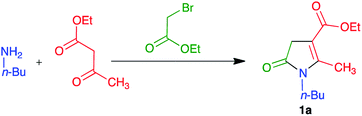 |
| | Scheme 2 Synthesis of compound 1a from butylamine, ethyl bromoacetate and ethyl acetoacetate. | |
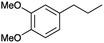
These optimal conditions (5% InCl3, solvent-free microwave irradiation, 120 °C) were applied to obtain a library of diversely substituted pyrrolinones in a 40–76% range of yields (Scheme 3 and Table 2), employing simple and commercially available starting materials. The scope of the R1 substituent on nitrogen included a variety of groups such as alkyl (entries 1–4, 7–9 and 13), arylalkyl (entries 5, 6 and 12), allyl (entry 10) and functionalized alkyl (entry 11). The R2 chain was chosen among several primary alkyl chains, including methyl, ethyl (entry 7) and propyl (entries 4 and 9). The reaction was compatible with the presence of ester or ketone functions at C-3. While most compounds 1 were unsubstituted at C-4 because our planned applications involved a condensation at this position, we also demonstrated the possibility to prepare a C4-phenyl derivative (entry 13). In this case, the α-haloester component was an iodide, and aluminium trichloride proved to be more efficient in promoting the reaction than indium trichloride. Finally, we also examined several reactions starting from ethyl β-aminocrotonate. Thus, its reaction with ethyl 2-bromoacetate gave the N-unsubstituted pyrrolinone 1n in 55% yield (entry 14). This is a significant result because a previous preparation of this compound by reaction of the same aminocrotonate with glyoxal required a 7 h reflux in ethanol and afforded 1n in only 29% yield.8 Three additional examples of N-unsubstituted pyrrolinones, including one substituted at C-4 (compound 1o), were obtained by the same method (entries 15–17). Interestingly, we did not observe the isomerization of 2-pyrrolin-5-ones to their regioisomeric 4-hydroxypyrroles noticed by previous authors.9
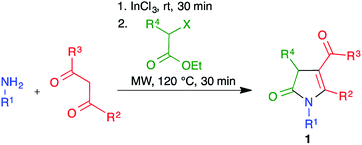 |
| | Scheme 3 Sequential multicomponent synthesis of 2-pyrrolin-5-ones 1. | |
Table 2 Results of the synthesis of compounds 1a
| Entry |
Cmpd |
R1 |
R2 |
R3 |
R4 |
Yield (%) |
| The X leaving group was Br in all cases except for entry 13, where X = I. In this case the catalyst was aluminium trichloride (10%). From ethyl β-aminocrotonate and the suitable α-bromoester. |
| 1 |
1a |
n-Bu |
Me |
OEt |
H |
60 |
| 2 |
1b |
n-Bu |
Me |
OMe |
H |
50 |
| 3 |
1c |
n-Bu |
Me |
Me |
H |
42 |
| 4 |
1d |
n-Bu |
n-Pr |
OEt |
H |
52 |
| 5 |
1e |
Bn |
Me |
OEt |
H |
52 |
| 6 |
1f |
Bn |
Me |
OMe |
H |
55 |
| 7 |
1g |
n-Bu |
Et |
OEt |
H |
59 |
| 8 |
1h |
Me |
Me |
OEt |
H |
76 |
| 9 |
1i |
n-Hex |
n-Pr |
OEt |
H |
72 |
| 10 |
1j |
Allyl |
Me |
OMe |
H |
50 |
| 11 |
1k |
2-Hydroxyethyl |
Me |
OMe |
H |
43 |
| 12 |
1l |
 |
Me |
OMe |
H |
52 |
| 13 |
1m |
n-Bu |
Me |
OEt |
Ph |
58b |
| 14 |
1n |
H |
Me |
OEt |
H |
55c |
| 15 |
1o |
H |
Me |
OEt |
Me |
43c |
| 16 |
1p |
H |
Me |
OEt |
Et |
40c |
| 17 |
1q |
H |
Me |
OEt |
Ph |
41c |
Mechanistically, our three-component process was expected to proceed via a Hantzsch-type mechanism that is depicted in Scheme 4 for the reaction leading to compound 1a. Thus, the reaction would start with the InCl3-catalyzed formation of a β-enamino ester,20 which would then react with the α-haloester to give intermediate I, which can tautomerize to species II or III. However, only the E isomer II can undergo cyclization, thus driving these equilibria to the final product.
 |
| | Scheme 4 Mechanistic proposal for the three-component 2-pyrrolin-5-one synthesis. | |
An alternative Paal–Knorr-like mechanism would involve the formation of a 1,4-dicarbonyl species IV that would then react with the primary amine to give the previous intermediate II. However, we verified that ethyl acetoacetate and ethyl bromoacetate did not react at all in the presence of InCl3 under our conditions. Furthermore, we found that treatment of the known21 ethyl acetosuccinate IV with n-butylamine failed to give the 2-pyrrolin-5-one 1a under our conditions. On the contrary, the isolated β-enamino ester arising from n-butylamine and ethyl acetoacetate22 furnished compound 1a when treated with ethyl bromoacetate in the presence of InCl3 under our usual conditions.
We next turned our attention to the application of the method to a target-oriented synthesis project. To this end, as mentioned in the Introduction, we chose as our target a 2-pyrrolin-5-one derivative (compound 2) that had been previously proposed as an inhibitor of HIV integrase on the basis of thorough computational studies,11 but which has never been studied experimentally owing to the lack of suitable synthetic access. Our synthesis of 2 is shown in Scheme 5, and comprised the preparation of pyrrolinone 1r from β-phenethylamine, methyl acetoacetate and ethyl bromoacetate under our standard conditions, followed by its Knoevenagel condensation with piperonal.23
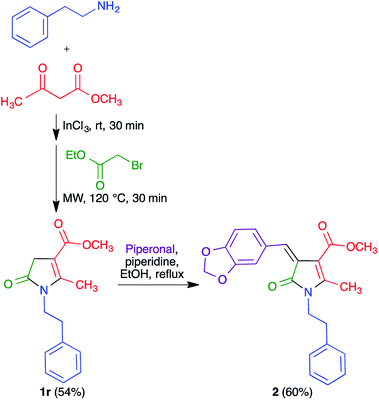 |
| | Scheme 5 Synthesis of compound 2, a HIV integrase inhibition candidate proposed by computational methods. | |
Finally, we examined the construction of a library of complex spirocyclic systems by combining our Hantzsch-like process with a second multicomponent reaction having as the key step the [3 + 2] dipolar cycloaddition between non-stabilized azomethine ylides, prepared in situ from isatin and α-amino acids, with activated olefins prepared by Knoevenagel reactions of our 2-pyrrolin-5-ones 1 with aromatic aldehydes.24 Compounds 5 thus obtained were then used as dipolarophiles for the construction of the spiropyrrolidine library. Starting from five isatin derivatives and two N-substituted amino acids, the target dispiro compounds were obtained generally in good yields under focused microwave irradiation at 100 °C in ethanol solution (Scheme 6 and Table 3). Probably because of steric hindrance, our protocol was more efficient in the case of reactions starting from sarcosine as the amino acid component in comparison with those involving the use of proline.
 |
| | Scheme 6 Regio- and diastereoselective synthesis of 2-pyrrolin-5-one-derived dispiro compounds via a three-component reaction having a 1,3-dipolar cycloaddition as the key step. | |
Table 3 Results obtained in the synthesis of dispiro compounds 3 and 4
| Entry |
Cmpd |
R1 |
R2 |
R3 |
R4 |
R5 |
Yield (%) |
| 1 |
3a |
n-Bu |
Me |
H |
H |
H |
50 |
| 2 |
3b |
n-Bu |
Me |
H |
Cl |
H |
56 |
| 3 |
3c |
Bn |
Me |
H |
Cl |
H |
73 |
| 4 |
3d |
Bn |
Me |
H |
I |
H |
52 |
| 5 |
3e |
Bn |
Me |
H |
Me |
H |
55 |
| 6 |
3f |
Bn |
Me |
H |
H |
H |
65 |
| 7 |
3g |
Bn |
Me |
H |
H |
Bn |
75 |
| 8 |
3h |
Bn |
Me |
OMe |
H |
Bn |
68 |
| 9 |
3i |
Bn |
Me |
OMe |
H |
H |
55 |
| 10 |
3j |
Bn |
Me |
OMe |
Cl |
H |
73 |
| 11 |
3k |
Bn |
Me |
OMe |
I |
H |
50 |
| 12 |
3l |
Bn |
Me |
OMe |
Me |
H |
54 |
| 13 |
3m |
Bn |
Me |
Cl |
H |
H |
78 |
| 14 |
3n |
Bn |
Me |
Br |
H |
H |
88 |
| 15 |
4a |
n-Bu |
Me |
H |
H |
H |
42 |
| 16 |
4b |
n-Bu |
Et |
H |
H |
H |
38 |
The compounds thus obtained were fully characterized by NMR studies. Thus, a NOESY experiment carried out on compound 4b shows NOE enhancements between the phenyl o-proton and the α-amino proton, suggesting the endo structure I (see Scheme 6 below). Furthermore, the benzylic proton gives a NOE with one of the CH2 hydrogens, which is compatible only with structure I, since in the alternative exo structure II the benzyl hydrogen and the CH2 are too far away to provide a NOE. The proposed structure was finally confirmed by a single-crystal X-ray diffraction study of compound 4b (Fig. 1).25
 |
| | Fig. 1 Single-crystal X-ray diffraction study of compound 4b, including a summary of the NOE effects observed in the NOESY experiment. | |
A mechanism that explains the regio- and diastereoselective isolation of compounds 3 and 4 is given in Scheme 7, using the case of 4b as a representative example. Condensation of proline with isatin followed by decarboxylation26 furnishes a nitrogen ylide, which acts as the 1,3-dipole in the reaction. This intermediate could in principle react with the dipolarophile following the alternative pathways A and B, which would afford two different regioisomers I and II, respectively. However, only product I, formed through path A, was observed, which can be explained by the steric clash between the phenyl and carbonyl groups of both reacting species in pathway B. The preference for the structure endo I over the exo III, arising through pathway C, can be attributed to a favourable secondary orbital interaction (SOI) effect between the carbonyl groups of the dipolarophile and the dipole in the transition state corresponding to pathway A.27
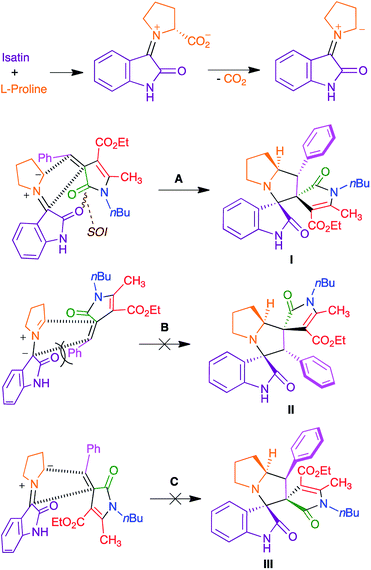 |
| | Scheme 7 Mechanistic proposal accounting for the regio- and diastereoselectivity of the three-component reaction leading to dispiro compounds 3 and 4. | |
Experimental section
General experimental details
All reagents and solvents were of commercial quality and were used as received. Reactions were monitored by thin layer chromatography on aluminium plates coated with silica gel and fluorescent indicator. Microwave-assisted reactions were performed on a CEM Discover focused microwave reactor. Separations by flash chromatography were performed using a Combiflash Teledyne automated flash chromatograph or on conventional silica gel columns. Melting points were measured with a Kofler-type heating platine microscope from Reichert, 723 model, and are uncorrected. Infrared spectra were recorded with an Agilent Cary630 FTIR spectrophotometer with a diamond ATR accessory for solid and liquid samples, requiring no sample preparation; wavenumbers are given in cm−1. NMR spectroscopic data were obtained using spectrometers maintained by the CAI de Resonancia Magnética, UCM, operating at 250 MHz for 1H NMR and 63 MHz for 13C NMR; chemical shifts are given in (δ) parts per million and coupling constants (J) in hertz. Elemental analyses were determined by the CAI de Microanálisis, Universidad Complutense, using a Leco CHNS-932 combustion microanalyzer.
General procedure for the synthesis of 2-pyrrolin-5-one derivatives 1
To a suspension of indium trichloride (5% mmol) in the corresponding β-dicarbonyl compound (1 eq.), placed in a microwave reaction vial, was added the suitable amine (1–1.2 eq.). The mixture was stirred at room temperature for 30 minutes and monitored by TLC. After the reaction completion, the excess of amine was evaporated under reduced pressure. Then, the non-purified enamino ester and the appropriate α-haloester (1 eq.) were exposed to focused microwave irradiation at 120 °C for 30 minutes. Once the reaction was completed, the mixture was diluted with CHCl3 (20 mL) and washed with water (2 × 5 mL). The organic phase was dried over anhydrous sodium sulphate and then evaporated under reduced pressure. The mixture was chromatographed on silica gel using as eluent a mixture of hexane/ethyl acetate.
Ethyl 1-butyl-2-methyl-5-oxo-4,5-dihydro-1H-pyrrole-3-carboxylate (1a). Orange solid (135 mg, 60%): mp 62–68 °C; 1H NMR (250 MHz, CDCl3): δ 4.21 (q, J = 7.2 Hz, 2H), 3.55–3.49 (m, 2H), 3.27 (q, J = 2.4 Hz, 2H), 2.47 (t, J = 2.4 Hz, 3H), 1.61–1.49 (m, 2H), 1.43–1.24 (m, 2H), 1.31 (t, J = 7.2 Hz, 3H), 0.96 (t, J = 7.2 Hz, 3H); 13C NMR (63 MHz, CDCl3): δ 176.4, 163.9, 159.8, 103.3, 59.6, 37.0, 36.6, 31.5, 20.1, 14.4, 13.7, 12.9; IR (neat, cm−1): 1725, 1691, 1226. Anal. calcd for C12H19NO3: C 63.98, H 8.50, N 6.22%. Found: C 63.66, H 8.33, N 5.97%.
Methyl 1-butyl-2-methyl-5-oxo-4,5-dihydro-1H-pyrrole-3-carboxylate (1b). Yellow oil (111 mg, 50%); 1H NMR (250 MHz, CDCl3): δ 3.72 (s, 3H), 3.50 (t, J = 7.2 Hz, 2H), 3.24 (q, J = 2.3 Hz, 2H), 2.44 (t, J = 2.3 Hz, 3H), 1.59–1.45 (m, 2H), 1.43–1.23 (m, 2H), 0.93 (t, J = 7.2 Hz, 3H); 13C NMR (63 MHz, CDCl3): δ 176.4, 165.1, 155.0, 103.4, 51.4, 40.4, 37.0, 31.8, 20.5, 14.1, 12.7; IR (neat, cm−1): 1723, 1690, 1223. Anal. calcd for C11H17NO3: C 62.54, H 8.11, N 6.63%. Found: C 62.43, H 7.89, N 6.19%.
4-Acetyl-1-butyl-5-methyl-1,3-dihydro-2H-pyrrole-2-one (1c). Yellow oil (82 mg, 42%); 1H NMR (250 MHz, CDCl3): δ 3.57–3.51 (m, 2H), 3.34 (q, J = 2.3 Hz, 2H), 2.50 (t, J = 2.3 Hz, 3H), 2.22 (s, 3H), 1.58–1.49 (m, 2H), 1.44–1.29 (m, 2H), 0.96 (t, J = 7.0 Hz, 3H); 13C NMR (63 MHz, CDCl3): δ 192.8, 175.4, 154.0, 111.8, 39.8, 37.1, 31.2, 29.5, 20.0, 13.6, 12.8; IR (neat, cm−1): 1721, 1659. Anal. calcd for C11H17NO2: C 67.66, H 8.78, N 7.17%. Found: C 67.32, H 8.44, N 6.81%.
Ethyl 1-butyl-5-oxo-2-propyl-4,5-dihydro-1H-pyrrole-3-carboxylate (1d). Orange oil (132 mg, 52%); 1H NMR: (250 MHz, CDCl3): δ 4.18 (q, J = 7.1 Hz, 2H), 3.50–3.44 (m, 2H), 3.24 (s, 2H), 2.82–2.76 (m, 2H), 1.64–1.48 (m, 4H), 1.40–1.23 (m, 2H), 1.28 (t, J = 7.1 Hz, 3H), 1.03 (t, J = 7.3 Hz, 3H), 0.93 (t, J = 7.2 Hz, 3H); 13C NMR: (63 MHz, CDCl3): δ 176.3, 163.9, 158.3, 102.9, 59.6, 40.0, 36.6, 31.3, 27.6, 22.0, 20.0, 14.3, 14.0, 13.6; IR (neat, cm−1): 1728, 1694, 1218. Anal. calcd for C14H23NO3: C 66.37, H 9.15, N 5.53%. Found: C 65.33, H 9.00, N 5.36%.
Ethyl 1-benzyl-2-methyl-5-oxo-4,5-dihydro-1H-pyrrole-3-carboxylate (1e). Yellow oil (135 mg, 52%); 1H NMR: (250 MHz, CDCl3): δ 7.39–7.30 (m, 3H), 7.22 (dd, J = 8.0 Hz, J = 1.8 Hz, 2H), 4.79 (s, 2H), 4.22 (q, J = 7.1 Hz, 2H), 3.41 (q, J = 2.4 Hz, 2H), 2.37 (t, J = 2.4 Hz, 3H), 1.32 (t, J = 7.1 Hz, 3H); 13C NMR: (63 MHz, CDCl3): δ 176.0, 164.2, 154.0, 136.5, 128.9, 127.7, 126.8, 103.7, 59.8, 43.4, 36.6, 14.4, 12.6; IR (neat, cm−1): 1726, 1693, 1227. Anal. calcd for C15H17NO3: C 69.48, H 6.61, N 5.40%. Found: C 69.16, H 6.89, N 5.31%.
Methyl 1-benzyl-2-methyl-5-oxo-4,5-dihydro-1H-pyrrole-3-carboxylate (1f). Pale brown solid (135 mg, 55%): mp 82–84 °C; 1H NMR (250 MHz, CDCl3): δ 7.42–7.15 (m, 5H), 4.79 (s, 2H), 3.75 (s, 3H), 3.40 (q, J = 2.4 Hz, 2H), 2.37 (t, J = 2.4 Hz, 3H); 13C NMR (63 MHz, CDCl3): δ 176.4, 154.8, 136.9, 129.3, 128.2, 127.3, 103.8, 51.5, 43.9, 37.0, 13.0; IR (neat, cm−1): 1727, 1685, 1250. Anal. calcd for C14H15NO3: C 68.56, H 6.16, N 5.71%. Found: C 68.53, H 6.08, N 5.78%.
Ethyl 1-butyl-2-ethyl-5-oxo-4,5-dihydro-1H-pyrrole-3-carboxylate (1g). Yellow oil (142 mg, 59%); 1H NMR: (250 MHz, CDCl3): δ 4.22 (q, J = 7.1 Hz, 2H), 3.55–3.48 (m, 2H), 3.27 (s, 2H), 2.90–2.83 (m, 2H), 1.65–1.40 (m, 4H), 1.39–1.23 (m, 6H), 0.93 (t, J = 7.2 Hz, 3H); 13C NMR: (63 MHz, CDCl3): δ 176.4, 163.9, 159.8, 102.9, 59.6, 40.0, 36.6, 31.5, 20.1, 19.2, 14.4, 13.7, 12.9; IR (neat, cm−1): 1726, 1693, 1228. Anal. calcd for C13H21NO3: C 65.25, H 8.84, N 5.85%. Found: C 65.16, H 8.89, N 5.79%.
Ethyl 1,2-dimethyl-5-oxo-4,5-dihydro-1H-pyrrole-3-carboxylate (1h). Yellow oil (140 mg, 76%); 1H NMR: (250 MHz, CDCl3): δ 4.17 (q, J = 7.1 Hz, 2H), 3.05 (s, 3H), 3.23 (q, J = 2.4 Hz, 2H), 2.42 (t, J = 7.1 Hz, 3H), 1.27 (t, 3H, J = 2.4 Hz); 13C NMR: (63 MHz, CDCl3): δ 176.0, 164.2, 154.1, 103.2, 59.7, 36.5, 26.3, 14.3, 12.4; IR (neat, cm−1): 1725, 1692, 1228. Anal. calcd for C9H13NO3: C 59.00, H 7.15, N 7.65%. Found: C 59.22, H 7.30, N 7.52%.
Ethyl 1-hexyl-5-oxo-2-propyl-4,5-dihydro-1H-pyrrole-3-carboxylate (1i). Orange oil (203 mg, 72%); 1H NMR: (250 MHz, CDCl3): δ 4.20 (q, J = 7.1 Hz, 2H), 3.57–3.48 (m, 2H), 3.27 (s, 2H), 2.82–2.76 (m, 2H), 1.63–1.57 (m, 4H), 1.34–1.26 (m, 6H), 1.29 (t, J = 7.1 Hz, 3H), 1.05 (t, J = 7.5 Hz, 3H), 0.91 (t, J = 7.0 Hz, 3H); 13C NMR: (63 MHz, CDCl3): δ 176.4, 163.9, 158.3, 102.9, 59.6, 40.3, 36.6, 31.3, 29.3, 27.7, 26.5, 22.5, 22.0, 14.4, 14.1, 14.0; IR (neat, cm−1): 1726, 1702, 1227. Anal. calcd for C16H27NO3: C 68.29, H 9.67, N 4.98%. Found: C 68.22, H 9.30, N 4.82%.
Methyl 1-allyl-2-methyl-5-oxo-4,5-dihydro-1H-pyrrole-3-carboxylate (1j). Yellow oil (98 mg, 50%); 1H NMR (250 MHz, CDCl3): δ 5.84–5.62 (m, 1H), 5.16–4.96 (m, 2H), 4.11 (dt, J = 5.0, 1.7 Hz, 2H), 3.67 (s, 3H), 3.24 (q, J = 2.4 Hz, 2H), 2.36 (t, J = 2.4 Hz, 3H); 13C NMR (63 MHz, CDCl3): δ 174.6, 163.6, 153.5, 131.3, 115.8, 102.1, 50.1, 41.0, 35.5, 11.2; IR (neat, cm−1): 1720, 1685, 1228. Anal. calcd for C10H13NO3: C 61.53, H 6.71, N 7.18%. Found: C 61.19, H 6.65, N 6.98%.
Methyl 1-(2-hydroxyethyl)-2-methyl-5-oxo-4,5-dihydro-1H-pyrrole-3-carboxylate (1k). Pale red solid (86 mg, 43%): mp 111–114 °C; NMR data are identical to those found in the literature.9 IR (neat, cm−1): 3482, 2940, 1715, 1669, 1616, 1231. Anal. calcd for C9H13NO: C 54.26, H, 6.58, N, 7.03%. Found: C 54.14, H 6.39, N 6.79%.
Methyl 1-(3,4-dimethoxyphenethyl)-2-methyl-5-oxo-4,5-dihydro-1H-pyrrole-3-carboxylate (1l). Beige solid (166 mg, 52%): mp 99–103 °C; 1H NMR (250 MHz, CDCl3): δ 6.73 (d, J = 8.0 Hz, 1H), 6.65 (d, J = 1.9 Hz, 1H), 6.60–6.59 (m, 1H), 3.79 (s, 3H), 3.78 (s, 3H), 3.68–3.59 (m, 5H), 3.19 (q, J = 2.3 Hz, 2H), 2.75 (t, J = 7.3 Hz, 2H), 2.13 (t, J = 2.4 Hz, 3H); 13C NMR (63 MHz, CDCl3): δ 175.0, 163.6, 153.5, 148.0, 146.9, 129.4, 119.8, 110.9, 110.3, 101.8, 88.8, 54.9, 50.0, 41.1, 35.5, 33.7, 11.0. IR (neat, cm−1): 1717, 1685, 1220. Anal. calcd for C17H21NO5: C 63.94, H 6.63, N 4.39%. Found: C 63.77, H 6.47, N 4.29%.
Ethyl 1-butyl-2-methyl-5-oxo-4-phenyl-4,5-dihydro-1H-pyrrole-3-carboxylate (1m). Orange oil (175 mg, 58%); 1H NMR (250 MHz, CDCl3): δ 7.35–7.15 (m, 5H), 4.36 (q, J = 2.0 Hz, 1H), 4.13–3.97 (m, 2H), 3.58 (m, 2H), 2.48 (d, J = 2.0 Hz, 3H), 1.65–1.53 (m, 2H), 1.41–1.28 (m, 2H), 1.06 (t, J = 7.2 Hz, 3H), 0.95 (t, J = 7.0 Hz, 3H); 13C NMR (63 MHz, CDCl3): δ 177.8, 164.5, 155.0, 137.0, 129.0, 128.3, 127.6, 108.9, 60.0, 53.2, 40.4, 31.8, 20.4, 14.5, 14.1, 12.7. IR (neat, cm−1): 1721, 1696, 1218. Anal. calcd for C18H23NO3: C 71.73, H 7.69, N, 4.65%. Found: C 71.65, H 7.64, N 4.69%.
Ethyl 2-methyl-5-oxo-4,5-dihydro-1H-pyrrole-3-carboxylate (1n). Beige solid (93 mg, 55%): mp 119–123 °C; 1H NMR (250 MHz, CDCl3): δ 8.72 (br s, 1H), 4.22 (q, J = 7.1 Hz, 2H), 3.32 (q, J = 2.3 Hz, 2H), 2.39 (t, J = 2.3 Hz, 3H), 1.32 (t, J = 7.1 Hz, 3H); 13C NMR (63 MHz, CDCl3): δ 178.7, 164.6, 152.0, 104.9, 60.3, 38.0, 14.8, 13.9; IR (neat, cm−1): 3165, 1702, 1682, 1251. Anal. calcd for C8H11NO3: C 56.80, H 6.55, N 8.28%. Found: C 56.42, H 6.36, N 7.90%.
Ethyl 2,4-dimethyl-5-oxo-4,5-dihydro-1H-pyrrole-3-carboxylate (1o). Yellow oil (79 mg, 43%); 1H NMR (250 MHz, CDCl3): δ 8.11 (br s, 1H), 4.42–4.09 (m, 2H), 3.29 (qq, J = 7.6, 2.1 Hz, 1H), 2.40 (d, J = 2.1 Hz, 3H), 1.44 (d, J = 7.6 Hz, 3H), 1.33 (t, J = 7.1 Hz, 3H); 13C NMR (63 MHz, CDCl3): δ 182.1, 164.7, 150.9, 110.7, 60.1, 43.5, 15.6, 14.8, 14.0; IR (neat, cm−1): 1723.1, 1690.4, 1223.0; IR (neat, cm−1): 3186, 1721, 1686, 1249. Anal. calcd for C9H13NO3: C 59.00, H 7.15, N 7.65%. Found: C 58.79, H 6.95, N 7.73%.
Ethyl 4-ethyl-2-methyl-5-oxo-4,5-dihydro-1H-pyrrole-3-carboxylate (1p). Yellow oil (79 mg, 40%); 1H NMR (250 MHz, CDCl3): δ 8.22 (br s, 1H), 4.34–4.14 (m, 2H), 3.43–3.29 (m, 1H), 2.41 (d, J = 2.2 Hz, 3H), 2.18–1.88 (m, 2H), 1.33 (t, J = 7.1 Hz, 3H), 0.83 (t, J = 7.5 Hz, 3H); 13C NMR (63 MHz, CDCl3): δ 181.5, 164.7, 151.8, 108.1, 60.1, 48.9, 22.7, 14.8, 14.1, 9.4; IR (neat, cm−1): 3257, 1715, 1689, 1223. Anal. calcd for C10H15NO3: C 60.90, H 7.67, N 7.10%. Found: C 60.88, H 7.48, N 7.13%.
Ethyl 2-methyl-5-oxo-4-phenyl-4,5-dihydro-1H-pyrrole-3-carboxylate (1q). Yellow oil (101 mg, 41%); 1H NMR (250 MHz, CDCl3): δ 8.21 (br s, 1H), 7.44–7.15 (m, 5H), 4.42 (app. d, J = 2.2 Hz, 1H), 4.18–3.93 (m, 2H), 2.47 (d, J = 2.2 Hz, 3H), 1.09 (t, J = 7.1 Hz, 3H); 13C NMR (63 MHz, CDCl3): δ 179.4, 164.3, 152.9, 136.4, 129.1, 128.3, 127.9, 109.8, 60.1, 54.2, 14.5, 14.0; IR (neat, cm−1): 3238, 1719, 1687, 1223. Anal. calcd for C14H15NO3: C 68.56, H 6.16, N 5.71%. Found: C 68.41, H 6.16, N 5.57%.
Methyl 2-methyl-5-oxo-1-phenethyl-4,5-dihydro-1H-pyrrole-3-carboxylate (1r). Light brown solid (140 mg, 54%): mp 99–103 °C; 1H NMR (250 MHz, CDCl3): δ 7.20–6.91 (m, 5H), 3.56 (t, J = 7.3 Hz, 2H), 3.53 (s, 3H), 3.08 (q, J = 2.2 Hz, 2H), 2.69 (t, J = 7.3 Hz, 2H), 2.00 (t, J = 2.2 Hz, 3H); 13C NMR (63 MHz, CDCl3): δ 175.0, 163.6, 153.5, 137.0, 127.8, 127.7, 125.9, 101.9, 50.0, 41.0, 35.5, 34.2, 11.0; IR (neat, cm−1): 1703, 1669, 1230. Anal. calcd for C15H17NO3: C 69.48, H 6.61, N 5.40%. Found: C 69.19, H 6.50, N 5.15%.
General procedure for the synthesis of 4-arylmethylen-2-pyrrolin-5-ones (compound 2 and compounds 5)
In a round-bottomed flask, the suitable 2-pyrrolin-5-one (1 eq.) was suspended in ethanol (10 mL). Then, the corresponding aldehyde (1.1 eq.) and piperidine (2 eq.) were added. The mixture was refluxed for 1 h and monitored by TLC. Once the reaction was completed the mixture was cooled to room temperature, diluted with ethyl acetate (20 mL) and washed with water (2 × 10 mL). The organic phase was dried over anhydrous sodium sulphate and then evaporated under reduced pressure. The mixture was chromatographed on silica gel using as eluent a mixture of hexane/ethyl acetate.
Methyl (Z)-4-(benzo[d][1,3]dioxol-5-ylmethylene)-2-methyl-5-oxo-1-phenethyl-4,5-dihydro-1H-pyrrole-3-carboxylate (2). Yellow solid (235 mg, 60%): mp 179 °C; 1H NMR (250 MHz, CDCl3): δ 8.17 (d, J = 1.6 Hz, 1H), 8.13 (s, 1H), 7.56 (dd, J = 8.2, 1.6 Hz, 1H), 7.38–7.11 (m, 5H), 6.88 (d, J = 8.2 Hz, 1H), 6.05 (s, 2H), 3.87 (t, J = 7.3 Hz, 2H), 3.85 (s, 3H), 2.93 (t, J = 7.3 Hz, 2H), 2.25 (s, 3H); 13C NMR (63 MHz, CDCl3) δ 166.1, 165.3, 151.9, 149.9, 147.8, 141.9, 138.6, 129.6, 129.3, 129.1, 127.2, 125.1, 111.7, 108.3, 103.9, 101.9, 51.3, 42.5, 35.8, 13.4. IR (neat, cm−1): 1672, 1264. Anal. calcd for C23H11NO5: C 70.58, H 5.41, N 3.58%. Found: C 70.38, H 5.32, N 3.67%.
Methyl (Z)-4-benzylidene-1-butyl-2-methyl-5-oxo-4,5-dihydro-1H-pyrrole-3-carboxylate (5a). Yellow solid (210 mg, 70%): mp 84–87 °C; 1H NMR (250 MHz, CDCl3): δ 8.14 (s, 1H), 8.11–7.99 (m, 2H), 7.45–7.30 (m, 3H), 3.84 (s, 3H), 3.68–3.52 (m, 2H), 2.53 (d, J = 0.5 Hz, 3H), 1.67–1.47 (m, 2H), 1.44–1.22 (m, 2H), 0.93 (t, J = 7.2 Hz, 3H); 13C NMR (63 MHz, CDCl3): δ 166.1, 165.3, 155.9, 153.5, 141.6, 135.1, 131.9, 130.3, 128.3, 127.1, 51.3, 40.4, 31.9, 20.6, 14.2, 13.8; IR (neat, cm−1): 1699, 1689, 1601, 1213. Anal. calcd for C18H21NO3: C 72.22, H 7.07, N 4.68%. Found: C 72.17, H 6.94, N 4.59%.
Ethyl (Z)-4-benzylidene-1-butyl-2-methyl-5-oxo-4,5-dihydro-1H-pyrrole-3-carboxylate (5b). Yellow solid (179 mg, 57%): mp 161–163 °C; 1H NMR (250 MHz, CDCl3): δ 8.20 (s, 1H), 7.41 (dd, J = 4.8, 2.5 Hz, 2H), 7.43–7.29 (m, 3H), 4.35 (q, J = 7.1 Hz, 2H), 3.64 (t, J = 7.6 Hz, 2H), 2.56 (s, 3H), 1.66–1.51 (m, 2H), 1.42 (t, J = 7.1 Hz, 3H), 1.42–1.30 (m, 2H), 0.96 (t, J = 7.2 Hz, 3H); 13C NMR (63 MHz, CDCl3): δ 166.2, 164.8, 153.3, 141.6, 135.1, 131.9, 130.3, 128.4, 127.2, 103.9, 60.2, 40.3, 31.9, 20.6, 14.9, 14.2, 13.8; IR (neat, cm−1): 1672, 1158. Anal. calcd for C19H23NO3: C 72.82, H 7.40, N 4.47%. Found: C 72.85, H 7.34, N 4.51%.
Methyl (Z)-1-benzyl-4-benzylidene-2-methyl-5-oxo-4,5-dihydro-1H-pyrrole-3-carboxylate (5c). Yellow solid (167 mg, 50%): mp 83–86 °C; 1H NMR (250 MHz, CDCl3): δ 8.28 (s, 1H), 8.22–8.11 (m, 2H), 7.54–7.14 (m, 8H), 4.90 (s, 2H), 3.87 (s, 3H), 2.45 (s, 3H); 13C NMR (63 MHz, CDCl3): δ 166.2, 165.2, 153.4, 142.2, 137.1, 135.0, 132.1, 130.5, 129.3, 128.4, 128.0, 127.2, 126.8, 104.3, 51.4, 43.8, 14.2; IR (neat, cm−1): 1684, 1599, 1193. Anal. calcd for C21H19NO3: C 75.66, H 5.74, N 4.20%. Found: C 75.55, H 5.68, N 4.18%.
Methyl (Z)-1-benzyl-4-(4-methoxybenzylidene)-2-methyl-5-oxo-4,5-dihydro-1H-pyrrole-3-carboxylate (5d). Yellow solid (218 mg, 60%): mp 121–124 °C; 1H NMR (250 MHz, CDCl3): δ 8.39–8.08 (m, 3H), 7.47–7.10 (m, 5H), 7.03–6.83 (m, 2H), 4.93 (s, 2H), 3.89 (s, 3H), 3.86 (s, 3H), 2.44 (s, 3H); 13C NMR (63 MHz, CDCl3): δ 164.2, 163.2, 159.6, 149.4, 140.2, 135.1, 132.6, 130.5, 127.1, 125.8, 125.0, 122.4, 111.8, 102.3, 53.6, 49.2, 41.6, 12.0; IR (neat, cm−1): 1679.0, 1589.4, 1254.4. Anal. calcd for C22H21NO4: C 72.71, H 5.82, N 3.85%. Found: C 72.46, H 5.84, N 3.92%.
Methyl (Z)-1-benzyl-4-(4-chlorobenzylidene)-2-methyl-5-oxo-4,5-dihydro-1H-pyrrole-3-carboxylate (5e). Yellow solid (166 mg, 45%): mp 97–100 °C; 1H NMR (250 MHz, CDCl3): δ 8.09 (s, 1H), 8.00 (d, J = 8.4 Hz, 2H), 7.35–7.20 (m, 5H), 7.16–7.06 (m, 2H), 4.81 (s, 2H), 3.76 (s, 3H), 2.36 (d, J = 0.6 Hz, 3H); 13C NMR (63 MHz, CDCl3): δ 166.2, 165.1, 153.6, 140.6, 136.9, 136.3, 133.4, 129.4, 129.3, 128.7, 128.1, 127.3, 127.1, 104.2, 51.4, 43.8, 14.2; IR (neat, cm−1): 1691, 1677, 1602, 1196. Anal. calcd for C21H18ClNO3: C 68.57, H 4.93, N 3.81%. Found: C 68.20, H 4.88, N 3.81%.
Methyl (Z)-1-benzyl-4-(4-bromobenzylidene)-2-methyl-5-oxo-4,5-dihydro-1H-pyrrole-3-carboxylate (5f). Yellow solid (219 mg, 53%): mp 136 °C; 1H NMR (250 MHz, CDCl3): δ 8.16 (s, 1H), 8.02 (d, J = 8.5 Hz, 2H), 7.55 (d, J = 8.5, 2H), 7.48–7.14 (m, 5H), 4.90 (s, 2H), 3.86 (s, 3H), 2.45 (s, 3H); 13C NMR (63 MHz, CDCl3): δ 166.2, 165.1, 153.7, 140.6, 136.9, 133.8, 133.6, 131.6, 129.3, 128.1, 127.3, 127.2, 124.9, 104.2, 51.4, 43.8, 14.2; IR (neat, cm−1): 1691.8, 1674.4, 1602.0, 1196.6; IR (neat, cm−1): 3190, 1708, 1681, 1612, 1249, 1203. Anal. calcd for C21H18BrNO3: C 61.18, H 4.40, N 3.40%. Found: C 60.99, H 4.38, N 3.26%.
General procedure for the synthesis of dispirooxindoles 3 and 4
The suitable isatin (1.5 eq.) and the appropriate aminoacid (1.5 eq.) were placed in a microwave reaction vial. Then the corresponding 4-arylmethylen-2-pyrrolin-5-one (1 eq.) suspended in ethanol (2 mL) was added and irradiated at 100 °C for 1 h. After the reaction completion, the mixture was cooled at room temperature and a precipitate was formed. The solid compound was filtered and washed twice with cold ethanol. No further purification was needed.
Methyl (3S*,3′R*,4′R*)-1′′-butyl-1′,5′′-dimethyl-2,2′′-dioxo-4′-phenyl-1′′,2′′-dihydrodispiro[indoline-3,2′-pyrrolidine-3′,3′′-pyrrole]-4′′-carboxylate (3a). Pale brown solid (237 mg, 50%): mp 215–218 °C; 1H NMR (250 MHz, CDCl3): δ 7.90 (br s, 1H), 7.44–7.29 (m, 2H), 7.29–7.03 (m, 5H), 6.86 (td, J = 7.7, 0.9 Hz, 1H), 6.74 (d, J = 7.7 Hz, 1H), 5.34 (dd, J = 10.1, 8.7 Hz, 1H), 4.24 (t, J = 8.7 Hz, 1H), 3.78 (s, 3H), 3.65 (dd, J = 10.1, 8.7 Hz, 1H), 3.34–3.13 (m, 1H), 3.02–2.78 (m, 1H), 2.34 (s, 3H), 1.96 (s, 3H), 1.17–0.94 (m, 2H), 0.94–0.79 (m, 2H), 0.79–0.62 (m, 3H); 13C NMR (63 MHz, CDCl3): δ 178.1, 175.2, 165.6, 156.0, 142.5, 137.7, 129.7, 129.3, 128.3, 127.1, 126.0, 122.4, 110.2, 103.6, 78.2, 68.2, 56.2, 51.2, 43.5, 39.7, 36.3, 30.9, 20.0, 14.1, 12.8; IR (neat, cm−1): 3140, 1725, 1702, 1688, 1602, 1208. Anal. calcd for C28H31N3O4: C 71.02, H 6.60, N 8.87%. Found: C 70.84, H 6.54, N 8.85%.
Methyl (3S*,3′R*,4′R*)-1′′-butyl-5-chloro-1′,5′′-dimethyl-2,2′′-dioxo-4′-phenyl-1′′,2′′-dihydrodispiro[indoline-3,2′-pyrrolidine-3′,3′′-pyrrole]-4′′-carboxylate (3b). Pale brown solid (284 mg, 56%): mp 102–104 °C; 1H NMR (250 MHz, CDCl3): δ 8.55 (br s, 1H), 7.35 (dd, J = 7.9, 1.4 Hz, 2H), 7.29–7.05 (m, 5H), 6.74 (d, J = 8.3 Hz, 1H), 5.34 (dd, J = 9.9, 8.7 Hz, 1H), 4.22 (t, J = 8.7 Hz, 1H), 3.73 (s, 3H), 3.69–3.56 (m, 1H), 3.23–2.98 (m, 2H), 2.34 (s, 3H), 1.99 (s, 3H), 1.29–1.07 (m, 1H), 1.07–0.83 (m, 3H), 0.78 (t, J = 6.4 Hz, 3H); 13C NMR (63 MHz, CDCl3): δ 179.5, 176.3, 166.8, 157.4, 142.5, 138.7, 131.0, 130.6, 129.6, 129.2, 129.2, 128.5, 127.7, 112.7, 104.6, 79.5, 69.6, 57.5, 52.5, 44.9, 41.2, 37.6, 32.4, 21.4, 15.3, 14.3; IR (neat, cm−1): 3238, 1717, 1689, 1613, 1210, 1175. Anal. calcd for C28H30ClN3O4: C 66.20, H 5.95, N 8.27%. Found: C 66.02, H 5.71, N 8.21%.
Methyl (3S*,3′R*,4′R*)-1′′-benzyl-5-chloro-1′,5′′-dimethyl-2,2′′-dioxo-4′-phenyl-1′′,2′′-dihydrodispiro[indoline-3,2′-pyrrolidine-3′,3′′-pyrrole]-4′′-carboxylate (3c). Beige solid (396 mg, 73%): mp 166–169 °C; 1H NMR (250 MHz, CDCl3): δ 8.06 (br s, 1H), 7.49–7.34 (m, 2H), 7.28–6.89 (m, 8H), 6.67 (d, J = 8.3 Hz, 1H), 6.23 (d, J = 7.0 Hz, 2H), 5.37 (dd, J = 10.0, 8.5 Hz, 1H), 4.81 (d, J = 16.3 Hz, 1H), 4.24 (t, J = 8.5 Hz, 1H), 3.88 (d, J = 16.3 Hz, 1H), 3.77–3.51 (m, 4H), 2.30 (s, 3H), 1.72 (s, 3H); 13C NMR (63 MHz, CDCl3): δ 177.7, 175.0, 165.4, 156.1, 141.0, 137.3, 136.1, 129.9, 129.6, 129.1, 128.6, 128.2, 127.9, 127.5, 127.4, 126.2, 111.3, 103.7, 78.4, 77.6, 68.8, 56.0, 51.3, 43.5, 43.0, 36.3, 13.2; IR (neat, cm−1): 3224, 1721, 1692, 1617, 1255, 1181. Anal. calcd for C31H28ClN3O4: C 68.69, H 5.21, N 7.75%. Found C 68.75, H 5.10, N 7.67%.
Methyl (3S*,3′R*,4′R*)-1′′-benzyl-5-iodo-1′,5′′-dimethyl-2,2′′-dioxo-4′-phenyl-1′′,2′′-dihydrodispiro[indoline-3,2′-pyrrolidine-3′,3′′-pyrrole]-4′′-carboxylate (3d). Beige solid (329 mg, 52%): mp 140–143 °C; 1H NMR (250 MHz, CDCl3): δ 7.70–7.61 (m, 2H), 7.55 (dd, J = 8.2, 1.8 Hz, 1H), 7.52–7.43 (m, 2H), 7.36–7.27 (m, 3H), 7.19–7.00 (m, 3H), 6.61 (d, J = 8.2 Hz, 1H), 6.32 (d, J = 6.9 Hz, 2H), 5.44 (dd, J = 10.1, 8.5 Hz, 1H), 4.96 (d, J = 16.3 Hz, 1H), 4.34 (t, J = 8.5 Hz, 1H), 3.95 (d, J = 16.3 Hz, 1H), 3.80 (s, 3H), 3.72 (app. t, J = 9.6 Hz, 1H), 2.42 (s, 3H), 1.82 (s, 3H); 13C NMR (63 MHz, CDCl3): δ 175.0, 165.3, 156.3, 142.0, 138.7, 138.7, 136.1, 134.7, 129.6, 129.2, 128.7, 127.5, 127.4, 126.2, 112.3, 103.6, 85.1, 78.1, 77.6, 68.8, 56.1, 51.4, 43.4, 43.0, 36.5, 31.4, 13.2; IR (neat, cm−1): 3222, 1719, 1688, 1607, 1177. Anal. calcd for C31H28IN3O4: C 58.78, H 4.46, N 6.63%. Found C 58.67, H 4.39, N 6.71%.
Methyl (3S*,3′R*,4′R*)-1′′-benzyl-1′,5,5′′-trimethyl-2,2′′-dioxo-4′-phenyl-1′′,2′′-dihydrodispiro[indoline-3,2′-pyrrolidine-3′,3′′-pyrrole]-4′′-carboxylate (3e). Beige solid (287 mg, 55%): mp 217 °C; 1H NMR (250 MHz, CDCl3): δ 7.78 (br s, 1H), 7.61–7.42 (m, 2H), 7.31–7.29 (m, 3H), 7.20–6.93 (m, 5H), 6.70 (d, J = 7.8 Hz, 1H), 6.30 (d, J = 7.3 Hz, 2H), 5.48 (app. t, J = 8.9 Hz, 1H), 4.86 (d, J = 16.3 Hz, 1H), 4.33 (app. t, J = 8.9 Hz, 1H), 3.96 (d, J = 16.3 Hz, 1H), 3.81 (s, 3H), 3.72 (app. t, J = 9.6 Hz, 1H), 2.40 (s, 3H), 2.26 (s, 3H), 1.80 (s, 3H); 13C NMR (63 MHz, CDCl3): δ 177.9, 175.2, 165.5, 155.7, 140.0, 137.7, 136.3, 132.1, 130.1, 129.7, 129.1, 128.6, 127.5, 127.2, 126.5, 126.1, 126.0, 110.0, 104.1, 68.7, 56.1, 51.3, 43.5, 42.8, 36.4, 31.4, 21.5, 13.2; IR (neat, cm−1): 3155, 1705, 1682, 1616, 1216, 1190. Anal. calcd for C32H31N3O4: C 73.68, H 5.99, N 8.06%. Found: C 73.54, H 6.01, N 8.18%.
Methyl (3S*,3′R*,4′R*)-1′′-benzyl-1′,5′′-dimethyl-2,2′′-dioxo-4′-phenyl-1′′,2′′-dihydrodispiro[indoline-3,2′-pyrrolidine-3′,3′′-pyrrole]-4′′-carboxylate (3f). White solid (330 mg, 65%): mp 200–203 °C; 1H NMR (250 MHz, CDCl3): δ 7.74 (br s, 1H), 7.52 (s, 2H), 7.41–6.97 (m, 8H), 6.91 (t, J = 7.6 Hz, 1H), 6.79 (d, J = 7.6 Hz, 1H), 6.31 (d, J = 7.3 Hz, 2H), 5.48 (app. t, J = 9.0 Hz, 1H), 4.91 (d, J = 16.3 Hz, 1H), 4.34 (app. t, J = 8.4 Hz, 1H), 3.91 (d, J = 16.3 Hz, 1H), 3.82 (s, 3H), 3.73 (app. t, J = 9.6 Hz, 1H), 2.40 (s, 3H), 1.81 (s, 3H); 13C NMR (63 MHz, CDCl3): δ 175.1, 165.5, 155.9, 142.4, 137.7, 136.3, 129.9, 129.7, 129.0, 128.6, 127.5, 127.2, 126.3, 125.9, 125.8, 122.6, 110.2, 104.0, 78.4, 77.6, 68.7, 56.0, 51.3, 43.4, 43.0, 36.3, 13.1; IR (neat, cm−1): 3139, 1708, 1684, 1614, 1252, 1218. Anal. calcd for C31H29N3O5: C 73.35, H 5.76, N 8.28%. Found: C 73.13, H 5.60, N 8.14%.
Methyl (3S*,3′R*,4′R*)-1,1′′-dibenzyl-1′,5′′-dimethyl-2,2′′-dioxo-4′-phenyl-1′′,2′′-dihydrodispiro[indoline-3,2′-pyrrolidine-3′,3′′-pyrrole]-4′′-carboxylate (3g). Light yellow solid (448 mg, 75%): mp 113–115 °C; 1H NMR (250 MHz, CDCl3): δ 7.53–7.54 (m, 2H), 7.39–7.25 (m, 9H), 7.17–7.02 (m, 4H), 6.89 (t, J = 7.4 Hz, 1H), 6.58 (d, J = 7.7 Hz, 1H), 6.31 (d, J = 7.2 Hz, 2H), 5.56 (dd, J = 10.0, 8.4 Hz, 1H), 5.10 (d, J = 15.8 Hz, 1H), 4.92 (d, J = 16.3 Hz, 1H), 4.58 (d, J = 15.8 Hz, 1H), 4.37 (t, J = 8.4 Hz, 1H), 3.90 (d, J = 16.3 Hz, 1H), 3.84–3.68 (m, 4H), 2.40 (s, 3H), 1.79 (s, 3H); 13C NMR (63 MHz, CDCl3): δ 175.7, 175.2, 165.3, 155.3, 144.3, 137.8, 136.3, 136.1, 129.8, 129.7, 129.2, 129.0, 128.6, 127.9, 127.6, 127.5, 127.2, 126.3, 125.4, 125.2, 122.6, 109.7, 104.2, 78.4, 68.9, 56.2, 51.3, 44.0, 43.5, 43.0, 36.4, 13.1; IR (neat, cm−1): 1709, 1688, 1260, 1210. Anal. calcd for C38H35N3O4: C 76.36, H 5.90, N 7.03%. Found: C 76.23, H 5.81, N 7.16%.
Methyl (3S*,3′R*,4′R*)-1,1′′-dibenzyl-4′-(4-methoxyphenyl)-1′,5′′-dimethyl-2,2′′-dioxo-1′′,2′′-dihydrodispiro[indoline-3,2′-pyrrolidine-3′,3′′-pyrrole]-4′′-carboxylate (3h). Light yellow solid (427 mg, 68%): mp 198–200 °C; 1H NMR (250 MHz, CDCl3): δ 7.37 (d, J = 8.7 Hz, 2H), 7.30–7.11 (m, 6H), 7.11–6.87 (m, 4H), 6.85–6.68 (m, 3H), 6.48 (d, J = 7.7 Hz, 1H), 6.21 (d, J = 7.2 Hz, 2H), 5.41 (dd, J = 10.2, 8.4 Hz, 1H), 5.00 (d, J = 15.8 Hz, 1H), 4.84 (d, J = 16.4 Hz, 1H), 4.48 (d, J = 15.8 Hz, 1H), 4.21 (t, J = 8.4 Hz, 1H), 3.81 (d, J = 16.4 Hz, 1H), 3.74 (s, 3H), 3.71–3.57 (m, 4H), 2.29 (s, 3H), 1.69 (s, 3H); 13C NMR (63 MHz, CDCl3): δ 175.7, 175.3, 165.3, 158.9, 155.2, 144.3, 136.3, 136.1, 130.8, 129.8, 129.6, 129.2, 128.9, 127.9, 127.6, 127.5, 126.3, 125.4, 125.3, 122.6, 113.9, 109.7, 104.2, 78.3, 77.6, 69.0, 56.4, 55.5, 51.3, 44.0, 42.9, 36.4, 13.0; IR (neat, cm−1): 1713, 1685, 1605, 1243, 1225. Anal. calcd for C39H37N3O5: C 74.62, H 5.94, N 6.69%. Found C 74.33, H 6.02, N 6.81%.
Methyl (3S*,3′R*,4′R*)-1′′-benzyl-4′-(4-methoxyphenyl)-1′,5′′-dimethyl-2,2′′-dioxo-1′′,2′′-dihydrodispiro[indoline-3,2′-pyrrolidine-3′,3′′-pyrrole]-4′′-carboxylate (3i). Beige solid (296 mg, 55%): mp 212–214 °C; 1H NMR (250 MHz, CDCl3): δ 7.57 (br s, 1H), 7.44 (d, J = 8.7 Hz, 2H), 7.33–6.97 (m, 5H), 6.98–6.68 (m, 4H), 6.31 (d, J = 7.2 Hz, 2H), 5.43 (dd, J = 10.2, 8.7 Hz, 1H), 4.93 (d, J = 16.3 Hz, 1H), 4.29 (t, J = 8.7 Hz, 1H), 3.92 (d, J = 16.3 Hz, 1H), 3.83 (s, 3H), 3.82 (s, 3H), 3.70 (dd, J = 10.2, 8.7 Hz, 1H), 2.39 (s, 3H), 1.81 (s, 3H); 13C NMR (63 MHz, CDCl3): δ 177.9, 175.4, 165.7, 159.1, 155.9, 142.5, 136.4, 130.9, 130.0, 129.6, 129.1, 127.7, 126.5, 126.0, 122.8, 114.1, 110.3, 104.2, 78.5, 77.8, 69.0, 56.4, 55.7, 51.4, 43.1, 43.0, 36.5, 13.3; IR (neat, cm−1): 3140, 1721, 1702, 1685, 1611, 1245, 1212. Anal. calcd for C32H31N3O5: C 71.49, H 5.81, N 7.82%. Found: C 71.36, H 5.57, N 7.88%.
Methyl (3S*,3′R*,4′R*)-1′′-benzyl-5-chloro-4′-(4-methoxyphenyl)-1′,5′′-dimethyl-2,2′′-dioxo-1′′,2′′-dihydrodispiro[indoline-3,2′-pyrrolidine-3′,3′′-pyrrole]-4′′-carboxylate (3j). Light yellow solid (418 mg, 73%): mp 181–185 °C; 1H NMR (250 MHz, CDCl3): δ 8.04 (br s, 1H), 7.42 (d, J = 8.8 Hz, 2H), 7.33 (d, J = 2.0 Hz, 1H), 7.23–7.01 (m, 4H), 6.84 (d, J = 8.8 Hz, 2H), 6.76 (d, J = 8.3 Hz, 1H), 6.31 (d, J = 7.1 Hz, 2H), 5.41 (dd, J = 10.0, 8.6 Hz, 1H), 4.94 (d, J = 16.3 Hz, 1H), 4.28 (app. t, J = 8.6 Hz, 1H), 3.99 (d, J = 16.4 Hz, 1H), 3.84 (s, 3H), 3.78 (s, 3H), 3.68 (dd, J = 10.0, 9.2 Hz, 1H), 2.39 (s, 3H), 1.82 (s, 3H); 13C NMR (63 MHz, CDCl3): δ 177.7, 175.1, 165.4, 159.0, 156.0, 141.0, 136.1, 130.7, 129.8, 129.1, 129.0, 128.2, 128.0, 127.6, 126.2, 126.2, 114.0, 111.3, 103.7, 78.3, 68.9, 56.2, 55.5, 51.4, 42.9, 36.3, 31.4, 13.2; IR (neat, cm−1): 3199, 1721, 1688, 1605, 1245, 1207. Anal. calcd for C32H30ClN3O5: C 67.19, H 5.29, N 7.35%. Found: C 67.02, H 5.34, N 7.30%.
Methyl (3S*,3′R*,4′R*)-1′′-benzyl-5-iodo-4′-(4-methoxyphenyl)-1′,5′′-dimethyl-2,2′′-dioxo-1′′,2′′-dihydrodispiro[indoline-3,2′-pyrrolidine-3′,3′′-pyrrole]-4′′-carboxylate (3k). Pale brown solid (331 mg, 50%): mp 141–143 °C; 1H NMR (250 MHz, CDCl3): δ 8.35 (br s, 1H), 7.42 (d, J = 1.8 Hz, 1H), 7.32 (dd, J = 8.2, 1.8 Hz, 1H), 7.21 (d, J = 8.8 Hz, 2H), 7.00–6.80 (m, 3H), 6.63 (d, J = 8.8 Hz, 2H), 6.44 (d, J = 8.2 Hz, 1H), 6.10 (d, J = 7.0 Hz, 2H), 5.21 (dd, J = 10.0, 8.6 Hz, 1H), 4.77 (d, J = 16.4 Hz, 1H), 4.07 (app. t, J = 8.6 Hz, 1H), 3.76 (d, J = 16.4 Hz, 1H), 3.63 (s, 3H), 3.54 (s, 3H), 3.48 (dd, J = 10.0, 9.1 Hz, 1H), 2.18 (s, 3H), 1.61 (s, 3H); 13C NMR (63 MHz, CDCl3): δ 177.5, 175.2, 165.4, 159.0, 156.1, 142.3, 138.6, 136.1, 134.5, 130.7, 129.1, 129.0, 128.5, 127.6, 126.2, 113.9, 112.6, 103.6, 85.1, 78.2, 68.9, 56.3, 55.6, 51.4, 42.8, 42.8, 36.4, 13.3; IR (neat, cm−1): 3164, 1714, 1694, 1671, 1245, 1176. Anal. calcd for C32H30IN3O5: C 57.93, H 4.56, N 6.33%. Found: C 57.75, H 4.42, N 6.46%.
Methyl (3S*,3′R*,4′R*)-1′′-benzyl-4′-(4-methoxyphenyl)-1′,5,5′′-trimethyl-2,2′′-dioxo-1′′,2′′-dihydrodispiro[indoline-3,2′-pyrrolidine-3′,3′′-pyrrole]-4′′-carboxylate (3l). Light yellow solid (298 mg, 54%): mp 213–215 °C; 1H NMR (250 MHz, CDCl3): δ 7.41 (br s, 1H), 7.34 (d, J = 8.7 Hz, 2H), 7.10–6.85 (m, 5H), 6.79–6.68 (m, 2H), 6.57 (d, J = 7.9 Hz, 1H), 6.22 (d, J = 7.1 Hz, 2H), 5.32 (dd, J = 10.3, 8.6 Hz, 1H), 4.78 (d, J = 16.3 Hz, 1H), 4.18 (t, J = 8.6 Hz, 1H), 3.88 (d, J = 16.3 Hz, 1H), 3.74 (s, 3H), 3.72 (s, 3H), 3.59 (dd, J = 10.3, 8.6 Hz, 1H), 2.29 (s, 3H), 2.16 (s, 3H), 1.70 (s, 3H); 13C NMR (63 MHz, CDCl3): δ 177.7, 175.3, 165.5, 158.9, 155.6, 139.8, 136.3, 132.1, 130.7, 130.1, 129.5, 128.9, 127.5, 126.6, 126.2, 113.9, 109.8, 104.1, 78.3, 77.6, 68.8, 56.3, 55.5, 51.3, 42.9, 42.8, 36.3, 21.5, 13.1; IR (neat, cm−1): 3162.5, 1706.6, 1687.8, 1616.8, 1247.0, 1217.0; IR (neat, cm−1): 3164, 1714, 1694, 1671, 1245, 1176. Anal. calcd for C33H33N3O5: C 71.85, H 6.03, N 7.62%. Found: C 71.91, H 5.97, N 7.58%.
Methyl (3S*,3′R*,4′R*)-1′′-benzyl-4′-(4-chlorophenyl)-1′,5′′-dimethyl-2,2′′-dioxo-1′′,2′′-dihydrodispiro[indoline-3,2′-pyrrolidine-3′,3′′-pyrrole]-4′′-carboxylate (3m). White solid (423 mg, 78%): mp 118–120 °C; 1H NMR (250 MHz, CDCl3): δ 7.45 (d, J = 8.5 Hz, 2H), 7.37 (br s, 1H), 7.29–7.03 (m, 7H), 6.92 (td, J = 7.6, 0.6 Hz, 1H), 6.78 (d, J = 7.6 Hz, 1H), 6.39–6.20 (m, 2H), 5.45 (dd, J = 10.1, 8.3 Hz, 1H), 4.93 (d, J = 16.3 Hz, 1H), 4.28 (t, J = 8.3 Hz, 1H), 3.90 (d, J = 16.3 Hz, 1H), 3.83 (s, 3H), 3.79–3.66 (m, 1H), 2.40 (s, 3H), 1.82 (s, 3H); 13C NMR (63 MHz, CDCl3): δ 176.6, 174.1, 164.3, 154.9, 141.3, 135.2, 135.1, 132.1, 130.1, 129.0, 128.1, 127.7, 126.8, 125.2, 124.7, 121.7, 109.3, 102.7, 77.4, 67.6, 55.0, 50.4, 42.0, 41.8, 35.2, 30.4, 12.1; IR (neat, cm−1): 3142, 1724, 1705, 1686, 1615, 1286, 1209. Anal. calcd for C31H28ClN3O4: C 68.69, H 5.21, N 7.75%. Found: C 68.57, H 5.07, N 7.81%.
Methyl (3S*,3′R*,4′R*)-1′′-benzyl-4′-(4-bromophenyl)-1′,5′′-dimethyl-2,2′′-dioxo-1′′,2′′-dihydrodispiro[indoline-3,2′-pyrrolidine-3′,3′′-pyrrole]-4′′-carboxylate (3n). Pale brown solid (516 mg, 88%): mp 222 °C; 1H NMR (250 MHz, DMSO-d6): δ 10.34 (br s, 1H), 7.50 (d, J = 8.6 Hz, 2H), 7.33 (d, J = 8.6 Hz, 2H), 7.24–7.00 (m, 5H), 6.86 (td, J = 7.6, 0.9 Hz, 1H), 6.74 (d, J = 7.6 Hz, 1H), 6.32 (d, J = 6.8 Hz, 2H), 5.32 (dd, J = 10.1, 8.2 Hz, 1H), 4.72 (d, J = 16.6 Hz, 1H), 4.25–3.95 (m, 2H), 3.70 (s, 3H), 3.57–3.46 (m, 1H), 2.15 (s, 3H), 1.71 (s, 3H); 13C NMR (63 MHz, DMSO-d6): δ 176.6, 174.4, 164.5, 154.5, 143.7, 137.1, 136.6, 131.4, 131.3, 129.9, 128.6, 127.3, 125.9, 125.1, 124.8, 121.6, 120.5, 110.0, 103.2, 77.5, 67.7, 51.2, 42.0, 41.9, 35.5, 31.1, 12.5; IR (neat, cm−1): 3141, 1724, 1704, 1686, 1614, 1285, 1208. Anal. calcd for C31H28BrN3O4: C 63.49, H 4.81, N 7.16%. Found: C 63.62, H 4.77, N 7.05%.
Methyl (1′R*,2′R*,3S*,7a′S)-1′′-butyl-5′′-methyl-2,2′′-dioxo-1′-phenyl-1′′,2′′,5′,6′,7′,7a′-hexahydro-1′H-dispiro[indoline-3,3′-pyrrolizine-2′,3′′-pyrrole]-4′′-carboxylate (4a). Light yellow solid (210 mg, 42%): mp 156–158 °C; 1H NMR (250 MHz, CDCl3): δ 7.81 (br s, 1H), 7.46 (d, J = 6.5 Hz, 2H), 7.38 (d, J = 7.5 Hz, 1H), 7.28–7.09 (m, 4H), 6.90 (t, J = 7.5 Hz, 1H), 6.71 (d, J = 7.7 Hz, 1H), 4.91 (s, 2H), 3.81 (s, 3H), 3.34–3.16 (m, 1H), 3.11–2.95 (m, 1H), 2.88 (t, J = 7.1 Hz, 1H), 2.81–2.64 (m, 1H), 2.31–2.00 (m, 4H), 1.94 (s, 3H), 1.22–1.05 (m, 2H), 1.04–0.88 (m, 2H), 0.80 (t, J = 6.9 Hz, 3H); 13C NMR (63 MHz, CDCl3): δ 178.7, 175.8, 165.8, 154.8, 141.4, 137.8, 129.4, 129.3, 128.4, 127.1, 126.0, 122.5, 109.8, 104.2, 77.3, 73.2, 68.7, 51.2, 49.7, 47.9, 39.8, 32.4, 31.0, 30.5, 20.1, 14.1, 12.7; IR (neat, cm−1): 3138, 1707, 1687, 1615, 1254, 1205. Anal. calcd for C30H33N3O4: C 72.12, H 6.66, N 8.41%. Found: C 71.98, H 6.55, N 8.46%.
Ethyl (1′R*,2′R*,3S*,7a′S)-1′′-butyl-5′′-methyl-2,2′′-dioxo-1′-phenyl-1′′,2′′,5′,6′,7′,7a′-hexahydro-1′H-dispiro[indoline-3,3′-pyrrolizine-2′,3′′-pyrrole]-4′′-carboxylate (4b). Light yellow solid (195 mg, 38%): mp 155–157 °C; 1H NMR (250 MHz, CDCl3): δ 7.58 (br s, 1H), 7.46 (d, J = 6.9 Hz, 2H), 7.35 (d, J = 7.5 Hz, 1H), 7.28–7.00 (m, 4H), 6.87 (t, J = 7.7 Hz, 1H), 6.66 (d, J = 7.7 Hz, 1H), 4.91 (s, 1H), 4.99–4.77 (m, 2H), 4.32 (m, 1H), 4.16 (m, 1H), 3.29–3.13 (m, 1H), 3.06–2.91 (m, 1H), 2.85 (t, J = 7.5 Hz, 1H), 2.70 (dd, J = 16.4, 7.9 Hz, 1H), 2.26–1.96 (m, 4H), 1.91 (s, 3H), 1.39 (t, J = 7.1 Hz, 3H), 1.18–1.01 (m, 2H), 1.01–0.83 (m, 2H), 0.76 (t, J = 6.6 Hz, 3H); 13C NMR (63 MHz, CDCl3): δ 178.6, 175.8, 165.4, 154.5, 141.4, 137.8, 129.4, 128.4, 128.0, 127.1, 126.0, 122.5, 109.8, 104.2, 77.3, 73.3, 68.7, 60.6, 49.7, 47.8, 39.8, 32.4, 31.0, 30.5, 30.1, 20.1, 14.6, 14.1, 12.6; IR (neat, cm−1): 3190, 1708, 1681, 1612, 1249, 1203. Anal. calcd for C31H35N3O4: C 72.49, H 6.87, N 8.18%. Found: C 72.33, H 6.90, N 7.97%.
Conclusions
A sequential reaction between primary amines, β-dicarbonyl compounds and α-bromoesters in the presence of indium trichloride as a Lewis acid catalyst, which was performed under microwave-assisted, solvent-free conditions, constitutes the first multicomponent synthesis of 2-pyrrolin-5-ones and proceeds via a Hantzsch-type mechanism. In spite of their simplicity and potential importance in drug discovery, these compounds are not easily synthesized by the few previously known procedures. Their ready preparation by our method allowed their use as synthetic building blocks, both in target-oriented and diversity-oriented synthesis contexts. Thus, we devised a two-step route to compound 2, which had previously been proposed as a suitable candidate for HIV integrase inhibition on the basis of computational studies. The versatility of 2-pyrrolin-5-ones was further verified by their use in diversity-oriented synthesis, leading to a library of highly functionalized bispiro oxindoles. The overall process leading to these compounds involved the generation of six bonds and two cycles over three steps, two of which are multicomponent, and the fully controlled generation of up to four stereocenters, including two quaternary ones.
Acknowledgements
Financial support from MINECO (grants CTQ2012-33272-BQU and CTQ2015-68380-R) is gratefully acknowledged. We also thank David Castaño and Nicola Anzani for experimental assistance and Dr Francisca Sanz (Servicio de Difracción de Rayos X, Universidad de Salamanca) for the study of compound 4b.
Notes and references
-
(a) V. M. Dembitsky, T. A. Gloriozova and V. V. Poroikov, Mini-Rev. Med. Chem., 2005, 5, 319 CrossRef CAS PubMed;
(b) J. T. Gupton, Top. Heterocycl. Chem., 2006, 2, 53 CAS;
(c) H. Fan, J. Peng, M. T. Hamann and J. F. Hu, Chem. Rev., 2008, 108, 264 CrossRef CAS PubMed;
(d) B. Forte, B. Malgesini, C. Piutti, F. Quartieri, A. Scolaro and G. Papeo, Mar. Drugs, 2009, 7, 705 CrossRef CAS PubMed;
(e) A. Al-Mourabit, M. A. Zancanella, S. Tilvi and D. Romo, Nat. Prod. Rep., 2011, 28, 1229 RSC.
-
(a) M. Biava, G. C. Porretta and F. Manetti, Mini-Rev. Med. Chem., 2007, 7, 65 CrossRef CAS PubMed;
(b) C. Teixeira, F. Barbault, J. Rebehmed, K. Liu, L. Xie, H. Lu, S. Jiang, B. Fan and F. Maurel, Bioorg. Med. Chem., 2008, 16, 3039 CrossRef CAS PubMed;
(c) M. Biava, G. C. Porretta, G. Poce, C. Battilocchio, S. Alfonso, A. de Logu, F. Manetti and M. Botta, ChemMedChem, 2011, 4, 593 CrossRef PubMed;
(d) A. Kunfermann, M. Witschel, B. Illarionov, R. Martin, M. Rottmann, H. W. Höffken, M. Seet, W. Eisenreich, H.-J. Knölker, M. Fischer, A. Bacher, M. Groll and F. Diederich, Angew. Chem., Int. Ed., 2014, 53, 1 CrossRef PubMed.
- B. D. Roth, Prog. Med. Chem., 2002, 40, 1 CrossRef CAS PubMed.
-
(a) H. H. Wasserman and A. Liberles, J. Am. Chem. Soc., 1960, 82, 2086 CrossRef CAS;
(b) A. Takamizawa, H. Harada and I. Makino, Chem. Pharm. Bull., 1978, 26, 722 CrossRef CAS;
(c) S. Gelin and R. Gelin, J. Org. Chem., 1979, 44, 808 CrossRef CAS;
(d) F. Eiden and U. Grusdt, Arch. Pharm, 1987, 320, 1020 CrossRef CAS.
-
(a) J. D. Sunderhaus and S. F. Martin, Chem.–Eur. J., 2009, 15, 1300 CrossRef CAS PubMed;
(b) J. J. Sahn, B. A. Granger and S. F. Martin, Org. Biomol. Chem., 2014, 12, 7659 RSC.
-
(a) R. Sarkar and C. Mukhopadhyay, Tetrahedron Lett., 2013, 54, 3706 CrossRef CAS;
(b) H. Gao, J. Sun and C.-G. Yan, Beilstein J. Org. Chem., 2013, 9, 2934 CrossRef CAS PubMed.
- For a recent generalization of the Hantzsch pyrrole synthesis, see:
(a) V. Estévez, M. Villacampa and J. C. Menéndez, Chem. Commun., 2012, 49, 591 RSC;
(b) V. Estévez, V. Sridharan, S. Sabaté, M. Villacampa and J. C. Menéndez, Asian J. Org. Chem., 2016, 5 DOI:10.1002/ajoc.201600061.
- A. San Feliciano, E. Caballero, J. A. P. Pereira and P. Puebla, Tetrahedron, 1989, 45, 6553 CrossRef CAS.
- E. Caballero, P. Puebla, M. Domercq, M. Medarde, J. L. López and A. San Feliciano, Tetrahedron, 1994, 50, 7849 CrossRef CAS.
- B. Khalili, P. Jajarmi, B. Eftekhari-Sis and M. M. Hashemi, J. Org. Chem., 2008, 73, 2090 CrossRef CAS PubMed.
- P. Gupta, P. Garg and N. Roy, Med. Chem. Res., 2013, 22, 5014 CrossRef CAS.
- For a review of methods for the design of multicomponent reactions towards molecular diversity and complexity, see: E. Ruijter, R. Scheffelaar and R. V. A. Orru, Angew. Chem., Int. Ed., 2011, 50, 6234 CrossRef CAS PubMed.
- For a review of the combination of multicomponent and multi-catalysis cascade reactions, see: D. B. Ramachary and S. Jain, Org. Biomol. Chem., 2011, 9, 1277 CAS.
- For a review of the use of spirocyclic scaffolds in drug discovery, see: Y. Zheng, C. M. Tice and S. B. Singh, Bioorg. Med. Chem. Lett., 2014, 24, 3673 CrossRef CAS PubMed.
- A. I. Almansour, R. Suresh Kumar, F. Beevi, A. N. Shirazi, H. Osman, R. Ismail, T. S. Choon, B. Sullivan, K. McCaffrey, A. Nahhas, K. Parang and M. Ashraf Ali, Molecules, 2014, 19, 10033 CrossRef PubMed.
-
(a) R. Ranjith Kumar, S. Perumal, P. Senthilkumar, P. Yogeeswari and D. Sriram, J. Med. Chem., 2008, 51, 5731 CrossRef PubMed;
(b) R. Ranjith Kumar, S. Perumal, P. Senthilkumar, P. Yogeeswari and D. Sriram, Eur. J. Med. Chem., 2009, 44, 3821 CrossRef CAS PubMed;
(c) R. Suresh Kumar, S. M. Rajesh, S. Perumal, D. Banerjee, P. Yogeeswari and D. Sriram, Eur. J. Med. Chem., 2010, 45, 411 CrossRef PubMed;
(d) S. M. Rajesh, S. Perumal, J. C. Menéndez, P. Yogeeswari and D. Sriram, Med. Chem. Commun., 2011, 2, 626 RSC.
-
(a) Y. Kia, H. Osman, R. Suresh Kumar, V. Murugaiyah, A. Basiri, S. Perumal, H. A. Wahab and C. S. Bing, Bioorg. Med. Chem., 2013, 21, 1696 CrossRef CAS PubMed;
(b) Y. Kia, H. Osman, R. Suresh Kumar, A. Basiri and V. Murugaiyah, Bioorg. Med. Chem., 2014, 22, 1318 CrossRef CAS PubMed.
- For a review of the use of CAN as a catalyst in organic synthesis, see: V. Sridharan and J. C. Menéndez, Chem. Rev., 2010, 110, 3805 CrossRef CAS PubMed.
- For a recent example from our group, see: D. Rocchi, J. F. González and J. C. Menéndez, Molecules, 2014, 19, 7317 CrossRef PubMed.
- The Z configuration of the intermediate β-enamino esters was established by the NH chemical shift and NOE studies, and is probably stabilized by an intramolecular hydrogen bond. See:
(a) J.-C. Zhuo and K. Schenk, Helv. Chim. Acta, 1997, 80, 2137 CrossRef CAS;
(b) R. K. Vohra, J.-L. Renaud and C. Bruneau, Synthesis, 2007, 731 CAS;
(c) R. Thorwith and A. Stolle, Synlett, 2011, 2200 Search PubMed.
- I. Kádas, V. Morvai, G. Árvai, L. Tőke, Á. Szöllősy, G. Tóth and M. Bihari, Monatshefte für Chemie Chemical Monthly, 1995, 126, 107 CrossRef.
- V. Sridharan, C. Avendaño and J. C. Menéndez, Synlett, 2007, 881 CAS.
- The evaluation of compound 2 as an inhibitor of HIV integrase is in progress.
- For a review summarizing the use of multicomponent 1,3-dipolar cycloaddition reactions in the synthesis of spiroheterocycles, see: N. Arumugam, R. Suresh Kumar, A. I. Almansour and S. Perumal, Curr. Org. Chem., 2013, 17, 1929 CrossRef CAS.
- ESI.†.
- For an example of the generation of an azomethine ylide by decarboxylative coupling of an α-amino acid and a ketone, see: R. Suresh Kumar, H. Osman, S. Perumal, J. C. Menéndez, M. Ashraf Ali, R. Ismail and T. S. Choon, Tetrahedron, 2011, 67, 3132 CrossRef.
- For representative examples of the use of secondary orbital interactions to explain the outcome of related 1,3-dipolar cycloadditions, see:
(a) N. V. Lakshmi, P. Thirumurugan and P. T. Perumal, Tetrahedron Lett., 2010, 51, 1064 CrossRef CAS;
(b) Y. Arun, K. Saranraj, C. Balachandran and P. T. Perumal, Eur. J. Med. Chem., 2014, 74, 50 CrossRef CAS PubMed.
Footnote |
| † Electronic supplementary information (ESI) available: Copies of spectra of all compounds. CCDC 1456952. For ESI and crystallographic data in CIF or other electronic format see DOI: 10.1039/c6ra06317a |
|
| This journal is © The Royal Society of Chemistry 2016 |
Click here to see how this site uses Cookies. View our privacy policy here. 

 *
*


