Wen-Jie Fan*a,
Gui-Juan Yanga,
Jian-Wei Chia,
You Yua and
Da-Zhi Tan*bc
aCollege of Science, Dalian Ocean University, Dalian 116023, P. R. China. E-mail: fanwenjie@dlou.edu.cn
bExperimental Center of Chemistry, Faculty of Chemical, Environmental and Biological Science and Technology, Dalian University of Technology, Dalian 116024, P. R. China. E-mail: tandz@dlut.edu.cn
cState Key Laboratory of Fine Chemicals, Dalian University of Technology, Dalian 116024, P. R. China
First published on 2nd June 2016
We present a computational study of the physisorption of benzene and its derivatives on a series of planar conjugated microporous polymers (CMPs) composed of alternative phenylene and ethynylene units, using a density-functional tight-binding method with a dispersion correction. We focus on the significant role of the skeleton structures on the binding strength, which is one of the key factors determining both the adsorption performance and adsorption selectivity in experiments. Our calculations show that the meta-oriented phenylene moiety in the node demonstrates a stronger binding energy to organic molecules than the para-oriented phenylene unit in the linker. Consistent with previous experimental findings, compared with CMP networks with a sole meta-oriented phenylene moiety, the existence of the para-oriented phenylene unit in the linker of the CMP frameworks will lead to smaller average binding energies to benzene derivatives. Compared to benzene, the benzene derivatives (phenol, aniline, and nitrobenzene) exhibit stronger physisorption. We further find that by enlarging the size (area) of the linker or adding substituent groups in the node, the binding energy between the CMPs and adsorbates will increase significantly, which contributes to a better adsorption performance demonstrated in experiments. Our calculations not only deepen the understanding of the physisorption mechanism between aromatic molecules and CMP networks, but also provide theoretical guidance for the rational design of novel CMP superhydrophobic materials for adsorption/separation of organic pollution from water.
Up to now, several classes of microporous organic networks have been synthesized in experiments, including polymers of intrinsic microporosity (PIMs),3 hypercrosslinked polymers,4 covalent organic frameworks (COFs),5 and conjugated microporous polymers (CMPs).6,7 As one sub-class of microporous polymers, CMPs materials composed of building blocks linked in a π-conjugated manner were first reported by Cooper group in 2007. Taking advantages of their rigid π-conjugated structures, larger surface areas, high thermal and chemical stability, CMPs materials have received much more attention as promising nanoporous medium for gas/molecule adsorption.6 The porosity of the CMPs networks is fundamentally important, and previous research by Cooper group has shown that the pore sizes for the CMP networks can be fine-tuned by varying the length and size of the building block monomers.7
The superhydrophobic wettabilities of the CMPs were reported by us in 2011.8 Such superwetting property enables the selective absorption of oils and organic solvents from water by applying them into oils (organics)/water system, and offers a new method to solve the environmental problems especially for the global scale of severe water pollution arising from oil spills and industrial organic pollutants. Later by altering the monomer ratio,9 the solvents,10 and the structure of monomers during polymerizations,11 we have prepared several kinds of CMPs with different porous properties and morphologies. We emphasized the importance of solvent for these reactions and our results show that the characteristics and morphologies of the CMP samples affect the adsorption capacities for organic solvents significantly.
Although great progress has been achieved in the synthesis and applications of CMPs materials in the past decade, at atomistic level the structure–performance relationship and the mechanism of (selective) adsorption of organics by CMPs remain unclear. So far molecular dynamic simulations have been used to study the porosity of disordered systems, such as polymers and rigid molecules.12–14 Recently, Jiang and colleagues describe a novel computational method to model the solid-state amorphous packing of porous organic cages and simulated the diffusion of H2/N2 gases within the amorphous porous organic cages.15
Although most CMPs networks reported are amorphous and show no evidence of long range molecular order, our experimental work have shown that the morphologies of CMP networks are greatly affected by the choice of polymerization solvents.10,11 And short-range ordered structures can be received, especially the two-dimensional (2D) film and nanotube-like structures composed of alternative phenylene and ethynylene units. The SEM images demonstrate that those CMP networks possessed a certain degree of ordered structures in short range.10,11
As a computational attempt to unveil the adsorption mechanism of ordered CMPs to organic molecules, this paper presents a theoretical investigation of the physisorption feature of various organic molecules on a series of CMPs. Using a density-functional tight-binding method with a dispersion correction, we study in detail the critical role of CMPs skeleton structures on the binding strength in the weakly bounded systems. To explain the experimental finding that CMPs materials show enhanced adsorption capacities to benzene derivatives than benzene, we also studied the adsorption of three benzene derivatives (phenol, aniline, and nitrobenzene) on CMP networks surface.
This paper focuses on the significant role of CMPs skeleton structures on the physisorption bindings of CMPs–organics systems at atomic level, and provides some insights into the differences in the adsorption performance observed in our experiments. We considered a series of 6 CMPs with 2D film-like morphologies (named CMPF here) in this paper, as shown in Scheme 1. The CMPF1 networks was polymerized in mesitylene solvents by 1,3,5-triethynylbenzene and 1,3,5-tribromobenzene by us in 2012 (named CMP-M there10). CMPF1 networks consists of 1,3,5-substituted benzene nodes connected by strutures containing one ethynylene group. To increase the length of the organic linker in CMPF1, one additional rigid phenylene moiety and one more ethynylene group is added to the linker part, which produces the network structure of CMPF2. Experimentally in 2013 we reported the synthesis of CMPF2 by polymerization of 1,3,5-triethynylbenzene with 1,4-dibromo-benzene (named CMP-F there16).
On the basis of CMPF2, we further tune the ring structures and the ring diameters by varying the size of the organic linker and incorporating substituents to the node of the framework. By replacing phenylene moiety with larger size naphthalene and anthracene structures, CMPF3 and CMPF4 are constructed, respectively. The introduction of substituents of –OH and –NH2 units in the benzene node in CMPF2 produce CMPF5 and CMPF6, respectively.
In our calculations, we use a supercell model for the organic–CMPFs system. For CMPF1 with the smallest ring diameter, a supercell of 23.9 × 41.4 × 20.0 Å3 consisting of a CMPF sheet with 192 atoms is adopted. For CMPF2 with a larger (pore) ring diameter, we use a supercell of 23.8 × 41.6 × 20.0 Å3 with 120 atoms. Since CMPFs 3–6 are modified from CMPF2, they adopt the same supercell lattice parameters as CMPF2. In this work, we optimize the structures by conjugate gradient algorithm methods. The convergence criterion for force and charge are set to be 5 × 10⁻⁴ au and 10−5 electrons, respectively. The k-point was set to 1 × 1 × 1 for the Brillouin zone integration. All the calculations were performed using the DFTB+ program package,28 with the parameter sets mio-0-1. To describe the vdW interaction, we considered the Lennard-Jones dispersion correction scheme with the Rappé's universal force field.29
An increase in the rigidity of the linker structure is responsible for the greater porosity, at the same time this limits the rotation of the benzene rings and maintains greater conjugation for the CMP skeleton. For CMPF2, since rigid phenylene and ethynylene group is incorporated to the linker part, the ring formed is much larger than that in CMPF1. The ring diameter is as large as 19.8 Å, which is still in the micropore range. The introduction of larger size naphthalene and anthracene structures in CMPF3 and CMPF4 leads to obvious reduction of the ring diameter. The ring diameters are calculated to be 17.2 Å and 14.7 Å for CMPF3 and CMPF4, respectively. The introduction of substituents in the node phenylene group shows small effect on the ring diameter, since the size of –OH and NH2 are relatively small. The ring diameters for CMPF5 and CMPF6 are about 19.8 Å.
The modifications of the ring structure also change the molecular orbital (MO) patterns of the CMPs. Fig. 2 shows the frontier orbital highest occupied molecular orbital (HOMO) and lowest unoccupied molecular orbital (LUMO) distributions of the six CMPs structures considered in this paper. It is shown that electronic distribution properties changes obviously when tuning the ring structure by varying the size of the organic linker and incorporating substituents to the node.
For the HOMO of CMPF1 and CMPF2, increasing the size and length of the linker leads to a more and more expanded π-conjugation between the nodes benzene unites. The electron distribution feature in the node benzene is similar, but quite different for the linker part. For CMP2, CMPF3 and CMPF4, increasing size of the acenes from benzene to anthracene leads to a more and more expanded π-conjugation structures between the nodes unites, which results in more delocalization of the HOMO and LUMO patterns on some acene units. The introduction of –OH and –NH2 units in the node part also shows a great effect on the MO patterns of the CMPs, as shown in Fig. 2.
For the arene–arene non-covalent interactions, there are different conformations, such as the face-to-face arrangement (sandwich, parallel-displaced, etc.) and perpendicular edge-to-face arrangement (T-shaped conformation). In this study, we focus on the π–π interactions between the benzene derivative and phenyl unit, and we consider three typical adsorption orientations of “bridge site” (b) with benzene molecule over the middle of a C–C bond, “top site” (t) with benzene laying over a carbon atom, and “hollow site” (h) with benzene laying over a benzene, which are shown in Fig. 3(b)–(d), respectively. Benzene and its derivatives were initially placed on these sites with their plane parallel to the CMP sheet.
For the benzene derivatives, their substituent is either electron-donating or electron-withdrawing. In this paper, we considered three typically used benzene derivatives in experiments, including phenol, aniline, and nitrobenzene. The –OH and –NH2 units are electron-donating, and the –NO2 group is electron-withdrawing. Experimentally, we have tested the adsorption capacity of CMPF1 and CMPF2 materials for different organics.10,11 Both CMP samples show good adsorption performance for various organic solvents. For instance, in experiments the absorbency of benzene is 1050 wt% and 683 wt% for CMPF1 and CMPF2, respectively.
Fig. 4 shows the side-view of the optimized structures of benzene derivatives–CMPF2 complexes. The organic molecules are favourably bonded to the CMPs by π–π stacking, and the nearest distance between the adsorbate–CMPs is around 3.2–3.4 Å, which is a typically distance for physisorption bonded system. We find that after adsorption, both the CMPs and the organic molecules remain their structures.
The binding energy (Ebinding) of the benzene derivatives adsorbed on CMPFs was calculated as:
| ΔEbinding = E(organic–CMPFs) − E(organic) − E(CMPFs) |
For all the organic–CMPs complexes considered here, our calculations show that the adsorption energies are insensitive to the adsorption sites (b, t, h), and the energy difference between these sites is within 0.5 kcal mol−1, as listed in Table 1. We will consider the average bindings for each adsorption site in the following discussion. The average adsorption energies for benzene on CMPF1 at two adsorption units (B1 and A) range from −7.7 to −7.2 kcal mol−1 (Table 1), which are much smaller than the adsorption energies of benzene on graphene sheet (−13.4 to −13.5 kcal mol−1 from DFTB calculations25). Although CMPF1 has sheet morphology, the microstructure of CMPF1 is quite different from graphene. The formation of large rings with diameters of 8.76 Å on the surface decreases the portion of π moiety and the π electron distribution, and therefore the binding between benzene and CMPF1 is much weaker than that between benzene and graphene surface.
| Adsorption sites | B1 | B2 | A | |||||
|---|---|---|---|---|---|---|---|---|
| B1b | B1t | B1h | B2b | B2t | B2h | A1 | A2 | |
| CMPF1–benzene | −7.76 | −7.76 | −7.40 | — | — | — | −7.20 | −7.26 |
| CMPF2–benzene | −7.47 | −7.53 | −7.52 | −6.63 | −6.61 | −6.61 | −6.66 | −6.58 |
| CMPF5–benzene | −8.06 | −8.10 | −7.85 | −6.63 | −6.56 | −6.60 | −6.76 | −6.80 |
| CMPF6–benzene | −8.37 | −8.22 | −7.88 | −6.70 | −6.66 | −6.57 | −7.41 | −7.38 |
Of the three binding moieties B1, B2, and A, our calculations show that the node phenylene moiety B1 demonstrates the largest adsorption energy with organic molecules, as shown in Table 1. For example, the average binding energies of benzene interaction with B1, B2, and A moieties in CMPF2 are calculated to be −7.51, −6.62, and −6.62 kcal mol−1, respectively. Compared to the linker phenylene moiety, the node phenylene has a larger binding energy of 0.9 kcal mol−1. For all the three benzene derivatives considered, the node phenylene groups all demonstrate stronger bindings than the linker phenylene. Compared with CMPF1 which only possesses node phenylene, the existence of linker phenylene moiety in CMPF2 obviously decreases the average binding strength with organic molecules. Lower binding energy might result in decreased adsorption capacity. Our previous experiments show that both BET surface and total pore volume of CMPF2 are larger than those of CMPF1, however, the latter demonstrate much lower adsorption performance (1050 wt% for CMPF1 vs. 683 wt% for CMPF2).10,11 Our calculations of the binding strength presented here can explain such findings. In addition, the larger ring diameter in CMPF2 significantly decreases the strength and distribution of π electrons. Since the organic molecule/CMPs interface is a prototypical weakly bound system with π–π interactions, the smaller size of physisorption area to interact with organics in CMPF2 also contributes to the decreased adsorption capacities.
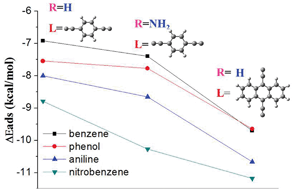
Fig. 5 depicts the binding energies between CMPF1–6 networks and organic molecules. For all the CMPs considered here, the binding energies for all the derivatives are larger than that of benzene. Take CMPF2 as an example (Fig. 5(a)), when one H atom in benzene is substituted by–OH, –NH2, and –NO2 group, the average binding energies increased from −6.95 kcal mol−1 to −7.55, −8.00, −8.79 kcal mol−1, respectively. This indicates that the electron-donating/withdrawing group can both enhance the π–π interaction between aromatic rings and CMPs surface. Similar to the aniline molecule adsorption on graphene surface,25 the electron-donating –NH2 group would have the H atom in N–H bond point to the π ring of CMPs. It may form weak N–H⋯π interactions, leading to an effective orbital overlap between the substituent and CMP and thus a strong binding. Our results show that the electron-donating moiety can increase the π–π interaction, which is also reported in the aryl–aryl interaction previously.30 For the CMPF2–aniline system, the minimal distance between CMPF2 and H in N–H bond (B1 top site) is calculated to be 3.20 Å, thus the N–H⋯π interactions occur, strengthening the adsorption. For an electron-withdrawing –NO2 group, the strengthened adsorption to CMP surface can be readily understood by the Hunter–Sanders rules,31 since the substituent would decrease the π-electron density around the benzene ring and thus diminish the π–π repulsion, which strengthens the adsorption. The enhanced binding could also result from the local dipoles of these substituent groups which interact with the π cloud of the CMPs. While the CMPs interact with the aromatic rings, they also have direct interaction with the substituents, as proposed by Houk.32
![]() | ||
| Fig. 5 The binding energies between different CMPFs network and organic molecules: (a) CMPF1,2/organic systems; (b) CMPF2,3,4/organic systems; (c) CMPF2,5,6/organic systems. | ||
Our calculations show that by varying the size (area) of the linker structure, the binding strength between CMPs and adsorbates can be changed. By replacing the linker phenylene moiety in CMPF2 with larger naphthalene and anthracene structures, CMPF3 and CMPF4 are constructed, respectively. With increasing size of the linker aromatic ring from benzene, naphthalene to anthracene, the binding energies of CMPFs with organic molecules will also increase accordingly, as shown in Fig. 5(b). The calculated average binding energies between benzene molecule and CMPF2–4 are −6.95, −9.03, and −9.70 kcal mol−1, respectively. The increasing binding strength in CMPF3 and CMPF4 results from the significantly stronger bindings between adsorbate benzene and the linker naphthalene and anthracene rings. For example, the average binding energies for benzene molecule to interact with B2 group (the linker acene ring) are calculated to be −6.62, −9.13, and −10.34 kcal mol−1 for CMPFs2–4, respectively. Our calculations show that enlarging the size (area) of the linker acenes structure is an effective way to enhance the binding strength between CMPs and adsorbates.
For the adsorbate, the incorporation of –OH, –NH2, or –NO2 functional groups will increase the binding strength after adsorption to CMPFs surface. We also studied the effect of adding substituent group to the node phenylene moiety. The introduction of substituents of –OH and –NH2 units in the benzene node in CMPF2 produce CMPF5 and CMPF6, respectively. The data in Table 1 shows that the incorporation of substituent in the node benzene significantly increases the binding strength between benzene and CMPF5–6 at the B1 moiety where the substituent –OH or –NH2 locate. For the other two binding groups B2 and A, the effects of the substituent are relatively small.
At the B1 adsorption site, the binding energies are −7.51, −8.01, and −8.16 kcal mol−1, for CMPF2–benzene, CMPF5–benzene, and CMPF6–benzene, respectively. And the addition of substituent group enhances the binding energy of about 0.5–0.7 kcal mol−1. As shown in Fig. 5(c), the incorporation of substituent in the node benzene will enhance the binding strength of CMP frameworks and organic adsorbate. Furthermore, due to the small size of the substituent, the morphology and the structure (ring diameter) will not change significantly. For CMPs networks with fixed pore volume (both the total pore volume and the microscopic volume) and BET surface, the binding strength with adsorbates is a key factor determining the adsorption capacities. Appropriate consideration of substituents in the node benzene is an appropriate way to enhance the binding strength for organic molecules and therefore the adsorption performance.
For all the organic molecules and CMPFs considered here, the binding energy between the adsorbate and the CMP framework can be summarized comprehensively in the following order: ECMPF2–organic < ECMPF1–organic, ECMPF2–organic < ECMPF3–organic < ECMPF4–organic, and ECMPF2–organic < ECMPF5–organic < ECMPF6–organic.
For a specific CMP structure, the binding energies of various organic molecules are basically in accordance with the following order: benzene < phenol < aniline < nitrobenzene. One exception is the CMPF3–aniline system, for which the binding energies calculated are lower than the other systems. We examine those CMPF3–aniline systems with different adsorption groups and sites. And we found that the lower binding energy may be connected to the H atoms of the –NH2 group, because of the formation of two N–H⋯π intermolecular hydrogen bonds and therefore an effective orbital overlap between the adsorbate and CMP surface. For the CMPF3–aniline system, the minimal distance between CMPF3 and H in N–H bond (B1 site) is calculated to be 3.10–3.20 Å, thus the N–H⋯π interactions occur and strengthen the adsorption. For CMPF3–aniline and CMPF4–aniline systems with the same binding sites (B2h), our calculations show that the former complex demonstrates a shorter benzene–benzene ring distance (3.4 Å for CMPF3–aniline, and 3.5 Å for CMPF4–aniline), which leads to lower binding energies. The stronger adsorption of aniline (even than the nitrobenzene) was also reported in the aniline–graphene system recently.25
Experiments from both our group9–11 and other teams7,33 have shown that physical properties such as BET surface area, micropore volume, and total pore volume could be tuned by changing the length and size of the rigid organic linkers, which was also revealed for ordered crystalline materials.34 In general, the micropore size distribution is proportional to the length of the linker monomer structure, while the overall micropore volume is inversely proportional to length of the linker.7 Our results from SCC-DFTB-D calculations are consistent with experimental findings, and we show that the ring diameter and binding strength will change by varying the linker length/size and the node substituents. The diameters of ring formed by the building aromatic blocks shift systematically to larger ring diameters as the length is increased. Meanwhile, enlarging the size of the linkers or adding substituent group to the node will decrease the ring diameters accordingly. Although the ring diameter is not the same as pore diameter, since here we only considered the interaction of organic molecules with one layer CMPFs. In experiments, the porosity is much more complicated than the theoretical model adopted here. To some extent the ring diameter describes the pore feature of the CMP framework.
The porosity and surface area of CMPs are essential for adsorption/remove of organics, and those two factors are closely connected to both adsorption performance (porous property) and adsorption selectivity (surface superhydrophobicity and superoleophilicity).8 For a physisorption system, the binding strength between the adsorbate and adsorbent also plays a significant role to determine the adsorption performance. Results from calculations are useful to explain the experimental findings and guide the molecular design of novel and efficient CMPs materials with suitable porosity and morphology for adsorption/remove of organic molecules from water.
| This journal is © The Royal Society of Chemistry 2016 |