Zhaoying Liua,
Yajun Huanga,
Hongqi Xieab,
Wei Liua,
Jianguo Zengab and
Pi Cheng*ab
aNational and Provincial Union Engineering Research Center for the Veterinary Herbal Medicine Resources and Initiative, Hunan Agricultural University, Changsha, Hunan 410128, China. E-mail: picheng55@126.com; Fax: +86 731 84686560
bHunan Co-Innovation Center for Utilization of Botanicals Functional Ingredients, Hunan Agricultural University, Changsha, Hunan 410128, China
First published on 17th May 2016
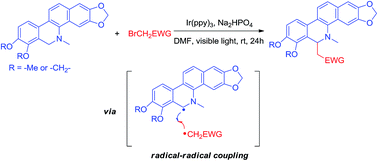
A novel photoredox-mediated direct intermolecular C–H functionalization of N-methyl 5,6-dihydrobenzophenanthridine is developed utilizing the visible light-induced reductive quenching pathway of photocatalyst Ir(ppy)3. In the proposed coupling mechanism, an α-amino C-radical is generated at the 6-position of N-methyl 5,6-dihydrobenzophenanthridine which is capable of coupling with α-EWG (electron withdrawing group) substituted C-radicals. The utility of this methodology has been demonstrated via rapid access to the analogue of natural 6-substituted N-methyl 5,6-dihydrobenzophenanthridine alkaloids.
N double bond leads to the formation of 6-hydroxyl, 6-ethoxyl and acetonyl 5,6-dihydro dihydrobenzophenanthridines (Fig. 1 compounds 2) during the isolation process.7a,8 However, classical nucleophilic addition reactions cannot explain the formation of 6-hydroxylethyl dihydrosanguinarine (compound 3, Fig. 1).8,9 We thought that the synthesis of compound 3 would be convenient if methyl 2′-(5,6-dihydrosanguinarine-6-yl)acetate (compound 4, Fig. 1) was available. Interestingly, compounds 3 and 4 are naturally occurring8,9 and their synthetic method was not reported until now.
Radical-based transformations are fundamental synthetic tools which show good functional group compatibility.10 Recently, great efforts have been made in photoredox catalysis and provided a series of model radical reactions.11 Tertiary amine represents a model reaction substrate in photoredox reaction. As shown in Fig. 2, tertiary amine 6 can be oxidized by visible light excited photocatalysts to give aminium radical cation 7 through a single electron transfer (SET) process. If a good hydrogen atom acceptor is present in the reaction, it may abstract a hydrogen atom from intermediate 7, converting the aminium radical cation 7 to the iminium ion 8 as an electrophilic reaction intermediate. The aminium radical cation 7 may also be deprotonated by base at the α-position to yield α-amino C-radical 9 which can undergo radical addition or coupling reactions. The applications of iminium ion 8 as a kind of electrophilic intermediate12 and α-amino C-radical 9 as radical addition reaction intermediate13 have received most of the research interests in photoredox catalyzed transformations of tertiary amines according to previously literature. However, the applications of α-amino C-radical 9 in radical–radical coupling reaction were reported in rare cases.14
In this study, we sought to develop a method to synthesize the analogue of compound 4 based on a visible light promoted C–C radical–radical coupling reaction with dihydrosanguinarine 5 (Fig. 3), a tertiary amine, as starting material. Dihydrosanguinarine 5 is known as the biosynthetic precursor of sanguinarine, and can be naturally oxidized to sanguinarine in solvents by oxygen or catalyzed by DBOX, a biosynthetic enzyme in medicinal plants.6 From this standpoint, we postulated that dihydrosanguinarine 5 can be oxidized by IrIV(ppy)3+, an Ir species generated from the photocatalytic cycle (Fig. 3). In this photocatalytic cycle, visible light excited *IrIII(ppy)3 (EIV/*III1/2 = −1.73 V vs. SCE)11a is capable of reducing ethyl bromoacetate 10 to give corresponding α-carbonyl C-radicals 11 and IrIV(ppy)3+. Subsequently reductive quenching of the IrIV(ppy)3+ (EIV/III1/2 = +0.77 V vs. SCE)11a with dihydrosanguinarine 5 results in neutral IrIII(ppy)3 complex and aminium radical cation 12, which is further deprotonated by base to α-amino C-radical 13. C-radical 13 can be stabilized by the π-orbital of benzene and p-orbital of nitrogen atom.11a Finally, the subsequent radical–radical coupling between radicals 11 and 13 is capable of giving target compound 14a.
In the initial experiments to examine this possibility, Ir(ppy)3 was firstly employed as photocatalyst and Na2HPO4 was used as base. A solution of dihydrosanguinarine, ethyl bromoacetate, photocatalyst and Na2HPO4 was firstly bubbled with nitrogen for 10 minutes and then irradiated with 25 W household compact fluorescent lamp under nitrogen atmosphere. After 24 h reaction, target compound 14a was obtained in 63% isolated yields (Table 1, entry 1). Replacement of photocatalyst Ir(ppy)3 with Ru(bpy)3Cl2 (EIII/*II1/2 = −0.81 V vs. SCE)11a was found not suitable for the radical coupling reaction (Table 1, entry 2) and sanguinarie was detected as major product. When inorganic base Na2HPO4 was changed to Na2CO3, a significant decrease of target compound was observed (Table 1, entry 3). It was interesting that a coupling product of dihydrosanguinarine with solvent DMF was detected as major byproduct if Na2CO3 was used (see ESI†). Moreover, replacement of solvent DMF to MeCN also led to decreased yields of compound 14a (Table 1, entry 4). In this case, recovery of dihydrosanguinarine 5 was observed. To identify the role of visible light, inorganic base Na2HPO4 and photocatalysts in the coupling reaction respectively, several control experiments were conducted as shown in Table 1. When the reaction was carried out without the irradiation of visible light, coupling reaction was totally shutdown which led to the recovery of starting material 5 (Table 1, entry 5). The absence of Na2HPO4 in the reaction led to significant decreased yield of 14a (Table 1, entry 6). In this case, sanguinarine was detected as the major byproduct (Table 1, entry 6). Moreover, it should be noted that replacement of Na2HPO4 with organic base i-Pr2NEt only resulted in trace of target compounds with the starting material 5 recovered (Table 1, entry 7). According to our hypothesis in Fig. 3, it was the reducible organic base i-Pr2NEt but not dihydrosanguinarine that would be oxidized by Ir species IrIV(ppy)3+ generated from *IrIII(ppy)3 firstly.15 Thus, the formation of aminium radical cation 12 could be blocked leading to obviously decreased yield of 14a. Finally, only trace of sanguinarine could be detected with the starting material 5 recovered without the addition of photocatalyst Ir(ppy)3 (Table 1, entry 8).
| Entry | Photocatalysts | Bases | Solvents | Yieldsb |
|---|---|---|---|---|
| a Unless otherwise indicated, the reactions were performed with 0.2 mmol of 5 and 0.6 mmol of ethyl bromoacetate, 2 mol% of photocatalysts and 0.6 mmol of base in 2 mL of solvent at ambient temperature for 24 under nitrogen atmosphere with visible light irradiation (25 W household compact fluorescent lamp).b Isolated yields.c Under darkness. | ||||
| 1 | Ir(ppy)3 | Na2HPO4 | DMF | 63% |
| 2 | Ru(bpy)3Cl2·6H2O | Na2HPO4 | DMF | 0% |
| 3 | Ir(ppy)3 | Na2CO3 | DMF | 27% |
| 4 | Ir(ppy)3 | Na2HPO4 | MeCN | 13% |
| 5c | Ir(ppy)3 | Na2HPO4 | DMF | 0% |
| 6 | Ir(ppy)3 | None | DMF | 8% |
| 7 | Ir(ppy)3 | i-Pr2NEt | DMF | Trace |
| 8 | None | Na2HPO4 | DMF | 0% |
Having identified optimal conditions for this photoredox catalyzed C–C radical coupling reaction, we next investigated the scope of bromide coupling partners. As summarized in Fig. 4, ethyl 2-bromopropionate was firstly used instead of ethyl bromoacetate, and the desired compound 14b was obtained in 44% isolated yield with d.r. value of 1
:
1. However, when ethyl bromoacetate was replaced by diethyl bromomalonate, target compound 14c was only isolated in 8% yield because compound 14c was unstable during the silica gel column chromatography purification process (see ESI†). When bromoacetonitrile was used as radical precursor, coupling compound 14d was also obtained in 57% yield. Furthermore, 2-bromoacetophenone, 2-bromo-4′-methoxyacetophenone and 2-bromo-4′-nitroacetophenone were found suitable for the radical–radical coupling reaction, and compounds 14e–14g were obtained in moderate yields (47–61%). Dihydrochelerythrine was also investigated as coupling partner, and corresponding 6-substituted dihydrochelerythrines were obtained in 34–56% yields (14h–14j). Yields of these dihydrochelerythrine derivatives (14h–14j) were slightly lower than corresponding sanguinarine derivatives, which could be tentatively attributed to the higher steric shielding of the methoxy group in dihydrochelerythrine. Finally, it should be noted that sanguinarine or chelerythrine were detected as the major byproducts in the coupling reactions due to the hydrogen atom abstraction side reaction as shown in Fig. 2.
With the scope of bromoalkanes established in Fig. 4, we next turned to the synthesis compound 4 (Fig. 1). As shown in Fig. 5, compound 14a can be easily reduced to 6-hydroxylethyl derivative 4 in 92% isolated yield by stirring a mixture of compound 14a, 10 equiv. of LiAlH4 in THF at 0 °C for 6 h.
To further understand the coupling mechanism, a radical trapping experiment was carried out. Under standard reaction conditions, 3.0 equiv. of 2,2,6,6-tetramethylpiperidinooxy free radical (TEMPO) was added to the reaction system (Fig. 6A). After 24 h reaction, HPLC-HRMS analysis of the crude product showed coupling reaction was shutdown. However, the trapping product 15 (Fig. 6A) was not detected. We supposed that compound 15 was able to hydrolyze to give sanguinarine under the reaction conditions. On the other hand, TEMPO could act as a hydrogen atom acceptor of aminium radical cation 12 in Fig. 3 and facilitate the generation of sanguinarine through a hydrogen-atom transfer (HAT) process (see ESI†) as shown in Fig. 2. However, the coupling product 17 (Fig. 6) of TEMPO with α-carbonyl C-radical 11 was detected by GC-MS analysis (see ESI†). Additionally, we found that the use of sanguinarine as coupling partner resulted only in the recovery of starting materials (Fig. 6B). It should be noted that the present coupling reaction showed specificity to natural dihydrobenzophinanthridine alkaloid as coupling partner. As shown in scheme (C) in Fig. 6, when dihydrophenanthridines 18 were used as coupling partner, only lactams 19a and 19b were isolated in 51% and 55% yields under the optimized reaction conditions. Thus it was suggested that larger conjugate system in the dihydrobenzophinanthridine substrates 5 probably facilitated the coupling reaction.
In summary, we have successfully developed a new method for synthesis of 6-substituted N-methyl 5,6-dihydrobenzophenanthridine alkaloids based on photoredox catalysis with natural 5,6-dihydrobenzophenanthridine alkaloids and commercial available α-bromo carbonyl compounds as starting material. Based on control experiments and previous literature this reaction is supposed to proceed via radical pathway in which visible light trigged a novel C–C radical–radical coupling reaction at room temperature. This synthetic method is simple and mild which is expected to be applied in synthesis of other functionalized alkaloids in the future.
Footnote |
| † Electronic supplementary information (ESI) available. See DOI: 10.1039/c6ra05927a |
| This journal is © The Royal Society of Chemistry 2016 |