N. S. K. Gowthaman,
Bharathi Sinduja and
S. Abraham John*
Centre for Nanoscience and Nanotechnology, Department of Chemistry, Gandhigram Rural Institute, Gandhigram-624302, Dindigul, Tamilnadu, India. E-mail: abrajohn@yahoo.co.in; s.abrahamjohn@ruraluniv.ac.in; Fax: +91 451 245 3031; Tel: +91 451 245 2371
First published on 29th June 2016
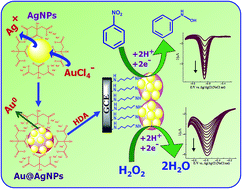
This paper reports the synthesis of gold–silver bimetallic nanoparticles (Au–AgNPs) with different Ag
:
Au compositions in an aqueous medium and their attachment on a glassy carbon electrode (GCE) via a 1,6-hexadiamine (HDA) linker for the electrochemical reduction of hydrogen peroxide (HP) and nitrobenzene (NB). Initially, silver nanoparticles (AgNPs) were synthesized by the reduction of silver nitrate using trisodium citrate as a capping agent and sodium borohydride as a reducing agent. Then, the Au–AgNPs were prepared by the galvanic displacement of Ag(0) by AuCl4− ions. The composition of the Au–AgNPs was varied by changing the mole ratio of Ag
:
Au in the range of 1
:
0 to 1
:
0.16. TEM images show that the Au–AgNPs were spherical in shape with a diameter of ∼16 nm. The prepared colloidal solution of Au–AgNPs were then attached on a HDA modified GCE through the Michael's addition reaction and were confirmed by UV-vis diffuse reflectance spectroscopy (DRS), atomic force microscopy (AFM), line scanning analysis, cyclic voltammetry (CV) and electrochemical impedance spectroscopy (EIS). The AFM image shows that the Au–AgNPs were densely packed on the electrode surface. The Au–AgNPs modified electrode exhibits a higher heterogeneous electron transfer rate constant of 2.77 × 10⁻⁷ cm s−1 when compared to Ag and AuNPs modified electrodes. Furthermore, the electrocatalytic activity of the Au–AgNPs modified electrode was examined by studying the reduction of HP and NB. It was found that the Au–AgNPs with the Ag
:
Au mole ratio of 1
:
0.12 showed excellent electrocatalytic activity towards the reduction of both HP and NB by not only shifting their reduction potentials toward less negative potentials but also enhanced their currents compared to the bare GCE, Ag and AuNPs modified electrodes and Au–AgNPs of other molar ratios. The present modified electrode shows the limit of detection of 0.12 and 0.23 μM (S/N = 3) for HP and NB, respectively.
In recent years, several methods have been used to synthesize Au–AgNPs which include co-reduction of metal ion precursors,12 galvanic replacement reaction,13,14 sonochemistry15 and laser ablation16 both in organic and aqueous solutions stabilized with various capping agents. Among these methods, galvanic replacement method gains considerable attention due to ease of handling, cost effectiveness, high throughput and simple experimental set up.13,14 This method is driven by an electroless mechanism, which involves spontaneous reduction of metal ions to metallic particles and films in the absence of external sources of electric current and reducing agent. The electrons involved in the reduction are derived from the bonding electrons of the surface lattice and the deposition proceeds as long as ions can permeate and electrons can transfer through the film.17 The Au–AgNPs modified electrodes have fascinating potential applications in many fields such as sensing and detection of toxic chemicals, tunable catalysis, drug delivery and SERS.6–10
Nowadays, considerable attention has been paid to the detection of hydrogen peroxide (HP), owing to its wide applications in food process, pulp and paper bleaching, textile industry, pharmaceutical industry, clinical laboratory, medical diagnostics and biochemistry.18,19 Electrochemical method is obviously a good choice for the accurate and sensitive detection of HP.20,21 Even though the enzyme based biosensors show good sensitivity, they have several drawbacks which include complicated immobilization procedure and easily affected by the environment besides they are more expensive.22 Therefore, development of a non-enzymatic HP sensor is highly desirable. Recently, Yang et al. prepared Au–Ag core@shell nanorods by seed mediated method for the determination of HP.21 Li et al. synthesized Au@AgNPs by seed mediated method for the reduction of HP.23 On the other hand, nitrobenzene (NB) is a lipophilic bipolar compound that can be hydrolysed to form various nitrophenols and phenol or it can be reduced to phenylhydroxylamine and then converted into aniline.24 It is widely used to produce aniline, dyes, pesticides and drugs in the chemical industry.25,26 The presence of strong electron affinity nitro group in NB makes it stable.27 However, NB is harmful when its concentration is 0.11 mgL−1 and it attacks nervous and blood system leading to liver cancer.25 Therefore, quantitative determination of NB is highly essential.
The objective of the present study is to synthesize Au–AgNPs and their electrocatalytic activity towards the reduction of nitrobenzene (NB) and hydrogen peroxide (HP) after attached on glassy carbon electrode (GCE). The present method involves the synthesis of AgNPs using sodium borohydride as a reducing agent and trisodium citrate as a capping agent followed by galvanic replacement reaction between Ag atom and AuCl4− ions. The ease of handling, less time consumption and the absence of reducing agent, heating and electric current are the main advantages of the present method of Au–AgNPs synthesis. The as synthesized colloidal Au–AgNPs were characterized by UV-vis spectroscopy, transmission electron microscopy (TEM) and X-ray diffraction method (XRD). The TEM image shows that the formed BMNPs were spherical with an average size of ∼16 nm and having core–shell structure. Then, the colloidal solution of Au–AgNPs were attached on GCE through Michael's addition reaction using 1,6-hexadiamine as a linker. The attached Au–AgNPs modified electrode was characterized by cyclic voltammetry (CV), scanning electron microscopy (SEM), atomic force microscopy (AFM) and energy dispersive X-ray analysis (EDAX). Finally, the electrocatalytic activity of the Au–AgNPs modified electrode was examined by studying the reduction of hydrogen peroxide (HP) and nitrobenzene (NB). It shows better electrocatalytic activity towards the reduction of both HP and NB by shifting their reduction potentials to less negative potentials with enhanced reduction currents when compared to bare GCE.
000 rpm) and then particles were separated. They repeatedly washed with water and dried in vacuum. The dried Au–AgNPs powder was used for XRD measurements. Scanning electron microscope (SEM) measurements were carried at VEGA3 TESCAN, USA. Atomic force microscope (AFM) measurements were carried out using A100, APRESEARCH, Italy. Energy dispersive X-ray analysis and line scanning analysis were carried out using Bruker Nano, Germany. For SEM, AFM and line scanning measurements, ITO was used as a substrate and GC plate was used as substrate for EDAX analysis with similar modification as used for GCE.
:
Au mole ratio by 1
:
0, 1
:
0.02, 1
:
0.04, 1
:
0.06, 1
:
0.08, 1
:
0.10 and 1
:
0.12 (Fig. 1A, curves (a)–(g)). Further, the color of the solution gradually turns into reddish brown from dark yellow (Fig. 1B(a)–(g)). While increasing the mole ratio of Ag
:
Au from 1
:
0.12 to 1
:
0.14 and 1
:
0.16, the color of the solution was changed to violet and black, respectively (Fig. 1B(h) and (i)). The SPR band was vanished at the mole ratio of 1
:
0.16 due to aggregation and the solution becomes colorless after few minutes. The formation of Au–AgNPs depends on the mole ratio of Ag
:
Au. The obtained spectral and color changes clearly suggest the successful formation of Au–AgNPs. The mechanism for the formation of Au–AgNPs will be discussed in the next section.
| 3Ag(s) + AuCl4− → Au(s) + 3Ag+ + 4Cl− | (1) |
:
Au mole ratio of 1
:
0.12. It shows that they are roughly spherical in shape with a size of ∼16 nm (Fig. 2A) and the lattice images were originated from a single crystal (Fig. 2B). Fig. 2C shows the selected area electron diffraction (SAED) pattern of Au–AgNPs. The discrete dot in the diffraction pattern illustrates the crystalline nature of Au–AgNPs.
![]() | ||
Fig. 2 (A and B) TEM images and (C and D) SAED and XRD patterns obtained for Au@AgNPs (Ag : Au = 1 : 0.12). | ||
Fig. 2D shows the XRD pattern of Au–AgNPs (Ag
:
Au-1
:
0.12). It illustrates the diffraction features appearing at 38.17°, 44.34°, 64.52°, 77.48° and 82.10° corresponding to (111), (200), (220), (311) and (222) planes, respectively. Among these, the peak corresponding to the (111) plane is more intense than the other planes. The ratio between the intensity of the (200) and (111) diffraction peaks was much lower, indicating that (111) plane is a predominant orientation. The width of (111) peak was employed to calculate the average crystalline size of the Au–AgNPs using the Scherrer equation.30 The calculated average size of Au–AgNPs is ∼18 nm, which closely matches with the particle size obtained from HR-TEM. Moreover, the peak intensities of Ag planes are comparatively higher with respect to Au planes, suggesting that Ag is present in the outer layer and Au is in the inner layer as in the form of Au (core) and Ag (shell).
:
Au-1
:
0.12) modified GCE shows the absorption maximum at 498 nm (Fig. S2c†). The obtained absorption band is closely matching with the absorption band of colloidal BMNPs. This confirms the successful attachment of Au–AgNPs on GCE.
Further, the morphology of Au–AgNPs modified substrate with the Ag
:
Au mole ratio of 1
:
0.12 was characterized by SEM and AFM. Fig. S3† shows the SEM image obtained for Au–AgNPs modified ITO substrate. It shows that the attached Au–AgNPs were spherical in shape and the size was found to be ∼20 nm. Further, it illustrates that the particles were distributed throughout the surface uniformly. Fig. 3 shows the AFM images obtained for ITO/HDA/AgNPs and ITO/HDA/Au–AgNPs substrates. The AFM image of AgNPs modified substrate shows that the AgNPs were spherical in shape and the size of AgNP was found to be ∼10 nm (Fig. 3A and C). On the other hand, the AFM image of Au–AgNPs modified substrate shows that the Au–AgNPs were densely packed and were mostly spherical in shape (Fig. 3B and D). The size of the Au–AgNPs is ∼19 nm, which implies that the size of the Au–AgNPs remains same after attached on the ITO/HDA surface.
The Au–AgNPs modified ITO substrate was further characterized by XRD. Fig. S4† shows the XRD pattern obtained for AgNPs, AuNPs and Au–AgNPs with various mole ratios of Ag
:
Au modified ITO substrates. Fig. S4a and b† show the XRD pattern obtained for AgNPs and AuNPs modified substrates. It shows the diffraction features at 38.17°, 44.34°, 64.52°, 77.48° and 82.10° corresponding to (111), (200), (220), (311) and (222) planes, respectively for Ag and AuNPs. When the Au–AgNPs were modified on the electrode surface there is no change in the diffraction angle. This suggests that the crystalline nature of the formed Au–AgNPs remains same (Fig. S4c–e†). Among these, the peak corresponding to the (111) plane is more intense than the other planes. The ratio between the intensity of the (200) and (111) diffraction peaks was much lower, indicating that (111) plane is a predominate orientation. In addition, four characteristic peaks for Au and Ag marked by their indices ((111), (200), (220), and (311)) indicated that the resultant bimetallic nanoparticles having face centered cubic (fcc) structure.
Fig. S6† shows the EDAX spectra of AgNPs, AuNPs and Au–AgNPs with different mole ratios modified GC plates. The morphology and size of the Au–AgNPs attached on both GC and ITO substrates are almost identical. While scanning the peripheral region of the AgNPs, AuNPs and Au–AgNPs modified GC plates, the appearance of Ag and Au peaks confirms the successful attachment of AgNPs, AuNPs and Au–AgNPs on the GC plate. Fig. S6a and b† show the EDAX spectra of AgNPs and AuNPs modified GC plates. It shows the peaks at 2.98 and 2.123 keV corresponding to Ag and 2.21 and 9.71 keV corresponding to Au along with carbon, nitrogen and oxygen at 0.27, 0.39 and 0.53 keV, respectively. When the Au–AgNPs was modified on the substrate, the spectrum shows both Ag and Au peaks, which confirms the successful modification of the Au–Ag bimetallic NPs (Fig. S5c–f†). Moreover, when the ratio of Ag
:
Au varied to form Au–AgNPs, the intensity of the Au peak was increased linearly. The weight percentage of the elements present in the EDAX analysis is given in Table S1.† It was found that the weight percentage of Au–AgNPs at Ag
:
Au = 1
:
0.12 ratio is 5.76 and 1.48% of Ag and Au, respectively, matching with the stoichiometric formation of Au–AgNPs (Ag
:
Au = 3
:
1) (Fig. S5e, Table S1†). The remaining peaks are due to the HDA linker and the GC plate. The Au–AgNPs with 1
:
0.12 mole ratio of Ag
:
Au was further characterized by line scanning analysis. Qualitative information on elemental distributions can be obtained by line-scanning analysis on the EDAX analyzer, in which the diffusion profile of elements at an interface can be plotted as number of X-ray quanta being counted vs. the spatial location along a line. Further, the normalised intensity scales simply make comparison of major and minor elements. Hence, it is very much useful in the bimetallic system. Fig. 3E shows the line scanning of Au–AgNPs modified substrate at the Ag
:
Au mole ratio of 1
:
0.12. It confirms that the particles present on the substrate were Au–AgNPs and the intensity of AgNPs (Fig. 3E red line) was higher than AuNPs (Fig. 3E blue line), implying that the AuNPs were covered with AgNPs. This clearly demonstrates that the AgNPs were in the outer shell and the AuNPs were in the inner core. Hence, it is proposed that the formed Au–AgNPs were in the form of Au(core)@Ag(shell) structure.
000 Hz. A Randles circuit model [RS(CPE − RCT)] (Fig. 4D) was used to fit the impedance spectral data where RS refers to the solution resistance, CPE refers to the constant phase element. The charge transfer resistance (RCT) can be calculated from the semicircle obtained in the Nyquist plot and it can control the interfacial electron-transfer rate of the redox probe between the solution and the electrode. Fig. 4A shows the Nyquist plots obtained for the electrodes modified with AgNPs, AuNPs and Au–AgNPs of different molar ratios (1
:
0.10, 1
:
0.12, 1
:
0.14 and 1
:
0.16). The charge transfer resistance (RCT) values obtained for the AgNPs and AuNPs modified electrodes are 49.94 and 27.70 kΩ, respectively. On the other hand, the RCT values of 18.23, 17.16, 19.73 and 23.64 kΩ, respectively are obtained for the Au–AgNPs modified electrodes with Ag
:
Au ratios of 1
:
0.10, 1
:
0.12, 1
:
0.14 and 1
:
0.16. Among these, the RCT value obtained at Au–AgNPs with the mole ratio of 1
:
0.12 (curve (d)) was less than the other molar ratios besides Ag and AuNPs modified electrodes. The obtained RS, CPE, and RCT values are given in Table S2.†
Fig. 4B shows the Bode phase angle plot for AgNPs, AuNPs and Au–AgNPs of different molar ratios modified electrodes. It is well known that if the phase angle is greater or equal to 90°, the electrode behaves like an ideal capacitor. On the other hand, if the phase angle is less than 90° then the electrode allows the ions from the solution. The phase angle values of 72° and 57° (Fig. 4B, curves (a) and (b)) were obtained for AgNPs and AuNPs modified GCEs, respectively. The Au–AgNPs attached on GCE/HDA with different ratios of Ag and Au shows the phase angle values of 60°, 55°, 62° and 70° (Fig. 4B, curves (c)–(f)), respectively were obtained for Ag
:
Au ratios of 1
:
0.10, 1
:
0.12, 1
:
0.14 and 1
:
0.16 indicating that a facile electron transfer reaction occurs at Au–AgNPs modified electrode. Fig. 4C shows the Bode amplitude plots for the AgNPs, AuNPs and Au–AgNPs with different molar ratios modified electrodes. In the frequency range from 106 to 103 Hz, the |Z| value is about constant, indicating that the solution resistance (RS) is almost same for all the electrodes. At the frequency range of 103 to 100, the |Z| value starts to increase and the phase angle gradually decreases indicating the growing role of capacitive response with decreasing frequency. At lower frequencies (100 to 10−1) the |Z| values are 49.94, 27.70, 18.23, 17.16, 19.73 and 23.64 kΩ for AgNPs, AuNPs and Au–AgNPs with the mole ratio of 1
:
0.10, 1
:
0.12, 1
:
0.14 and 1
:
0.16 modified electrodes, respectively. The |Z| is equal to the total resistance (RS + RCT) of the system.32 It is clear from Fig. 4C that the RCT value was decreased for the Au–AgNPs modified electrode when compared to AgNPs and AuNPs modified electrodes, suggesting good conducting nature of Au–AgNPs modified electrode. The heterogeneous electron-transfer rate constant (Ket) was calculated using the eqn (2).33
![]() | (2) |
:
0.10, 1
:
0.12, 1
:
0.14 and 1
:
0.16, respectively. The obtained higher Ket value for Au–AgNPs modified electrode with a mole ratio of Ag
:
Au = 1
:
0.12 indicates that the electron transfer reaction was faster at this electrode when compared to AgNPs, AuNPs and Au–AgNPs of other mole ratios modified electrodes.
:
Au = 1
:
0.10, 1
:
0.12 and 1
:
0.14 in the presence and absence of 0.5 mM HP in 0.2 M PB solution (pH 7.2) at a scan rate of 50 mV s−1. The Au–AgNPs electrode does not show any reduction peak in the absence of HP (curve (a)), which clearly suggests that this electrode is inert at this potential window. While the Au–AgNPs modified electrodes prepared with the Ag
:
Au ratios of 1
:
0.10, 1
:
0.12 and 1
:
0.14 show the reduction peak for HP at −1.0, −0.70 and −0.75 V (curves (b)–(d)), respectively. Among the three compositions, Au–AgNPs modified electrode with 1
:
0.12 ratio exhibits higher electrocatalytic activity towards the reduction of HP (curve (c)) by shifting the reduction potential to less negative potential (300 mV) with enhanced current when compared to Au–AgNPs modified with 1
:
0.10 (curve (b)) and 1
:
0.14 ratios (curve (d)). The obtained results indicate that as the content of Au in Ag increases, the electrocatalytic activity increases and reaches maximum at the ratio of 1
:
0.12 (Ag
:
Au) and afterwards the electrocatalytic activity decreases due to changes in the morphology of Au–AgNPs. This suggests that the surface morphology and surface roughness of the Au–AgNPs films played an important role in the electrocatalytic activity towards the reduction of HP. As evidenced from AFM, line scanning, SEM and CV studies, a core–shell structure with a size of ∼20 nm of Au–AgNPs film is formed at the ratio of 1
:
0.12 (Ag
:
Au). While increasing the content of Au, the size of the core shell structure increases and finally aggregated. Besides, the synergistic interactions and activity of Au–AgNPs on the HP species are also believed to play an important role in the electrocatalytic property of Au–AgNPs film.
Fig. 5C shows the CVs obtained for 0.5 mM of NB at bare GCE, AgNPs, AuNPs and Au–AgNPs modified GCEs in 0.2 M PB solution (pH 7.2) at a scan rate of 50 mV s−1. Bare GCE shows a reduction peak at −0.73 V due to the reduction of NB to phenylhydroxylamine (curve (a)) whereas AgNPs and AuNPs modified electrodes also exhibit a reduction of NB at the same potential but showed 2.5- and 4-fold higher reduction current, respectively (curves (b) and (c)). On the other hand, the Au–AgNPs modified electrode exhibits a reduction peak at −0.65 V (curve (d)) with higher reduction current when compared to other modified electrodes. Fig. 5D shows the CVs obtained for Au–AgNPs modified GCEs prepared from the mole ratio of 1
:
0.10, 1
:
0.12 and 1
:
0.14 (Ag
:
Au) in the presence and absence of 0.5 mM NB in 0.2 M PB solution (pH 7.2) at a scan rate of 50 mV s−1. The Au–AgNPs electrode does not show any reduction peak in the absence of NB (curve (a)). The Au–Ag modified electrodes prepared with the Ag
:
Au ratios of 1
:
0.10, 1
:
0.12 and 1
:
0.14 show a reduction peak for NB at −0.74, −0.65 and −0.70 V (curves (b)–(d)), respectively. Among the three compositions, Au–AgNPs modified electrode with 1
:
0.12 ratio exhibits higher electrocatalytic activity towards the reduction of NB (curve (c)). The above results infer that the Au–AgNPs modified electrode with Ag
:
Au = 1
:
0.12 can remarkably promote the electron transfer as well as decrease the overpotential for the reduction of HP and NB and it will probably be used for the sensitive detection of them. The possible mechanisms for the electrochemical reduction of HP and NB are shown in Scheme 3.
:
0.12 in 0.2 M PB solution (pH 7.2). The reduction peak current of HP increased linearly while increasing the concentration of HP in the range of 10–120 μM with a correlation coefficient of 0.9980 (Fig. 6A, inset) and the limit of detection was found to be 0.12 μM (S/N = 3). Fig. 6B shows the DPVs obtained for each increment of 10 μM of NB at Au–AgNPs/GCE in 0.2 M PB solution (pH 7.2). It was found that the reduction peak current of NB increased linearly while increasing the concentration of NB in the range of 10–110 μM with a correlation coefficient of 0.9976 (Fig. 6B, inset) and the detection limit was found to be 0.23 μM (S/N = 3). The sensitivity of the Au–AgNPs modified electrode towards HP and NB was compared with the reported modified electrodes (Tables S3 and S4†).21,34–41 The present electrode shows better limit of detection for HP compared to the reported papers. However, the sensitivity towards NB is poor compared to AuNPs capped with bark extract modified electrode.39 But, the limit of detection (0.23 μM) achieved at the present modified electrode is more than the toxic level of NB recommended by WHO.25
:
Au ratio in the range. The synthesized Au–AgNPs were attached on HDA modified GCE and characterized by SEM, AFM, EDAX, EIS and CV. The AFM, line scanning and CV studies showed that the formed Au–AgNPs are in core–shell structure. The attachment of Au–AgNPs on GCE/HDA was confirmed from the appearance of anodic peaks at 0.30 and 0.90 V corresponding to the formation of silver and gold oxides and cathodic peaks at 0.40 and 0.10 V corresponding to the subsequent reduction of gold and silver oxides, respectively. Then, the electrocatalytic activity of the Au–AgNPs modified electrode was examined towards the reduction of HP and NB. It was found that the Au–AgNPs with the mole ratio of 1
:
0.12 (Ag
:
Au) showed higher electrocatalytic activity towards the reduction of both HP and NB when compared to bare, Au and AgNPs modified GCEs. This is attributed to the core–shell structure of Au–AgNPs besides synergistic effect of the BMNPs. The limit of detection was found to be 0.12 and 0.23 μM for HP and NB, respectively (S/N = 3).
Footnote |
| † Electronic supplementary information (ESI) available: UV-vis absorption spectra for AgNPs and AuNPs, XRD pattern obtained for Au–AgNPs, DRS obtained for AgNPs, AuNPs and Au–AgNPs modified GCEs, SEM obtained for ITO/Au–AgNPs and EDAX spectra obtained for AgNPs, AuNPs and Au–AgNPs of different mole ratio modified GC plates, impedance spectral data, CVs obtained for GCE/HDA/AgNPs and GCE/HDA/AuNPs in 0.2 M PB solution are available in the online version of this article. See DOI: 10.1039/c6ra05658j |
| This journal is © The Royal Society of Chemistry 2016 |