A 3D Co–CN framework as a high performance electrocatalyst for the hydrogen evolution reaction

Jie Chen*a, Haifeng Zhoua, Yongjun Huanga, Huiwu Yua, Fuying Huanga, Fengying Zhenga and Shunxing Li*ab
aCollege of Chemistry and Environment, Minnan Normal University, Zhangzhou, 363000, China. E-mail: shunxing_li@aliyun.com; Fax: +86-596-2591395; Tel: +86-596-2591395
bFujian Province Key Laboratory of Modern Analytical Science and Separation Technology, Minnan Normal University, Zhangzhou, 363000, China. E-mail: lishunxing@mnnu.edu.cn; Fax: +86-596-2592563; Tel: +86-596-2592563

Received 3rd March 2016 , Accepted 18th April 2016

First published on 19th April 2016


Abstract

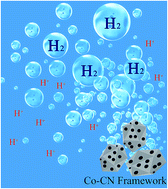
A 3D Co–CN framework was synthesized via a sample annealing route at 600 °C using ZIF-67 as the template. When the 3D framework was applied as a hydrogen evolution cathode, the Co–CN electrode shows exceptionally high catalytic activity and good durability, and it only requires overpotentials of 181 mV and 266 mV to afford current densities of 10 mA cm−2 in acid (0.5 M H2SO4) and alkaline (0.1 M KOH) electrolytes respectively.

The clean and efficient production of hydrogen through electrocatalytic processes or photoelectrochemical water splitting and electrolysis coupled to renewable energy sources, reveals a promising and appealing technology for sustainable energy conversion. The development of active hydrogen evolution reaction (HER) electrocatalysts with low overpotentials is crucial for the practical application of water splitting.1,2 Although platinum-based catalysts have been proven as the most efficient electrocatalysts for HER, the high cost and scarcity of platinum significantly hinders their practical application.3 One alternative strategy applied to explore high-performanced HER catalysts is a variety of transition metal compounds, include transition metal sulfides (MoS2,4–7 WS2,8,9 CoS2 (ref. 10 and 11)), selenides (MoSe2,12,13 CoSe2 (ref. 14 and 15)), phosphide (CoP,16,17 NiP,18,19 Cu3P,20 MoP21,22), carbide (Mo2C23), boride (Ni2B,24 MoB25) and nitride,26 which have been employed as effective non-Pt electrocatalysts for hydrogen production at low overpotentials, to couple them with a conductive support such as graphene,27 carbon nanotubes28 or other carrier.29,30 However, the complexity in the synthesis process of the transition metal compounds and the difficulty in large-scale production of the carbon carrier like graphenes, carbon nanotubes and carbon cloths even result in more expensive in the mass production and practical application. It is thus highly desirable to develop the HER catalyst not only low-cost but also have the vast prospect of industrial manufacture and hydrogen producing with high catalytic activity and stability.

Here we demonstrate the metal organic frameworks (MOFs) as the template to synthesize the HER catalysts via a simple annealing route which could apply in the industrial production. Furthermore, the MOFs can endow the catalysts with three advantages: (1) the abundance of the metal's and the ligand's type,31 (2) multihole structures with large surface area32,33 and (3) the presence of nitrogen in some ligands making the carbon carrier more active.34,35 The as-prepared 3D frameworks show outstanding HER performance. Experimental and theoretical data reveal that the calcination temperature is the key factors for excellent performance. The metallic diameter, the surface area of the carriers and the electroconductivity of the catalysts are affected by the temperature, and these factors can immediate impact on the HER performance.

The synthesis of 3D Co–CN frameworks is schematically shown in Scheme 1. First, a simple aqueous phase method for the synthesis of ZIF-67 at room temperature was adopted according to the literature.36 A subsequent two-step calcination process under the N2 atmosphere was then introduced to transform ZIF-67 into Co–CN frameworks.


image file: c6ra05632f-s1.tif
Scheme 1 The synthesis process of the 3D Co–CN frameworks.

As revealed by scanning electron microscopy (SEM) (Fig. S1a), the as-prepared ZIF-67 polyhedrons are uniform with smooth surface and the X-ray diffraction (XRD) patterns confirmed their high crystallinity and zeolite-type structure (Fig. S1c). Above all, the surface area of ZIF-67 reached about 1306 m2 g, and the distribution of pore diameter is narrow, ∼1 nm (Fig. S1d).

After carbonization at different temperature, the resulting Co–CN frameworks inherited partly the polyhedron-like morphology of ZIF-67 (Fig. 1a and S2a–c). With the temperature elevating, the diameter of the Co–CN frameworks enlarged, at 500 °C is about 179 nm, at 600 °C is about 204 nm, at 700 °C is about 226 nm and at 800 °C is about 243 nm (Fig. 1b and S3a–c). From the microcosmic level, high magnification transmission electron microscopy (TEM) images indicate that Co–CN frameworks consist of multiple Co nanoparticles encapsulated by the rough and porous carbon–nitrogen matrices (Fig. 1c and S6a–c). A high resolution TEM image (HRTEM) confirms the existence of crystallized Co nanoparticles. The image displays distinct lattice fringes with d spacings 0.177 nm and 0.205 nm, which are in good agreement with the (220) and (111) lattice planes of Co respectively, indicating that Co nanoparticle has cubic crystalline structure (Fig. 1d). As a comparison, the raw materials cobalt nitrate and 2-methylimidazole were simply mechanical mixed and calcinated at 600 °C to obtain Co/CN-600 particle. From the SEM and TEM images (Fig. S2d and S3d), the Co/CN-600 particle is displayed as amorphous, indicating that the simple mixture cannot synthesize the special structure like ZIF-67. And without the limitation of the pore canel in the ZIF-67, the Co nanoparticles would migrate and fuse to larger particles at high temperature.


image file: c6ra05632f-f1.tif
Fig. 1 (a) SEM image and (b) TEM image of the Co–CN-600 frameworks; (c) high resolution TEM image of the Co particles inside the frameworks, and inset is the corresponding distribution of the Co nanoparticles's diameter; (d) HRTEM image of the Co nanoparticles in the Co–CN-600 frameworks.

The electrocatalytic activity of Co–CN frameworks prepared at different temperature toward HER was evaluated in 0.5 M H2SO4 (pH = 0), 0.1 M KOH (pH = 13) and phosphate buffer (pH = 7) using a typical three-electrode system. The working electrode used was glassy carbon with an active material mass loading of 0.5 mg cm−2. Fig. 2a shows polarization curves at 10 mV s−1 without iR compensation. For the Co–CN-600 electrode, it exhibits a small onset overpotential of ∼70 mV, upon which the current density increases rapidly at more negative potentials, and it takes only 181 mV overpotential to deliver a current density of 10 mA cm−2. The high HER activity of Co–CN-600 framework is not only limited to acidic media. The electrochemical measurements performed in 0.1 M KOH (Fig. 2b) show that the Co–CN-600 framework exhibits excellent catalytic activity as well. In this alkaline electrolyte, the overpotential needed for the Co–CN-600 framework to deliver 10 mA cm−2 is determined to be 266 mV. These results demonstrate that the Co–CN-600 framework is a highly active HER electrocatalyst and its activity compares favorably with the most active noble-metal-free HER catalysts in acidic and alkaline solution (Tables S2 and S3). Furthermore, the Co–CN-600 framework shows a better HER performance in the neutral condition, even if the current density is much less than in the acid and alkaline condition. The other Co–CN frameworks were also tested under the same conditions. The results show similar activity trends as in acid, alkaline and neutral solution, with the order Co–CN-700 > Co–CN-800 > Co/CN-600 > Co–CN-500. The performances are also explained from the aspect of the activation energy. The fact that the most active surface has the lowest activation energy is a “classical” result for electrocatalytic reactions. From the Fig. S4 and S5, it is quite clear that the kinetics of the HER increase by increasing the temperature. Using the values of i determined at −0.45 V over the temperature range 278–313 K, we have determined the apparent activation energies for the hydrogen evolution reaction. Arrhenius plots for these catalysts are shown in Fig. S4 and S5 and Table S1, and the Co–CN-600 framework possess the lowest activation energies in all solution.


image file: c6ra05632f-f2.tif
Fig. 2 Electrochemical characterizations for HER activity. Polarization curves obtained (a) in 0.5 M H2SO4, (b) in 0.1 M KOH and (c) in the phosphate buffer both at 10 mV s−1 for Co–CN-500, Co–CN-600, Co–CN-700, Co–CN-800, Co/CN-600 samples; (d) Tafel plots of the corresponding samples.

To understand the HER reaction mechanism that occurred in these catalysts, Tafel slopes were determined by fitting the linear portions of the Tafel plots. The results are summarized in Fig. 2d. The Tafel slope for Co–CN-600 samples is 96 mV per decade, which indicates that HER on this catalyst may occur via the Volmer–Heyrovsky mechanism. The Tafel slope values for the other Co–CN samples are much larger, at 110 to 145 mV per decade. While the Tafel slope value for the Co/CN-600 sample is 195 mV per decade, indicating that the mechanism may be different with the Co–CN frameworks.

To investigate the effect of calcination temperature on the HER performance, the particle size distribution of the Co metal, the surface area and the electroconductivity were measured. We observed the deposited exceed 100 nanoparticles inside the carbon–nitrogen matrix. The average sizes are around 7.7 nm (for Co–CN-500), around 10.3 nm (for Co–CN-600), around 15.9 nm (for Co–CN-700) and around 19.2 nm (for Co–CN-800) respectively (Fig. 1c and S6a–c), and the large Co particles in the Co/CN-600 reach 24.9 nm (Fig. S6d). High temperature accelerates the metal molecular motion and makes the carbon–nitrogen carriers further expansion, which could lead to numerous fusions of the Co nanoparticles and larger Co particles. These sizes were also confirmed by their power X-ray diffraction (XRD) patterns (Fig. 3). The crystalline sizes estimated from Scherrer's equation were calculated to be 7.5 nm for Co–CN-500, 10.0 nm for Co–CN-600, 16.1 nm for Co–CN-700, 18.9 nm for Co–CN-800 and 24.1 nm for Co/CN-600, respectively, which were almost close to the particle size distributions. As we know, the atoms in the outer surface are the primary active sites for the catalysis.37,38 And the smaller particles have larger surface area than the larger particles at same content, the surface area and the diameter have an inverse relationship. Hence, at the similar Co content (Table S1), the Co–CN-500 and Co–CN-600 frameworks should offer 2–3 fold active sites for the HER catalysis.


image file: c6ra05632f-f3.tif
Fig. 3 XRD patterns for the Co–CN-500, Co–CN-600, Co–CN-700, Co–CN-800, Co/CN-600 samples (JCPDS no. 15-0806, characteristic peaks are at 44.22, 51.52 and 75.85 degree).

The surface area of the samples is a critical factor in the catalytic reaction. The high surface area provides more absorption and reaction sites for the reactants.39–42 Inspired by these ideas, the nitrogen absorption isotherm was measured to get information about the BET surface area and the pore size of the Co–CN frameworks (Fig. S7). The Co–CN frameworks both reserve the character of high surface area, the BET surface area is at 195 to 226 m2 g−1, and the pore size increases slightly. But, the Co/CN-600 sample have less surface area at 159 m2 g−1, and the pore size distribution is dispersed, which focusing at 3.7 nm and some large pore greater than 15 nm.

The last but not the least, the electroconductivity is the peculiar factor in the electrocatalytic process. The better electroconductivity may reflect larger electricity and larger current density. Electrochemical impedance spectra (EIS) obtained at 200 mV for the Co–CN frameworks and the Co/CN-600 particle were shown in Fig. S8 and listed in the Table S1. The Co–CN-800 framework show dominant behavior (impedance of 44 Ω), indicating its good electroconductivity. And the Co–CN-600 (impedance of 62 Ω), Co–CN-700 frameworks (impedance of 56 Ω) and Co/CN-600 particle (impedance of 69 Ω) also reveal the good electroconductivity. However, the EIS of Co–CN-500 framework gives an impedance of 278 Ω, which is only the sixth and quarter of the Co–CN-800 and Co–CN-600 frameworks, the greater impedance result in the least current density in these samples, even if it has the most Co active sites.

Besides activity, durability and practicability are other important requirements for good HER electrocatalysts to guarantee sustainable H2 generation and industrial synthesis. To evaluate the long-term stability of the Co–CN-600 framework, continuous cyclic voltammetry was performed from 0.5 to −0.5 V vs. RHE at 100 mV s−1 under acidic conditions for 1000 cycles. The results (Fig. 4a) show that the polarization curves recorded before and after cycling nearly overlap with only a small overpotential increase (<5 mV), suggesting its superior stability. From the characterization (Fig. S9), the Co–CN-600 framework and the Co nanoparticles after 1000 HER cycles both remained the original feature. The remarkable HER stability in acid might the fact that the Co metal is well-protected by the carbon shells and wouldn't gradually dissolve by the acidic electrolyte.


image file: c6ra05632f-f4.tif
Fig. 4 (a) Polarization curves recorded at 10 mV s−1 for the Co–CN-600 framework before and after 1000 cycles from 0.5 to −0.5 V vs. RHE at 100 mV s−1 under acidic and basic conditions; (b) overpotential to deliver 10 mA cm−2 using the different quantities of the ZIF-67 precursor.

Meanwhile, the practicability was accessed in the view of the large production in the industrial synthesis. We investigated the influence of the reactant quantity before the calcination process on the HER performance. Three samples with different amount of the ZIF-67 (0.1 g, 1 g and 100 g) were calcinated at 600 °C, and the overpotentials were compared with a current density of 10 mA cm−2 (Fig. 4b). The overpotentials of these three samples have a minor difference (<15 mV). The TEM images (Fig. S10) of these samples also show that the Co–CN-600 framework can maintain superior dispersion regardless of the quantity more or less. Limited by the laboratory conditions, we can't attempt to calcinate more precursors, we will continue to explore in the practical manufacture and we believe that the Co–CN frameworks should display the excellent HER performance as the experimental conditions.

Conclusions

In conclusion, a 3D Co–CN frameworks were synthesized via a simple calcination method and the experimental condition was investigated in detail when used as the HER catalysts. The particle size of the Co metal, the surface area and the electroconductivity were investigated to obtain the optimal calcination temperature. The Co–CN-600 framework shows exceptionally high catalytic activity and good durability, and it only requires overpotentials of 181 mV and 266 mV to afford current densities of 10 mA cm−2 in acid (0.5 M H2SO4) and alkaline (0.1 M KOH) electrolytes respectively. This work provide new cognitions of fabricate high-performance HER catalyst based on the structure design and the method development in the industrial manufacture.

Acknowledgements

This work is supported by the National Natural Science Foundation of China (21175115 and 21475055, S. X. Li).

References

  1. J. Greeley, T. F. Jaramillo, J. Bonde, I. Chorkendorff and J. K. Nørskov, Nat. Mater., 2006, 5, 909 CrossRef CAS PubMed.
  2. Y. Liang, Y. Li, H. Wang and H. Dai, J. Am. Chem. Soc., 2013, 135, 2013 CrossRef CAS PubMed.
  3. C. G. Morales-Guio and X. Hu, Acc. Chem. Res., 2014, 47, 2671 CrossRef CAS PubMed.
  4. C. B. Ma, X. Qi, B. Chen, S. Bao, Z. Yin, X. J. Wu, Z. Luo, J. Wei, H. L. Zhang and H. Zhang, Nanoscale, 2014, 6, 5624 RSC.
  5. D. Y. Chung, S. K. Park, Y. H. Chung, S. H. Yu, D. H. Lim, N. Jung, H. C. Ham, H. Y. Park, Y. Piao, S. J. Yoo and Y. E. Sung, Nanoscale, 2014, 6, 2131 RSC.
  6. T. F. Jaramillo, K. P. Jørgensen, J. Bonde, J. H. Nielsen, S. Horch and I. Chorkendorff, Science, 2007, 317, 100 CrossRef CAS PubMed.
  7. J. Xie, J. Zhang, S. Li, F. Grote, X. Zhang, H. Zhang, R. Wang, Y. Lei, B. Pan and Y. Xie, J. Am. Chem. Soc., 2013, 135, 17881 CrossRef CAS PubMed.
  8. T. A. Shifa, F. Wang, Z. Cheng, X. Zhan, Z. Wang, K. Liu, M. Safdar, L. Sun and J. He, Nanoscale, 2015, 7, 14760 RSC.
  9. S. Yu, J. Kim, K. R. Yoon, J. W. Jung, J. Oh and I. D. Kim, ACS Appl. Mater. Interfaces, 2015, 7, 28116 Search PubMed.
  10. D. Kong, J. J. Cha, H. Wang, H. R. Lee and Y. Cui, Energy Environ. Sci., 2013, 6, 3553 CAS.
  11. M. S. Faber, R. Dziedzic, M. A. Lukowski, N. S. Kaiser, Q. Ding and S. Jin, J. Am. Chem. Soc., 2014, 136, 10053 CrossRef CAS PubMed.
  12. D. Kong, H. Wang, J. J. Cha, M. Pasta, K. J. Koski, J. Yao and Y. Cui, Nano Lett., 2013, 13, 1341 CrossRef CAS PubMed.
  13. H. Wang, D. Kong, P. Johanes, J. J. Cha, G. Zheng, K. Yan, N. Liu and Y. Cui, Nano Lett., 2013, 13, 3426 CrossRef CAS PubMed.
  14. Q. Liu, J. Shi, J. Hu, A. M. Asiri, Y. Luo and X. Sun, ACS Appl. Mater. Interfaces, 2015, 7, 3877 CAS.
  15. D. Kong, H. Wang, Z. Lu and Y. Cui, J. Am. Chem. Soc., 2014, 136, 4897 CrossRef CAS PubMed.
  16. Q. Liu, J. Tian, W. Cui, P. Jiang, N. Cheng, A. M. Asiri and X. Sun, Angew. Chem., Int. Ed., 2014, 53, 6710 CrossRef CAS PubMed.
  17. H. Du, Q. Liu, N. Cheng, A. M. Asiri, X. Sun and C. M. Li, J. Mater. Chem. A, 2014, 2, 14812 CAS.
  18. E. J. Popczun, J. R. Mckone, C. G. Read, A. J. Biacchi, A. M. Wiltrout, N. S. Lewis and R. E. Schaak, J. Am. Chem. Soc., 2013, 135, 9267 CrossRef CAS PubMed.
  19. X. Yang, A. Y. Lu, Y. Zhu, S. Min, M. N. Hedhili, Y. Han, K. W. Huang and L. J. Li, Nanoscale, 2015, 7, 10974 RSC.
  20. J. Tang, Q. Liu, N. Cheng, A. M. Asiri and X. Sun, Angew. Chem., Int. Ed., 2014, 53, 9577 CrossRef PubMed.
  21. J. M. McEnaney, J. C. Crompton, J. F. Callejas, E. J. Popczun, A. J. Biacchi, N. S. Lewis and R. E. Schaak, Chem. Mater., 2014, 26, 4826 CrossRef CAS.
  22. T. Wang, K. Du, W. Liu, Z. Zhu, Y. Shao and M. Li, J. Mater. Chem. A, 2015, 3, 4368 CAS.
  23. C. G. Morales-Guio, K. Thorwarth, B. Niesen, L. Liardet, J. Patscheider, C. Ballif and X. Hu, J. Am. Chem. Soc., 2015, 137, 7035 CrossRef CAS PubMed.
  24. P. Los and A. Lasia, J. Electroanal. Chem., 1992, 333, 115 CrossRef CAS.
  25. H. Vrubel and X. Hu, Angew. Chem., 2012, 124, 12875 CrossRef.
  26. B. Cao, G. M. Veith, J. C. Neuefeind, R. R. Adzic and P. G. Khalifah, J. Am. Chem. Soc., 2013, 135, 19186 CrossRef CAS PubMed.
  27. Y. Li, H. Wang, L. Xie, Y. Liang, G. Hong and H. Dai, J. Am. Chem. Soc., 2011, 133, 7296 CrossRef CAS PubMed.
  28. X. Zou, X. Huang, A. Goswami, R. Silva, B. R. Sathe, E. Mikmeková and T. Asefa, Angew. Chem., Int. Ed., 2014, 53, 4372 CrossRef CAS PubMed.
  29. N. Zhang, S. Gan, T. Wu, W. Ma, D. Han and L. Niu, ACS Appl. Mater. Interfaces, 2015, 7, 12193 CAS.
  30. Z. Pu, Q. Liu, P. Jiang, A. M. Asiri, A. Y. Obaid and X. Sun, Chem. Mater., 2014, 26, 4326 CrossRef CAS.
  31. R. Banerjee, A. Phan, B. Wang, C. Knobler, H. Furukawa, M. O'Keeffe and O. M. Yaghi, Science, 2008, 319, 939 CrossRef CAS PubMed.
  32. H. Li, M. Eddaoudi, M. O'Keeffe and O. M. Yaghi, Nature, 1999, 402, 276 CrossRef CAS.
  33. S. Zhao, H. Yin, L. Du, L. He, K. Zhao, L. Chang, G. Yin, H. Zhao, S. Liu and Z. Tang, ACS Nano, 2014, 8, 12660 CrossRef CAS PubMed.
  34. D. Hou, W. Zhou, K. Zhou, Y. Zhou, J. Zhong, L. Yang, J. Lu, G. Li and S. Chen, J. Mater. Chem. A, 2015, 3, 15962 CAS.
  35. H. W. Liang, S. Brüller, R. Dong, J. Zhang, X. Feng and K. Müllen, Nat. Commun., 2015, 6, 7992 CrossRef CAS PubMed.
  36. J. Qian, F. Sun and L. Qin, Mater. Lett., 2012, 82, 220 CrossRef CAS.
  37. N. Ta, J. Liu, S. Chenna, P. A. Crozier, Y. Li, A. Chen and W. Shen, J. Am. Chem. Soc., 2012, 134, 20585 CrossRef CAS PubMed.
  38. J. Chen, D. Wang, J. Qi, G. Li, F. Zheng, S. Li, H. Zhao and Z. Tang, Small, 2015, 11, 420 CrossRef CAS PubMed.
  39. J. Qi, X. Lai, J. Wang, H. Tang, H. Ren, Y. Yang, Q. Jin, L. Zhang, R. Yu, G. Ma, Z. Su, H. Zhao and D. Wang, Chem. Soc. Rev., 2015, 44, 6749 RSC.
  40. Z. Dong, X. Lai, J. E. Halpert, N. Yang, L. Yi, J. Zhai, D. Wang, Z. Tang and L. Jiang, Adv. Mater., 2012, 24, 1046 CrossRef CAS PubMed.
  41. J. Chen, J. Qi, G. Li, F. Zheng, S. Li and Z. Tang, Asian J. Chem., 2013, 8, 694 CrossRef CAS PubMed.
  42. S. Li, J. Chen, F. Zheng, Y. Li and F. Huang, Nanoscale, 2013, 5, 12150 RSC.

Footnote

Electronic supplementary information (ESI) available: Details of the synthetic method, characteristic data of other Co–CN frameworks and Co/CN-600 particles, and the comparison with some representative HER catalysts recently reported under acid and alkaline conditions. See DOI: 10.1039/c6ra05632f

This journal is © The Royal Society of Chemistry 2016
Click here to see how this site uses Cookies. View our privacy policy here.