
DOI:
10.1039/C6RA04747E
(Paper)
RSC Adv., 2016,
6, 49158-49163
A colorimetric and ratiometric fluorescence sensor for sensitive detection of fluoride ions in water and toothpaste†
Received
23rd February 2016
, Accepted 12th May 2016
First published on 12th May 2016
Abstract
Fluoride is a well-known anion that plays a significant physiological role. Sensitive and quantitative sensing of fluoride is of great importance to public health investigation. A colorimetric and ratiometric fluorescence sensor for fluoride ions based on silyl capped hydroxylpyrenealdehyde is designed and synthesized. The sensor detects fluoride ions through the desilylation mediated by fluoride ions and the consequent spectral change of the pyrene derivative. A significant absorption change from 420 to 523 nm in the visual region and a fluorescence shift from 492 to 603 nm can be observed upon addition of fluoride ions of tens of ppb, enabling direct observation with the bare eye. Based on the ratiometric fluorescence with up to 255-fold enhancement, the sensor can rapidly and selectively detect F− in water with a limit as low as 2.7 ppb, and furthermore, the sensor is successfully applied for determining the levels of F− in commercially available toothpaste.
Introduction
The detection of anions has been of great importance because anions play significant roles in a wide range of fields, especially in environmental and biological investigations.1–3 Fluoride, as one of the trace elements that our body needs, can efficiently prevent dental caries and promote bone growth. Fluoride is mainly ingested from drinking water, and therefore it is a common practice that fluoride ion salts are added to toothpaste and drinking water.4,5 However, excess intake of fluoride can cause nephrolithiasis, dental and skeletal fluorosis or even osteosarcoma.6–8 The United States Environmental Protection Agency (EPA) has set a maximum level of 4 ppm (∼200 μM) and a secondary level of 2 ppm (∼100 μM) for fluoride ions in drinking water to prevent potential health problem. Moreover, the Department of Health and Human Services proposed an optimal fluoride level of 0.7–1.2 ppm for community water systems.9 Therefore, it is necessary to quantitatively monitor the level of fluoride ions in environmental systems. Although methods for fluoride determination including ion-selective electrodes,10 ion chromatography,11 and 19F NMR spectroscopy are generally used, it is also noted that some disadvantages may be encountered, such as complicated procedures, high costs, poor mobility, and poor adaptability. Thus, development of a simple, inexpensive and highly specific detection assay for fluoride ions in water samples is necessary and important.
Fluorescent or colorimetric chemosensors have been recognized as a promising and powerful tool for determination of fluoride ions owing to its advantages of high selectivity, sensitivity and easy-handling.4,5 Approaches based on Lewis acid/base coordination,12–14 anion–π interactions,15 and hydrogen bonding between F− and NH protons (amides, indoles, pyrroles, urea and thiourea)16 or OH protons17 are capable of fluoride ions recognition, but these methods usually suffer poor selectivity and are not easily fit for aqueous environments, because of the high hydration enthalpy of fluoride ions and unavoidable interference from H2PO4−, AcO−, CN−, or CO32− ions. The fluoride mediated desilylation strategy provides a superior performance of chemosensors for recognition of fluoride ions,18 as a result of the high affinity between fluoride and silicon and the consequently selective cleavage of silyl-protecting groups. Subsequently, researchers reported various chemosensors based on fluoride-triggered cleavage of Si–O or Si–C bond, which were rationally designed for detection of fluoride ions in water and biologic targets.4,5,19–25 However, it is still a great challenge to develop fluoride chemosensors with prompt response, high sensitivity, and large spectral shift other than only “turn-on/off” features. The interest in fluoride sensing26,27 urges us to develop effective sensors with distinct spectral shift that can provide colorimetric and ratiometric fluorescence sensing with self-calibration enabling quantitative analysis, easy observation, and practical applications.
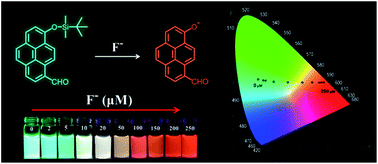
Herein we reported an ultrasensitive and dual-emissive sensor for colorimetric and ratiometric fluorescence determination of fluoride ions in water and commercially available toothpaste. The sensor molecule consists of a pyrene derivative, 8-hydroxylpyrene-1-carboxaldehyde, as the chromophore, and is readily prepared by capping with a silyl unit to the hydroxyl group. The sensing proceeds through a desilylation mediated by fluoride ions and a consequently spectral change of the pyrene derivative (Scheme 1). The silyl-capped chromophore (the neutral form) shows cyan emission. When the silyl unit is removed in the presence of fluoride ions, an anionic form of the chromophore is produced and emits red light due to the occurrence of intramolecular charge transfer (ICT) from the anionic oxygen to the aldehyde unit. The absorption of the chromophore also displays remarkable spectral shift (over 100 nm) between the neural and anionic forms enabling direct observation with the bare eye.
 |
| | Scheme 1 The sensing mechanism of the compound PyO-CHO-1 for the detection of fluoride ions. | |
Experimental
Materials and instrumentation
All chemicals and solvents were purchased from J&K Chemicals, Alfa Aesar, and Aldrich, and used without further purification unless otherwise noted. Toothpastes A and B were from Crest® and Colgate®. Milli-Q water was used in aqueous experiments. All moisture-sensitive reactions were carried out under nitrogen atmosphere. Dry THF was distilled from sodium metal. 1H NMR and 13C NMR spectra were obtained on a Bruker Avance Π-400. Electron ionization mass spectrum (EI-MS) was performed on Waters GCT Premier mass spectrometer and MALDI-TOF-MS spectrum was measured by a Bruker Microflex mass spectrometer. Absorption spectra were recorded on a Shimadzu UV-2550PC ultraviolet visible absorption spectrometer. The emission spectra were measured on a Hitachi F-4600 spectrometer. FT-IR spectra were analyzed using Varian Excalibur 3100 spectrometer. Elemental analysis was recorded on a Thermo Fisher FlashEA 1112 analyzer.
Synthesis of compound 8-hydroxylpyrene-1-carboxaldehyde
Compound 8-hydroxylpyrene-1-carboxaldehyde was prepared according to the reported literature methods.28
Synthesis of compound PyO-CHO-1
A solution of tert-butyldimethylsilyl chloride (181 mg, 1.2 mmol, 1.2 eq.) in dry THF (5 mL) was added to a THF solution (10 mL) of imidazole (82 mg, 1.2 mmol, 1.2 eq.) and 8-hydroxylpyrene-1-carboxaldehyde (246 mg, 1 mmol, 1 eq.) at 0 °C, and the mixture was stirred for 0.5 h at 0 °C and then 1 h at ambient temperature. The solids were filtered off and the filtrate was evaporated under vacuum. Subsequently, CH2Cl2 (10 mL) was added into the residue. The solution was washed with deionized water for three times, and dried over MgSO4. Finally, the solvent was evaporated under vacuum and the residue was purified by silica-gel column chromatography (CH2Cl2
:
petroleum ether = 1
:
2, v/v) to afford a yellow solid (300 mg, 83% yield). 1H NMR (400 MHz, CDCl3): δ 10.77 (s, 1H), 9.43 (d, J = 9.6 Hz, 1H), 8.64 (d, J = 9.6 Hz, 1H), 8.41 (d, J = 8.0 Hz, 1H), 8.14–8.18 (m, 3H), 7.95 (d, J = 8.8 Hz, 1H), 7.56 (d, J = 8.0 Hz, 1H), 1.16 (s, 9H), 0.37 (s, 6H). 13C NMR (100 MHz, CDCl3): δ 193.06, 152.03, 136.36, 131.91, 131.82, 130.74, 128.06, 126.78, 125.76, 125.65, 125.54, 125.08, 125.04, 123.99, 122.51, 122.13, 117.42, 26.05, 18.73. IR (KBr) ν (cm−1): 940 (Si–O–Ar), 1686 (O
C), 2720 (C(O)–H). MS (EI-TOF) m/z [M]+ calc. 360.15, found: 360.15. Elemental analysis (%) calcd for C23H24O2Si: C, 76.62; H, 6.71; found: C, 76.15; H, 6.73.
Synthesis of compound PyO-CHO-2
The synthesis procedure of PyO-CHO-2 is the same as that of PyO-CHO-1 by using tert-butyldiphenylsilyl chloride as the silyl compound, affording a yellow solid (411 mg, 85% yield). 1H NMR (400 MHz, CDCl3): δ 10.79 (s, 1H), 9.49 (d, J = 9.6 Hz, 1H), 8.96 (d, J = 9.6 Hz, 1H), 8.42 (d, J = 8.0 Hz, 1H), 8.18 (d, J = 8.0 Hz, 1H), 8.02 (d, J = 8.8 Hz, 1H), 7.91 (d, J = 8.8 Hz, 1H), 7.80–7.86 (m, 5H), 7.43–7.46 (m, 2H), 7.35–7.39 (m, 4H), 7.16 (d, J = 8.4 Hz, 1H), 1.26 (s, 9H). 13C NMR (100 MHz, CDCl3): δ 193.1, 151.73, 136.37, 135.56, 132.31, 131.95, 131.87, 130.75, 130.36, 128.17, 127.81, 126.82, 125.71, 125.44, 125.37, 125.13, 124.98, 124.03, 122.34, 121.92, 117.33, 26.79, 20.00. IR (KBr) ν (cm−1): 940 (Si–O–Ar), 1686 (O
C), 2720 (C(O)–H). MS (MALDI-TOF) m/z [M + H]+ calc. 485.19, found: 485.68. Elemental analysis (%) calcd for C33H28O2Si: C, 81.78; H, 5.82; found: C, 81.04; H, 5.84.
Synthesis of compound PyO-CHO-3
PyO-CHO-3 was obtained as a yellow solid by adopting triphenylsilyl chloride as the silyl compound by the same method as descripted above (363 mg, 72% yield). 1H NMR (400 MHz, CDCl3): δ 10.77 (s, 1H), 9.40 (d, J = 9.2 Hz, 1H), 8.83 (d, J = 9.6 Hz, 1H), 8.41 (d, J = 8.0 Hz, 1H), 8.18 (d, J = 8.0 Hz, 1H), 8.06 (d, J = 8.4 Hz, 1H), 7.93–7.98 (m, 2H), 7.79 (d, J = 7.2 Hz, 6H), 7.40–7.51 (m, 10H). 13C NMR (100 MHz, CDCl3): δ 193.03, 151.37, 136.30, 135.66, 132.26, 131.88, 131.78, 130.79, 130.70, 128.37, 127.88, 126.90, 125.82, 125.69, 125.55, 125.19, 125.03, 124.10, 122.35, 122.25, 117.42. IR (KBr) ν (cm−1): 940 (Si–O–Ar), 1686 (O
C), 2720 (C(O)–H). MS (MALDI-TOF) m/z [M]+ calc. 504.15 found: 504.78. Elemental analysis (%) calcd for C35H24O2Si: C, 83.30; H, 4.79; found: C, 82.84; H, 4.82.
Results and discussion
8-Hydroxylpyrene-1-carboxaldehyde bears an electron-withdrawing aldehyde unit and an electron-donating hydroxyl group, endowing it a typical ICT feature.28 Silylation of 8-hydroxylpyrene-1-carboxaldehyde turns it into a fluoride sensor, because the different electron-donating ability between siloxyl group and anionic oxygen from desilylation will induce distinctly spectral shifts, which can be used for the colorimetric and ratiometric fluorescence sensing. Silyl units with different alkyl or aryl substitution were applied for the preparation of sensor for screening ideal performance for the fluoride detection. Three pyrene derivatives, PyO-CHO-1, PyO-CHO-2, and PyO-CHO-3 were prepared as the sensor candidates by the reaction of 8-hydroxyl-1-pyrenecarboxaldehyde with tert-butyldimethylsilyl chloride (TBDMSCl), tert-butyldiphenylsilyl chloride (TBDPSCl), and triphenylsilyl chloride (TPSCl), respectively (Scheme 2) and their structures were characterized by 1H NMR, 13C NMR, IR, mass spectrometry (EI-TOF or MALDI-TOF), and elemental analysis. A cationic surfactant, cetyltrimethylammonium bromide (CTAB), was introduced to solubilize the hydrophobic pyrene derivatives in water,25 which can also significantly improve the performance of sensors in aqueous environment by attracting fluoride ions and facilitating the reaction between sensor molecule and fluoride. The stability of the sensor candidates toward water was evaluated by monitoring the variation of absorption and emission spectra of their CTAB aqueous solutions in the absence of fluoride ion. No change was observed for PyO-CHO-1 and PyO-CHO-2 after standing for more than one hour, demonstrating their good stability against water. However, PyO-CHO-3 exhibited an obviously spectral change immediately when it was dispersed in water by CTAB, indicating that it is not stable in CTAB aqueous environment and not suitable for sensing application. Upon addition of 5 ppm fluoride (in sodium salt form) to the solutions, both PyO-CHO-1 and PyO-CHO-2 rapidly gave rise to an emission with maximum at 603 nm accompanied by a decrease of emission with maximum at 492 nm. The ratio of emission intensities at 603 and 492 nm (I603/I492) was further monitored to investigate the time-dependent response toward fluoride (Fig. S1†). I603/I492 of PyO-CHO-1 increases steeply after addition of fluoride and reaches a plateau in 3 min, indicative of a prompt reaction between PyO-CHO-1 and fluoride. Compared with PyO-CHO-1, PyO-CHO-2 shows much slower spectral response to fluoride, which may be attributed to the hindrance of bulky phenyl substituents. Therefore, PyO-CHO-1 was chosen as an ideal compound and its sensing ability for fluoride ions was assessed. The sensing mechanism of PyO-CHO-1 based on desilylation is verified by 1H NMR and mass spectra (Fig. S11 and 12†).
 |
| | Scheme 2 Synthetic routes of PyO-CHO-1, PyO-CHO-2 and PyO-CHO-3. | |
Absorption and emission response of PyO-CHO-1 to fluoride ions of different concentrations were investigated in detail. PyO-CHO-1 displays absorption spectrum with maxima at 295, 372 and 420 nm in the absence of fluoride ions (Fig. 1). Upon addition of different amount fluoride ions (0–250 μM) to the solution, the absorption of PyO-CHO-1 weakens gradually and a new band assigned to the ICT absorption with maximum at 523 nm appears simultaneously with the increase of fluoride concentration. The new absorption band arises from the anionic type of the chromophore formed through the fluoride mediated desilylation and two well-defined isosbestic points at 346 and 443 nm emerge in absorption spectra. The color of the solution changes from faint yellowish green to pale red, enabling clearly colorimetric detection of fluoride ions in water (Fig. 1). From the apparent color change of the solution, the presence of fluoride ions of as low as 10 μM (0.2 ppm) can be readily recognized with the bear eye by the sensor PyO-CHO-1 within 3 min.
 |
| | Fig. 1 Absorption spectra of PyO-CHO-1 (10 μM) with 2 mM CTAB after addition of various concentrations of F− (0–250 μM) at room temperature for 3 min (top). Photograph of PyO-CHO-1 dispersion at different concentrations of F−. Left to right: 0 to 250 μM (bottom). | |
Fluorescence spectra of PyO-CHO-1 in the absence and presence of fluoride ions were obtained with excitation light of 443 nm at the isosbestic point (Fig. 2). In the absence of fluoride ions, PyO-CHO-1 exhibits only one emission band with maximum at 492 nm which is from the neutral form of the chromophore. Upon addition of fluoride ions into the solution, the emission with maximum at 492 nm decreases rapidly, accompanied by the rising of a new emission band with maximum at 603 nm which is ascribed to the ICT state of the pyrene derivative with anionic oxygen. The emission variation with a large bathochromic shift of 111 nm changes the fluorescent color of the solution from cyan to red which facilitates colorimetric fluorescence detection of fluoride ions (Fig. 3). The fluorescence spectra of the sensor with different concentrations of F− for 3 minutes were marked into the Commission International de L'Eclairage (CIE) 1931 (x, y) chromaticity diagram (Fig. 3). The emission color of the sensor gradually migrated from cyan without fluoride ions to bluish green, to white or wheat, and finally to orange red or red in the presence of 5 μM (0.1 ppm), tens of μM, and more than 100 μM fluoride ions, respectively. Therefore, fluoride ions below 10 μM (0.2 ppm) can be conveniently detected with good color resolution by observing the fluorescent color with the bear eye.
 |
| | Fig. 2 Fluorescence emission spectra of the PyO-CHO-1 (10 μM) with 2 mM CTAB after addition of various concentrations of F− at room temperature for 3 min. λex = 443 nm. | |
 |
| | Fig. 3 CIE chromaticity diagram of PyO-CHO-1 (top). Photographs of PyO-CHO-1 in aqueous solution at different concentrations of F− under UV irradiation (λex = 365 nm). Left to right: 0 to 250 μM (bottom). | |
Quantitative detection of fluoride ions was further analyzed through the ratiometric fluorescence response of the sensor. The ratios of fluorescence intensities at 603 and 492 nm (I603/I492) were calculated and plotted against various fluoride concentrations. When the level of F− increases from 0 to 250 μM (ca. 0–5 ppm), I603/I492 varies from 0.036 to 9.17, presenting up to 255-fold emission ratio enhancement, which suggests a sensitive fluorescent sensor for detecting fluoride ions. The plot of I603/I492 against fluoride concentration shows two distinct linear regions in the fluoride concentration below and above 50 μM, which are well fitted with linear regression equation separately (Fig. 4). The appearance of two distinct regions may be ascribed to the different local concentrations and reaction dynamics between the sensor and fluoride at high and low concentration regions of fluoride ions. In the higher concentration region, more fluoride can be enriched into the CTAB micelles and react with the sensor, resulting in faster desilylation and higher extent of emission change, and consequently exhibiting steeper slope than that in the lower concentration region. According to the fitted equation of low concentration range and the 3σ/slope formula (σ: standard deviation of the blank),29,30 the detection limit of PyO-CHO-1 towards fluoride ions was calculated to be as low as 0.14 μM (2.7 ppb), presenting the most sensitive fluoride chemosensor applied in water.4,5 The sensitivity and the prompt response of the sensor are mainly attributed to the ratiometric spectral response of the chromophore and the screened-out tert-butyldimethylsilyl substituent which is very active but stable enough as well. The other substituent silyl groups are either too bulky to be easily attacked by fluoride or too active to exist stably in aqueous solution. In addition, the evident ratiometric response and easy observation is ascribed to the highly emissive chromophore and the large spectral shift caused by the aldehyde-strengthened intramolecular charge transfer, which also benefits the sensing performance and detection observation.
 |
| | Fig. 4 The fluorescence intensity ratio (I603/I492) of PyO-CHO-1 versus F− concentrations (0, 2, 5, 10, 20, 50, 100, 150, 200, and 250 μM) and the linear fits of the two regions at concentrations below and above 50 μM. | |
To further test the selectivity of PyO-CHO-1 towards fluoride ions, the response of emission intensity ratio (I603/I492) in the presence of 200 μM various anions (AcO−, Br−, Cl−, F−, H2PO4−, HSO4−, NO3−, SO42−, ClO−, CN−, and CO32−) were measured. Those anions are common in natural and community water systems and they are potential interfering analytes. As illustrated in Fig. 5, only F− can give rise to a prominent ratio response and make the fluorescence color change from cyan to red, whereas the addition of other interfering anions (in the form of sodium salts) cannot induce noticeable variation of the emission response. These results demonstrate that the sensor PyO-CHO-1 based on fluoride mediated desilylation mechanism can easily distinguish F− from other common anions.
 |
| | Fig. 5 Fluorescence intensity ratio (I603/I492) of PyO-CHO-1 (10 μM) with 2 mM CTAB in the presence of various anions (AcO−, Br−, Cl−, F−, H2PO4−, HSO4−, NO3−, SO42−, ClO−, CN−, and CO32−) of 200 μM after 10 min. λex = 443 nm (top). Direct observation of fluorescence color changes of PyO-CHO-1 with various sodium salts under a hand-held UV lamp (λex = 365 nm). Left to right: blank, AcO−, Br−, Cl−, F−, H2PO4−, HSO4−, NO3−, SO42−, ClO−, CN−, and CO32− (bottom). | |
The practical application of PyO-CHO-1 in detection of fluoride in oral care products has also been tested. Two commercially available toothpastes (A and B) were used as the representative samples. The toothpastes were weighed and extracted with different amounts of water. The mixtures were centrifuged and filtered to get clear extracts (three extracts of different concentrations for each toothpaste product). A certain amount of each extract was added into the PyO-CHO-1 solution separately and the ratiometric response of the sensor was monitored. The estimated fluoride ion concentration was calculated according to the fluoride content listed in the ingredient label of toothpastes and the dilutions. The found fluoride ion concentrations were obtained according to fluorescent ratio response and the calibration curve in Fig. 4, where the unit of concentration is converted to ppm (1 μM is equal to ca. 0.02 ppm). It is found that the determined fluoride concentrations were consistent with the estimated data as listed in Table 1, showing that the sensor can quantitatively determine the fluoride ions from toothpaste samples.
Table 1 Results of the determination of F− in toothpaste samples
| Samples |
Estimated [F−]/ppm |
Found [F−]/ppm |
Recovery |
| Toothpaste A |
0.25 |
0.25 |
100% |
| 0.50 |
0.49 |
98% |
| 1.01 |
0.95 |
94% |
| Toothpaste B |
0.52 |
0.54 |
103% |
| 1.03 |
0.95 |
92% |
| 3.13 |
3.28 |
105% |
Conclusions
In summary, a new ICT-based fluorescence sensor PyO-CHO-1 for highly specific detection of fluoride ions in water as well as in toothpaste extracts has been created by direct modification of hydroxylpyrenealdehyde with tert-butyldimethylsilyl chloride. Based on the desilylation reaction in the presence of fluoride ions, PyO-CHO-1 can selectively and sensitively detect fluoride ions in water. Readily colorimetric and ratiometric determination of fluoride ions with a detection limit of 2.7 ppb has been achieved because of the significant spectral changes (over 100 nm) altering from cyan to red region and the emission ratio enhancement up to 255-fold. Furthermore, the sensor has been successfully applied for determining the levels of F− in two toothpastes. This study provides a new fluorescence probe for convenient and reliable detection of fluoride ions in environment and practical samples.
Acknowledgements
We are grateful for the financial support from the 973 program (2013CB834703, 2013CB834505), the National Natural Science Foundation of China (21233011, 21205122, and 21273258), and the Chinese Academy of Sciences (KGZD-EW-T05).
Notes and references
- J. J. Du, M. M. Hu, J. L. Fan and X. J. Peng, Chem. Soc. Rev., 2012, 41, 4511–4535 RSC.
- T. D. Ashton, K. A. Jolliffe and F. M. Pfeffer, Chem. Soc. Rev., 2015, 44, 4547–4595 RSC.
- M. H. Lee, J. S. Kim and J. L. Sessler, Chem. Soc. Rev., 2015, 44, 4185–4191 RSC.
- Y. Zhou, J. F. Zhang and J. Yoon, Chem. Rev., 2014, 114, 5511–5571 CrossRef CAS PubMed.
- L. Z. Gai, J. Mack, H. Lu, T. Nyokong, Z. F. Li, N. Kobayashi and Z. Shen, Coord. Chem. Rev., 2015, 285, 24–51 CrossRef CAS.
- P. P. Singh, M. K. Barjatiya, S. Dhing, R. Bhatnagar, S. Kothari and V. Dhar, Urol. Res., 2001, 29, 238–244 CrossRef CAS PubMed.
- K. B. J. Fawell, J. Chilton, E. Dahi, L. Fewtrell and Y. Magara, Fluoride in Drinking Water, WHO Drinking-Water Quality Series, IWA Publishing, London, UK, Seattle, USA, 2006 Search PubMed.
- E. B. Bassin, D. Wypij, R. B. Davis and M. A. Mittleman, Canc. Causes Contr., 2006, 17, 421–428 CrossRef PubMed.
- K. Sebelius, Fed. Regist., 2011, 76, 6 Search PubMed.
- H. Hara and C. C. Huang, Anal. Chim. Acta, 1997, 338, 141–147 CrossRef CAS.
- L. N. Moskvin, A. N. Katruzov and T. G. Nikitina, J. Anal. Chem., 1998, 53, 173–177 CAS.
- Z. Xu, S. K. Kim, S. J. Han, C. Lee, G. Kociok-Kohn, T. D. James and J. Yoon, Eur. J. Org. Chem., 2009, 3058–3065 CrossRef CAS.
- I. S. Ke, M. Myahkostupov, F. N. Castellano and F. P. Gabbai, J. Am. Chem. Soc., 2012, 134, 15309–15311 CrossRef CAS PubMed.
- M. Hirai and F. P. Gabbai, Chem. Sci., 2014, 5, 1886–1893 RSC.
- S. Guha and S. Saha, J. Am. Chem. Soc., 2010, 132, 17674–17677 CrossRef CAS PubMed.
- M. Cametti and K. Rissanen, Chem. Commun., 2009, 2809–2829 RSC.
- K. Kanagaraj and K. Pitchumani, Chem.–Asian J., 2014, 9, 146–152 CrossRef CAS PubMed.
- T. H. Kim and T. M. Swager, Angew. Chem., Int. Ed., 2003, 42, 4803–4806 CrossRef CAS PubMed.
- S. Y. Kim, J. Park, M. Koh, S. B. Park and J. I. Hong, Chem. Commun., 2009, 4735–4737 RSC.
- B. C. Zhu, F. Yuan, R. X. Li, Y. M. Li, Q. Wei, Z. M. Ma, B. Du and X. L. Zhang, Chem. Commun., 2011, 47, 7098–7100 RSC.
- J. F. Zhang, C. S. Lim, S. Bhuniya, B. R. Cho and J. S. Kim, Org. Lett., 2011, 13, 1190–1193 CrossRef CAS PubMed.
- D. Kim, S. Singha, T. Wang, E. Seo, J. H. Lee, S. J. Lee, K. H. Kim and K. H. Ahn, Chem. Commun., 2012, 48, 10243–10245 RSC.
- L. Li, Y. Ji and X. Tang, Anal. Chem., 2014, 86, 10006–10009 CrossRef CAS PubMed.
- B. W. Ke, W. X. Chen, N. T. Ni, Y. F. Cheng, C. F. Dai, H. Dinh and B. H. Wang, Chem. Commun., 2013, 49, 2494–2496 RSC.
- J. Cao, C. Zhao, P. Feng, Y. Zhang and W. Zhu, RSC Adv., 2012, 2, 418–420 RSC.
- R. Hu, J. A. Feng, D. H. Hu, S. Q. Wang, S. Y. Li, Y. Li and G. Q. Yang, Angew. Chem., Int. Ed., 2010, 49, 4915–4918 CrossRef CAS PubMed.
- L. Xiong, J. Feng, R. Hu, S. Wang, S. Li, Y. Li and G. Yang, Anal. Chem., 2013, 85, 4113–4119 CrossRef CAS PubMed.
- L. X. Cao, X. Y. Li, S. Q. Wang, S. Y. Li, Y. Li and G. Q. Yang, Chem. Commun., 2014, 50, 8787–8790 RSC.
- W. Sun, J. Fan, C. Hu, J. Cao, H. Zhang, X. Xiong, J. Wang, S. Cui, S. Sun and X. Peng, Chem. Commun., 2013, 49, 3890–3892 RSC.
- F. Y. Zheng, F. Zeng, C. M. Yu, X. F. Hou and S. Z. Wu, Chem.–Eur. J., 2013, 19, 936–942 CrossRef CAS PubMed.
Footnote |
| † Electronic supplementary information (ESI) available. See DOI: 10.1039/c6ra04747e |
|
| This journal is © The Royal Society of Chemistry 2016 |
Click here to see how this site uses Cookies. View our privacy policy here.