Polyelectrolyte Brønsted acid catalyzed three-component Mannich reactions accelerated by emulsion

Xi Chen , Huaming Sun*, Yanlong Luo, Yajun Jian, Ya Wu, Weiqiang Zhang and Ziwei Gao*
Key Laboratory of Applied Surface and Colloid Chemistry, Ministry of Education, School of Chemistry & Chemical Engineering, Shaanxi Normal University, Xi'an 710062, P. R. China. E-mail: hmsun@snnu.edu.cn; zwgao@snnu.edu.cn; Fax: +86-29-81530821

Received 16th February 2016 , Accepted 11th April 2016

First published on 13th April 2016


Abstract

An effective polyelectrolyte Brønsted acid (polyacrylic acid) catalyzed three-component Mannich reaction accelerated by emulsion has been developed. The results demonstrated that the polyacrylic acid (PAA) provided the best catalytic activity in water because of the formation of emulsions during the reaction. This newly developed simple catalyst could be recycled at least five times without any loss of activity.

The Mannich reaction is one of the most important fundamental carbon–carbon bond forming reactions in organic synthesis,1 since its final products are important synthetic building blocks, as well as key intermediates of many valuable pharmaceuticals.2 Performing organic reactions in water has attracted much attention due to numerous advantages, such as water being safe, nontoxic, environmentally friendly, and cheap.3 In the past decade, impressive efforts have been devoted to performing Mannich reactions in water utilizing various catalyst systems with the involvement of Lewis or Brønsted acids, such as Bi(OTf)3·4H2O,4 scandium tris(dodecyl sulfate),5 HBF4,6 dodecylbenzenesulfonic acid,7–9 acidic ionic liquids,10 SO3H-fuctionalized ionic liquids,11 and amino acids.12 However, most of these examples suffer from severe drawbacks, such as being expensive, involving highly toxic catalysts and requiring complex workup procedures, etc.

One of the major challenges when performing an organic reaction in water is to solve the issue of immiscibility between the water phase and a majority of organic substrates. Surfactants, bearing both hydrophobic and hydrophilic moieties in a single molecule, can trigger the formation of an emulsion when oil and water coexist, and are usually a good choice for improving the molarity of organic compounds in emulsion droplets. Based on such a great idea, Kobayashi and coworkers13 has successfully applied a surfactant emulsion systems to improve the Mannich reaction in water. However, the huge surface tension of the catalyst made it difficult to separate the products from the catalyst. Thus, the exploration of an efficient approach to form a stable emulsion to promote the organic reaction in water remains of great significance. Polyelectrolytes14 may be good candidates as they are charged polymers capable of stabilizing colloidal emulsions through electrostatic interactions. Herein, we report a PAA catalyzed three-component Mannich reaction in water, with the formation of stable emulsion droplets, affording a product in good to excellent yield. Furthermore, the catalyst could be reused at least five times without any loss of activity.

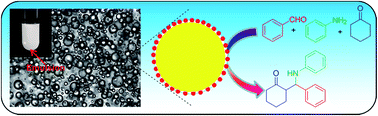
To examine the feasibility of our proposal, the Mannich reaction of benzaldehyde (1.0 mmol), aniline (1.1 mmol) and cyclohexanone (5.0 mmol) in the presence of catalysts (0.075 mmol) was choosed as a model reaction (Table 1) (see ESI in details). The data showed that the polyelectrolytes like PAA whose main chain contained a constituent carboxylic acid group could catalyze the reaction with the highest yield of 92% in water (entry 2). However, this great improvement could not be simply attributed to the fact that PAA is the Brønsted acid since the acrylic acid itself only generated the product in 59% yield (entry 1). Then control experiments were carried out in other solvents, such as acetonitrile, THF, DMF, DMSO, ethanol, and methylene dichloride (entry 6–11). To our surprise, the emulsion was formed in the process of the PAA-catalyzed reaction in water (Fig. 1 and 2). Among all solvents, the yield in water was also the best. Therefore, the forming of the emulsion was the key factor causing the yield increase.

Table 1 Catalyst and solvent screening for the Mannich reactiona

image file: c6ra04180a-u1.tif

Entry Catalyst Solvent Yieldb (%)
a Reaction conducted with 1.0 mmol of benzaldehyde, 1.1 mmol of aniline, 5.0 mmol of cyclohexanone and 0.075 mmol of catalysts in 1.0 mL solvent, at 25 °C for 6 h.b Isolated yield was obtained after purification by column chromatography.
1 Acrylic acid H2O 59
2 Polyacrylic acid H2O 92
3 Sodium polyacrylate H2O 12
4 Polypropylene H2O 9
5 Polymethyl acrylate H2O 11
6 Polyacrylic acid CH3CN 60
7 Polyacrylic acid THF 51
8 Polyacrylic acid DMF 30
9 Polyacrylic acid DMSO 20
10 Polyacrylic acid EtOH 57
11 Polyacrylic acid CH2Cl2 53


image file: c6ra04180a-f1.tif
Fig. 1 Illustration of the reaction process of PAA catalyzed three-component Mannich reaction in water.

image file: c6ra04180a-f2.tif
Fig. 2 Photographs of different solvents for PAA catalyzed Mannich reaction.

To better observe the emulsion, photographs and optical micrographs of the PAA catalyzed Mannich reaction at different time were recorded. The PAA (0.075 mmol) was stirred in 1 mL H2O for 10 minutes at 25 °C, ketone (5 mmol) was added into the mixture under vigorous stirring, resulting in an emulsion. Aldehyde (1 mmol) and aniline (1.1 mmol) was added into the emulsion and the reaction mixture was vigorously stirred. As shown in Fig. 3(a), the emulsion remained stable in water. The photographs and optical micrographs of PAA catalyzed Mannich reaction at 2 h, 4 h and 6 h suggested that the emulsion particles remained stable during the whole reaction process, as shown in Fig. 3(b)–(d). The substrates were concentrated in the emulsion particles, which acted as a hydrophobic reaction reactor and speeded the organic reactions in water up.


image file: c6ra04180a-f3.tif
Fig. 3 The Photographs and optical micrographs of the Mannich reaction at different time. ((a) Before the reaction; (b) after 2 hours; (c) after 4 hours; (d) after 6 hours).

The stability of the emulsion in static state was further tested by Turbiscan, the results were shown in Fig. 4. The figure showed the variation of the transmission profile ΔT vs the height of the samples as measured for 1.5 h. The interpretation of the transmission profiles was based on the change in the light transmission caused by the changes in size of the particles occurring over the sample tube. When changes take place in the latex, the transmission profiles vary with the height of the sample and with time. According to Fig. 4, we can see the ΔT was comparative small at the beginning of test, which indicated the emulsion was formed rapidly in the presence of PAA in water. The ΔT increased with an increasing time in the bottom, indicated the emulsion is oil/water type.


image file: c6ra04180a-f4.tif
Fig. 4 Transmission ΔT for the Mannich reaction catalyzed by PAA in water before the reaction.

In order to directly quantify the effect of PAA on the emulsion stability, we used the stability coefficient (TSI—Turbiscan Stability Index). This parameter takes into account all processes taking place in the sample (thickness of sediment and clear layer, process of particles settling). According to the fact that small TSI value indicates stability,15 we deduced that the emulsion could remain stable without any stirring in 1.5 h (Fig. 5).


image file: c6ra04180a-f5.tif
Fig. 5 TSI for the Mannich reaction catalyzed by PAA in water before the reaction.

Kinetics studies were further conducted to describe the highly efficient reaction process of the PAA catalyzed three-component Mannich reaction (Fig. 6). When the blank test group (without catalyst) was conducted or sodium polyacrylate was added, few products could be detected, indicating that Mannich reaction need add the catalyst. When PAA was added, the reaction occured, and Fig. 6 showed the conversion of products varying with time. After 6 h, the conversion of products with PAA reached 92% which was two times more than comparative experiments with acrylic acid as catalysts. The high reaction rate of the PAA-catalyzed three-component Mannich reaction in water could be attributed to the high concentration of substrates inside the emulsion droplet formed by PAA in water. In this case, the droplet could act as a hydrophobic reaction site which enabled the smooth transformation of the substrate into the product.16


image file: c6ra04180a-f6.tif
Fig. 6 Control experiment for the PAA-catalyzed Mannich reaction. image file: c6ra04180a-u2.tif PAA image file: c6ra04180a-u3.tif acrylic acid image file: c6ra04180a-u4.tif sodium polyacrylate image file: c6ra04180a-u5.tif without catalyst.

Under the optimized reaction conditions, the possible substrate range was throughly investigated (Table 2). Various ketone, aldehydes and aniline-bearing electron-donating or electron-withdrawing substituents were applied to this protocol and the desired products were obtained in high to excellent yields. It was found that the reaction proceeded smoothly with aromatic aldehydes and aromatic amines bearing either electron-withdrawing or donating groups. For example, when the p-substituents of amines were changed from methyl (4b) to chloro (4c) and nitro-groups (4d), the yields of the condensations increased from 80% to 84% and 90%, respectively (entry 2–4), which was slightly lower than aromatic aldehydes and aromatic amines without any substituents (4a) (entry 1). The m-(4e, 4f), o-(4g) functionalized anilines reacted with benzaldehydes and cyclohexanone giving yields from 75 to 78% (entry 5–7). Under similar conditions, changing the substituents of the aldehydes from methoxy (4h) to bromo (4i) and chloro-groups (4j) led to the yields of the condensation reaction increasing from 90% to 94% and 95%, respectively (entry 8–10). In the case, p-nitro aldehydes (4l) and aromatic amines with cyclohexanone, β-amino ketones were obtained in excellent yield (98%), which was somewhat higher than that of p-chloro aldehydes (4k) obtained at 93% (entry 11 and 12). However, m-nitro aldehydes (4m) were only obtained in 76% yield with a longer reaction time (entry 13). p-Functionalized benzaldehydes (4n, 4o, 4p) reacted with p-functionalized anilines and cyclohexanone with 63%, 72% and 65% yields (entry 14–16).

Table 2 The catalytic activity for three-component Mannich reactions in watera

image file: c6ra04180a-u6.tif

Entry R1 R2 R3, R4 Yieldb (%) dr
a Reaction conducted with 1.0 mmol of benzaldehyde, 1.1 mmol of aniline, 5.0 mmol of ketone and 0.075 mmol of PAA in 1.0 mL H2O, at 25 °C, 6–12 h.b Isolated yields were obtained after purification by column chromatography.
1 Ph H (CH2)4 4a, 92 54[thin space (1/6-em)]:[thin space (1/6-em)]46
2 Ph p-CH3 (CH2)4 4b, 80 64[thin space (1/6-em)]:[thin space (1/6-em)]36
3 Ph p-Cl (CH2)4 4c, 84 90[thin space (1/6-em)]:[thin space (1/6-em)]10
4 Ph p-NO2 (CH2)4 4d, 90 87[thin space (1/6-em)]:[thin space (1/6-em)]13
5 Ph m-CH3 (CH2)4 4e, 75 >99[thin space (1/6-em)]:[thin space (1/6-em)]1
6 Ph m-Cl (CH2)4 4f, 77 50[thin space (1/6-em)]:[thin space (1/6-em)]50
7 Ph o-OCH3 (CH2)4 4g, 78 62[thin space (1/6-em)]:[thin space (1/6-em)]38
8 o-OCH3Ph H (CH2)4 4h, 90 >99[thin space (1/6-em)]:[thin space (1/6-em)]1
9 o-BrPh H (CH2)4 4i, 94 >99[thin space (1/6-em)]:[thin space (1/6-em)]1
10 o-ClPh H (CH2)4 4j, 95 >99[thin space (1/6-em)]:[thin space (1/6-em)]1
11 p-ClPh H (CH2)4 4k, 93 80[thin space (1/6-em)]:[thin space (1/6-em)]20
12 p-NO2Ph H (CH2)4 4l, 98 52[thin space (1/6-em)]:[thin space (1/6-em)]48
13 m-NO2Ph H (CH2)4 4m, 76 52[thin space (1/6-em)]:[thin space (1/6-em)]48
14 p-ClPh p-Cl (CH2)4 4n, 63 54[thin space (1/6-em)]:[thin space (1/6-em)]46
15 p-ClPh p-CH3 (CH2)4 4o, 72 62[thin space (1/6-em)]:[thin space (1/6-em)]38
16 p-NO2Ph p-CH3 (CH2)4 4p, 65 58[thin space (1/6-em)]:[thin space (1/6-em)]42
17 Furyl o-OCH3 (CH2)4 4q, 82 76[thin space (1/6-em)]:[thin space (1/6-em)]24
18 Furyl H (CH2)4 4r, 74 53[thin space (1/6-em)]:[thin space (1/6-em)]47
19 i-Bu H (CH2)4 4s, 72 >99[thin space (1/6-em)]:[thin space (1/6-em)]1
20 Ph H Ph, H 4t, 85 n.d.
21 Ph p-Cl Ph, H 4u, 79 n.d.
22 Ph H CH3, H 4v, 36 n.d.
23 p-CH3OPh H CH3, H 4w, 27 n.d.
24 p-CH3OPh H CH3, C2H5 4x, 81 n.d.
25 Ph H CH3, C2H5 4y, 77 n.d.


To broaden the scope of this transformation, heterocycle and aliphatic aldehydes were examined as Mannich donors. The reaction with furaldehyde and aniline (4q), o-methoxyaniline (4r) afforded product yields in the range 74–82%, while isovaleraldehyde (4s) converted to the condensation product at 72% yield, a little lower than for furaldehyde (entry 17–19). Interestingly, a few Mannich reactions resulted in products with extremely excellent diastereoselectivities17 (entry 7–9 and 11).

To further investigate the scope and limitations of polyelectrolyte Brønsted acid catalyzed three-component Mannich reactions accelerated by emulsion, a series of ketones were screened, and the results were presented in Table 2. When acetophenones (4t, 4u) were used, the yields of 85% and 79% were afforded, respectively (entry 20 and 21). The reaction also worked well with cycloalkanones other than cyclohexanone under the same conditions (Table S4). The Mannich condensation of open chain ketones including acetone and 2-pentanone with benzaldehydes and aniline or p-methoxyaniline afforded the products (4v, 4w, 4x and 4y) in 36%, 27%, 81% and 88% yields. The yield with acetone was obviously lower than 2-pentanone and acetophenone because the emulsion could not be formed during the reaction (entry 22–25). This results was further supported by the optical micrographs (Fig S2–S6). Therefore, the reaction worked well with ketones which was some extent hydrophobic (see the ESI 3 in more details).

The recovery and reusability of the catalyst were investigated in a PAA-catalyzed Mannich reaction of aniline, benzaldehyde and cyclohexanone (Fig. 7). After the completion of the reaction, the reaction mixture was treated with chloroform, and the layers were separated. The aqueous phase was then directly transferred to another flask along with fresh reagents for the next run. To our delight, the catalytic activity of the catalyst had little change after five catalytic cycles. This result suggested the excellent chemical stability and sustained activity of the PAA catalyst (see the ESI 1.3).


image file: c6ra04180a-f7.tif
Fig. 7 Recycling test of polyacrylic acid catalyzed Mannich reaction in water.

A plausible mechanism18 for the three-component Mannich reactions catalyzed by PAA is proposed in Fig. 8. The hydrophobic characteristic of the emulsion particles induced the entry of benzaldehyde, followed by protonation by PAA. The resultant cation intermediate reacted with aniline to form an iminium ion with the simultaneous loss a water, followed by an attack of the enolized ketone to give rise to the Mannich product. Once the product was released, H+ was regenerated for the next cycle.


image file: c6ra04180a-f8.tif
Fig. 8 Proposed mechanism of polyacrylic acid catalyzed Mannich reaction in water.

Conclusions

In conclusion, an effective polyacrylic acid-catalyzed three-component Mannich reaction accelerated by emulsion has been developed. The results demonstrated that the PAA provided the best catalytic activity because of the formation of emulsions. Notably, the catalyst could be recovered directly by simple treatment and still exhibit over 90% yields after five cycles. The polyelectrolyte catalyst described herein represents an economic and ecological alternative enabling us to avoid the use of an organic solvent. Further investigations of the application of polyelectrolyte catalysts are currently ongoing in our laboratory.

Acknowledgements

We acknowledge the 111 Project (B14041), Innovative Research Team in University of China (IRT1070), the Project Supported by Natural Science Basic Research Plan in Shaanxi Province of China (Program No. 2015JQ2056), the grant from National Natural Science Foundation of China (21571121, 21271124, and 21446014), and the Fundamental Research Funds for the Central Universities (No. GK201302015, No. GK201501005) for financial support.

Notes and references

  1. A. Michael, W. Bernhard and R. Nikolaus, Angew. Chem., Int. Ed., 1998, 37, 1044–1070 CrossRef.
  2. R. Muller, H. Goesmann and H. Waldmann, Angew. Chem., Int. Ed., 1999, 38, 184–187 CrossRef CAS.
  3. M. O. Simon and C. J. Li, Chem. Soc. Rev., 2012, 41, 1415–1427 RSC.
  4. T. Ollevier, E. Nadeau and A. A. Guay-Begin, Tetrahedron Lett., 2006, 47, 8351–8354 CrossRef CAS.
  5. K. Manabe, Y. Mori, T. Wakabayashi, S. Nagayama and S. Kobayashi, J. Am. Chem. Soc., 2000, 122, 7202–7207 CrossRef CAS.
  6. T. Akiyama, J. Takaya and H. Kagoshima, Synlett, 1999, 9, 1426–1428 CrossRef.
  7. K. Manabe and S. Kobayashi, Org. Lett., 1999, 1, 1965–1967 CrossRef CAS.
  8. K. Manabe, Y. Mori and S. Kobayashi, Synlett, 1999, 9, 1401–1402 CrossRef.
  9. K. Manabe, Y. Mori and S. Kobayashi, Tetrahedron, 2001, 57, 2537–2544 CrossRef CAS.
  10. G. Y. Zhao, T. Jiang, H. X. Gao, B. X. Han, J. Huang and D. H. Sun, Green Chem., 2004, 6, 75–77 RSC.
  11. T. Chang, L. Q. He, L. Bian, H. Y. Han, M. X. Yuan and X. R. Gao, RSC Adv., 2014, 4, 727–731 RSC.
  12. S. Mitsumori, H. L. Zhang, P. H. Y. Cheong, K. N. Houk, F. Tanaka and C. F. Barbas, J. Am. Chem. Soc., 2006, 128, 1040–1041 CrossRef PubMed.
  13. K. Manabe, Y. Mori, T. Wakabayashi, S. Nagayama and S. Kobayashi, J. Am. Chem. Soc., 2000, 122, 7202–7207 CrossRef CAS.
  14. D. O. Grigoriev, T. Bukreeva, H. Möhwald and D. G. Shchukin, Langmuir, 2008, 24, 999–1004 CrossRef CAS PubMed.
  15. D. D. Kaombe, M. Lenes, K. Toven and W. R. Glomm, Energy Fuels, 2013, 27, 1446–1452 CrossRef CAS.
  16. K. Manabe, Y. Mori, T. Wakabayashi, S. Nagayama and S. Kobayashi, J. Am. Chem. Soc., 2000, 122, 7202–7207 CrossRef CAS.
  17. (a) S. Shimizu, N. Shimada and Y. Sasaki, Green Chem., 2006, 8, 608–614 RSC; (b) Q. X. Guo, H. Liu, C. Guo, S. W. Luo, Y. Gu and L. Z. Gong, J. Am. Chem. Soc., 2007, 129, 3790–3791 CrossRef CAS PubMed.
  18. H. Y. Tan, P. Zhang, L. Wang, D. Yang and K. B. Zhou, Chem. Commun., 2011, 47, 11903–11905 RSC.

Footnotes

Electronic supplementary information (ESI) available. See DOI: 10.1039/c6ra04180a
Xi Chen and Yanlong Luo contributed equally to this article.

This journal is © The Royal Society of Chemistry 2016
Click here to see how this site uses Cookies. View our privacy policy here.