JianCheng Liu
a,
Christina Uhlira,
Parag K. Shaha,
Fang Sunbc and
Jeffrey W. Stansbury*ad
aDepartment of Chemical and Biological Engineering, University of Colorado, Boulder, Colorado 80309, USA
bState Key Laboratory of Chemical Resource Engineering, Beijing University of Chemical Technology, Beijing 100029, PR China
cCollege of Science, Beijing University of Chemical Technology, Beijing 100029, PR China
dDepartment of Craniofacial Biology, School of Dental Medicine, University of Colorado, 12800 19th Ave, RC1-N Mail Stop 8310, Aurora, Colorado 80045, USA. E-mail: jeffrey.stansbury@ucdenver.edu
First published on 4th July 2016
RAFT polymerization was utilized to prepare an amphiphilic block copolymer containing both hydrophilic and hydrophobic segments. The self-assembly behavior of the block copolymer into nano-scale particulate structures was studied in both water and polar organic solvents. Uniform micelle assemblies were stabilized by reaction within the hydrophobic core, which contained pendant azide groups, through copper-catalyzed azide-alkyne cycloaddition (CuAAC) click chemistry with a dialkyne crosslinker. The reaction preceded efficiently with negligible residual azide functionality and resulted in core–shell nanogel structures that were analyzed by a variety of techniques including light scattering, electron microscopy and the ability to take up hydrophobic molecules. Both thermo- and pH-responsive character of the nanogels and the linear polymers from which they were made were studied through cloud point testing at different pH levels. It was found that these nanogel dispersions in water exhibited the highest cloud point temperatures indicating a highly stable nanogel structure. The solvent-dispersed nanogels were used as building blocks to form extended polymer networks through the inter- as well as intra-particle reaction between hydroxyl groups within the hydrophilic domain of the nanogel shell by crosslinking with a diisocyanate. It was found that as little as 10 wt% nanogel dispersions in solvent reached the percolation threshold to yield highly porous macroscopic networks; while 50 wt% concentrations achieved densely packed and interdigitated nanogels to afford relatively homogeneous structures.
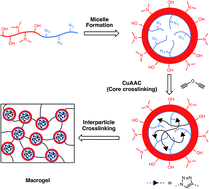
In the current study, an amphiphilic block copolymer containing DMAEMA was synthesized and further assembled into micelle structures with styrenic monomers as the hydrophobic block. Nanogel particles were formed after crosslinking the core region. The thermoresponsive character was studied for the copolymer, block copolymer and nanogel at different pH values. The ability to form macroscopic networks was explored by additional reaction of nanogel solutions at concentration above the percolation threshold.
![]() | ||
| Scheme 2 Synthesis of block copolymer with PPEGMA-co-PDMAEMA with styrene (St) and azidomethyl styrene (AzMSt) in MEK. | ||
:
1. The reaction was allowed to proceed for overnight and formation of a macroscopic polymer network was verified when the material maintained its shape without flow or deformation (Fig. 1).
:
1. The initial monomer feed ratio was 7
:
3 M for DMAEMA and PEGMA indicating PEGMA has a modestly lower reactivity than DMAEMA but the copolymer structure is assumed to be essentially random. The use of the CPBD/AIBN initiating system has previously been demonstrated to promote RAFT polymerization behaviour with the ability to produce block copolymer structures.8 After the reaction with styrene and AzMSt, the amphiphilic block copolymer was formed confirmed by the appearance of peaks around 6.3–7.3 ppm (aromatic protons) in the NMR (Fig. 2). The methylene peaks around 4.0–4.5 ppm included CH2 (adjacent to azide) from AzMSt and also CH2 (adjacent to ester group) in PEGMA and DMAEMA. By comparing the relative intensity of this peak to the 2.6 ppm peak (that solely belongs to –CH2– adjacent to amine in DMAEMA) in the block copolymer, the AzMSt concentration can be obtained. Furthermore, the styrene to AzMSt ratio was determined by separation of the aromatic proton signals of these two monomers at 6.3–7.3 ppm given the known AzMSt contribution. The molar ratio of St and AzMSt is 5
:
2, which is close to the 3
:
1 monomer feed ratio used in the preparation of this block, while the overall molar ratio of the hydrophobic units to hydrophilic units is 2
:
3. The molecular weight (Mw) of the hydrophilic copolymer was estimated about 48.8 kDa while the block copolymer had a Mw of 66.6 kDa based on the comparison of repeat monomer units with RAFT end group. The NMR end-group analysis method was adopted after attempts with GPC analysis failed due to strong interactions between the copolymers and GPC columns.
The block copolymer was further assembled in organic solvent. Most of the amphiphilic block copolymer self-assembly studies were carried out in water due to the strong repulsion of the hydrophobic segments with water. There have been some reports using organic solvents for block copolymer self-assembly primarily for reverse micelle formation or non-water dispersible polymers.16,17 The choice of solvents can affect final assembled polymer structure significantly including micelle morphology and dimension.18 In this study, it was demonstrated that water could disperse the block copolymer by forming core–shell micelle structures at dilute concentration (i.e. 1 mg ml−1). However, a higher concentration of micelles is desirable in order to generate large amounts of nanogel particles without conducting time-consuming multi-batch reactions. However, a cloudy solution was formed when the block copolymer concentration was increased to higher content (e.g. 20 mg ml−1) due to the aggregation of the micelle structures in the absence of any surfactant additive. From light scattering (not shown here), there were two peaks in size distribution in the solution at 37 nm and 170 nm. The 37 nm particle dimension was likely associated with the self-assembled micelle structures while the 170 nm average size structures represented aggregated particles that appeared at the higher polymer concentrations. Methanol, a poor solvent for the hydrophobic block, was added to the polymer solution in acetone slowly to yield an optically clear solution at 40 mg ml−1 concentration with methanol to acetone volume ratio of 0.35
:
1. Under these solvent conditions, the average particle size was 47 nm with narrow distribution indicating the formation of uniform micelles (Fig. 3). With the addition of propargyl ether in the presence of Cu(I) catalyst, an ambient CuAAC reaction was carried out to crosslink the hydrophobic block. CuAAC click chemistry has been demonstrated to provide an efficient coupling between alkyne and the azide groups in the core structure of block copolymer micelles.19,20 The styrene-based azide group of the block copolymer in the solution was 1.2 mmol through calculation based on the relative concentration of the AzMSt to the overall polymer (based on NMR data). By the reaction of azide with the stoichiometric ratio of alkyne groups, 95% of the azide groups in the block copolymer were consumed based on the signal reduction of azide IR absorption peak (2000–2200 cm−1, asymmetric stretching) (Fig. 4). As propargyl ether is hydrophobic, it is expected that the alkyne groups are concentrated in the hydrophobic core region of the block copolymer micelles. The high conversion of azide groups indicates the crosslinking reaction between azide and alkyne groups was highly efficient, similar to what has been reported previously.16 The proton in newly-formed triazole connecting group appeared in the 1H NMR spectrum at 8.1 ppm (Fig. 2). Since the mobility of the core structure was restricted compared to the hydrophilic shell, especially in a hydrophilic solvent – d-DMSO, broadened peaks for styrene and trizole were observed with low intensity. The resulting nanogel was also able to disperse in water as achieved through solvent exchange with dialysis. The nanogel size was reduced to 30 nm when dispersed in water rather than the methanol/acetone co-solvent (Fig. 3). Nanogels shrank in a more hydrophilic environment not only due to collapse of the hydrophobic core but probably also because the relatively hydrophilic shell layer of the copolymer from PEGMA and DMAEMA were found to have better solubility in the co-solvent than in neutral water. The collapsed nanogel particles freeze-dried in water had an average diameter of 15.4 ± 4.8 nm as characterized by SEM (Fig. S1;† analysis with ImageJ, n = 919). The relatively uniform globular particles confirmed the low polydispersity of nanogels after block copolymer self-assembly.
![]() | ||
| Fig. 4 IR spectra for the block copolymer (black line) and formed nanogels after CuAAC reaction (red line). The absorbance at 2000–2200 cm−1 belongs to azide groups. | ||
The LCST of DMAEMA polymer can be significantly affected by the addition of other monomer units. It has been shown that the LCST increased with PEGMA content by copolymerizing the two monomers together.21 This is due to PEG being more hydrophilic with greater affinity for water compared with the neutral tertiary amine. For the copolymer with 25 mol% PEGMA units, the cloud point was 69 °C in a neutral pH environment (Table 1). The pKa of DMAEMA is around 7.5 (ref. 22) and protonation of DMAEMA in pH 7 solution would be expected to enhance polymer solubility in water. In water at pH 4, no phase separation or cloud point was detected at any temperature since the higher degree of protonation increased polymer–solvent interaction even at high temperatures with reduced hydrogen bonding effect. Meanwhile, a lower cloud point (47 °C) was found due to deprotonation of amine groups in a basic environment (pH = 10). It has been reported previously that LCST is decreased by the incorporation of hydrophobic monomer units.23 The hydrophobic units preferably interact with each other in aqueous systems so that the interaction between water and the macromolecules can be minimized. However, at a certain temperature, polymer aggregation or phase separation can take place once the internal thermodynamic stabilization within a polymer coil (or a polymeric particle) no longer presents an energy minimum. With the incorporation of styrene and AzMSt, the greater hydrophobicity of the block copolymer was introduced with a corresponding decrease to a cloud point of 4–5 °C was found for pH 7 and 10 buffer solutions. This is not surprising since a significant decrease in the cloud point temperature was expected with the incorporation of 2/5 molar content of these quite hydrophobic monomers.23 Different from randomly copolymerizing hydrophobic monomers with hydrophilic monomers, a block copolymer can form relatively stable micelles in water solution with the hydrophobic block segregated in the core structure to avoid significant interaction with water. Thus, the shell comprised mainly of the hydrophilic monomer-based segments was able to interact with water in a similar way as did the simple hydrophilic copolymer. With an increase of temperature, the chain mobility is increased in the micelles so that the core structure could become unstable through enhanced interaction with water. By chemical crosslinking of the core, stable core–shell nanogels were formed and no cloud point was detected for the nanogel solution in pH 4 and 7 buffers (Fig. S2†). With the increase of temperature, the interaction between hydrophilic blocks was promoted within single nanogel particles when the hydrogen bonding with solvent was reduced. Notably, the nanogel solution remained stable and transparent at any given temperature in a neutral pH buffer indicating no large particles formed through multi-nanogel aggregation. The cloud point was 58 °C for nanogel solution in a pH 10 buffer, which is still considerably higher than either of the other two precursor components. Nanogel did precipitate out of the solution when the temperature was increased to 100 °C. The phase separation process was irreversible in that the nanogel-based precipitant remained insoluble when the sample was cooled back to room temperature. This is different than the behavior of the copolymer and block copolymer samples where the cloudy solutions rapidly transitioned back to transparent solutions when the temperature was dropped below the corresponding cloud point. This is probably because at high temperatures, once the isolated nanogels undergo aggregation and precipitation, the multiple chain entanglements and affinity between particles was strong enough to prevent redispersal without other more aggressive intervention.
| pH | Copolymer (°C) | Block copolymer (°C) | Nanogel (°C) |
|---|---|---|---|
| 4 | N/A | N/A | N/A |
| 7 | 69 | 65 | N/A |
| 10 | 47 | 42 | 58 |
Since these nanogel particles are composed of a hydrophobic core, it could be used to selectively absorb hydrophobic molecules that display little affinity for water. Here we used a hydrophobic dye, Nile Red, to test if selective absorption was available with the nanogel. From the images (Fig. 5), essentially no coloration was found by the addition of Nile Red to water due to its negligible solubility. The nanogel used here has a yellow color due to the presence of RAFT and AzMSt groups. However, due to the low concentration of nanogel (5 mg ml−1), the resulting dispersion did not have any noticeable color. However, with nanogel dispersed in the water, an obvious red color was displayed by adding Nile Red, which confirms that the self-assembled nanogel could be employed as a water-compatible absorbent or carrier for hydrophobic molecules. Under UV irradiation, once, again the dye only sample was colorless due to very limited aqueous solubility; however, a bluish color was observed for the nanogel dispersion (Fig. 5) due to the light scattering effect of nanogel particles. UV light with shorter wavelength is scattered by smaller particles than is visible light. For the nanogel and dye sample under UV light, Nile Red fluoresces resulting in a purple color as shown in the dye-loaded nanogel dispersion.
![]() | ||
| Fig. 5 Sample images of water solutions with just Nile Red or nanogel or both: (left) under visible light; and (right) under UV light. | ||
The pendent –OH groups in PEGMA units were able to crosslink nanogels together to form macrogel networks. This nanogel is dispersible in hydrophilic solvents like DMSO, DMF and acetonitrile as well as more hydrophobic solvent like toluene. The reaction between hydroxyl and isocyanate groups yields urethane functionality, which is less hydrophilic than –OH groups. Thus, in hydrophilic solvents, phase separation was observed during the crosslinking reaction. By dispersing nanogel in toluene from 5–66.7 wt%, initially homogeneous, transparent dispersions were formed with a linear relationship between the logarithm of viscosity and nanogel concentration (wt%) (Fig. 6). This indicates that the viscosity scales with the nanogel concentration at a single exponent despite the nanogel inter-particle distance. This loading range was selected to span isolated/discontinuous nanogel dispersions at the lower limit and overlapping, confluent solvent-swollen particles at the upper limit. Prior studies have found the slope of viscosity increasing when the polymer concentration is increased from a semi-dilute to an entangled state due to the additional contribution from significant polymer–polymer interaction.24 The possible reason that a constant slope was observed including the relatively dilute state (5 wt%) is that the nanogel–nanogel interaction is not negligible even at low concentrations since the hydrophilic nanogel shell preferentially interact with other nanogels due to the hydrophobicity of the solvent. At the lower nanogel concentration limit (5 wt%), the HMDI crosslinking reaction only led to an increase in solution viscosity instead of macrogelation. Under these conditions, intra-particle and limited inter-particle coalescence occurred with aggregate formation not large enough to induce observable visible light scattering. From loadings of 10 wt% and up, macrogel structures were formed in the crosslinking process. In a polar solvent like DMF, 10 wt% is also the lowest concentration to achieve macrogelation similar to the toluene solution. Opaque polymer samples were formed in DMF due to phase separation. The hydrophobic core has better swelling in toluene than in polar solvents, but the hydrophilic shell would likely be collapsed on the surface. These macrogelation experiments in various dispersion media and nanogel loading levels can be used to examine nanogel interspacing. At the 10 wt% loading level, a loosely crosslinked material was formed with significant interconnected porous structure as shown by imaging the fracture surface of the gel (Fig. 7). The polymers only occupied a small percentage of the volume, which further supported that the 10 wt% loading was just beyond the nanogel percolation threshold. With the increase of the nanogel content to 50 wt%, the crosslinked polymer presents a more uniform, continuous surface. The densely packed polymer consisted of a matrix with secondary nodular features that appeared in the dimension of less than 100 nm. The small features could be individual nanogels and nanogel aggregates were also formed what appeared as larger spherical morphologies. The interparticle spacing at 50 wt% loading is negligible so nanogels were able to interpenetrate significantly given the low Tg of the nanogel.
Footnote |
| † Electronic supplementary information (ESI) available. See DOI: 10.1039/c6ra03933b |
| This journal is © The Royal Society of Chemistry 2016 |